Introduzione
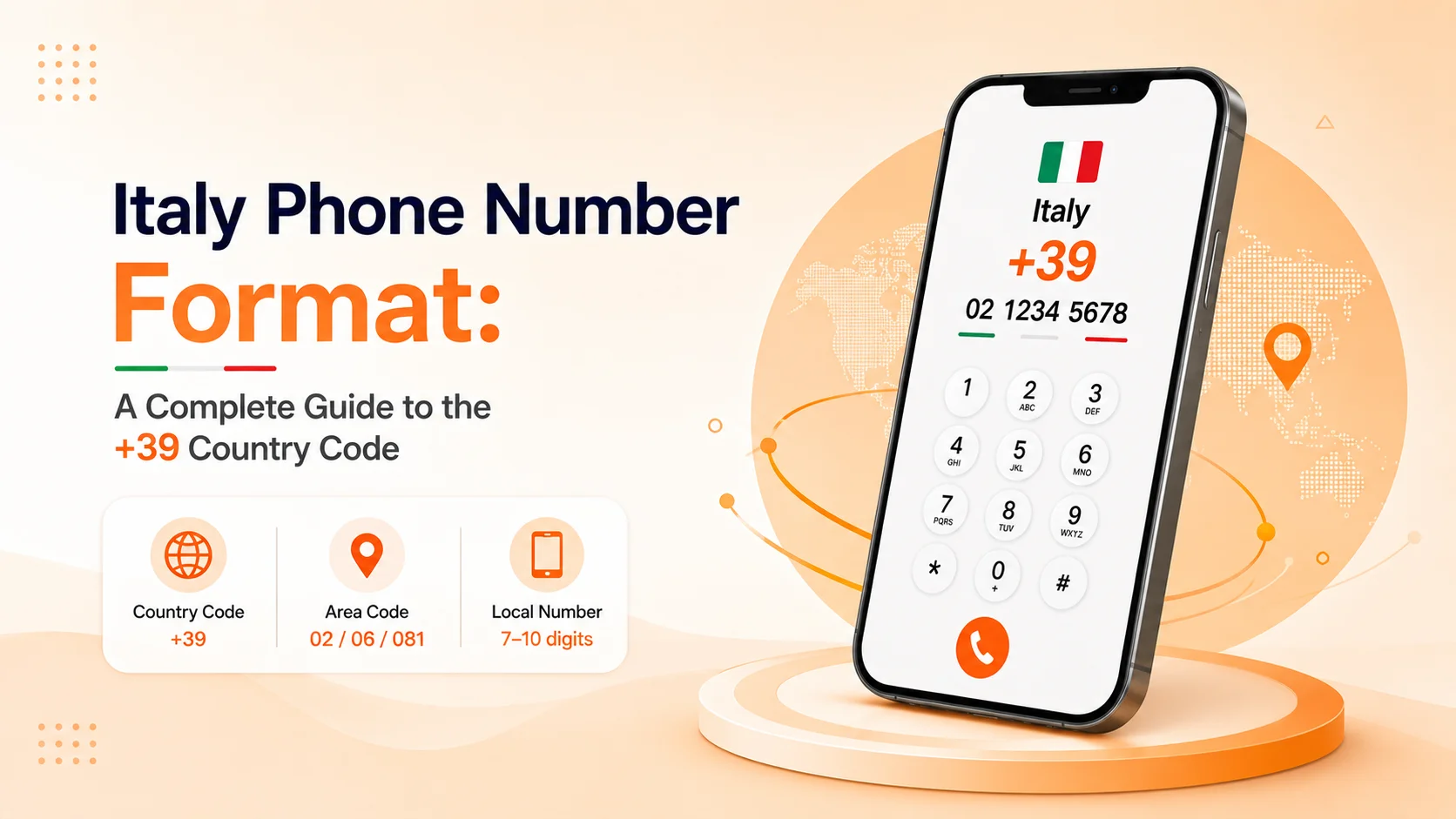
If you've ever stared at an Italian business card and wondered why the phone number still has a zero in it after the country code, you're not imagining things. The Italy phone number format breaks one of the most consistent rules in international telephony, and getting it wrong is an easy way to have a call quietly fail with no error message at all. This guide covers how numbers are built in Italy, why the country code behaves differently than almost anywhere else, and how to dial in and out without dropping a digit.
How the Italy Phone Number Format Is Built
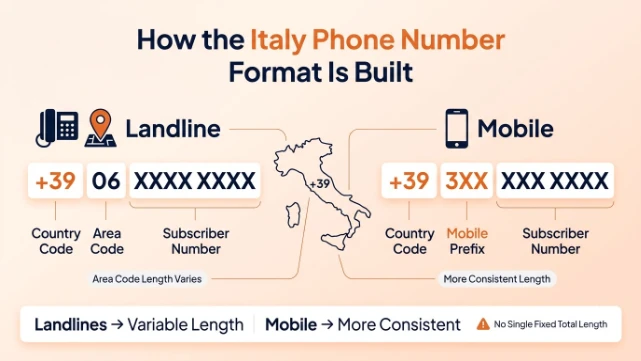
The Italian phone number format follows the same skeleton: country code, then either an area code (landlines) or a mobile prefix (mobile numbers), followed by the subscriber number. Written out fully, a Rome landline looks like +39 06 XXXX XXXX. A mobile number looks like +39 3XX XXX XXXX.
What trips people up is that the format doesn't have a fixed total length the way the US ten-digit system does. Landline numbers can run 6 to 8 digits after the area code depending on the city, and area codes themselves range from two digits (Rome's 06, Milan's 02) to four digits in smaller towns. Mobile numbers are more consistent at 9 or 10 digits after the +39 prefix. This variability comes from Italy's numbering plan evolving city by city rather than being redesigned from scratch, and it's the first thing anyone building a contact form or call center needs to account for when validating an Italian phone number format.
The +39 Country Code and Italy's International Dialing Prefix
The +39 country code is Italy's assigned country calling code, and it's what tells global phone networks to route a call to Italy specifically, rather than to France, Spain, or elsewhere in Europe. You'll see it written as +39, 0039, or occasionally just "39" depending on whether the source is using an international exit code or the plus-sign shorthand most smartphones now support automatically.
Unlike neighboring countries that reshuffled their numbering systems in the 1990s and 2000s, Italy kept a numbering plan that intentionally preserves local dialing habits. That decision is the root cause of the quirk most people associate with the Italian phone number format: the leading zero. It's worth flagging here because it's the single biggest reason people misdial Italian numbers from abroad. Any directory, invoice, or business listing showing the country code should also show that zero intact if it's a landline.
Rome's 06, Milan's 02: A Look at Italian Area Codes
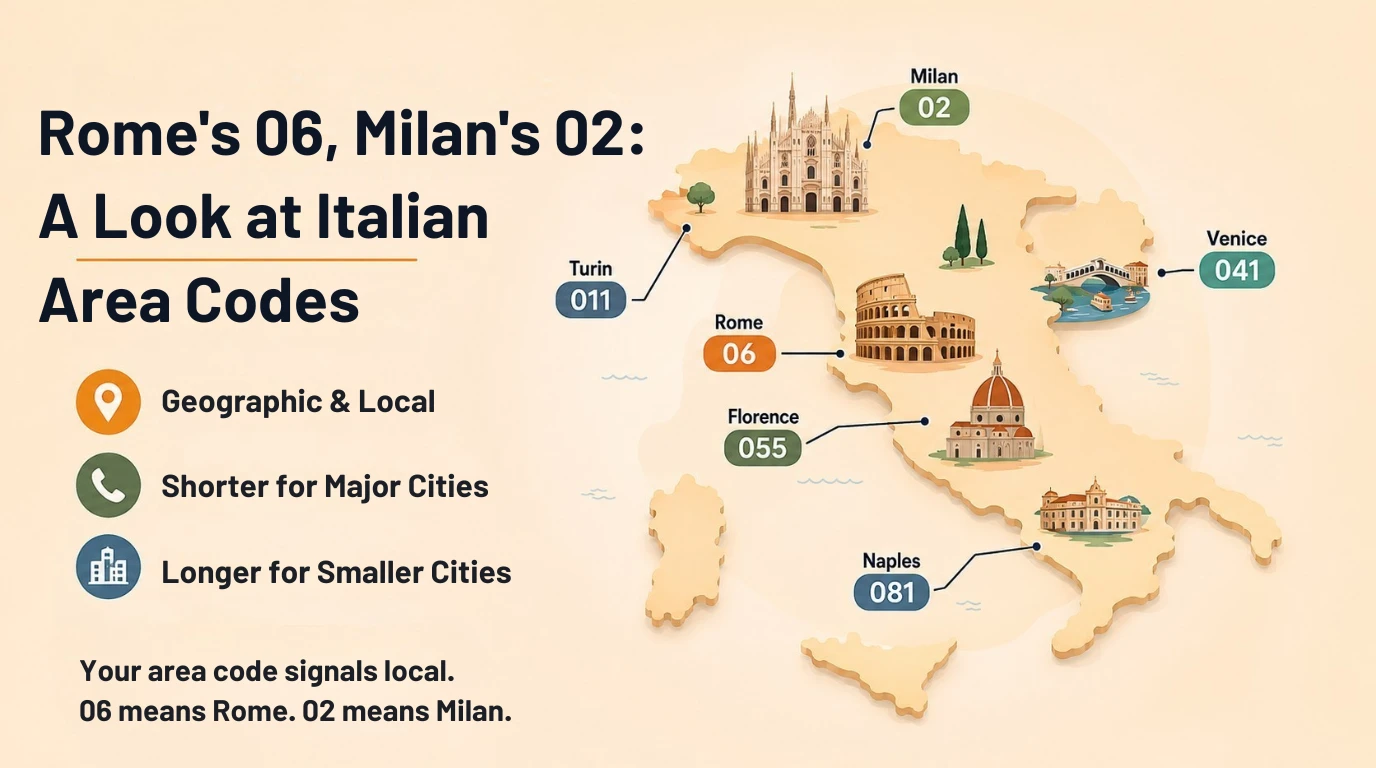
Italian area codes are geographic, tied to a specific city or region rather than assigned arbitrarily. Rome uses 06, one of the shortest and most recognizable Italian area codes because Rome was one of the first cities wired into the national network. Milan, Italy's financial capital, uses 02, another short, heavily used code given the call volume the city generates.
From there, area codes get progressively longer for smaller cities: Naples uses 081, Turin uses 011, Florence uses 055, Venice uses 041. Smaller municipalities can run to three or four digits, since they have fewer numbers to allocate in that exchange.
If you're building a business presence and want your caller ID to signal "local," matching the right area code to your target market matters. A number displaying 06 reads as Rome the same way a 212 area code reads as Manhattan in the US. A numero di telefono virtuale with the right prefix gets you that signal without opening an office there.
The Leading Zero That Refuses to Disappear (Italy's Landline Exception)
Here's the part that catches almost everyone off guard at least once: Italian landline numbers keep their leading zero even when dialed from outside the country. In nearly every other national numbering system, you drop the leading zero on the area code once you add the country code. Call a UK landline from abroad and 020 becomes +44 20. Call a German number and 089 becomes +49 89. Italy does not follow this convention.
A Rome landline written domestically as 06 1234 5678 stays exactly as 06 1234 5678 with the country code added: +39 06 1234 5678, not +39 6 1234 5678. The same applies to Milan: +39 02, not +39 2. This has been true since a 1998 restructuring of Italy's numbering plan, when the regulator folded the area code permanently into the subscriber number rather than treating it as a strippable routing prefix.
This single rule causes more misdialed and rejected Italian phone numbers than any other factor. Validation software built around "always drop the leading zero internationally" will flag a correctly formatted number in the Italian phone number format as invalid, and travelers dialing from a foreign SIM often strip the zero out of habit, only to hit a fast busy tone. If you remember one thing here, remember this: for landlines, the zero stays, always.
Italian Mobile Number Prefixes: The 3xx Series
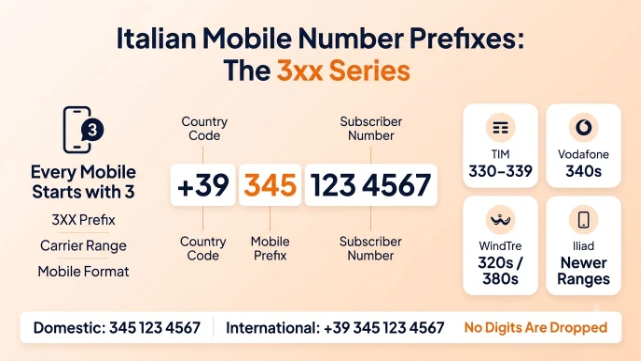
The mobile side of the Italy phone number format follows a different, more predictable pattern. Every Italian mobile number starts with a 3, followed by two digits that typically indicate the carrier, then the rest of the subscriber number. TIM numbers commonly start with 330-339, Vodafone Italy uses the 340s, WindTre uses the 320s and 380s, and newer entrant Iliad has carved out its own ranges too.
Crucially, no digit of an Italian mobile number is ever dropped, domestically or internationally: 345 123 4567 domestically becomes +39 345 123 4567 abroad, unchanged. This matches how most countries handle mobile numbers, which is part of why the landline exception feels so jarring by comparison.
Dialing Into Italy From Abroad
To call an Italian number from outside the country, dial your exit code (011 from the US and Canada, 00 from most of Europe), followed by 39, followed by the full number exactly as dialed domestically, leading zero and all for landlines. Calling a Rome landline from the US: 011 + 39 + 06 XXXX XXXX. Most smartphones simplify this with the plus-sign format instead: +39 06 XXXX XXXX, automatically substituting the correct exit code for the SIM in use.
Dialing Out of Italy to the Rest of the World
Calling out of Italy uses the same logic in reverse: dial 00, then the destination country's code, then the local number, usually dropping any domestic leading zero, since most countries don't share Italy's exception. To call a US number, dial 00 + 1 + the ten-digit number. To call a UK number, dial 00 + 44 and drop the UK's own leading zero.
Worth remembering: this "drop the zero" habit, correct when calling out of Italy to almost anywhere else, is exactly the habit that trips people up when calling into Italy. The exception runs one direction only.
Common Formatting Errors When Writing an Italian Phone Number
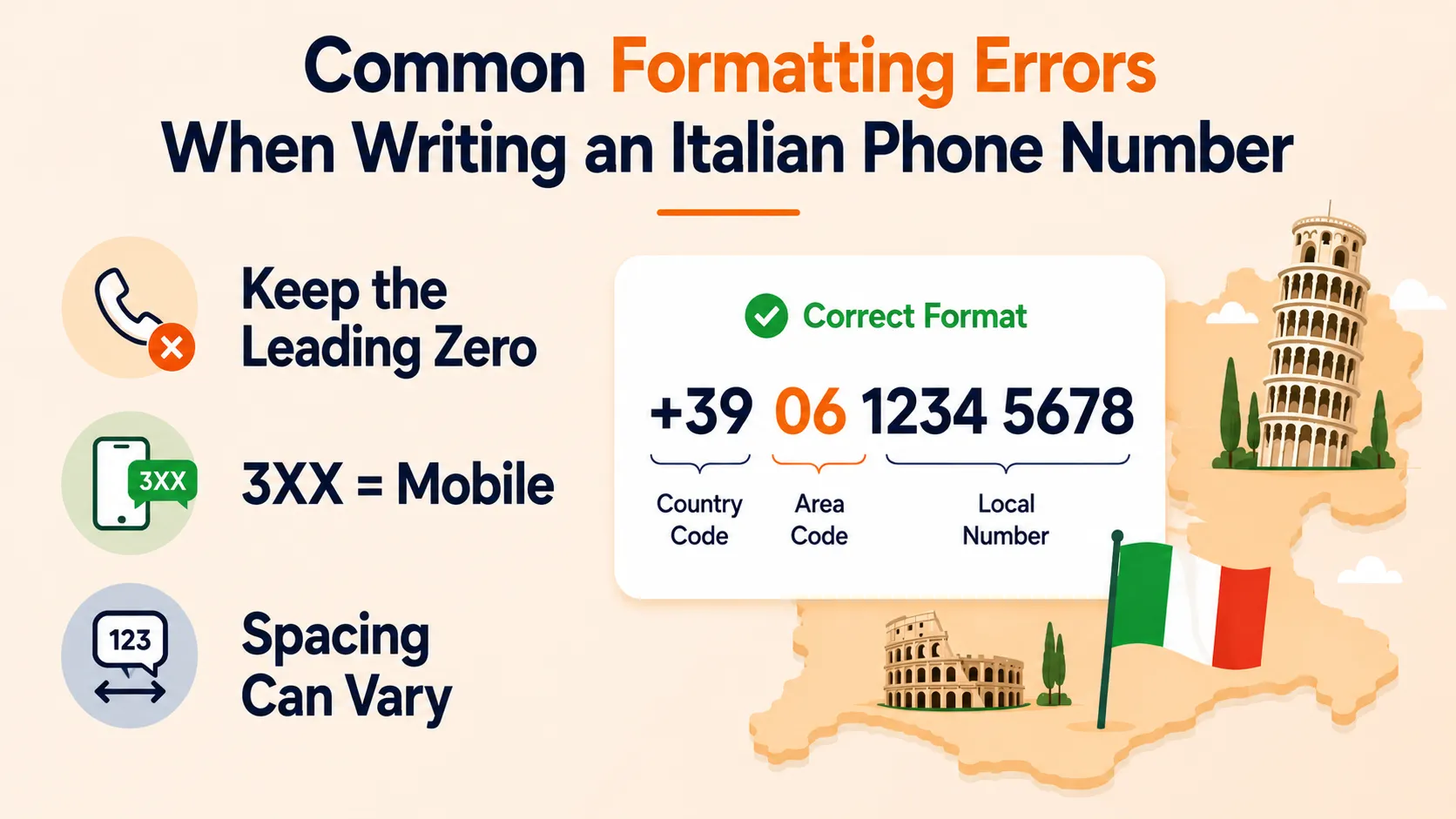
Getting the Italy phone number format wrong usually comes down to one of three habits. The most frequent mistake is stripping the leading zero from a landline number in international format, either because a form validator enforces the wrong rule or because someone applies logic learned from other countries. The second is confusing a mobile prefix with an area code; a number starting with 3 is always mobile, never a landline. The third is inconsistent spacing, since Italy has no single official spacing convention, so the same number appears as +39 06 12345678, +39 0612345678, or +39 06 1234 5678 depending on the source.
For any business collecting numbers through a website or app, the safest validation rule for the Italian phone number format is: allow a variable-length number after +39, require the leading zero for anything that looks like a landline, and never auto-strip a zero the way you might for other countries.
Getting a Local Italian Number Without Moving to Italy
For businesses that want to reach Italian customers without relocating staff or opening a physical office, a virtual phone number for Italy solves the local-presence problem directly. A number displaying a Rome 06 or Milan 02 prefix signals to Italian callers that they're dealing with a local business, which matters in a market where calls from unfamiliar foreign numbers are frequently ignored. LetsDial provisions numbers using real Italian area codes with the leading zero built in correctly, so there's no risk of a malformed number confusing callers or call-routing systems.
Setting one up doesn't require an Italian address or a local SIM card. LetsDial handles provisioning and call routing so a Rome or Milan number rings through to wherever your team works. For dialing rules, time zones, and business hours, see LetsDial's Italy country code guide.
Conclusione
The Italy phone number format comes down to one exception worth memorizing: the leading zero on a landline stays in place even with +39 added, while mobile numbers starting with 3 never drop a digit either way. Get that one rule right and Italian numbers stop being a guessing game.
According to GSMA, formatting standards vary enough by country that relying on one universal validation rule is a common source of failed SMS and voice deliverability worldwide, exactly the kind of edge case Italy represents. Ready for a real Italian number? Set one up with LetsDial today.
Domande frequenti
Scritto da Ariano Khan · 7 agosto 2026
Rispondi all'autore