Introduction
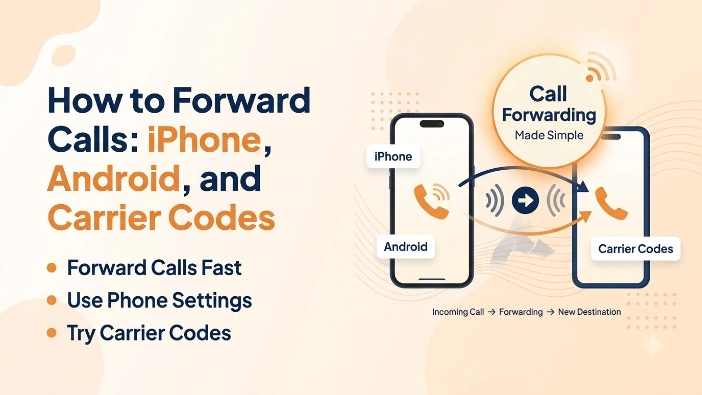
Call forwarding redirects incoming calls from one number to another automatically, whether that's sending a work line to a cell phone, a personal number to voicemail, or an entire business's calls to an on-call staffer after hours. The exact steps depend on whether you're using an iPhone, Android, or a carrier code directly, and Verizon in particular handles it differently from AT&T and T-Mobile. Anyone typing how to forward call into a search bar usually just wants the right steps for their specific phone and carrier without wading through instructions for the wrong one first.
This guide covers the exact steps for iPhone and Android, the universal dial codes that work when a phone's settings menu doesn't have a call forwarding option, carrier-specific differences, and how to turn forwarding back off once you no longer need it.
Call forwarding at a glance
- iPhone: Settings → Phone → Call Forwarding (not available on Verizon)
- Android: Phone app → Settings → Call Forwarding
- Verizon / US Cellular dial code: *72 to turn on, *73 to turn off
- AT&T / T-Mobile dial code: *21* + number + # to turn on, #21# to turn off
- Universal reset: ##002# cancels all forwarding on most carriers worldwide
- Conditional codes: *61* (no answer), *67* (busy), *62* (unreachable)
- Business alternative: a cloud dashboard replaces dial codes with one-click routing
How to Forward Calls on iPhone
On most carriers, iPhone call forwarding is a built-in toggle that doesn't require dialing any special code.
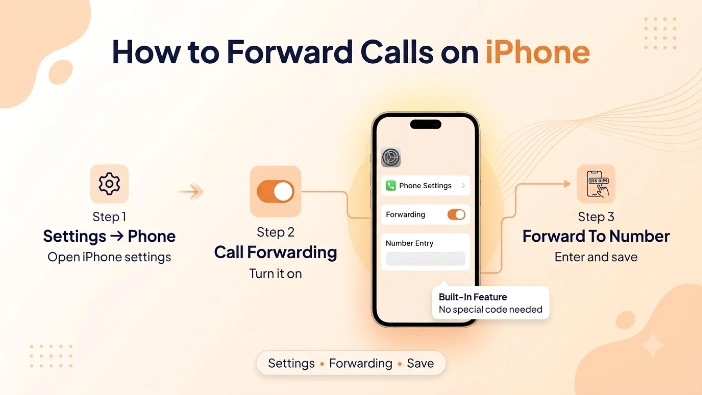
- Open Settings, then scroll down and tap Phone
- Tap Call Forwarding, then toggle it on
- Enter the number calls should forward to, then tap the back button to save
Why Verizon iPhones Don't Show This Option
Verizon iPhones don't display the Call Forwarding toggle in Settings at all, since Verizon's network handles forwarding through a dial code instead of the standard GSM setting Apple built the toggle around. Anyone on Verizon needs to use the carrier code method described further down rather than looking for a setting that isn't there.
How to Forward Calls on Android
Android's call forwarding setting lives inside the Phone app on every major manufacturer's device, though the exact menu path varies slightly between Samsung, Google Pixel, and other brands.
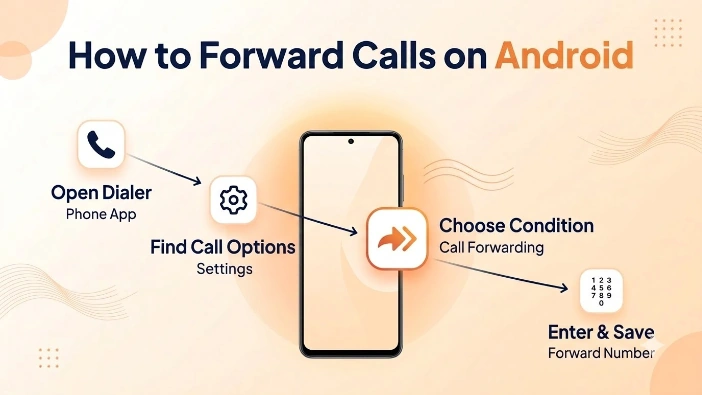
- Open the Phone app and tap the three-dot menu in the corner
- Tap Settings, then look for Calls, Supplementary Services, or Calling Accounts depending on the phone
- Tap Call Forwarding, choose a condition — always, when busy, when unanswered, or when unreachable — and enter the forwarding number
If that menu doesn't appear on a specific Android phone, the same carrier dial codes used as a Verizon iPhone backup work here too, since they operate at the network level rather than through the phone's own software.
Carrier Dial Codes for Call Forwarding
When a phone's built-in settings don't offer call forwarding, or don't work correctly on a specific carrier, dialing a code directly activates or deactivates it at the network level instead.
- Verizon and US Cellular — dial *72 followed by the 10-digit number and press call to turn forwarding on; dial *73 to turn it off
- AT&T and T-Mobile — dial *21*, the forwarding number, then # to turn it on; dial #21# to turn it off
- Universal GSM code — dialing ##002# cancels all active call forwarding on most carriers worldwide, useful as a reset if forwarding gets stuck on
Conditional forwarding, which only redirects calls under specific circumstances rather than every single one, uses its own set of standard codes on GSM carriers: *61* for no-answer forwarding, *67* for busy-signal forwarding, and *62* for when the phone is unreachable, each followed by the number and #.
That distinction matters most for anyone who wants their phone to ring normally most of the time but fall back to another number only when a call goes unanswered or the phone is off, rather than redirecting every single call unconditionally the way *72 or *21* do.
Turning Off Call Forwarding
Forgetting to disable forwarding is one of the most common ways someone misses calls without realizing why, since the phone shows no missed call notification when everything is silently redirected elsewhere.
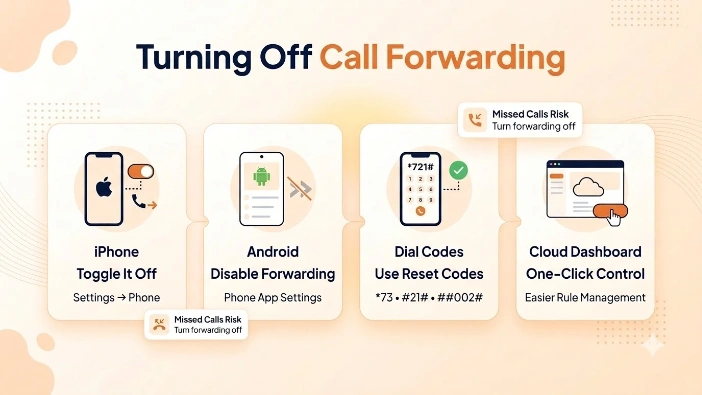
- On iPhone, return to Settings, then Phone, then Call Forwarding, and toggle it off
- On Android, return to the same call forwarding menu used to turn it on and select the option to disable it
- By dial code, use *73 on Verizon and US Cellular, #21# on AT&T and T-Mobile, or ##002# as a universal reset on most other carriers
A dedicated business number sidesteps this whole category of mistake, since forwarding rules live in a dashboard rather than a dial code nobody remembers using six months later, and turning a rule off takes one click instead of hunting down the right deactivation sequence for a specific carrier.
Common Call Forwarding Mistakes
A handful of avoidable mistakes account for most of the frustration people run into with call forwarding, and nearly all of them come down to forgetting the feature is active rather than the codes themselves failing.
Forwarding calls to a number that's frequently busy or unreachable, like another cell phone that's often off or out of signal, sends callers straight to a dead end instead of reaching anyone at all, since most conditional forwarding setups don't automatically fall back to a second number. International forwarding is another common surprise: forwarding a US number to an international destination can rack up per-minute charges on the forwarding line itself, charges that don't show up until the bill arrives, since the person who dialed pays nothing extra while the forwarding party absorbs the cost.
Relying purely on memory to track which forwarding rule is active, especially with several conditional codes layered on top of each other, makes it easy to lose track of exactly where calls are actually going. And a rule left on after a phone gets a new SIM or a number gets ported to a different carrier can keep silently redirecting calls to an old destination for weeks before anyone notices the gap.
Call Forwarding on Landlines and Office Phones
Traditional landlines and office desk phones handle forwarding a bit differently than cell phones, though the underlying dial codes are often nearly identical.
Most residential landline providers support the same *72/*73 activation and deactivation codes used on Verizon and US Cellular mobile lines, since both trace back to the same standard telephone company feature. Office phone systems add another layer entirely: a business running a PBX or a hosted phone system typically manages forwarding through an admin portal rather than a dial code on each individual handset, letting an office manager redirect an entire department's calls at once instead of configuring each desk phone separately. That centralized control is one of the clearest differences between a basic forwarding setup built for a single line and a system actually designed to route calls across a team.
That difference shows up most clearly during an office move or a staffing change: updating a dozen desk phones one at a time to forward to a temporary number takes far longer than changing a single routing rule in an admin dashboard that applies to the whole department at once.
Call Forwarding vs. a Cloud Phone System's Routing
Carrier-based call forwarding works well for simple, one-off redirects, but it has real limits: most carriers only support forwarding to a single number, offer no scheduling, and provide no record of what happened to a forwarded call.
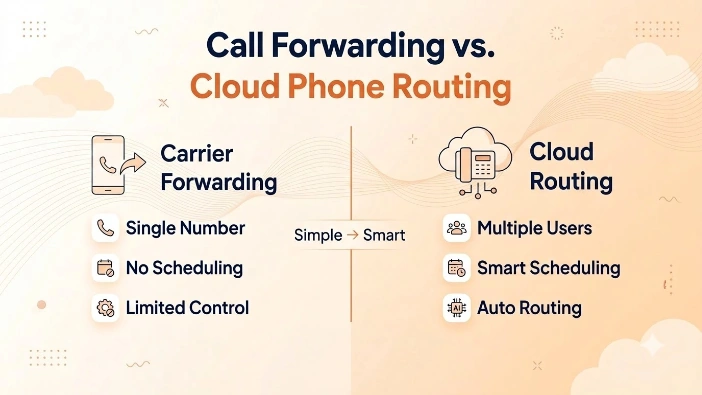
A cloud phone platform builds routing directly into the number itself, letting calls ring multiple staff at once, follow a schedule, or fall back to voicemail or an AI receptionist automatically, the kind of setup covered in this guide to call forwarding for growing teams.
Where These Dial Codes Come From
The formal specification behind these dial codes is documented on Wikipedia's page on call forwarding, which covers the GSM supplementary service standard nearly every US carrier code is built on.
Conclusion
Call forwarding takes only a couple of taps on iPhone and Android when the phone's built-in setting is available, and a short dial code when it isn't, particularly for Verizon iPhone users who need *72 instead of a Settings toggle. Whether it's forwarding a personal number to a work phone or setting up conditional forwarding for missed calls, the right method comes down to which phone and carrier combination you're using. Anyone asking how to forward call now has the steps for every major path, plus how to turn it back off when it's no longer needed.
Businesses that need more than a single forwarding number, like ringing a whole team or routing calls by time of day, outgrow carrier-based forwarding quickly. A cloud-based phone provider builds that flexibility in from the start, with call routing, an AI receptionist, and full call analytics on every line. Set up a Letsdial number today and stop relying on a dial code to manage where your calls actually go.
Frequently Asked Questions
Written by Aryan Khan · August 12, 2026
Reply to the author