

The Key Differences: Hosted vs. Cloud vs. On-Premise
The terms “hosted” and “cloud” are often used interchangeably, but there are important distinctions. Understanding them is crucial to making the right choice. We’ve created a simple table to compare the three primary models.
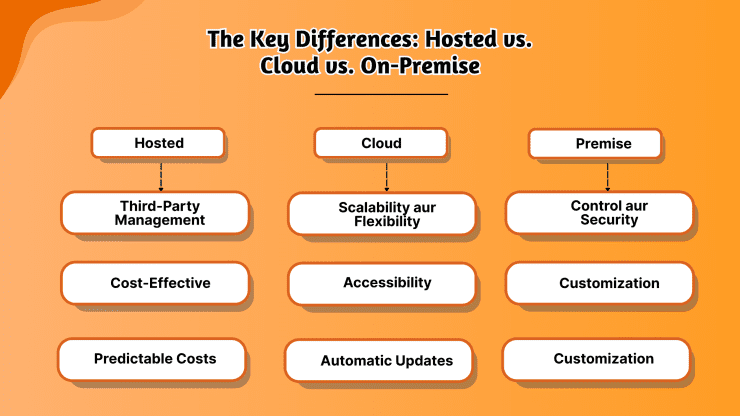
| Feature | On-Premise Contact Center | Hosted Contact Center | Cloud Contact Center (CCaaS) |
| Location | In your company’s own server room/data center. | On the provider’s servers in their secure data center. | On a distributed network of the provider’s servers. |
| Ownership | You own and are responsible for all hardware & software. | The provider owns and manages the hardware & software. | The provider owns and manages everything. |
| Cost Model | High upfront capital expense (CapEx) + ongoing maintenance. | Predictable monthly/annual subscription fee (OpEx). | Flexible, often usage-based subscription (OpEx). |
| Scalability | Difficult and expensive; requires buying new hardware. | Easy to scale up or down by adjusting your subscription. | Instant and highly flexible scalability on demand. |
| Maintenance | Handled entirely by your in-house IT team. | Handled entirely by the third-party provider. | Handled entirely by the provider with automatic updates. |
| Best For | Large enterprises with strict data control needs and huge IT budgets. | Businesses wanting to eliminate hardware management and gain flexibility. | Businesses of all sizes seeking maximum flexibility, speed, and innovation. |
How Does a Hosted Contact Center Work?
The process is straightforward and powerful. Instead of being tied to a physical phone number , your communications flow through the internet to your provider, who then manages everything seamlessly.

Here’s a simple breakdown of the process:
- Customer Interaction: A customer reaches out via any channel (phone call, email, web chat, etc.).
- Internet Routing: The interaction travels securely over the internet to your provider’s data center.
- Provider’s Infrastructure: The provider’s powerful servers and software process the interaction. They identify the customer, apply your business rules for https://www.letsdial.com/blog/how-does-a-cloud-phone-system-work/https://www.letsdial.com/blog/how-does-a-cloud-phone-system-work/, and queue the request.
- Agent Connection: The interaction is routed to the best-available agent, who can be working from anywhere with an internet connection—in the office, at home, or on the go.
- Seamless Communication: The agent handles the interaction using a simple software interface on their computer or device.
7 Core Benefits of Using a Hosted Solution
Moving to a hosted contact center model unlocks a wide range of business advantages that are simply not possible with on-premise systems.
1. Significant Cost Reduction
Eliminate the massive upfront capital expenses (CapEx) for servers, software licenses, and installation. A hosted model converts this to a predictable operational expense (OpEx), reducing your total cost of ownership and freeing up capital for other business priorities.
2. Effortless Scalability
Is your business seasonal? Experiencing rapid growth? With a hosted solution, you can add or remove agents in minutes, not months. You only pay for what you need, ensuring you can scale your operations to meet customer demand without buying expensive, underutilized hardware.
3. Empowers Remote & Hybrid Work
Because agents only need a computer and an internet connection, they can work productively from anywhere. This dramatically expands your talent pool, improves employee satisfaction, and provides business continuity in the face of unforeseen disruptions.
4. Access to Advanced Features
Hosted providers compete to offer the latest technology. This gives you immediate access to powerful features like omnichannel routing, Artificial Intelligence (AI) tools, Interactive Voice Response (IVR), and advanced analytics that would be prohibitively expensive to develop in-house.
5. Enhanced Security & Compliance
Reputable providers operate highly secure, geographically redundant data centers. They invest heavily in security measures and compliance certifications (like GDPR, PCI, and HIPAA), offering a level of protection that most businesses cannot achieve on their own.
6. Superior Reliability & Business Continuity
Forget worrying about downtime from power outages or hardware failure. Hosted providers offer Service Level Agreements (SLAs) with guaranteed uptime (often 99.99%), ensuring your contact center is always available to serve customers and provide an exceptional customer experience.
7. Faster Deployment & Implementation
An on-premise system can take months to deploy. A hosted contact center can be up and running in a matter of days or weeks. This speed and agility allow you to react faster to market changes and get a quicker return on your investment.
How to Choose the Right Hosted Contact Center: A 5-Step Checklist
Choosing a provider is a critical decision. Use this simple, actionable checklist to find the perfect partner for your business needs.
Step 1: Assess Your Core Business Needs
Before you look at any vendor, look at yourself. How many agents do you have? What channels do your customers use (voice, email, social)? What is your budget? What are your growth plans? A clear understanding of your needs is the foundation of a good decision.
Step 2: Evaluate Essential Features
Step 3: Scrutinize Security and Reliability
Don’t be shy about asking the tough questions. Ask for their uptime SLA. Inquire about their data center security and compliance certifications. Your customer data is invaluable, so ensure your provider treats it that way.
Step 4: Compare Pricing Models
Pricing is more than just the monthly fee. Understand what’s included. Are there extra charges for support, storage, or specific features? Compare providers based on the total cost of ownership to find a plan that offers real value without hidden fees.
Step 5: Always Request a Live Demo
Never buy a solution without seeing it in action. A live demo allows you to test the user interface for both agents and supervisors. Is it intuitive? Is it easy to use? This is your chance to ensure the platform is a good fit for your team.
Conclusion
In 2025 and beyond, the ability to adapt is no longer a luxury—it’s a requirement for survival. On-premise systems represent the old way of thinking: rigid, expensive, and complex. A hosted contact center provides the agility, scalability, and financial efficiency that modern businesses need to deliver an exceptional customer experience.
By moving your infrastructure to a trusted provider, you empower your team with better tools, provide your customers with better service, and position your business for future growth.


