Introducción
Si alguna vez has mirado un número mexicano preguntándote si ese dígito extra pertenece allí, no estás solo. El formato de número de teléfono de México atrae a más personas que llaman que casi cualquier otro formato de país en América, principalmente porque las reglas cambiaron en 2019 y muchas tarjetas de presentación y listas de contactos antiguas nunca se actualizaron.
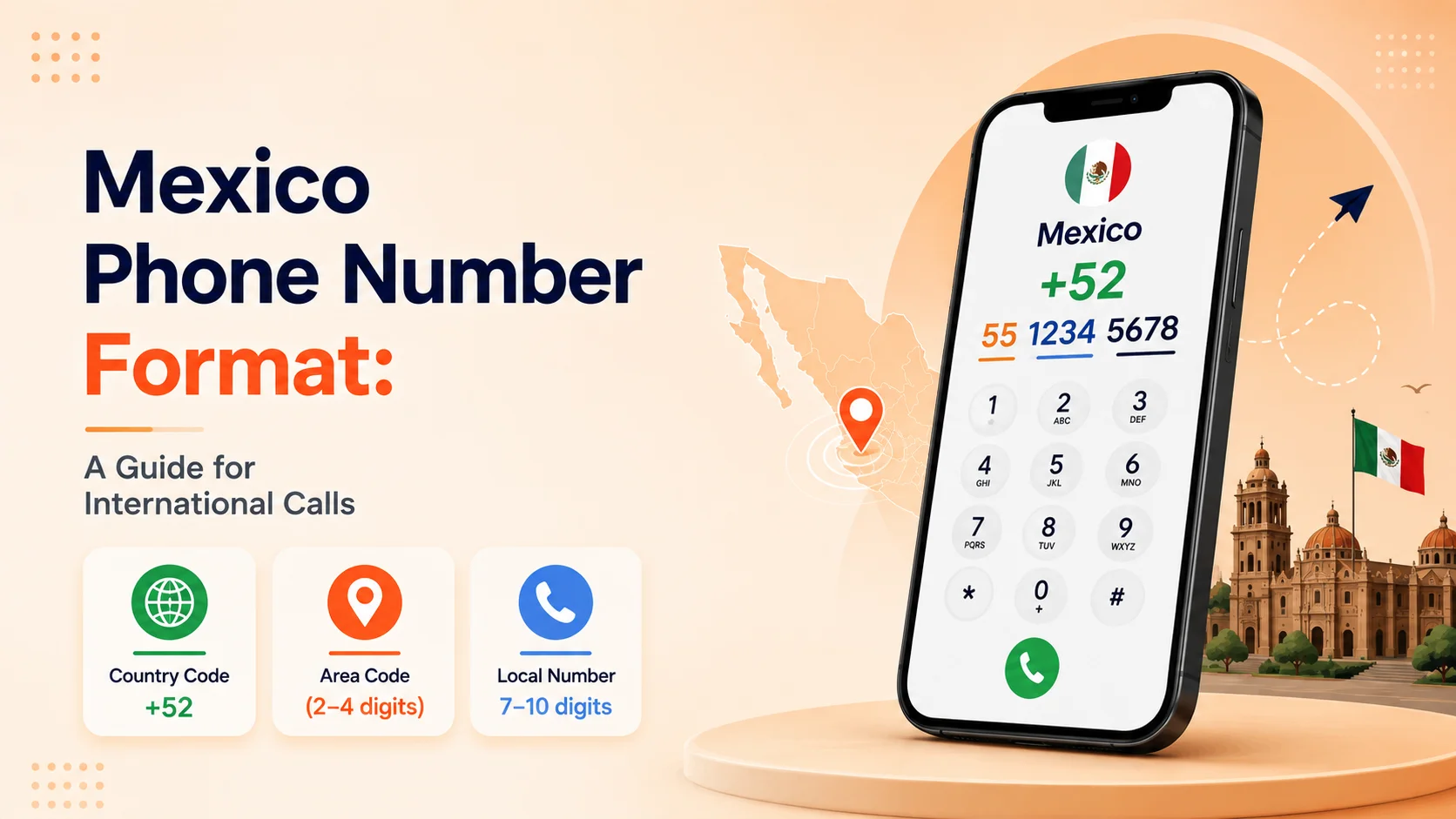
Esta guía desglosa pieza por pieza el formato del número de teléfono de México: el código de país +52, cómo se construyen los números de diez dígitos de México, qué códigos de área pertenecen a qué ciudades, el "1" ahora retirado que solía aparecer frente a los números móviles y exactamente cómo marcar dentro y fuera del país sin adivinar. Al final, podrás leer cualquier número mexicano a la vista y saber exactamente cómo ingresarlo, ya sea que llames desde un teléfono celular de EE. UU., un teléfono fijo del Reino Unido o una aplicación de VoIP.
Lo que realmente te dice "+52"
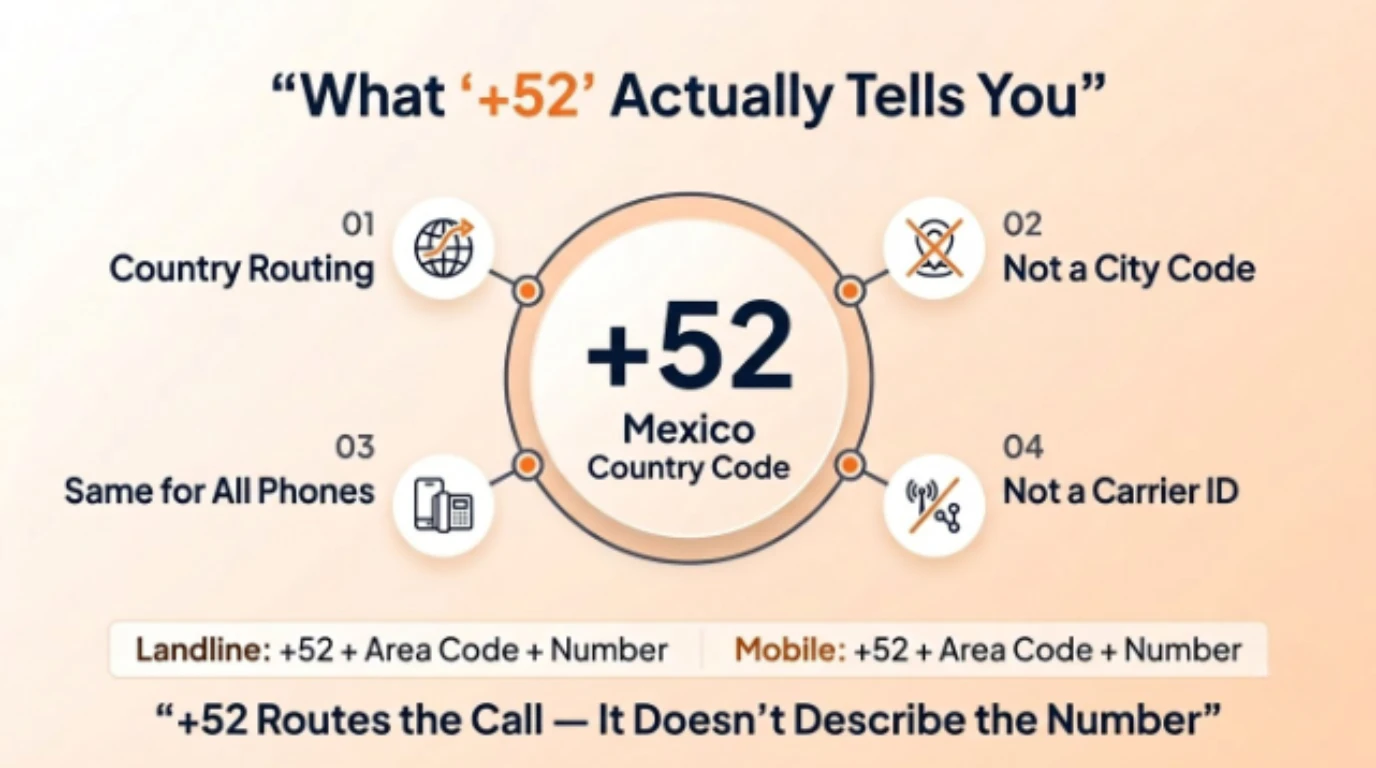
Todo número de teléfono en México comienza, al menos conceptualmente, con +52. Ese es el código de llamada de país asignado a México y es lo primero que necesita un marcador internacional antes de poder enrutar su llamada al sur de la frontera de EE. UU. Por sí solo, +52 no le dice nada sobre la ciudad, el operador o si se ha comunicado con un teléfono fijo o móvil; es una instrucción de ruta, no forma parte del número local.
Donde la gente se equivoca es al suponer que el código de país +52 cambia dependiendo de si están llamando a un teléfono móvil o fijo. No es así. A diferencia de algunos países que utilizan prefijos de línea fija y móvil separados, México aplica el mismo código de país +52 a todos los números del país. La distinción entre teléfono móvil y fijo se encuentra más abajo en el número, en el código de área, no en el código de país en sí.
Anatomía de un número mexicano de 10 dígitos
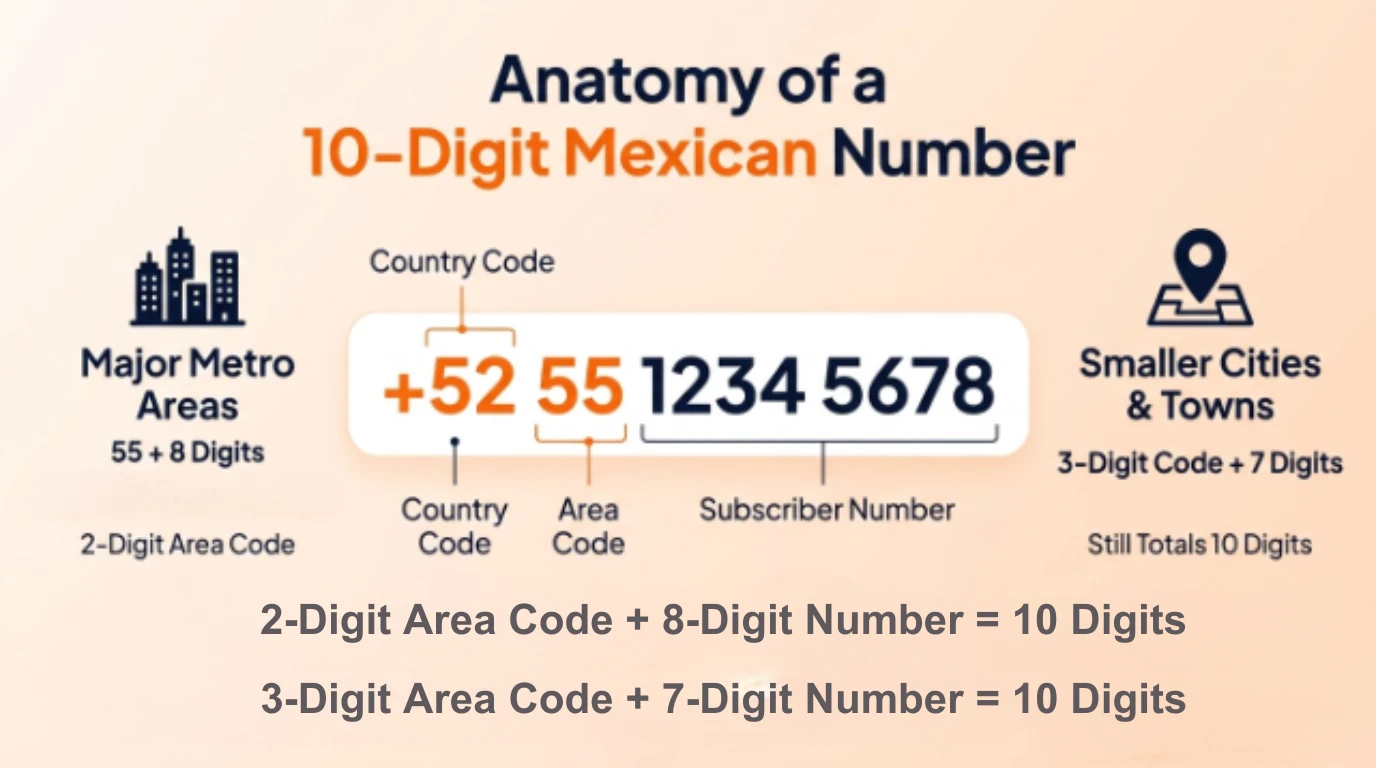
Una vez que eliminas +52, cada número válido en México se resuelve en exactamente diez dígitos. Esa es la regla básica del formato del número de teléfono de México y se aplica de manera uniforme ya sea que esté marcando un teléfono celular en Tijuana o un teléfono fijo comercial en Oaxaca. Esos diez dígitos se dividen en dos partes: un código de área de dos o tres dígitos que identifica la ciudad o región, seguido de un número de suscriptor de siete u ocho dígitos que identifica la línea específica.
Las principales áreas metropolitanas como Ciudad de México, Guadalajara y Monterrey utilizan códigos de área de dos dígitos combinados con números de abonado de ocho dígitos. Las ciudades y pueblos más pequeños suelen utilizar códigos de área de tres dígitos combinados con números de abonado de siete dígitos. De cualquier manera, el total siempre llega a diez dígitos. Si cuenta once o nueve dígitos después del código de país, algo anda mal: un prefijo sobrante, un error tipográfico o un formato desactualizado copiado de un registro antiguo.
Esta estructura de diez dígitos es lo que hace que el formato del número de teléfono de México sea realmente más simple de lo que parece a primera vista. No existe un esquema de conteo separado para teléfonos móviles y fijos, ni ningún dígito de alternancia enterrado en el medio. Una vez que conozca la longitud del código de área de una ciudad determinada, el resto del número encajará.
55 de la Ciudad de México y otros códigos de área regionales
Los códigos de área de México se asignan directamente a la geografía, y aprender algunos de los más importantes cubre la mayoría de las llamadas diarias. La Ciudad de México y su área metropolitana utilizan el código de área 55, uno de los códigos más marcados en el país dada la población de la capital. Guadalajara usa el código de área 33 y Monterrey, el centro industrial del norte, usa el código de área 81.
Más allá de esos tres, los códigos de área de México se distribuyen por estado y región: Tijuana usa 664, Cancún usa 998, Puebla usa 222 y Mérida usa 999. Las ciudades costeras y fronterizas tienden a agruparse en los rangos de 600 y 900, mientras que los estados centrales a menudo tienen códigos de tres dígitos. Tratar los códigos de área de México como una lección aproximada de geografía vale la pena: un código de área 55 señala la Ciudad de México de la misma manera que un código de área 212 señala Manhattan.
Para las empresas, este vínculo geográfico importa más allá de la precisión del marcado. Un cliente que ve un código de área 55 asume que está llamando a una empresa con sede en la Ciudad de México, y esa credibilidad local es parte de la razón por la que las empresas que se expanden a la región proporcionan números a través de un numero virtual de mexico en lugar de encaminarlo todo a través de una línea estadounidense.
El "1" desaparecido: la reforma de marcación móvil de México de 2019
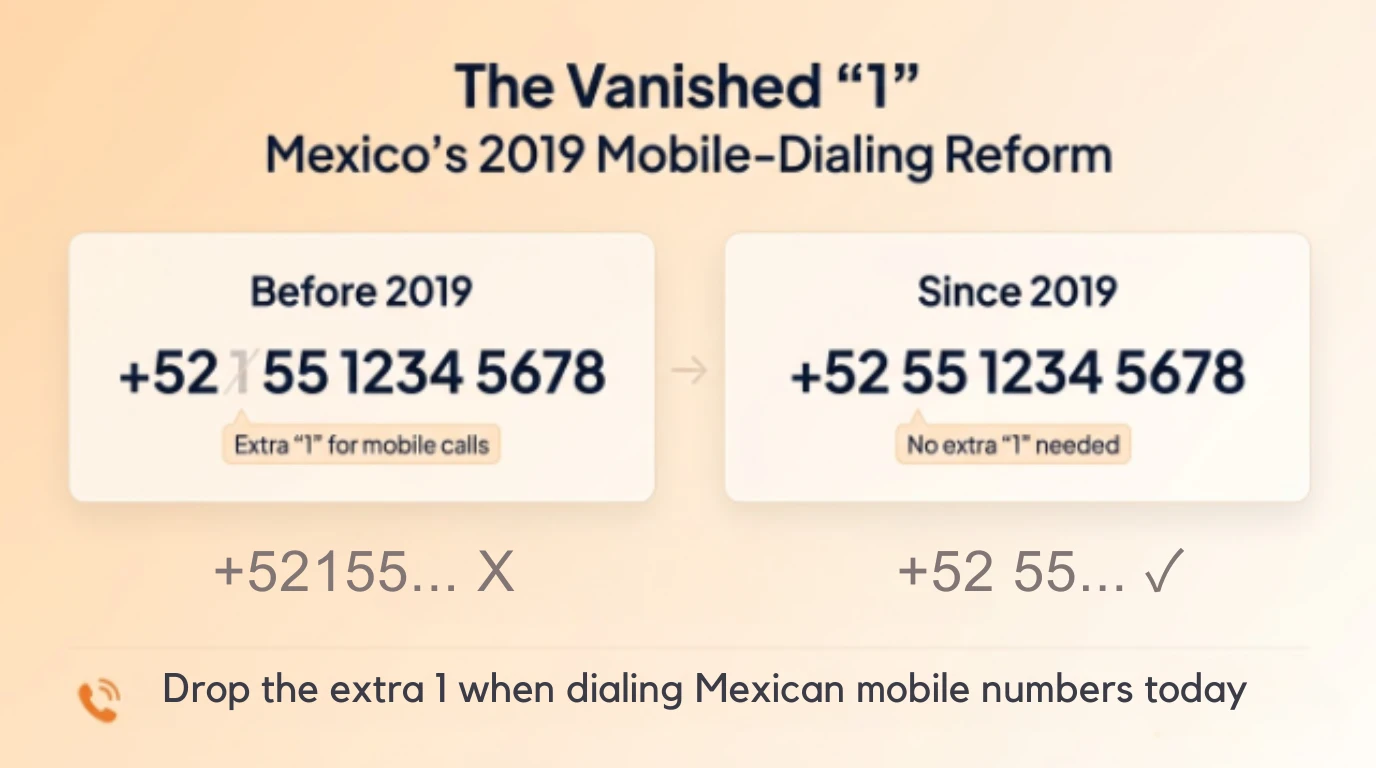
Aquí está la peculiaridad que atrapa incluso a las personas más experimentadas. Antes de agosto de 2019, marcar un número móvil mexicano desde fuera del país requería insertar un "1" entre el código del país y el código de área, por lo que un teléfono celular de la Ciudad de México parecía +52 1 55 1234 5678 en lugar del formato de diez dígitos utilizado para las líneas fijas. Ese dígito extra no pertenecía al número en sí; era una instrucción de enrutamiento que decía a los operadores "esta es una línea móvil".
El regulador de telecomunicaciones de México retiró esa regla el 3 de agosto de 2019, como parte de una reforma más amplia que también eliminó los prefijos de larga distancia nacional que los mexicanos usaban para marcar entre ciudades. Desde entonces, la marcación se ha unificado por completo: tanto los números móviles como los fijos utilizan los mismos diez dígitos después de +52, sin necesidad de insertar un "1" desde ningún lugar del mundo.
Si todavía ves un "1" adicional en un número de móvil mexicano en una tarjeta de presentación antigua o en una publicación de blog de hace años, ese registro es anterior a 2019 y necesita actualización: marcarlo hoy fallará por completo o se enrutará incorrectamente, según el operador.
Llamar a México desde el extranjero
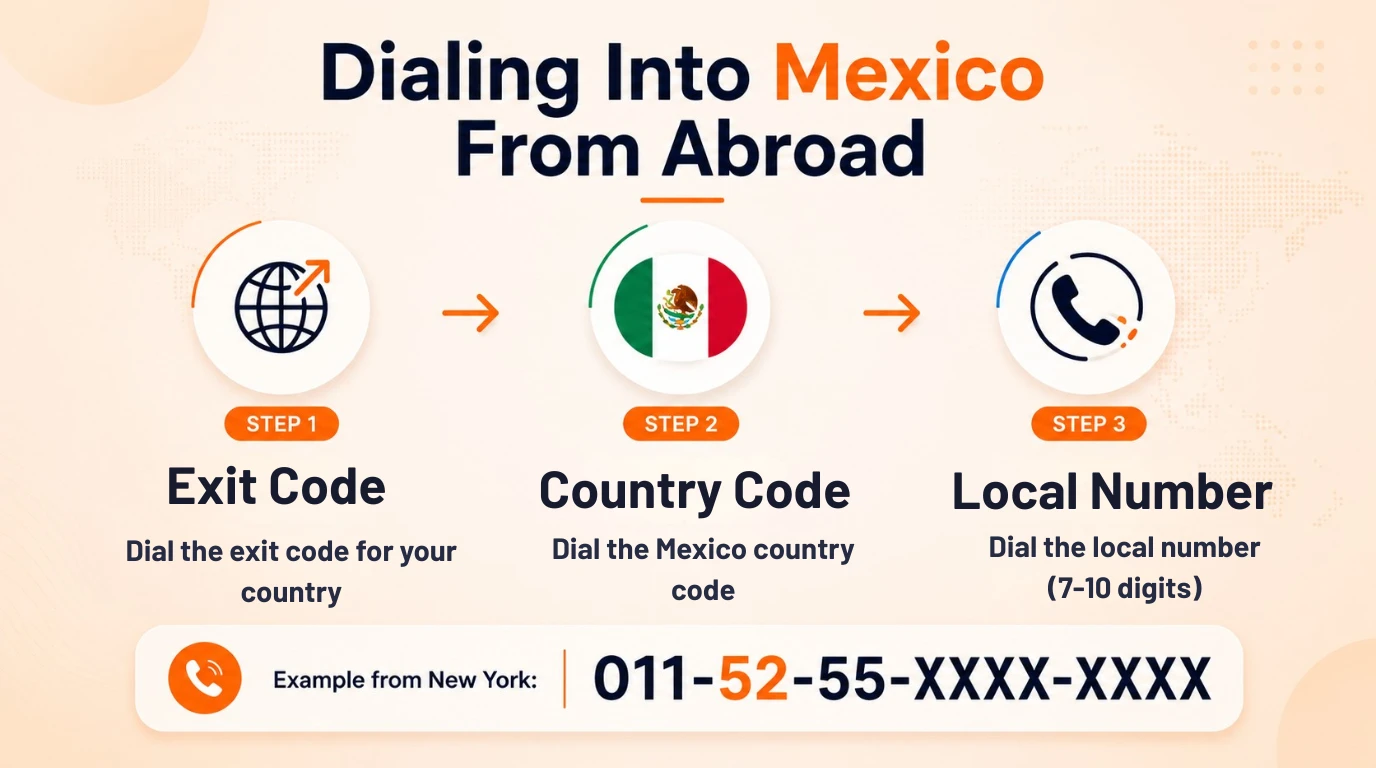
Para llamar a cualquier número de México desde el extranjero, la secuencia sigue siendo la misma para móvil o fijo. Comience con el código de acceso internacional de su propio país: 011 desde EE. UU. o Canadá, 00 desde el Reino Unido y la mayor parte de Europa, o simplemente "+" desde un teléfono móvil. Continúe con 52, el código de país +52 y luego el número local completo de diez dígitos.
Entonces, una llamada desde Nueva York a una oficina de la Ciudad de México se marcaría como 011-52-55-XXXX-XXXX, o +52 55 XXXX XXXX desde un teléfono inteligente. Ya no hay un paso separado para los números móviles: la reforma eliminó esa complejidad, por lo que la misma secuencia funciona ya sea que la persona al otro lado de la línea esté sosteniendo un teléfono celular o sentada frente a un teléfono de escritorio. LetsDial buscador de código de país muestra esta cadena de marcado exacta para México junto con el formato correcto para más de 240 países más, una práctica comprobación de cordura al marcar a algún lugar nuevo.
Marcando desde México
Ir en la otra dirección funciona de la misma manera a la inversa: marca 00 como código de salida internacional de México, luego el código de llamada del país de destino y luego su número local. Llamar a un número de EE. UU. desde México significa marcar 00-1 seguido del número de EE. UU. de diez dígitos.
Una cosa que vale la pena señalar para los viajeros y los equipos remotos: los operadores de telefonía móvil mexicanos a veces cobran de manera diferente por las llamadas internacionales que por las nacionales, y la calidad de la cobertura varía según la región fuera de las principales áreas metropolitanas. Las empresas que necesitan llamadas bidireccionales confiables a menudo evitan esa imprevisibilidad enrutando las llamadas a través de una conexión VoIP en lugar de una tarjeta SIM tradicional, manteniendo la experiencia de marcación consistente independientemente de la red.
Teléfono fijo vs móvil: detectando la diferencia hoy
Dado que la reforma de 2019 eliminó el prefijo "1", no existe una forma de marcar para distinguir un número fijo mexicano de un número móvil mirando los dígitos; ambos usan el mismo formato de número de teléfono de México. Se trata de una simplificación deliberada, pero significa que las empresas que solían filtrar contactos por prefijo ahora necesitan un método diferente. El código de área aún le indica la región y los operadores pueden identificar el tipo de línea internamente, pero si es importante distinguir la línea móvil de la fija (por ejemplo, para campañas de SMS), necesitará un servicio de búsqueda de operador en lugar de depender de la forma del número.
Formateo de resbalones que rompen un número mexicano
Un puñado de errores explican la mayoría de las llamadas fallidas a México. Lo más común es dejar ese prefijo "1" retirado en los números de móvil. Otra es eliminar un dígito del código de área, particularmente los códigos de tres dígitos mal escritos como dos dígitos. Algunas personas que llaman olvidan por completo el código de país y marcan sólo los diez dígitos locales, que no se enrutarán internacionalmente. Otros agregan un "0" adicional antes del código de área, un vestigio de un prefijo eliminado en 2019. En caso de duda, el hábito más seguro es escribir cada número en el formato de número de teléfono de México de manera limpia: +52 más los diez dígitos, sin prefijos adicionales.
Configurar un número mexicano con LetsDial
Para las empresas que desean ser accesibles dentro de México sin operar una oficina física allí, un número virtual es más práctico que administrar el formato del número de teléfono de México en una flota de tarjetas SIM locales. LetsDial proporciona números de teléfono virtuales de México con códigos de área mexicanos reales, incluido 55 para la Ciudad de México, que se reenvían a cualquier teléfono o aplicación en cualquier parte del mundo, para que los clientes marquen un número local familiar mientras su equipo responde desde donde esté.
La configuración toma minutos en lugar de las semanas que puede requerir un contrato de operador físico en México, y no hay necesidad de preocuparse por la peculiaridad del prefijo "1" o las reglas de marcado específicas del operador una vez que el número está activo: el enrutamiento se maneja en el back-end.
Conclusión
El formato del número de teléfono de México se reduce a +52 más diez dígitos, dividido en un código de área de dos o tres dígitos y un número de suscriptor coincidente de siete u ocho dígitos, con el antiguo prefijo "1" exclusivo para dispositivos móviles retirado desde agosto de 2019. Una vez que esa estructura le resulta familiar, leer o marcar cualquier número mexicano lleva unos segundos en lugar de conjeturas.
De acuerdo a Aviso del propio Twilio a los desarrolladores, a los operadores se les dio un período de gracia antes de que los números marcados con el antiguo prefijo "1" dejaran de conectarse por completo, una referencia útil si todavía estás desenredando una lista de contactos antigua. ¿Listo para un verdadero número mexicano? Configure uno con LetsDial hoy.
Preguntas frecuentes
Escrito por Aria Khan · 7 de agosto de 2026
Responder al autor