Introduction
More than 40% of customers leave after a single poor call experience. That makes one thing clear: the wholesale VoIP termination provider behind your phone system is not a back-office procurement decision — it's a customer-retention variable.
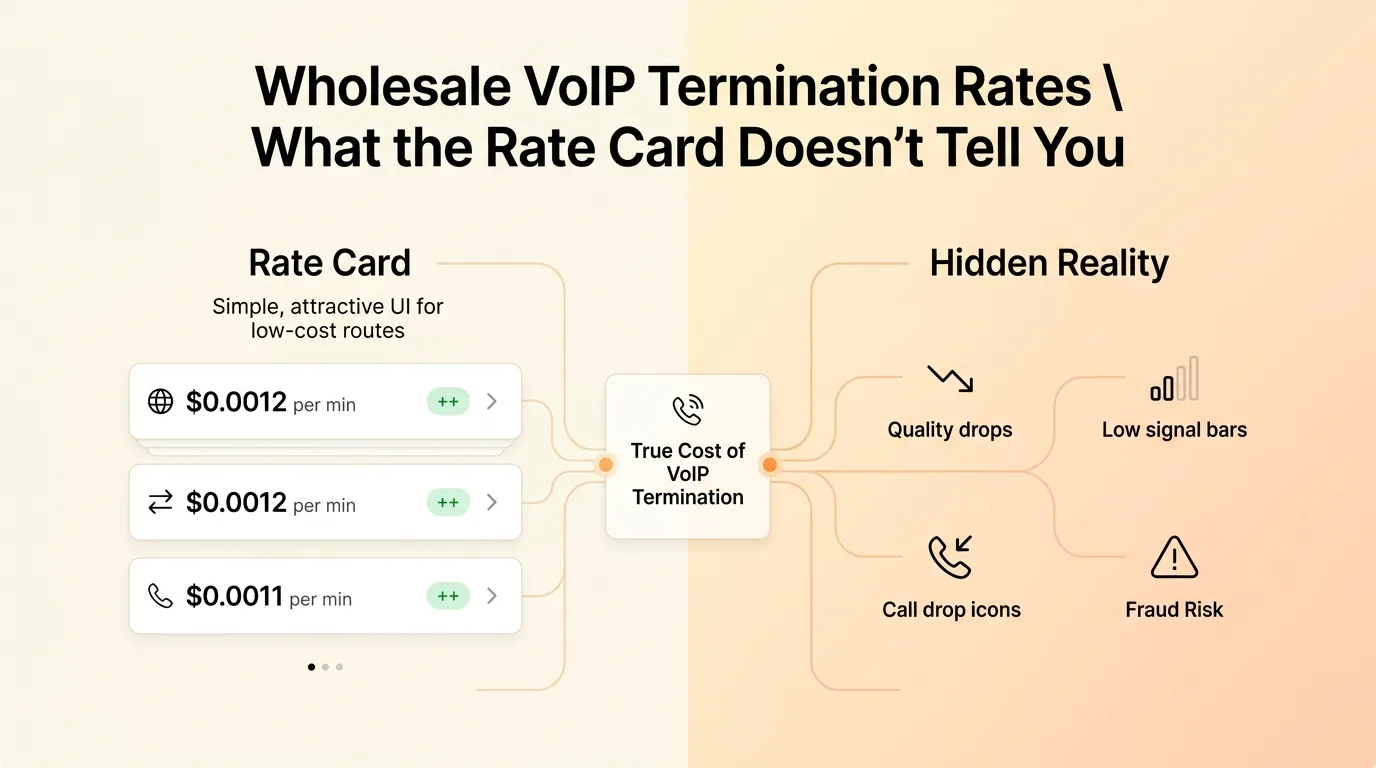
Most evaluation checklists stop at price and coverage. Two providers can quote identical rates and claim identical country counts while delivering drastically different call quality, security postures, and support experiences. The difference shows up in MOS scores, dropped calls, and fraud incidents — not in the sales deck. This guide breaks down the six criteria that actually matter, the questions to ask before you sign, and the red flags that should end the conversation immediately.
On this page:
- What Wholesale VoIP Termination Is
- Why Provider Choice Affects More Than Cost
- Pricing Models — Per-Minute, Per-Channel
- The Six Criteria That Separate Reliable Providers
- Coverage Numbers: What They Tell You and Hide
- Security and Fraud Prevention
- How letsdial Answers Each Criterion
- Frequently Asked Questions
What Wholesale VoIP Termination Is
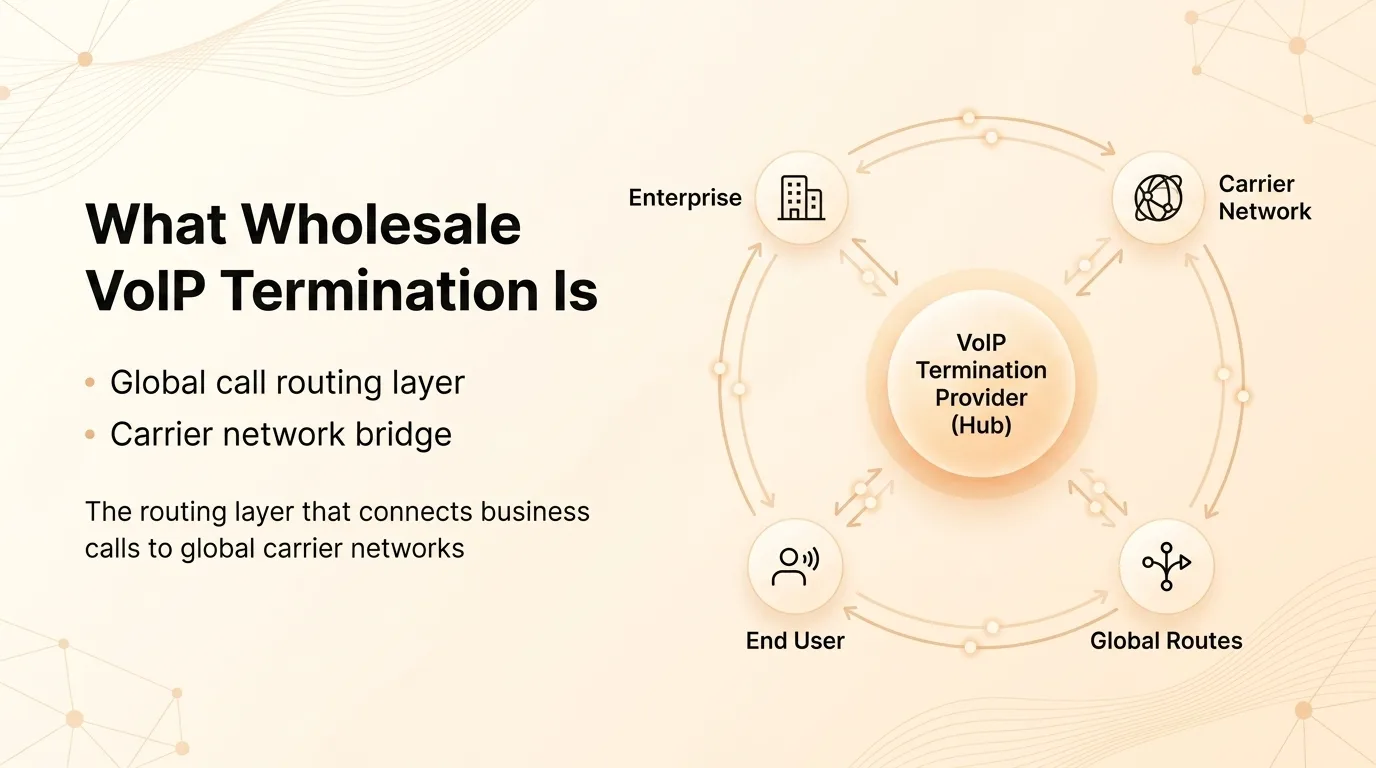
Wholesale VoIP termination is the process of routing and completing outbound voice calls across carrier networks at scale, priced for bulk volume rather than retail consumption. When a business places a call, the audio travels as data packets across the internet until it reaches the public switched telephone network (PSTN) — and the recipient's device. Termination is the handoff between the VoIP network and that PSTN endpoint.
Wholesale providers handle this handoff for thousands of simultaneous calls, maintaining direct interconnects with local carriers in each country and managing routing algorithms that balance quality against cost. The distinction from retail VoIP is volume and access model: retail providers sell per-seat plans to end users; wholesale providers sell bulk capacity — per-minute blocks or concurrent channels — to contact centers, UCaaS platforms, and resellers. More detail sits on our letsdial page.
Why Provider Choice Affects More Than Cost
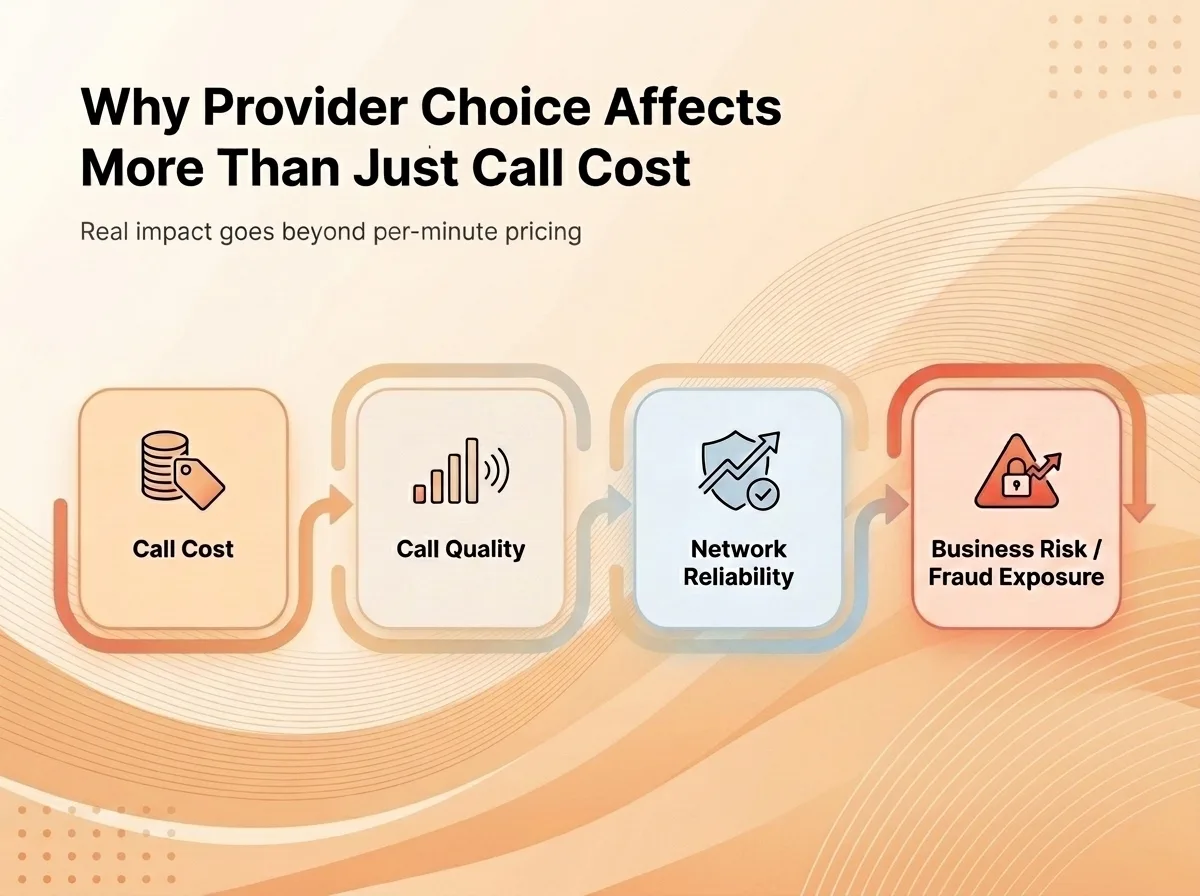
The obvious impact is price — a fraction of a cent per minute across millions of monthly minutes is a material cost line. The less obvious impact is quality. Call quality is measured by MOS (Mean Opinion Score), a 1–5 scale capturing clarity, latency, and jitter. The MOS gap between a Tier-1 route and a grey route is audible: a floor running on low-quality routes sees higher handle time, more repeat calls, and lower CSAT — none of which appear on the invoice.
Security is the third variable. Grey-route providers and underfunded networks attract toll fraud at a higher rate; a single fraudulent campaign through a compromised account can generate thousands in termination charges within hours. letsdial routes calls across Tier-1 partner networks with STIR/SHAKEN attestation and real-time fraud monitoring on every plan. More detail sits on our security posture page.
Pricing Models — Per-Minute, Per-Channel
Wholesale termination billing comes in four main structures. The right model depends on your call volume pattern, mix of inbound/outbound traffic, and month-to-month predictability:
- Per-minute billing — pay for each connected minute; best for variable, unpredictable traffic; watch for rate fluctuations on international routes.
- Per-channel billing — pay for concurrent call capacity, not minutes; best for consistent high-volume floors; watch for paying for unused capacity in quiet periods.
- Flat-rate bundles — a set monthly fee for a defined call block; best for predictable inbound queues; watch for overage charges above the bundle.
- Hybrid (minutes + channels) — a base channel fee plus per-minute for overflow; best for mixed inbound/outbound; watch for complexity in cost tracking.
> [NOTE] The hidden cost in per-minute pricing: international route rates aren't static, and some providers quote blended rates that average across quality tiers. When a specific country drives sudden traffic, the per-minute rate on that route may exceed the blended number in the proposal. Ask for route-specific rate sheets, not averages.
The Six Criteria That Separate Reliable Providers
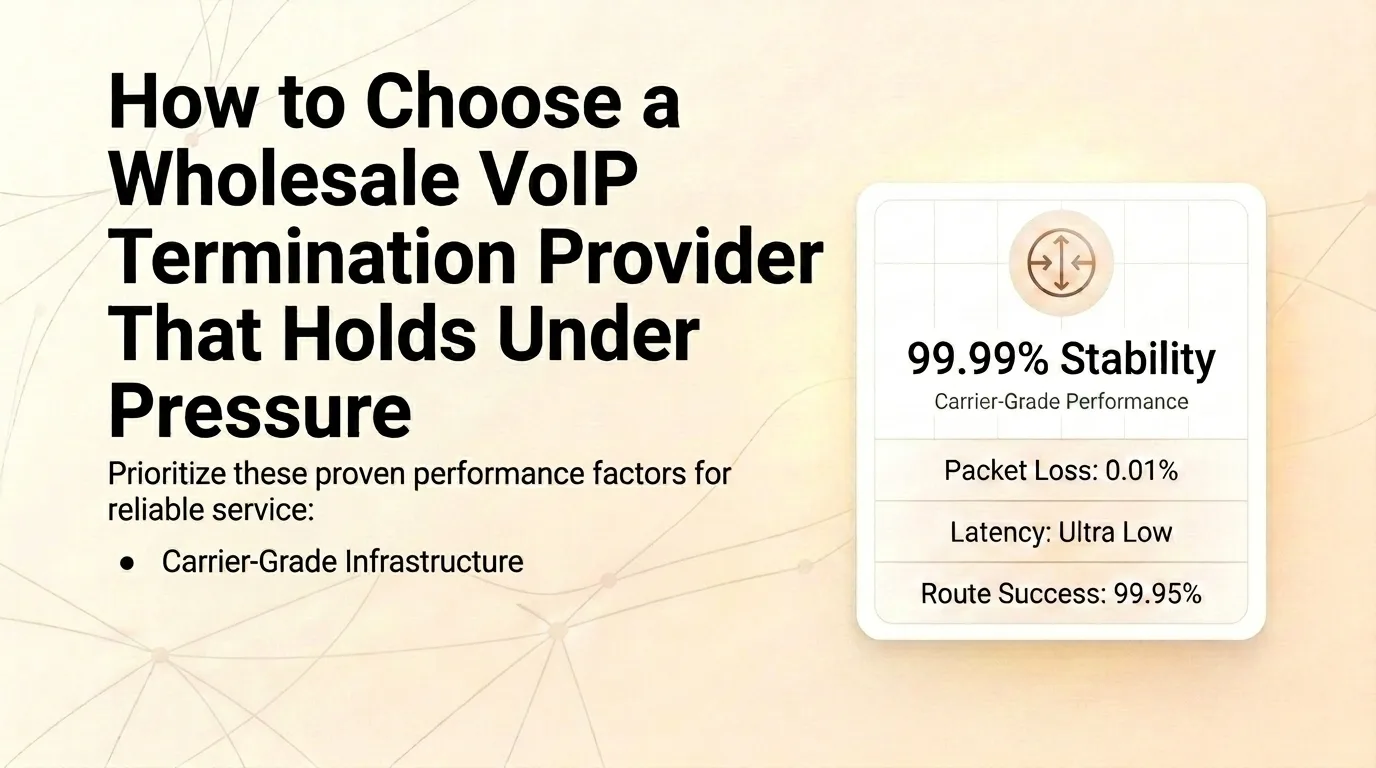
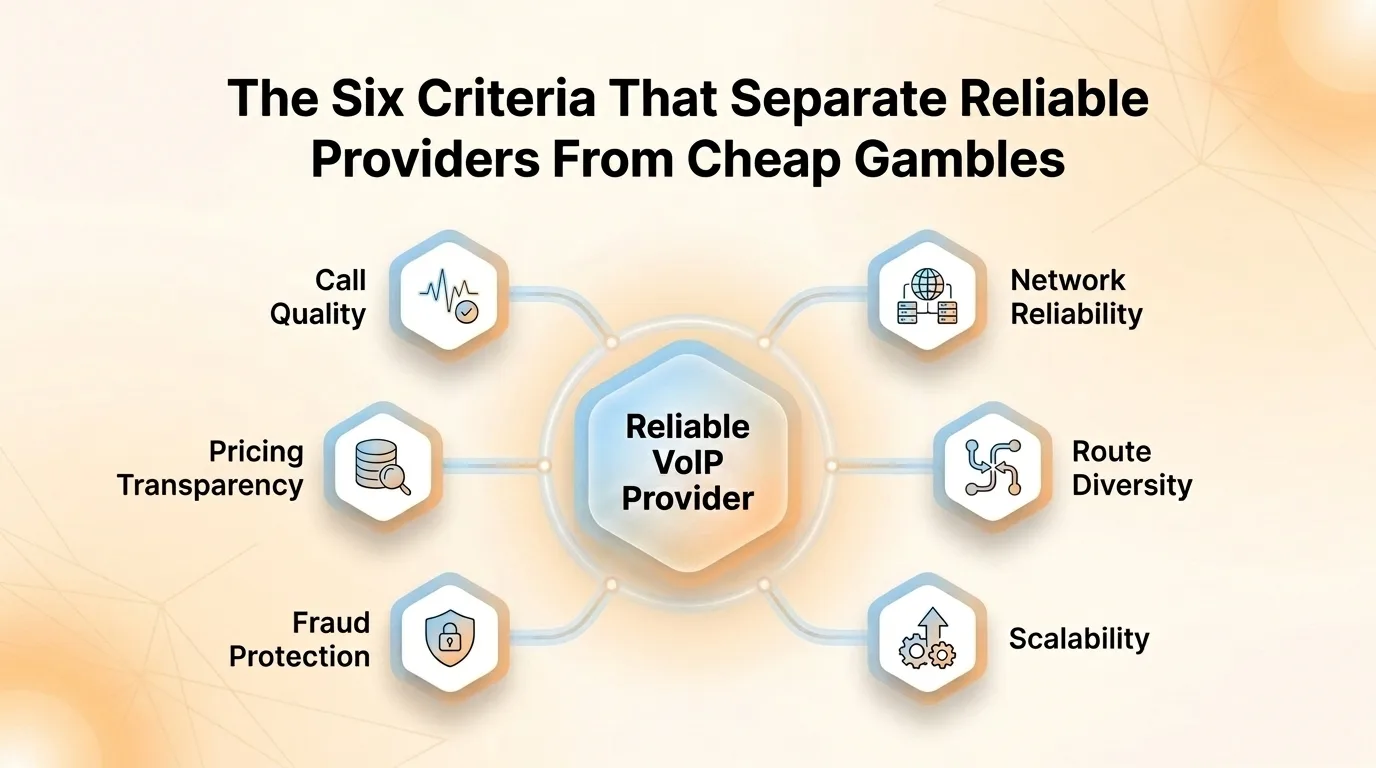
Most evaluations collapse into a rate comparison. Rates matter, but they aren't sufficient. Assess these six criteria during the sales process and verify them in the contract:
- Network uptime SLA — is it 99.9%+, and does it exclude planned maintenance? Red flag: vague exclusions or no financial penalty for breach.
- Tier-1 carrier interconnects — which specific carriers do you peer with directly? Red flag: the provider can't name its upstream partners.
- Call quality metrics — what's your average MOS and ASR on international routes? Red flag: no real-time QoS or MOS data available.
- Geographic coverage — how many countries have direct interconnects vs. resold routes? Red flag: a large country count padded with grey routes.
- Security protocols — is TLS + SRTP standard or an add-on, and what fraud monitoring is active? Red flag: encryption only on upgraded tiers.
- Scalability path — how quickly can capacity be added during volume spikes? Red flag: manual provisioning with multi-day lead times.
Coverage Numbers: What They Tell You and Hide
A provider quoting '200+ countries' sounds comprehensive. The number itself tells you almost nothing about actual termination quality in those markets.
- Direct interconnects vs. resold routes — direct peering means fewer hops, lower latency, and clear accountability; a resold route adds a handoff where quality degrades and accountability disappears.
- Grey routes — some providers pad country counts with calls routed through consumer SIM cards or unofficial interconnects; cheap to originate but unreliable and non-compliant with most SLAs. Ask explicitly whether any route in your markets uses grey-route termination.
- Coverage in your specific markets — if 90% of your volume goes to five countries, the total country count is largely irrelevant. Evaluate MOS, ASR, and uptime on the routes you'll actually use.
> [TIP] Ask for route-specific QoS reports for your top 10 destination countries. Any provider unwilling to share MOS scores, ASR data, or network uptime history on specific routes is hiding underperformance.
Security and Fraud Prevention
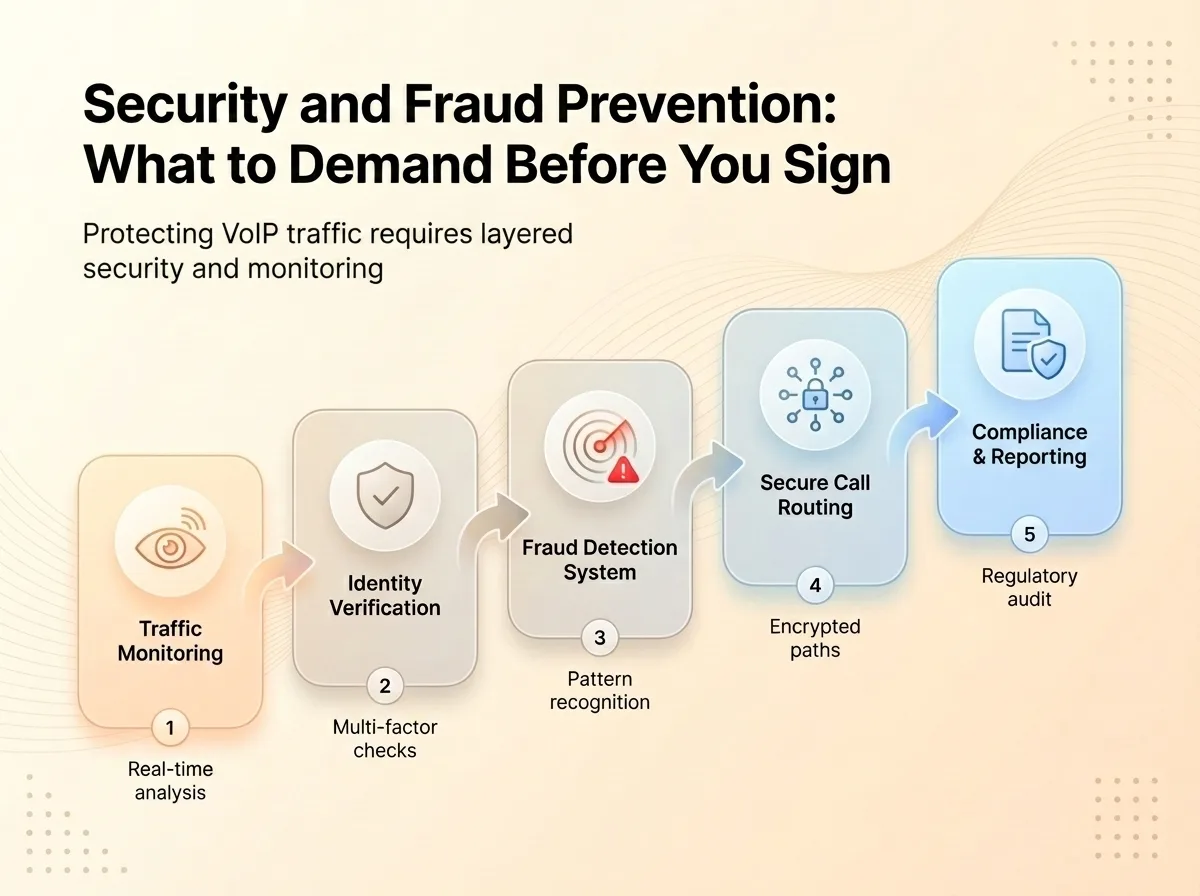
VoIP fraud losses cost the industry an estimated $28 billion annually (Communications Fraud Control Association). Wholesale providers are a primary target because high-volume accounts provide large windows for fraudulent traffic before detection.
- TLS and SRTP encryption — TLS protects the SIP signaling channel; SRTP encrypts the audio stream. Both should be standard on every account, not gated behind a premium tier. Get it in writing.
- Real-time fraud monitoring — AI-driven anomaly detection should flag sudden spikes to premium-rate numbers, sequential dialing, or calls outside your geographies and trigger suspension within minutes, not hours.
- STIR/SHAKEN attestation — A-level attestation means the carrier verified the caller owns the number. Without it, your numbers face carrier filtering and regulatory risk.
- Compliance scope — for regulated verticals, confirm SOC 2 Type II, HIPAA-readiness, PCI DSS, and GDPR coverage on every plan, not as a custom-quote line item.
> [TIP] letsdial ships AES-256 encryption at rest, TLS 1.3 in transit, STIR/SHAKEN A-level attestation, and SOC 2 Type II compliance on every paid plan — no tier upgrade required. Tour the security posture.
How letsdial Answers Each Criterion
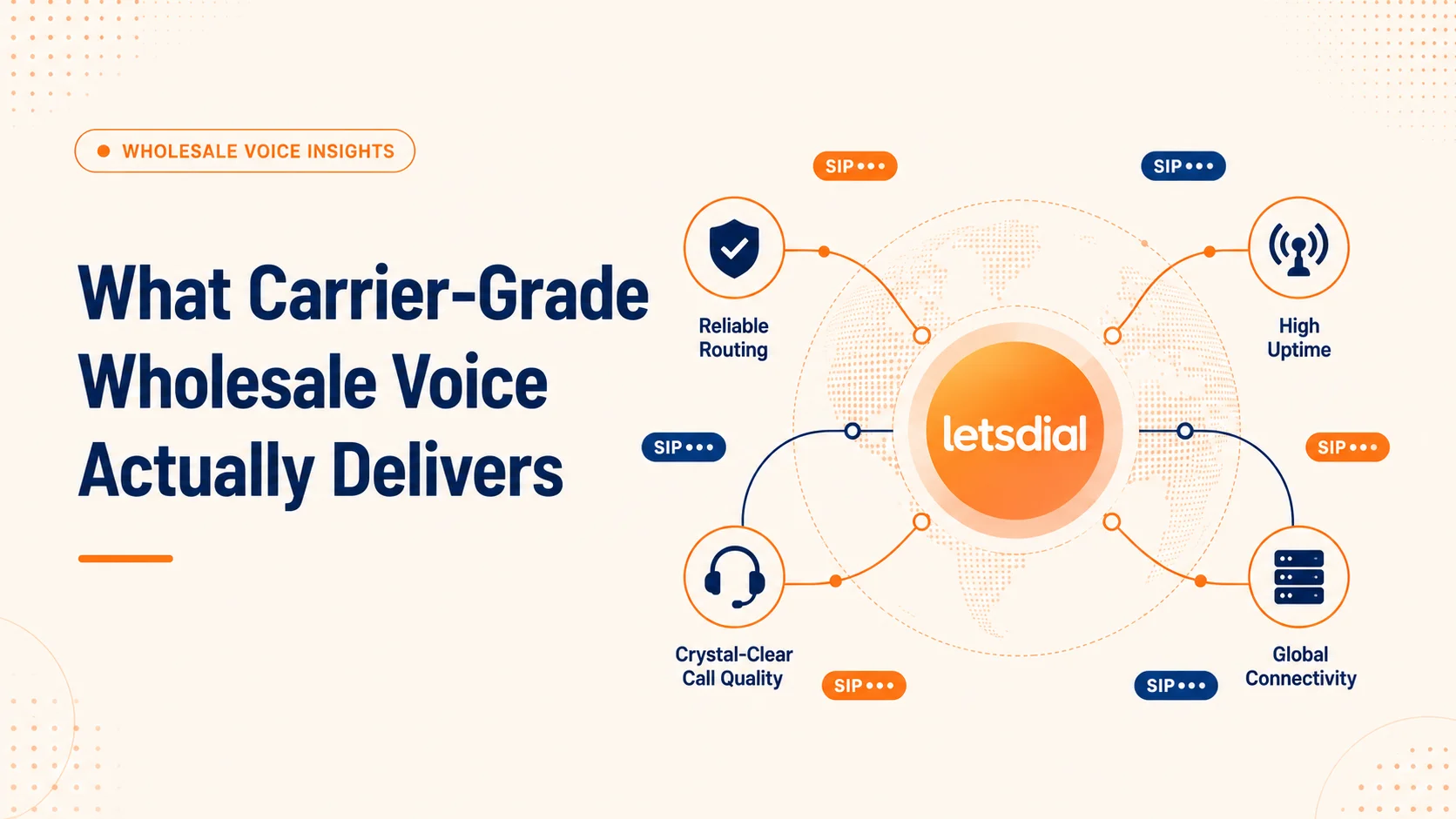
letsdial routes voice through direct Tier-1 carrier interconnects — Telin, MTT, Reliance Communications, Deutsche Telekom, China Mobile International, PLDT, and Telekom Slovenije — into 200+ countries, with local numbers in 100+ countries on sign-up and STIR/SHAKEN A-level attestation at the switch on every outbound call. Network uptime SLA, SOC 2 Type II, HIPAA-readiness, PCI DSS, and GDPR compliance are on every paid plan; AES-256 at rest and TLS 1.3 in transit are defaults; real-time fraud monitoring and call-quality analysis run continuously.
Conclusion
letsdial is not a termination-only provider. Cloud Phone and AI Contact Center — queues, outbound dialers, transcription, sentiment analysis, agent assist, and supervisor tools — share one routing engine with the voice infrastructure, on the same invoice and SLA. Setup takes under 3 minutes; number porting is free both directions; the Starter plan begins at $9.99/user/month with every AI feature at zero per-minute extra. See pricing. For how carriers settle these charges, see the FCC's intercarrier compensation overview.
Frequently Asked Questions
Written by Aryan Khan · June 30, 2026
Reply to the author