Introduction
You dial someone, and instead of hearing a ring, a flat automated voice cuts in: "Your call has been forwarded to an automated voice messaging system." No name, no personal greeting, just a generic prompt telling you to leave a message after the beep. It's one of the more anonymous-sounding messages in modern telephony, and the vagueness is exactly what makes people assume the worst.
This guide breaks down what's actually happening on the technical side when you hear that message, the handful of everyday reasons it shows up, how it's different from a normal voicemail greeting, and whether it's ever a sign you've been blocked.
What "Your Call Has Been Forwarded" Actually Means

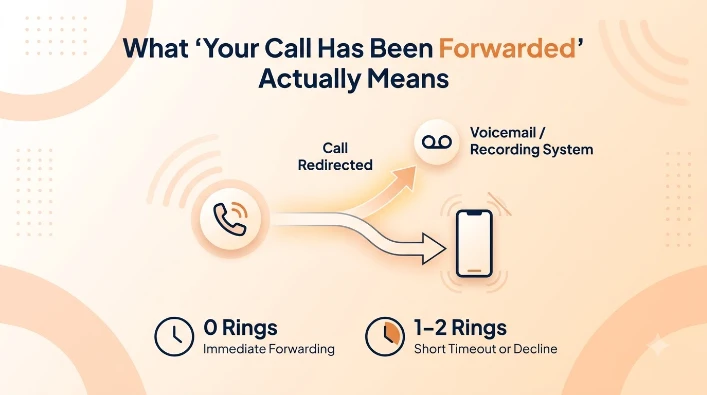
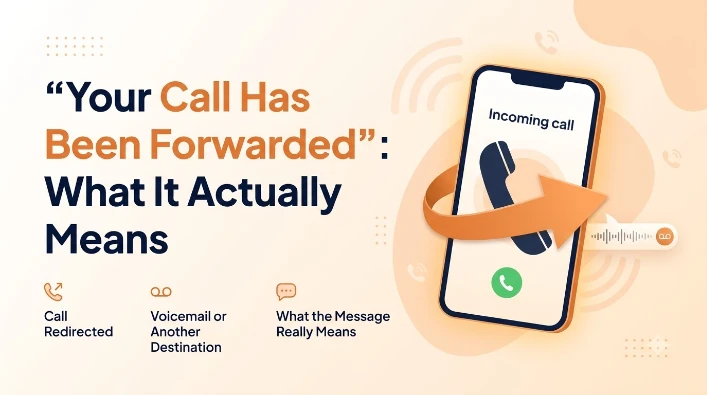
Despite how alarming a generic automated voice can sound, the message is describing something mundane: your call was redirected away from the recipient's phone and routed to a voicemail or message-recording system instead of ringing through. "Forwarded" here is literal, the call took a different path than a straight connection to the person's handset, ending at a recording system rather than a live line.
The message is generic because it's usually generated by the carrier's own network infrastructure, not by the person you're calling. Unlike a personalized voicemail greeting recorded in someone's own voice, this fallback message plays when no custom greeting has been set up, or when the call is routed through a forwarding path that bypasses the recipient's personal voicemail system entirely.
One small clue in how the call unfolds can hint at which scenario you're in, without confirming anything for certain. A call that goes straight to the forwarded message with zero rings usually points to the phone being off, unreachable, or set to forward unconditionally, since none of those situations give the network a working handset to ring in the first place. A call that rings once or twice before cutting to the message is more consistent with a declined call or an unanswered call hitting a very short ring-timeout that's been configured for forwarding.
Why You're Hearing an Automated Message Instead of a Ring
A handful of everyday situations trigger this exact message, and none of them require the recipient to be deliberately avoiding you.
- Phone powered off or in airplane mode — carriers automatically forward calls to voicemail when a device can't be reached on the network at all
- Do Not Disturb enabled — many phones silently route calls to voicemail during Do Not Disturb hours without ever ringing visibly
- Weak or no signal — a phone that's technically on but out of coverage gets treated the same as one that's off, and the carrier forwards the call
- The call was declined — a quick tap to reject an incoming call sends it straight to the same forwarding path
- Call forwarding is actively set up — the recipient has configured their line to forward every call, or calls that go unanswered, to a voicemail system by design
The exact wording varies slightly by carrier, which is part of why the message can feel unfamiliar. Verizon and T-Mobile numbers tend to use close variations of "has been forwarded to an automated voice messaging system," while some AT&T lines instead play "the wireless customer you are trying to reach is not available," a different phrase describing largely the same underlying redirect. None of these variations change what's actually happening on the network side, just which script the carrier's system happens to read.
Is This the Same Thing as Regular Voicemail?

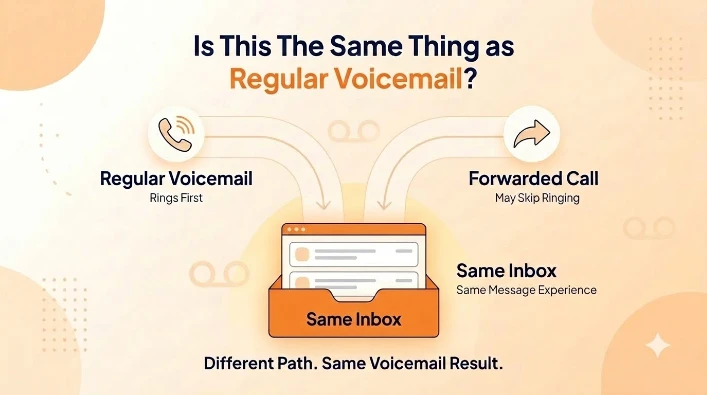
Functionally, yes, both end with you leaving a recorded message, but the path getting there is different. A standard voicemail greeting plays after a phone rings a set number of times with no answer, and it's usually the recipient's own recorded voice. "Your call has been forwarded" skips the ringing step entirely in most cases, since the call was redirected before it ever reached the point of ringing on the recipient's device, and the greeting itself is the carrier's generic recording rather than a personal one.
Visual voicemail, the transcribed, list-view voicemail inbox built into iPhone and most modern Android phones, doesn't distinguish between the two on the recipient's end either. A message left after this generic forwarded greeting shows up in the same inbox, gets transcribed the same way, and behaves identically to a message left after a normal ring-then-voicemail sequence. The difference only ever mattered on the caller's side, in what they heard before leaving the message.
Does It Mean You've Been Blocked?
On its own, no. Every one of the everyday causes above, a dead battery, Do Not Disturb, a bad signal, produces the identical message, so hearing it once is weak evidence of anything specific. What actually points toward being blocked is a consistent, repeating pattern rather than a single instance: the same forwarded message every single time you call, at every hour, paired with other signs like texts that never show as delivered. A one-off forwarded call after a normal call history is almost always just circumstance.
If it keeps happening with the same contact over days or weeks, a text message is usually a better next move than repeated calling. A text that goes through and gets a reply rules out a block entirely, since a blocking contact typically can't receive texts either, while a text that also disappears without a response strengthens the case that something more deliberate than bad timing is going on.
Setting Up Call Forwarding on Your Own Number
If this message made you curious about setting up forwarding on your own line rather than just receiving it from someone else, the process is a short one on both iPhone and Android, whether you want every call redirected unconditionally or only the calls you miss or decline.
The Vertical Service Codes Behind It

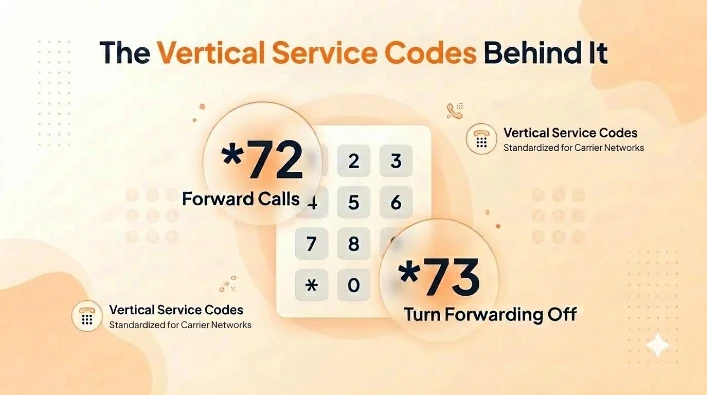
Underneath the menu screens, most carriers still support the same star codes that have worked for decades: dialing *72 followed by a destination number typically activates unconditional call forwarding, sending every incoming call straight to that number without your phone ever ringing, and *73 turns it back off. These are standardized as vertical service codes through NANPA, the organization that administers the North American Numbering Plan, which is why the same basic codes work across most U.S. carriers with only minor variations. Prepaid plans occasionally handle these codes differently than postpaid accounts, so it's worth checking a carrier's own support page if a code doesn't respond as expected.
Why Businesses Rely on Call Forwarding Deliberately

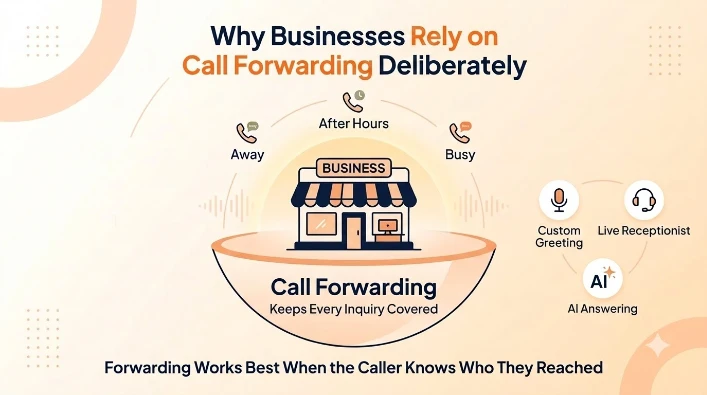
For a business, hearing this message when a customer calls is often intentional rather than accidental. Forwarding every call, or just the ones that go unanswered, to a shared voicemail or an answering system means no inquiry disappears just because the person who'd normally answer stepped away, closed for the night, or is already on another line. The generic-sounding message that individuals find unsettling is, in a business context, simply the sound of a call being caught by a system built to make sure it doesn't go completely unanswered.
The gap most businesses run into is that a carrier's default forwarding message gives a caller zero context about who or what they've reached, which reads as unprofessional even when the underlying forwarding logic is working exactly as intended. Replacing that generic recording with a custom greeting, or routing the call to a live receptionist or an AI-driven answering system instead of straight to voicemail, closes that gap without changing anything about how the forwarding itself is configured.
Conclusion
"Your call has been forwarded to an automated voice messaging system" is a carrier-generated message describing a redirected call, nothing more sinister than that in the overwhelming majority of cases. A dead battery, Do Not Disturb, a weak signal, or deliberate forwarding all produce the exact same wording, and a single instance says almost nothing reliable about whether someone is avoiding your call. Only a consistent, repeating pattern across multiple attempts starts to point toward something more deliberate, like being blocked.
For a business, though, that same message is worth engineering on purpose rather than leaving to a carrier default. Letsdial routes forwarded and missed calls through a real system with analytics and a custom greeting, instead of a generic recording that gives a caller no sense of who they actually reached. Set up a Letsdial number today and make sure every forwarded call still sounds like your business, not a carrier's fallback.
Frequently Asked Questions
撰写者 Aryan Khan · August 12, 2026
回复作者