Introduction
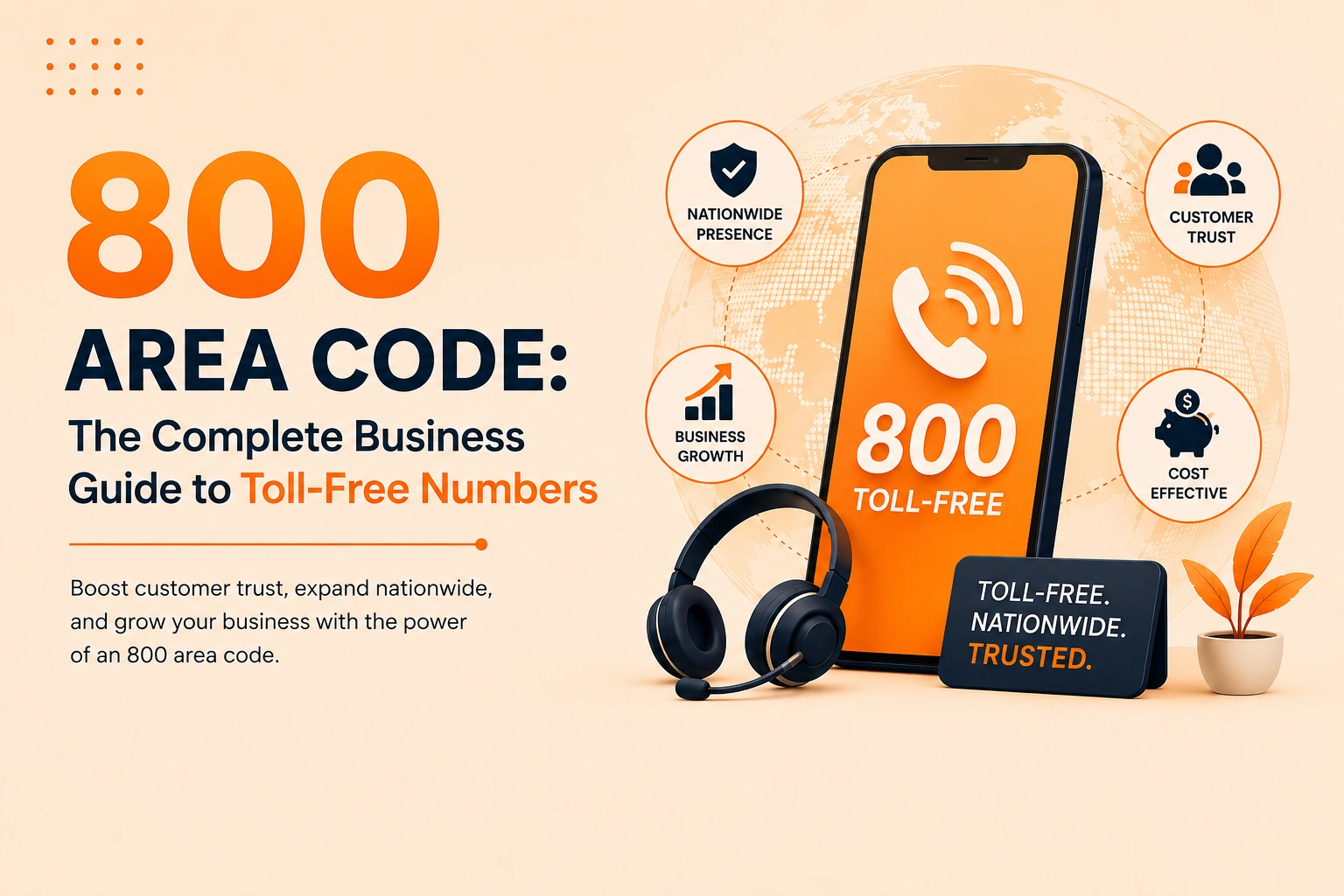
The 800 area code has no geographic home, no city, no time zone. Established on May 2, 1967 as the Incoming Wide Area Telephone Service (INWATS), the 800 prefix reversed the economics of a phone call: instead of the caller paying long-distance charges, the receiving business absorbs the cost. For over five decades this inversion transformed how companies build national presence — from 1-800-FLOWERS to the IRS taxpayer helpline. The 800 area code became, and remains, the most universally recognized symbol of business accessibility in North America.
INWATS was expensive at launch — early subscribers were almost exclusively high-volume enterprises like hotel chains, car rental companies, and airlines, since the flat-rate bulk pricing only made sense at scale. That changed in 1993, when the FCC mandated toll-free number portability: a new RespOrg system, built on the SMS/800 database, let a business keep its 800 number when switching carriers for the first time. That single regulatory change is why an 800 number today can move between providers in minutes rather than being tied to whichever carrier first issued it.
Canada adopted an equivalent RespOrg framework a year later, in 1994, extending the same portability guarantee to Canadian toll-free subscribers and keeping the two countries' systems interoperable under the shared NANP.
- Established May 2, 1967 as AT&T's INWATS service — the original toll-free system
- Non-geographic — no city, state, or time zone tied to an 800 number
- Portable since 1993, when the FCC mandated RespOrg-based number portability
What Is the 800 Area Code?
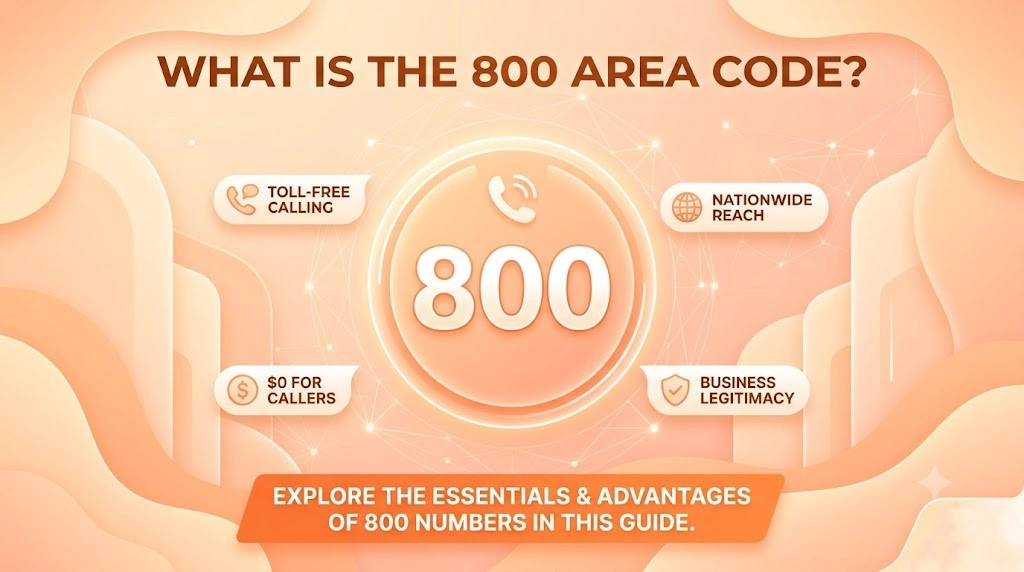
The 800 area code is the original toll-free service access code in the North American Numbering Plan (NANP), covering the United States, Canada, and over twenty Caribbean nations. Introduced by AT&T in 1967, the 800 prefix allowed customers to call businesses long-distance at no charge — the business pays per-minute for inbound calls, and the caller pays nothing. As demand surged through the 1980s and 1990s, the original 800 pool approached exhaustion, prompting the FCC to introduce additional toll-free prefixes: 888 (1996), 877 (1998), 866 (2000), 855 (2010), 844 (2013), and 833 (2017).
Unlike geographic area codes tied to cities and states, the 800 area code is non-geographic — a business in Seattle, Miami, or rural Kansas holds the same 800 number with no implication about physical location. All toll-free prefixes function identically from a technical standpoint — only perception and brand recognition differ, and 800 still carries the strongest brand recognition of the group simply because it's been in continuous use the longest.
Somos assigns new toll-free inventory strictly by prefix availability, not by industry or region, so two competitors in the same city could easily end up with an 800 number and an 833 number respectively simply based on when each applied — there is no ranking system that reserves 800 for larger companies, it is simply the oldest and therefore the most heavily allocated of the seven prefixes. The 833 guide covers the neighbouring ground.
How Toll-Free Routing Works
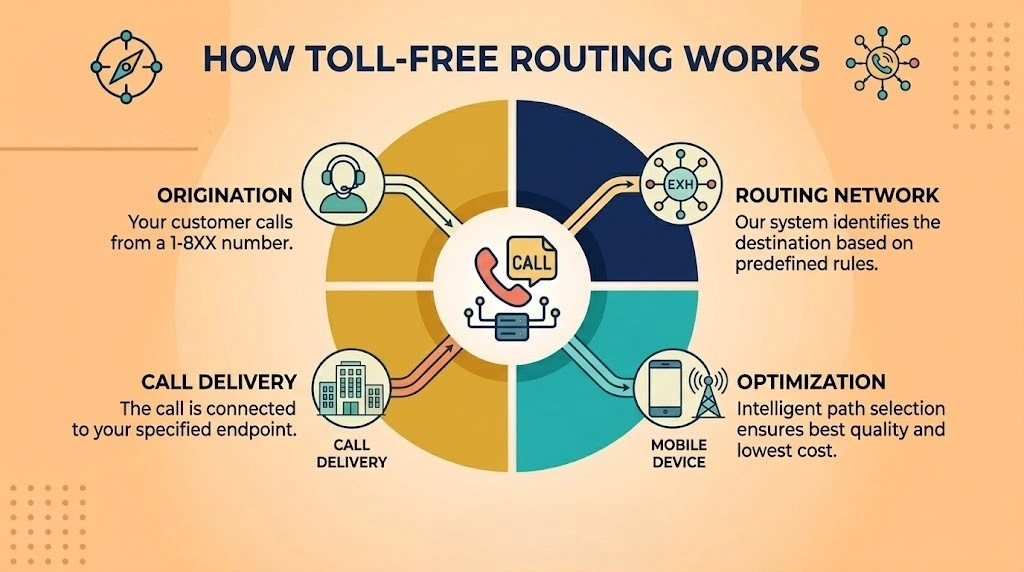
When a caller dials an 800 number, the call triggers a database lookup through the SMS/800 system managed by Somos, Inc. — the FCC-designated toll-free number administrator. The SMS/800 database maps each 800 number to a Responsible Organization (RespOrg) — the carrier or provider that administers the number on behalf of the business. The originating carrier queries the database to retrieve a routing number, then completes the connection transparently to both caller and business.
This architecture creates a key advantage: portability without interruption. Because an 800 number is registered to a RespOrg rather than a physical network address, businesses can switch carriers, move offices, or reroute calls across locations without the caller experiencing any disruption. Changing RespOrg requires only a signed Letter of Authorization from the new provider — no equipment swap, no downtime window. letsdial operates as a RespOrg-compliant provider, allowing businesses to port existing 800 numbers in or activate new ones — with routing changes taking effect in minutes, not weeks.
Before 1993, an 800 number belonged to whichever carrier first activated it — there was no independent database recording who administered a given number, so switching carriers meant giving up the number entirely and reprinting every piece of marketing material that carried it. The RespOrg system solved that by separating the number from any single carrier's network, which is why toll-free portability is now taken for granted in a way that took years of FCC rulemaking to achieve. More detail sits on our business phone system page.
Why Businesses Choose the 800 Area Code
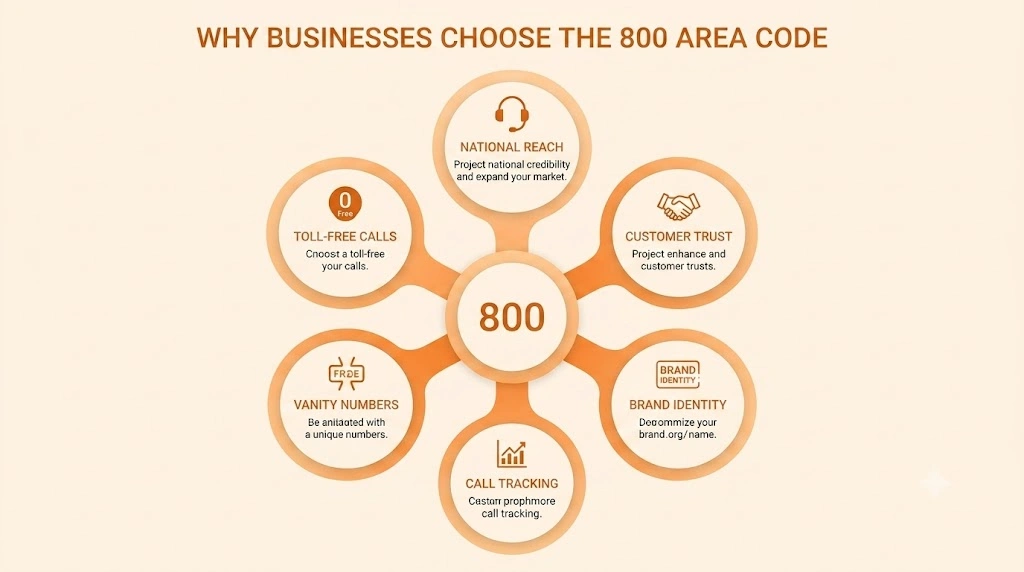
Despite the rise of chat, email, and social media, the 800 area code remains one of the most powerful business credibility signals available. Toll-free numbers — especially 800 — are associated with larger, established enterprises, giving startups an instant trust advantage. For companies investing in Google Ads, TV, or radio, an 800 number on the creative dramatically outperforms local numbers in ad recall and call-through rates.
The credibility signal cuts both ways by industry: a national e-commerce brand uses an 800 number to look established across every region it ships to, while a regional business uses it deliberately to suggest a bigger footprint than its physical office count would otherwise imply.
Call centers built around customer support, technical support, or order lines lean on 800 specifically because customers dialing in expect the call to be free — charging for support calls, even inadvertently through a local number that reads as long-distance to some callers, creates friction that a toll-free number removes entirely.
> [TIP] Note: Get an 800 toll-free number for your business today — letsdial lets you search available numbers and go live in minutes.
Vanity Numbers and the Power of 1-800
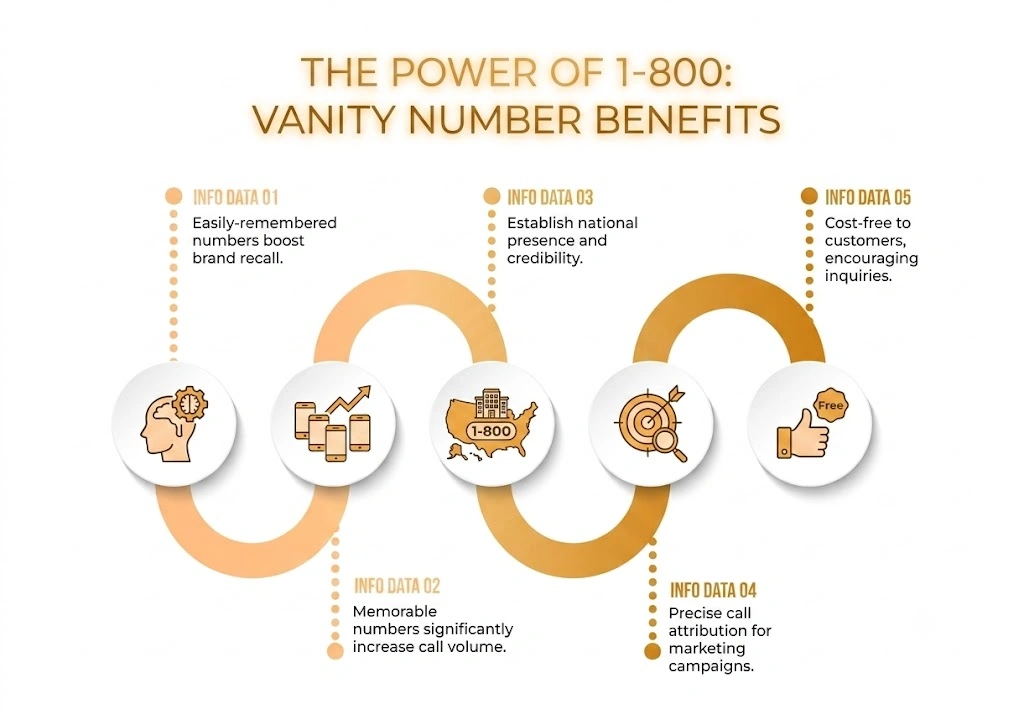
A vanity toll-free number — one that spells a word or phrase on the phone keypad — is one of the most cost-effective marketing tools a business can deploy. The human brain retains words far more efficiently than random digits, which is why 1-800-FLOWERS, 1-800-CONTACTS, and 1-800-GOT-JUNK remain in active use decades after acquisition.
A well-chosen vanity number becomes a second tagline — communicating what the company does and providing contact information in a single memorable unit — and because 800 was the first toll-free prefix, most of the best-known vanity combinations were claimed on it decades ago, which is itself part of why 800 still reads as more established than 888 or 833 to most callers.
Vanity numbers aren't limited to spelling a full word — a repeating digit pattern, a number ending in a recognizable local sequence, or a phrase that only spells out part of the number (1-800-555-TAXI, for instance) can be nearly as memorable as a full-word match while leaving more inventory to choose from.
The tradeoff is availability: because so much of the easiest-to-remember 800 inventory was claimed decades ago, businesses hunting for a strong vanity match today often find more open options on 888 or 833 than on 800 itself, even though 800 remains the more recognizable prefix in general.
Protecting Your Business from Toll-Free Scams
The same trust that makes 800 numbers valuable for legitimate businesses makes them attractive to fraudsters. Scammers who display spoofed 800 numbers exploit the universal assumption that a toll-free call comes from a legitimate enterprise. Common scams include IRS impersonation calls threatening arrest for unpaid taxes, fake bank fraud alerts, and Medicare impersonation targeting seniors. Legitimate organizations never demand immediate payment by gift card or wire transfer, never threaten arrest on an initial call, and never ask you to confirm account numbers on a call you didn't initiate.
Businesses that own a legitimate 800 number can protect their own brand by registering it with STIR/SHAKEN caller ID authentication through their RespOrg, which makes it harder for scammers to spoof that specific number convincingly.
Consumers can protect themselves further by hanging up and calling the business back using the number printed on an account statement or the company's official website rather than trusting a callback number the caller provides — spoofed 800 numbers are designed to look identical to the real one on caller ID, so the display alone is not a reliable way to verify who is actually calling.
The Future of the 800 Area Code
The 800 area code is not going anywhere — it is too embedded in North American business culture to be retired. Cloud VoIP platforms have democratized toll-free access, letting a solo entrepreneur acquire a full-featured 800 number for a fraction of what AT&T charged Fortune 500 companies in the 1980s. Integration with AI-powered call routing, CRM automation, and omnichannel messaging has transformed the 800 number from a simple call destination into a data-rich customer engagement hub.
Many toll-free numbers, including 800, now also support text messaging, letting a customer text the same number they'd otherwise call — a capability that didn't exist for most of the prefix's history and that continues to extend its usefulness well past its original voice-only design. The number pool itself is also holding up better than early-2000s exhaustion warnings suggested: Somos periodically reclaims 800 numbers that go dormant after a business closes or a number is abandoned without being ported, recycling them back into available inventory rather than forcing new demand exclusively onto 888 or 833.
That reclamation process is part of why a business searching for an 800 number today can still find reasonable options despite nearly six decades of continuous allocation. That record is published in full as public record for area code 800.
Conclusion
Nearly six decades after AT&T switched on INWATS, the 800 area code still does exactly what it was built to do: let a customer reach a business without thinking twice about the cost of the call. What's changed is who can afford one — a service once reserved for hotel chains and airlines is now available to any business through a cloud VoIP provider for a few dollars a month, with call routing, transcription, and CRM tools bundled in rather than sold as expensive add-ons.
For a company weighing 800 against a newer toll-free prefix, the decision usually comes down to how much that extra half-century of brand recognition is worth — and for most businesses fielding customer calls, it's worth quite a bit.
Frequently Asked Questions
Written by Aryan Khan · June 27, 2024
Reply to the author