Introduction
A 619 number carries instant recognition for anyone familiar with San Diego, a city built around one of the country's largest naval presences and the busiest land border crossing in the Western Hemisphere. If a 619 call just reached you, or you're weighing one for your own business, the region behind it is shaped by forces most area codes never have to account for.
This guide covers exactly where 619 reaches today, the unusual way it came to share its territory completely with a second code, which San Diego communities and industries anchor the region, and what dialing here actually requires. We'll finish with the scam tactics that try to trade on this recognizable code's credibility.
Where a 619 Number Actually Reaches
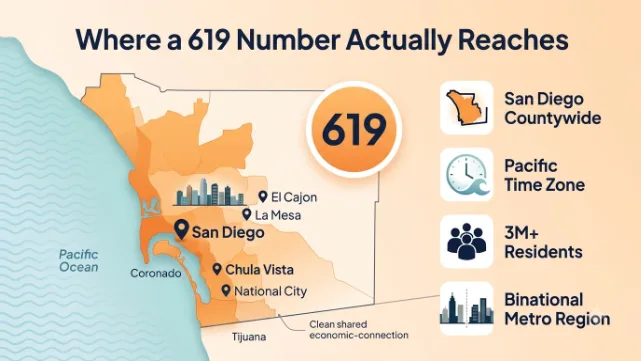
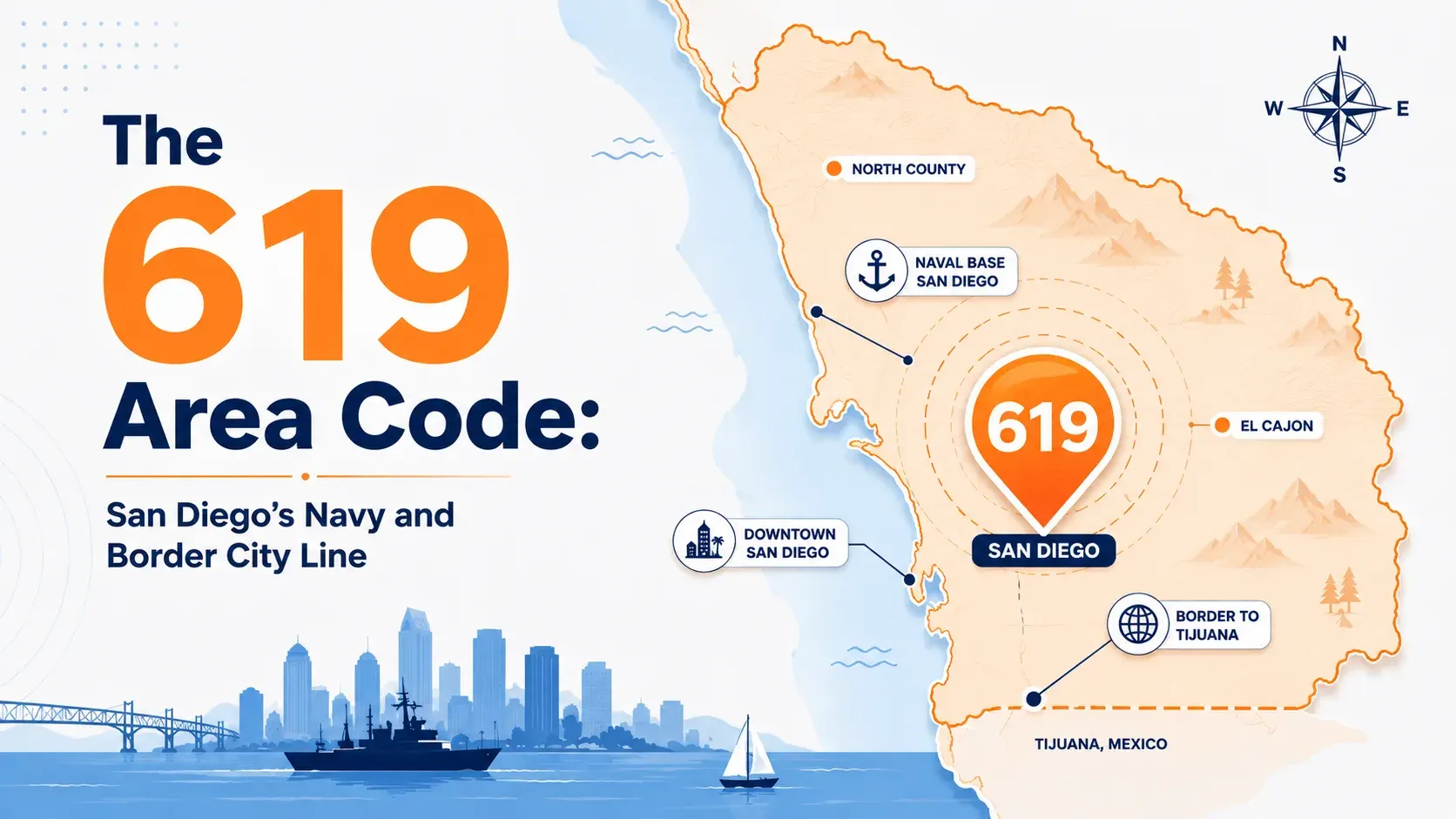
619 covers San Diego and the county that shares its name, tucked into California's southwestern corner against both the Pacific Ocean and the U.S.-Mexico border.
Today, 619 numbers can be issued anywhere across San Diego County, from the urban core downtown to Chula Vista and National City along the border, out to inland communities like El Cajon and La Mesa, and up the coast to Coronado. The entire region sits in the Pacific time zone, three hours behind the East Coast codes covered elsewhere on this site. San Diego County holds well over three million residents, making this one of the more densely populated regions in this series, and its economy is tightly woven with Tijuana just across the border, creating a genuinely binational metro area that few other U.S. cities can claim.
A Code That Learned to Share Its Entire Territory
619's history stands out from most other area codes because of how it ended up overlapping completely with a second code rather than simply splitting away from one.
619 was carved out of the original 714 area code in 1982, giving San Diego and the surrounding region its own dedicated number space for the first time. As the area's population and business-line demand grew through the 1990s, regulators split the northern portion of the county away in 1997 to form 760, and just two years later added 858 as an overlay specifically for San Diego County's northern communities, while 619 continued serving the south. For nearly two decades, callers could roughly guess a business's location just by whether its number started with 619 or 858. That changed in 2018, when regulators eliminated the geographic boundary between the two codes entirely, turning both into a full overlay of the whole county rather than a split between north and south.
San Diego's Defense, Border, and Innovation Economy
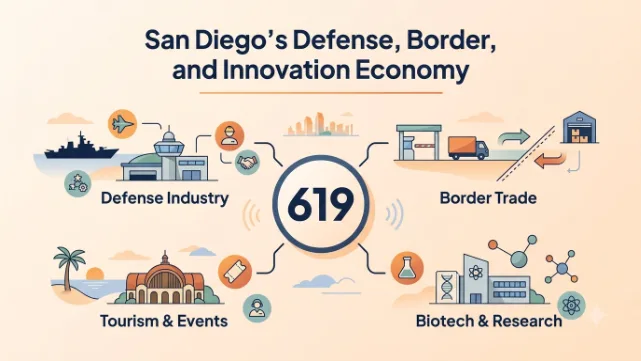
Few regions pack in as much strategic and economic weight as the territory behind a 619 number.
San Diego hosts one of the largest concentrations of Navy and Marine Corps installations on the West Coast, including Naval Base San Diego and Marine Corps Air Station Miramar, anchoring a defense economy that touches thousands of local businesses and contractors. Just south of downtown, the San Ysidro Port of Entry ranks as the busiest land border crossing in the Western Hemisphere, driving a cross-border trade and logistics economy that few other American metros can match.
The region has also built a strong reputation in biotech and life sciences research, clustered around its universities and research institutes, alongside a tourism trade built on Balboa Park, the San Diego Zoo, and a beach culture that draws visitors year-round. The city's annual Comic-Con convention adds another layer entirely, pulling in hundreds of thousands of visitors and a temporary surge in hospitality and event-services business every summer. For a business, that mix means a single 619 number can plausibly reach a defense contractor, a cross-border logistics firm, and a biotech researcher all within the same metro.
Dialing Across a Fully Overlapping Code
Because 619 and 858 now cover identical territory, dialing in San Diego County works the same way it does in any other overlay region.
Every local call, whether from a mobile phone, landline, or VoIP line, requires the full 10-digit number, area code included, a rule that's applied here since the 2018 boundary elimination. That means two neighbors on the same street could carry different area codes entirely and still have to dial each other's full 10-digit number. Businesses that once relied on the old 619-versus-858 geographic split to guess a caller's neighborhood can no longer make that assumption, since either code could now belong to any part of the county.
Why a 619 Number Still Signals San Diego
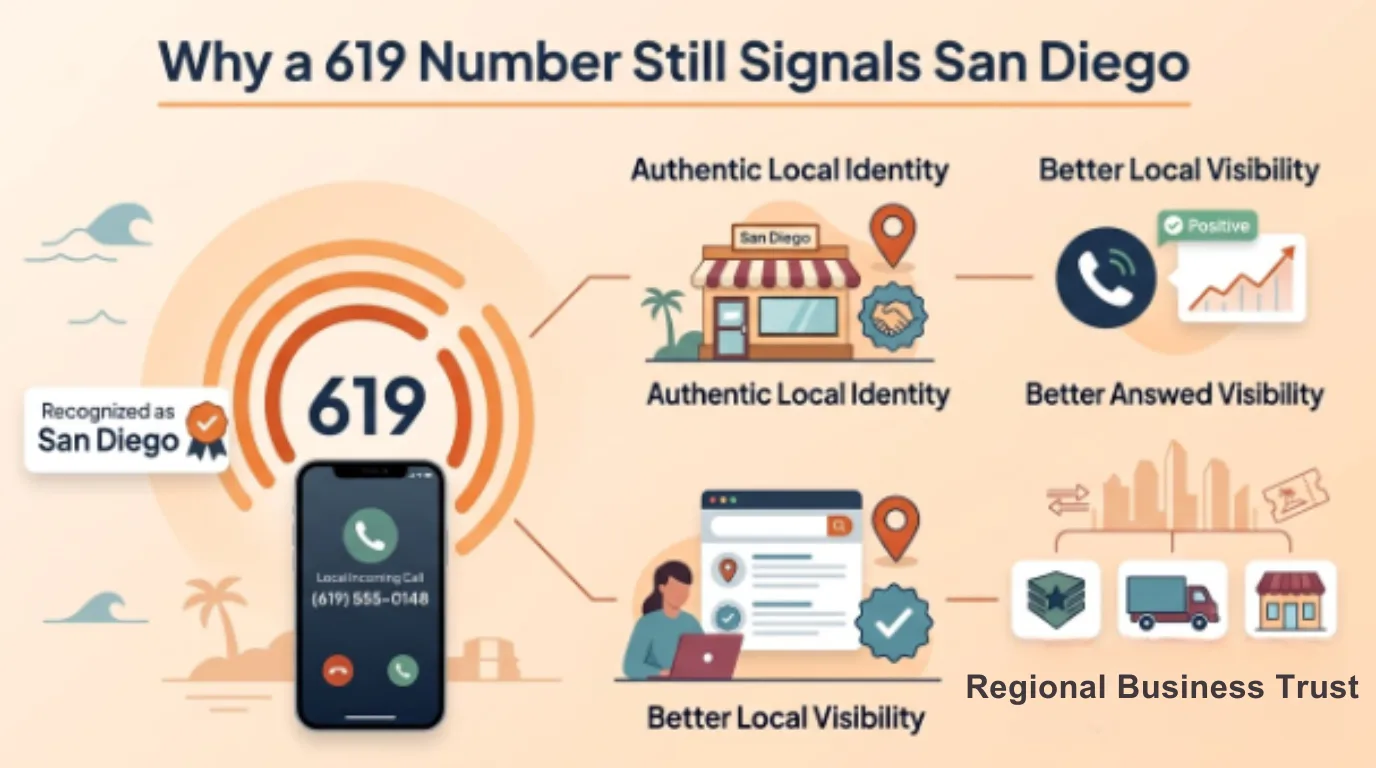
Even though the geographic boundary is gone, a 619 number still carries a specific kind of local recognition that businesses actively want.
Companies working with the region's defense contractors, cross-border logistics firms serving the San Ysidro corridor, and tourism businesses courting Balboa Park or beach-town visitors all benefit from a number that reads as authentically San Diego. Local numbers consistently earn higher answer rates than toll-free or out-of-area lines, a trust gap that matters even more in a border region where residents are used to fielding calls from both sides of the international line. A 619 number also strengthens local search visibility, the same kind of regional-trust advantage a business builds by pairing its brand with a matching local prefix, similar to how a company might lean on a Music City identity tied to a 615 number to reach Nashville-area customers specifically.
Setting Up a 619 Number for Your Business
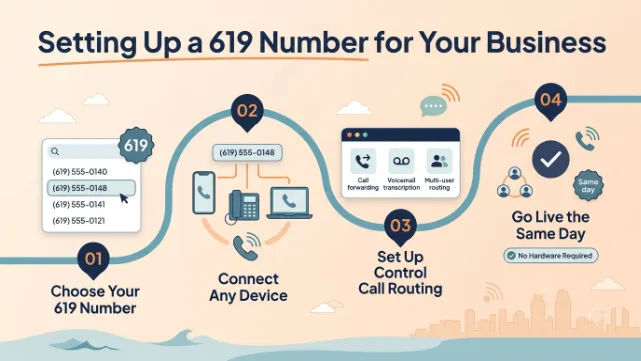
Claiming a 619 number today doesn't require a San Diego address or a long-term carrier contract.
Cloud-based virtual phone providers, letsdial included, let you select an available 619 number and connect it to any device — a cell phone, desk phone, or softphone app — usually going live the same day. Most plans bundle call forwarding, voicemail transcription, and multi-user routing, so a small remote team can run a 619 line the same way a fully staffed downtown San Diego office would. There's no equipment to buy or technician visit required, and the same self-service setup applies whether you're claiming a single line here or building a broader coastal presence the way we cover in our guide to the 954 area code in South Florida.
Scam Calls That Exploit the 619 Name
A widely recognized area code tied to a major border city is exactly the kind of number scammers want to spoof.
"Neighbor spoofing" is a persistent problem in San Diego County, with fraudsters faking a local 619 or 858 number so it looks like it's coming from a nearby business or government office. Reported scripts in this region include fake ICE or Customs and Border Protection threats aimed at border-community residents, Navy or military-benefits impersonation calls targeting service members and veterans, and utility shutoff threats impersonating San Diego Gas & Electric. Because the region has such a large military and border-adjacent population, scammers here often tailor their scripts specifically to those communities' unique fears. If an unexpected 619 or 858 call pressures you for personal information or payment, hang up and contact the organization directly through a number from its official website.
The FCC's guide to caller ID spoofing has more on reporting the call.
The Bottom Line on 619
619 has gone from a clean 1982 split off of 714 to a code that now fully overlaps with 858 across the entirety of San Diego County, a rare "boundary elimination" that few other regions in the country have gone through. What remains is a footprint built around one of the nation's most significant military and border economies, layered with biotech research and a tourism industry that draws visitors worldwide.
For businesses, a 619 number is a fast, low-cost way to build genuine San Diego credibility without ever opening a local office. Dial all 10 digits, stay alert for spoofed calls trading on the region's trust, and pick a provider that can get your number active without delay.
Frequently Asked Questions
Written by Aryan Khan · August 23, 2024
Reply to the author