

Signs You’re Ready for a Dedicated Business Number
If you’re wondering whether it’s the right time to make the switch, here are some clear signs that your business has outgrown your personal phone line: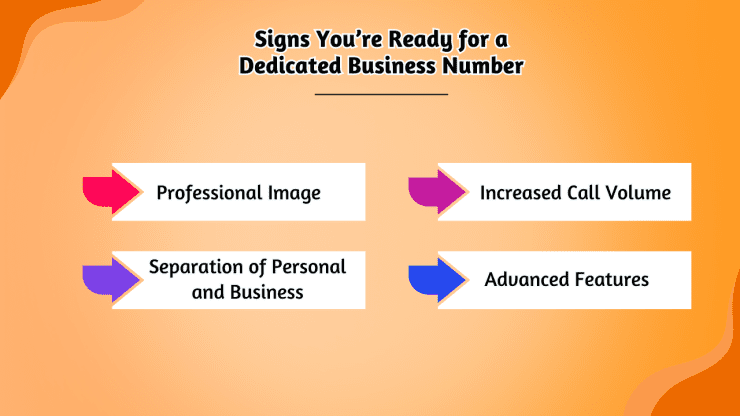
- You hesitate before answering a call, unsure if it’s a client or a personal contact.
- Your personal voicemail greeting is the first thing a potential high-value client hears.
- You’ve missed important business calls because you were on a personal call.
- You find yourself giving out your personal cell phone number to clients, vendors, and on marketing materials.
- You have no way to route a call to another team member when you’re busy.
- You wish you knew who was calling before you answered.
- You can’t “turn off” work, because business calls come in at all hours on your personal line.
If any of these sound familiar, it’s time to upgrade to a professional system.
Business Phone Service vs. Personal Cell Phone: A Clear Comparison
Using your personal number is convenient at first, but it puts your business at a significant disadvantage. Here’s a direct comparison:
| Feature | Personal Cell Phone | Professional Business Service (like LetsDial) |
| Professionalism | Mixed personal/business identity | Dedicated number, custom greetings, auto-attendant |
| Privacy | Your personal number is public | Keeps your personal number private and secure |
| Team Functionality | One person, one line | Add users, route calls to departments, collaborate |
| Advanced Features | Basic call/text/voicemail | Call recording, analytics, CRM integration, video conferencing |
| Scalability | Doesn’t grow with your business | Easily add or remove lines and features as you scale |
| Work-Life Balance | Business calls at any time | Set business hours to automatically route calls after work |
How to Get a Business Phone Number in 4 Key Steps
Getting a business phone number is a straightforward process when you know what to focus on.
Step 1. Assess Your Industry and Budget
Before looking at providers, look at your own business. Understanding your specific needs will prevent you from overpaying for features you don’t use or choosing a system you’ll quickly outgrow.
- Analyze Your Communication Needs: Are you a local service business that needs a trusted local area code? Are you a national e-commerce brand that would benefit from a toll-free 800-number? Do you need advanced features like call recording for quality assurance or CRM integrations to sync with your sales pipeline?
- Evaluate Your Budget: A solo entrepreneur has different budget constraints than a 20-person team. Modern VoIP services are incredibly cost-effective, with plans often starting around $15-$25 per user per month. Determine a realistic budget to narrow down your options.
Step 2. Choose the Right Business Phone Provider
This is the most crucial decision. A provider is more than just a number; they are your partner in communication.
- Reliability is Non-Negotiable: Look for providers with a proven track record of high uptime (99.999% is the industry standard). A missed call can be a missed opportunity.
- Essential Features vs. Bells and Whistles: Focus on core features like auto-attendants, call forwarding, business SMS, and high-quality mobile/desktop apps.
- Scalability for the Future: Choose a system that can grow with you. How easy is it to add new users, lines, or locations? A platform like LetsDial is built for scalability, allowing you to add users seamlessly as you expand.
Step 3. Select Your Business Phone Number(s)
After choosing a provider, you’ll select your number. Each type serves a different strategic purpose. We’ll explore these in more detail in the next section.
Step 4. Configure Your System and Features
This is where you bring your professional image to life. Your provider should make this easy.
- Set Up Your Auto-Attendant: Create a virtual receptionist to greet callers (“Thank you for calling [Your Company]. Press 1 for Sales…”) to direct traffic efficiently.
- Record Professional Greetings: A clear, welcoming voicemail greeting reinforces your brand’s professionalism.
Implement Call Forwarding & Ring Groups: Ensure no call goes unanswered by forwarding calls to your mobile phone or setting up ring groups where multiple team members are alerted for an incoming call.
Choosing the Right Type of Business Number: A Strategic Decision
The number you choose is part of your brand identity. Here’s a closer look at your options.
Local Phone Numbers
A number with a local area code is perfect for businesses that serve a specific geographic area. It builds immediate trust and a sense of community. When customers see a local number, they know they’re dealing with a local business, which can significantly increase answer rates.
Toll-Free Phone Numbers (800, 888, 877)
Toll-free numbers are a hallmark of established, nationwide businesses. They are free for customers to call from anywhere in the country, removing any barrier to them contacting you. This is essential for e-commerce companies, national consulting firms, and businesses with a customer service focus.
Vanity Numbers
These are custom numbers that spell out a word or phrase, like 1-800-LAW-FIRM. They are incredibly memorable and serve as powerful marketing tools. If your number is easy to recall from a billboard or radio ad, you have a significant competitive advantage.
10 Must-Have Business Phone System Features for 2025
A modern business phone system is far more than a dial tone. It’s a productivity suite. Here are the essential features to look for:
- Auto-Attendant (Virtual Receptionist): Automatically greets and routes callers to the right person or department, ensuring a professional first impression 24/7.
- Voicemail-to-Email / Transcription: Saves time by sending audio voicemails and/or text transcriptions directly to your email inbox, so you can read messages on the go.
- CRM Integration: A game-changer. This automatically syncs call logs, texts, and recordings with your Customer Relationship Management (CRM) software like Salesforce or HubSpot.
- Call Recording: Essential for training, quality assurance, and dispute resolution.
- Business Text Messaging (SMS/MMS): Communicate with customers on their preferred channel for appointment reminders, confirmations, and quick updates.
- Desktop and Mobile Apps (Softphones): Allows your team to make and receive business calls from their computer or smartphone, from anywhere in the world.
- Advanced Call Routing: Set up sophisticated rules based on time of day, caller ID, or team member availability to ensure calls are always handled efficiently.
- Ring Groups: Ring multiple team members’ phones simultaneously (e.g., the sales team) to ensure important calls are answered quickly.
- Analytics and Reporting: Gain insights into call volume, peak hours, wait times, and call duration to make data-driven decisions about staffing and performance.
- AI-Powered Intelligence: The future of communication. Features like those in LetsDial provide real-time call transcriptions and AI-generated summaries, turning every conversation into actionable intelligence.
The Best Business Phone Number Providers of 2025
While many options exist, only a few deliver the reliability, features, and support necessary for a growing business. Here’s how the top providers stack up.
1. LetsDial: Best Overall for Growing Businesses
LetsDial stands out as the premier choice for modern, growth-focused businesses. It moves beyond being just a phone system and becomes an intelligent communications platform. Its powerful AI features and deep integrations are designed to enhance productivity and uncover valuable customer insights from every call.
- Pros:
- AI-Powered Call Intelligence: Get automatic call transcriptions, summaries, and sentiment analysis to understand customer needs without re-listening to hours of calls.
- Deep CRM Integration: Seamlessly syncs with platforms like Salesforce and HubSpot, automatically logging calls and texts to provide a complete view of the customer journey.
- Built for Teams: Features like shared inboxes, call whispering, and team messaging foster seamless collaboration, whether your team is in-office or remote.
- Exceptional Reliability: Built on a resilient infrastructure to ensure your communication lines are always open.
- Cons:
- More powerful feature set may be more than what a solo user with basic needs requires.
- Pricing: Contact for custom pricing tailored to your business needs.
2. Nextiva: Best All-in-One Platform
Nextiva is a well-respected leader in the VoIP space, known for its “Amazing Service” and high reliability. It offers a comprehensive suite of tools, including voice, video, and chat, making it a strong contender for businesses looking for a single unified platform.
- Pros: Excellent uptime, 24/7 customer support, and a wide array of features.
- Cons: The most valuable features are often locked behind higher-priced tiers.
- Pricing: Starts around $15 per user/month.
3. RingCentral: Best for Large & Enterprise Teams
RingCentral is an enterprise-grade solution that excels in complex, large-scale deployments. Its main strength lies in its vast marketplace of integrations, allowing it to connect with almost any business software you can imagine.
- Pros: Unmatched integration capabilities, global presence, and robust analytics.
- Cons: Can be more complex and costly for smaller businesses.
- Pricing: Starts at $20 per user/month.
4. Google Voice: Best Free Option for Solopreneurs
For freelancers or solo business owners on a strict budget, Google Voice is a viable starting point. It provides a free, separate number that works through your existing Google account for basic calling and texting.
- Pros: Free, easy to set up, and offers voicemail transcription.
- Cons: Lacks professional features like an auto-attendant, call recording, and offers no real team functionality.
- Pricing: Free for personal use; business plans start at $10 per user/month.
5. Grasshopper: Best for Mobile Professionals
Grasshopper is designed for the entrepreneur who runs their business from their smartphone. It adds a professional layer on top of your existing personal phone, allowing you to manage business calls, texts, and voicemails separately.
- Pros: Affordable, simple to use, great for creating a professional image on a budget.
- Cons:* It’s a virtual service, not a full-fledged phone system; lacks deep collaboration tools.
- Pricing: Starts at $14 per user/month.
Conclusion
Choosing the right phone number service is a foundational business decision. You need a partner that not only provides a dial tone but empowers you with tools to drive efficiency, improve customer relationships, and scale effortlessly.
With LetsDial, you can set up a professional, intelligent phone system in minutes—no complex hardware or technical expertise required. Move beyond just making calls and start leveraging every conversation as a data point for growth.


