Introduction
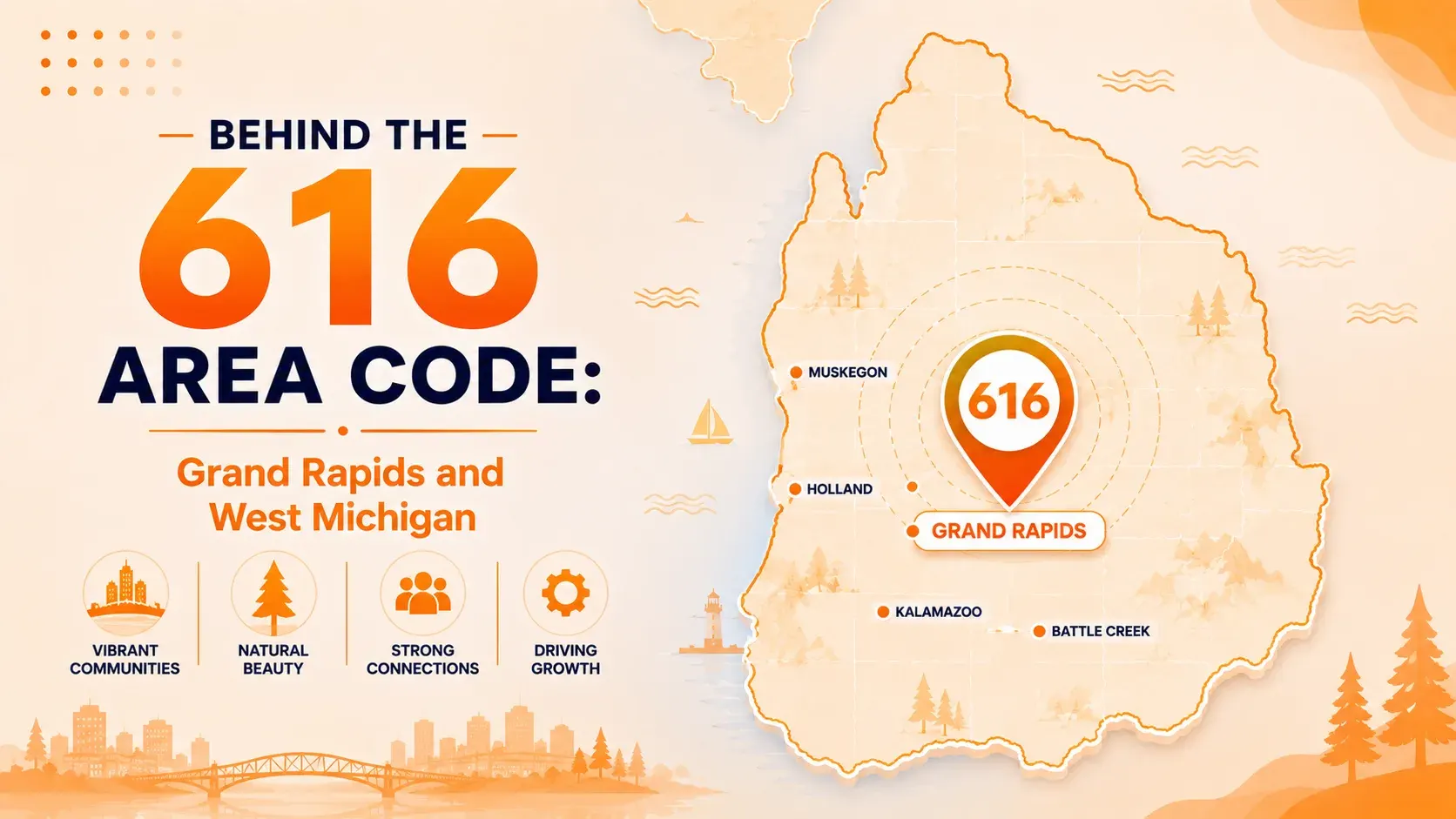
A 616 number ties back to one of Michigan's oldest and most historically significant area codes, one that used to blanket nearly the entire western half of the state before shrinking down to the Grand Rapids region it's known for today. If a 616 call just reached you, or you're weighing one for your business, it's worth understanding just how much territory this code has given up over the decades.
Here's what to know: the footprint 616 actually covers now, the three separate splits that carved it down from its original size, which West Michigan cities and industries anchor the region today, and what dialing here requires. We'll close with the scam tactics that try to borrow this long-standing code's credibility.
The Footprint of a 616 Number
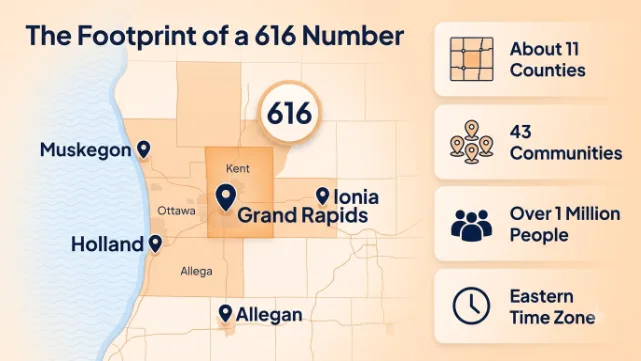
616 today covers Grand Rapids and a cluster of counties across southwestern Michigan, a fraction of the territory it once held.
The current footprint spans about 11 counties, including Kent, Ottawa, Muskegon, Allegan, and Ionia, and reaches roughly 43 cities and townships. Kent County, home to Grand Rapids itself, anchors the region with over 650,000 residents, and the broader area code territory holds just over a million people altogether. That's still a sizable region even after three rounds of splits, stretching from the Lake Michigan shoreline near Muskegon and Holland inland toward Ionia. The entire footprint sits in the Eastern time zone, matching the rest of Lower Michigan.
Michigan's Original Code and the Three Splits That Shrank It
616 isn't just an old area code, it was Michigan's very first one, and its story is really a story of the whole state's growth outpacing its number supply.
Assigned in 1947 under the original North American Numbering Plan, 616 initially covered the entire western half of Michigan's Lower Peninsula plus the whole of the Upper Peninsula, an enormous territory for a single code. The first cut came in 1961, when the Upper Peninsula split away entirely to form 906, separated from the rest of the state by the Straits of Mackinac.
Nearly four decades later, in 1999, the northwestern portion of the Lower Peninsula, including the Traverse City area, broke off to become 231. A final split followed in 2002, when the southern third of the remaining territory split away as 269, leaving 616 with the compact Grand Rapids-centered footprint it holds today. Three splits over four decades is a slower pace of change than some codes in this series have gone through, but the cumulative effect is the same: a region that once needed only one code for half a state now shares that history across four separate ones.
Grand Rapids and the West Michigan Economy
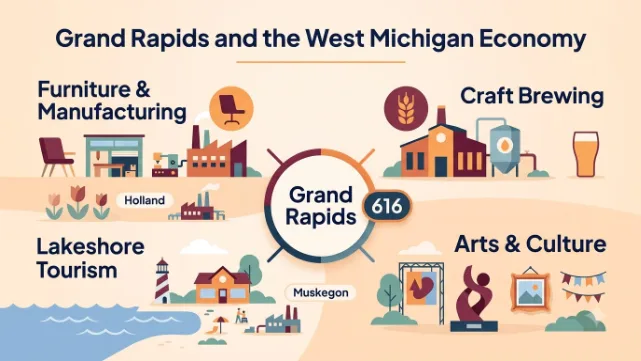
What's left of the original 616 territory has become one of Michigan's most economically diverse regions, built on a mix of manufacturing legacy and newer industries.
Grand Rapids earned the nickname "Furniture City" over a century ago and still carries a strong manufacturing base today, alongside a booming craft brewing scene that's earned the city recognition as one of the best beer destinations in the country. The city also hosts ArtPrize, a large public art competition each fall that draws visitors from across the state and helps anchor a growing downtown arts and culture scene.
The Amway Corporation and the DeVos family's business empire are headquartered just outside the city in Ada, while Meijer, the regional big-box retail chain, runs its headquarters from the Grand Rapids area as well. Holland, to the west, blends a strong furniture and manufacturing heritage with a distinct Dutch-American cultural identity celebrated every spring at its Tulip Time festival, while Muskegon anchors the Lake Michigan shoreline with a mix of tourism and industrial activity. For a business, that variety means a single 616 number can plausibly reach a furniture manufacturer, a craft brewery, and a Lake Michigan tourism operator all within the same compact region.
Dialing Within the Modern 616 Footprint
Even after three splits, 616 has never needed an overlay, which keeps its dialing rules relatively simple compared with some of the busier metro codes covered elsewhere.
Local calls follow the standard 616-XXX-XXXX format, and 10-digit dialing has been required nationwide since 2021, so Grand Rapids residents now dial the full area code even for calls across town. Long-distance calls into the region use the familiar 1-616-XXX-XXXX pattern, and international callers reach West Michigan through +1 616 XXX-XXXX. Because 616 has no overlay, businesses here haven't had to deal with the same kind of forced dialing-format shift that hit overlay regions like Nashville's 615 area code when a second code was layered on top of the original one.
What a 616 Number Signals to Local Customers
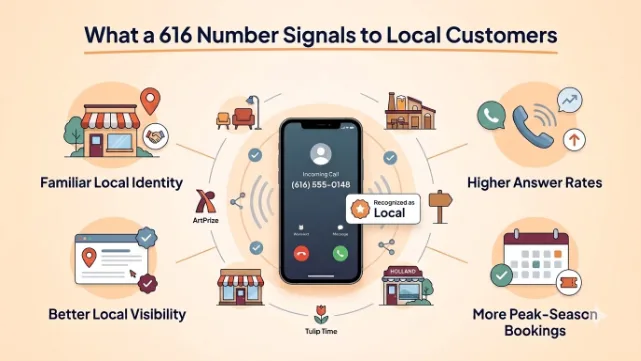
A recognizable, decades-old area code carries real weight with West Michigan customers who are used to screening calls from unfamiliar places.
Furniture and manufacturing suppliers working with Grand Rapids-based companies, breweries and hospitality businesses courting the region's growing beer-tourism crowd, and retailers serving Holland or Muskegon shoppers all benefit from a number that reads as genuinely local. Local numbers consistently see higher answer rates than toll-free or out-of-area lines, since West Michigan residents, much like customers anywhere with strong regional identity, tend to trust calls that look like they're coming from within the community. That trust factor matters even more for seasonal businesses tied to ArtPrize, Tulip Time, or the region's brewery trail, where a recognizable local number can be the difference between an answered call and a missed booking during peak season. A 616 number also strengthens local search visibility, similar to the way a business builds credibility with a matching regional prefix like the one covered in our guide to the 574 area code in Northern Indiana.
Setting Up a 616 Number for Your Business
Getting a 616 number today doesn't require a Grand Rapids address or a long-term carrier contract.
Cloud-based virtual phone providers, letsdial included, let you select an available 616 number and connect it to any device — a cell phone, desk phone, or softphone app — usually going live the same day. Most plans bundle call forwarding, voicemail transcription, and multi-user routing, so a small remote team can run a 616 line the same way a fully staffed Grand Rapids office would. There's no equipment to buy or technician visit required; the number activates through an online dashboard, and you can add more lines later as your presence across West Michigan grows.
Scam Calls Riding on the 616 Name
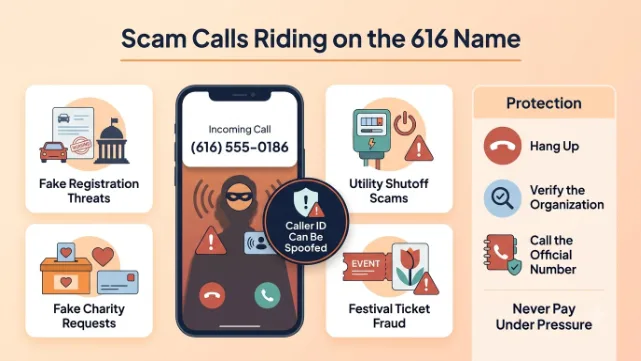
A long-established, trusted area code like 616 is exactly the kind of number scammers look to spoof.
"Neighbor spoofing" shows up across West Michigan the same way it does elsewhere, with fraudsters faking a local 616 number so it looks like it's coming from a nearby business or government office. Reported scripts in this region include fake Michigan Secretary of State or vehicle-registration threats, utility shutoff calls impersonating Consumers Energy, and fake charity solicitations timed around the region's many seasonal festivals and events. Some residents have also reported fake ArtPrize or Tulip Time ticket scams, taking advantage of the annual rush of visitors buying event passes online. If an unexpected 616 call pressures you for personal information or immediate payment, hang up and contact the organization directly through a number from its official website rather than trusting caller ID.
The FCC's guide to caller ID spoofing has more on how these scams work and how to report them.
Wrapping Up the 616 Area Code
616 has been reshaped more than most, going from covering nearly half of Michigan under the original 1947 numbering plan down to the Grand Rapids-centered footprint it holds today, after losing territory to 906 in 1961, 231 in 1999, and 269 in 2002. What remains is a compact but economically diverse region built on furniture manufacturing, craft brewing, and a handful of major corporate headquarters.
For businesses, a 616 number is a straightforward way to build local credibility across West Michigan without ever opening an office there. Keep an eye out for spoofed scam calls trading on the region's trust, and choose a provider that can get your number active without delay.
Frequently Asked Questions
Written by Aryan Khan · December 28, 2024
Reply to the author