Introduction
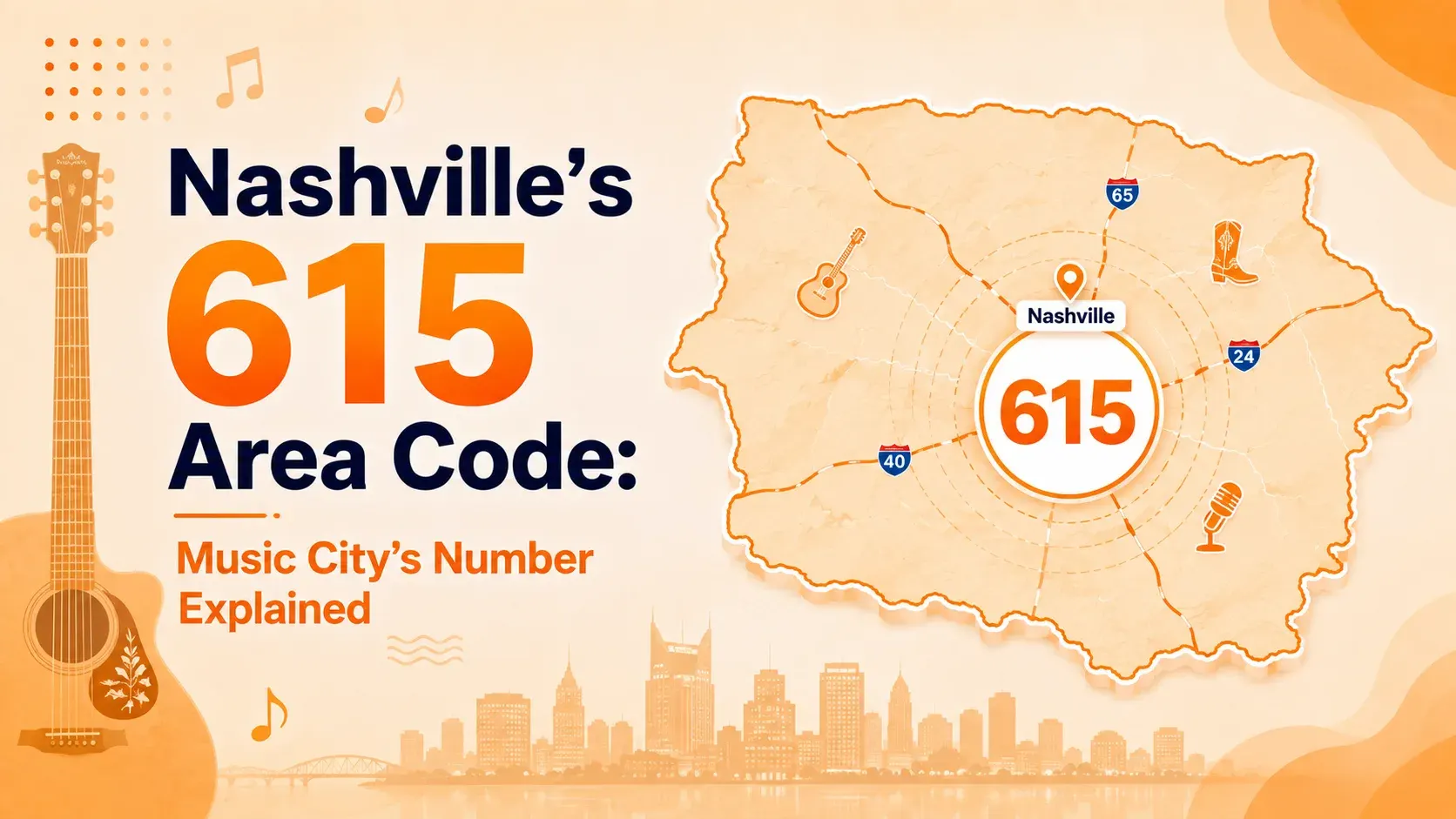
A 615 number carries instant recognition for a lot of people, tied to a city that's become synonymous with country music, healthcare corporate headquarters, and one of the fastest-growing populations in the South. If a 615 call just reached you, or you're weighing one for your own business, the code has a more layered backstory than most.
This guide covers exactly what territory 615 holds today, the back-and-forth history of splits and an overlay that shaped its current borders, which Middle Tennessee cities and industries define the region, and what dialing here actually requires. We'll wrap up with the scam tactics that try to trade on this well-known code's reputation.
The Territory Behind a 615 Number
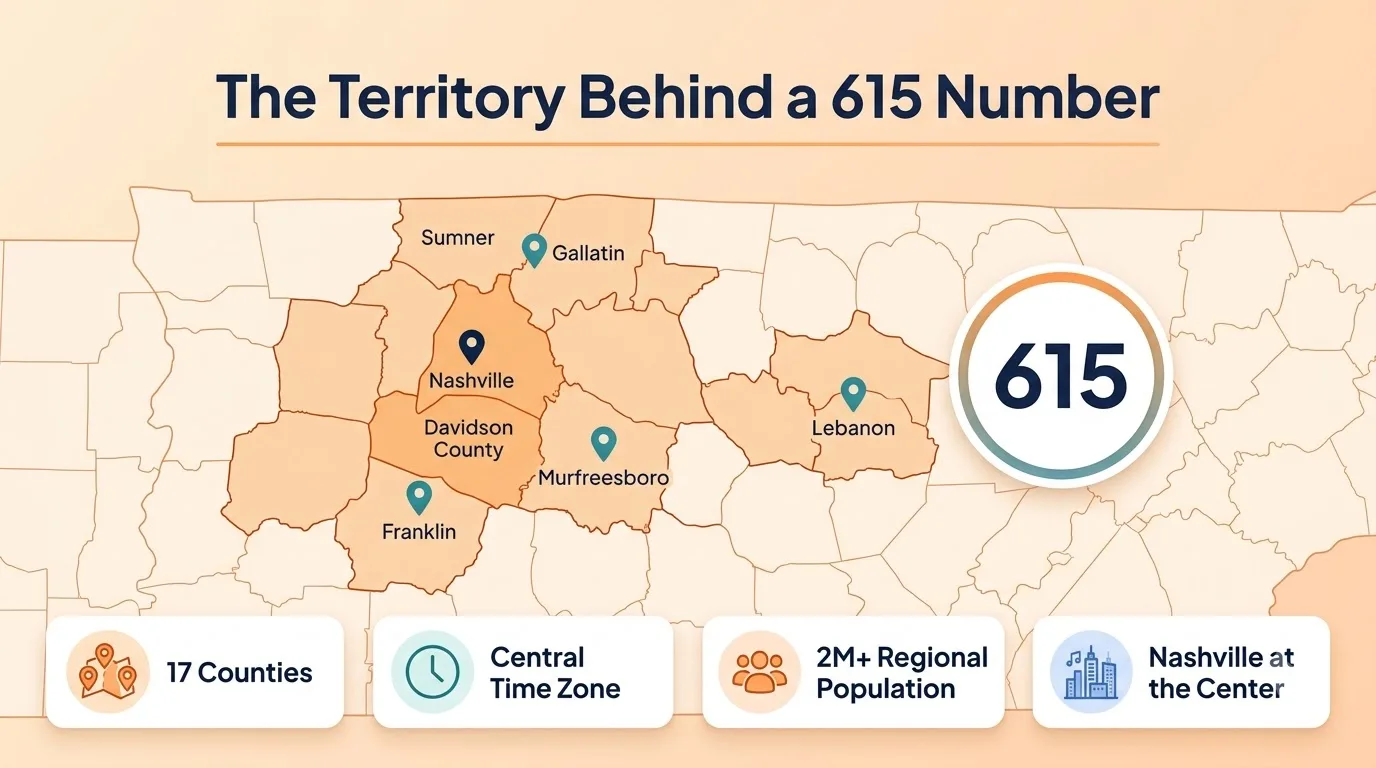
615 covers Nashville and the ring of counties that make up Middle Tennessee, a region that's absorbed some of the fastest population growth in the country over the past two decades.
The footprint spans roughly 17 counties, centered on Davidson County, home to Nashville itself, and extending through Williamson, Rutherford, Wilson, and Sumner counties. All of it sits in the Central time zone, one hour behind the East Coast codes and in line with the rest of Middle and West Tennessee. Davidson County alone holds close to 700,000 residents, but the broader 615 footprint, stretched across its surrounding suburban counties, pushes well past two million.
A Code That's Been Reshaped Twice
Few area codes in this series have gone through as much change as 615 has, losing ground twice before regulators finally chose a different strategy to keep up with growth.
615 dates back to Tennessee's original 1947 area code assignments, initially covering a much larger stretch of the state than it does now. As population and phone demand grew, the state carved off pieces of that original territory not once but twice: eastern Tennessee split away to form 423 in 1995, and a swath of central and southern counties split off to become 931 in 1997. Both changes happened within a two-year window, a sign of just how fast Tennessee's phone number demand was accelerating through the 1990s.
Why Nashville Got an Overlay Instead of a Third Split
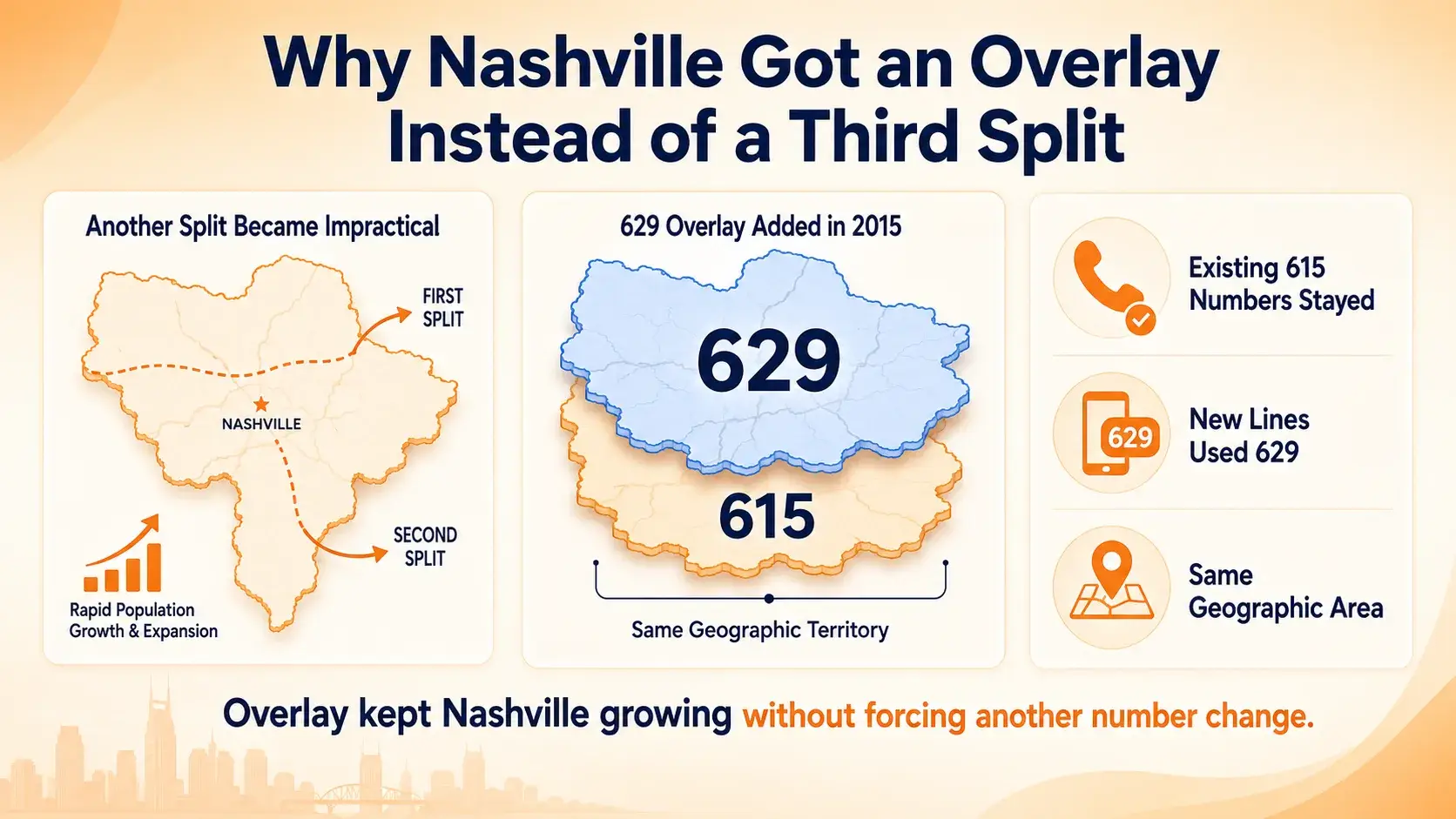
By the mid-2010s, Middle Tennessee was growing so quickly that a third split started to look impractical, so regulators changed their approach entirely.
Rather than carve off another chunk of territory and force businesses to change numbers again, the state layered a new code, 629, directly on top of the existing 615 footprint starting in 2015. That overlay approach let every existing 615 number stay exactly as it was, while giving new lines an entirely separate pool to draw from across the same geographic area. It's the same overlay strategy used in places like Pennsylvania's 582 area code, just applied to a region that had already been split twice before finally settling on it.
Middle Tennessee's Cities and Industries Under 615
What makes the 615 footprint distinct is how much economic variety it packs into one metro area, well beyond its most famous export.
Nashville itself anchors the region as the global center of the country music industry, home to the Grand Ole Opry, Music Row's recording studios, and a tourism economy built almost entirely around live music. Beyond music, the city has become one of the country's largest hubs for hospital and healthcare-company headquarters, with major operators managing facilities nationwide from Nashville offices, a sector that now employs more people locally than the entertainment industry it's often best known for. Franklin and Brentwood, just south of the city, host a cluster of corporate headquarters and upscale suburban development, while Murfreesboro has grown into one of the state's largest cities in its own right, anchored by Middle Tennessee State University. Hendersonville, Gallatin, and Mount Juliet round out the fast-growing suburban ring, each absorbing a steady stream of new residents drawn by the broader Nashville job market.
How Dialing Works Across the 615/629 Overlay
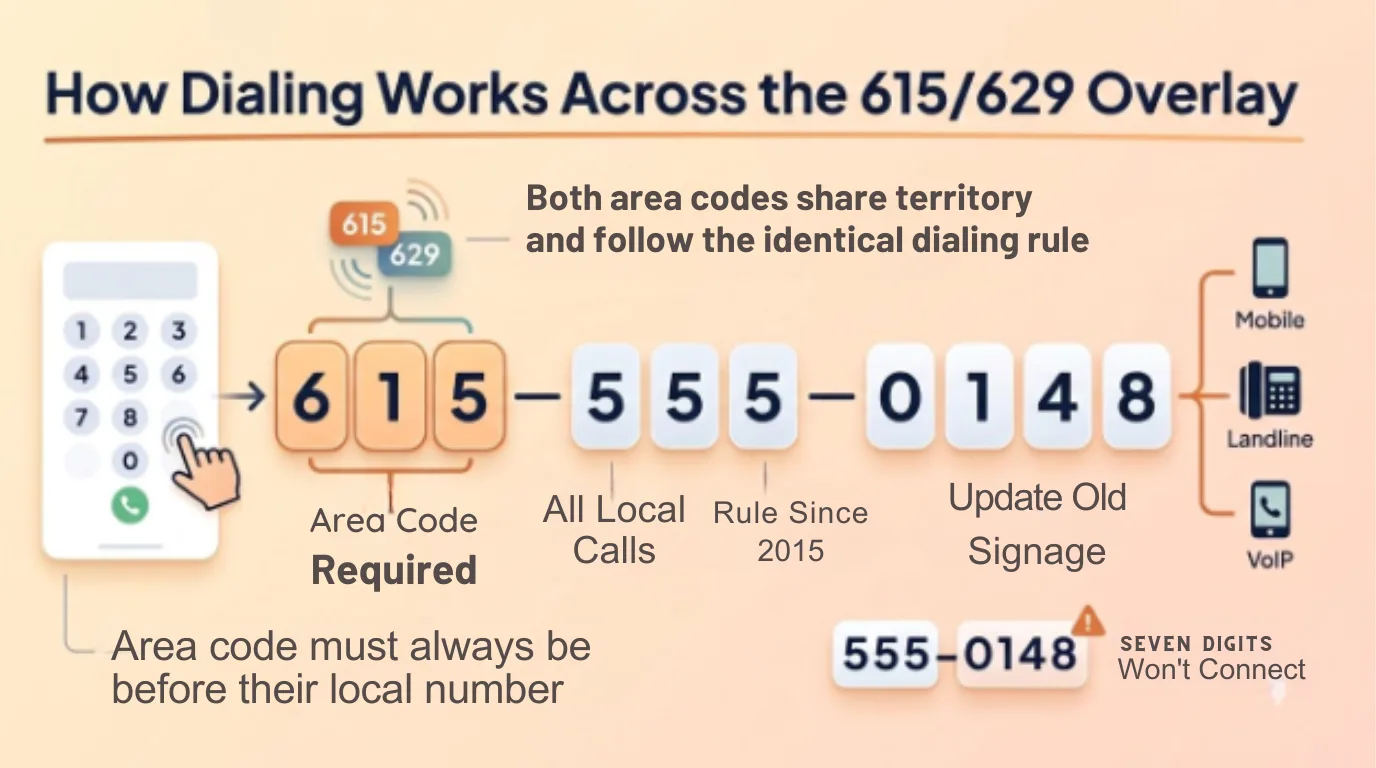
Because 615 shares its territory with 629, the region follows the same rule every overlay area does.
Every local call, whether from a mobile phone, landline, or VoIP line, requires the full 10-digit number, area code included, a rule that's been mandatory since the overlay cutover in early 2015. That applies to calls between neighbors in the same subdivision just as much as it does to calls across the metro. Businesses that still print a bare seven-digit number on older signage or menus should update it, since a caller dialing that shortcut will hit an error instead of reaching the business.
Why a 615 Number Still Carries Weight for Business
In a metro growing as fast as Nashville, a local area code helps a company stand out from the wave of new arrivals and out-of-state competitors moving in.
Tourism and hospitality businesses courting Music Row visitors, healthcare vendors serving the region's hospital-management headquarters, and service companies targeting Franklin or Murfreesboro's growing suburbs all benefit from a number that reads as genuinely local. Local numbers consistently earn higher answer rates than toll-free or out-of-area lines, a trust gap that tends to widen in a city absorbing thousands of transplants each year who are still learning which numbers to trust. A 615 number also strengthens local search visibility, the same kind of local-signal advantage a business gets from pairing its brand with a matching regional prefix, similar to what a company builds by claiming a Columbus, Ohio number to reach a specific metro audience.
Getting a 615 Number for Your Business
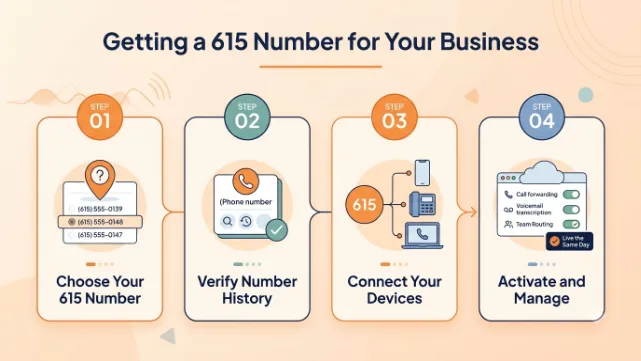
Claiming a 615 number today doesn't require a Nashville address or a long-term carrier contract.
Cloud-based virtual phone providers, letsdial included, let you select an available 615 number and connect it to any device — a cell phone, desk phone, or softphone app — usually going live the same day. Most plans bundle call forwarding, voicemail transcription, and multi-user routing, so a small remote team can run a 615 line the same way a fully staffed downtown Nashville office would, even if every employee is actually working from a different state entirely. There's no equipment to buy or technician visit required, and given how quickly 615 numbers can turn over in a fast-growing market, it's worth confirming your chosen number isn't a recycled line before printing it anywhere permanent.
Scam Calls That Borrow the 615 Name
A widely recognized area code tied to a booming, high-profile city is exactly the kind of number scammers want to spoof.
"Neighbor spoofing" is common across Middle Tennessee, with fraudsters faking a local 615 or 629 number so it looks like it's coming from a nearby business or government office. Reported scripts in this region include fake Metro Nashville code-enforcement or property-tax threats, utility shutoff calls impersonating local providers, and Vanderbilt or MTSU financial aid impersonation timed around enrollment season. Because so many new residents move to the area each year, scammers also target transplants specifically, betting that someone unfamiliar with local government offices is less likely to recognize a fake call. If an unexpected 615 or 629 call pressures you for personal information or payment, hang up and contact the organization directly using a number from its official website, and the FCC's guide to caller ID spoofing explains how to report calls like these.
The Bottom Line on 615
615 has been reshaped more than almost any other code in this series, losing territory to 423 in 1995 and 931 in 1997 before regulators finally settled on the 629 overlay in 2015 to keep pace with Nashville's continued growth. What remains is a footprint built around Music City itself, alongside a healthcare, education, and corporate economy that extends well past its country-music reputation.
For businesses, a 615 number is a fast, low-cost way to build credibility with Middle Tennessee customers without opening a physical office there. Dial all 10 digits, stay alert for spoofed calls trading on the region's trust, and pick a provider that can get your number active without delay.
Frequently Asked Questions
Written by Aryan Khan · March 5, 2025
Reply to the author