Introduction
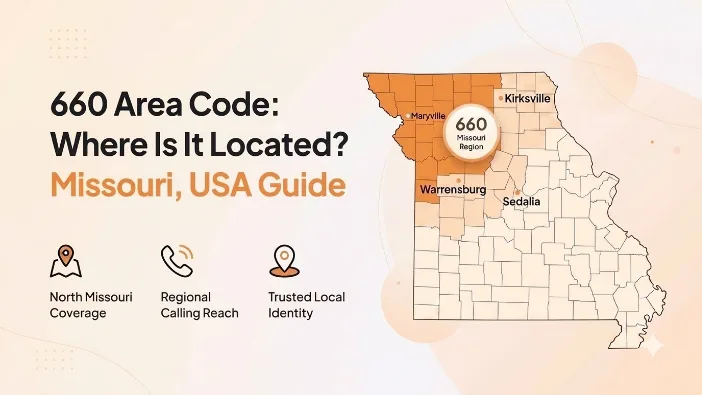
What area code is 660? It's in the USA — northern and west-central Missouri, split off from the older 816 area code in 1997. 660 reaches Sedalia, Kirksville, Maryville, and Chillicothe, covering a wide, mostly rural stretch of the state rather than a single metro area or city.
This guide answers exactly where the 660 area code is located, how it split from 816, the real history behind Chillicothe, Kirksville, Maryville, and Sedalia, its 1997 launch, and how to get a Missouri number that gets answered.
Where the 660 Area Code Reaches
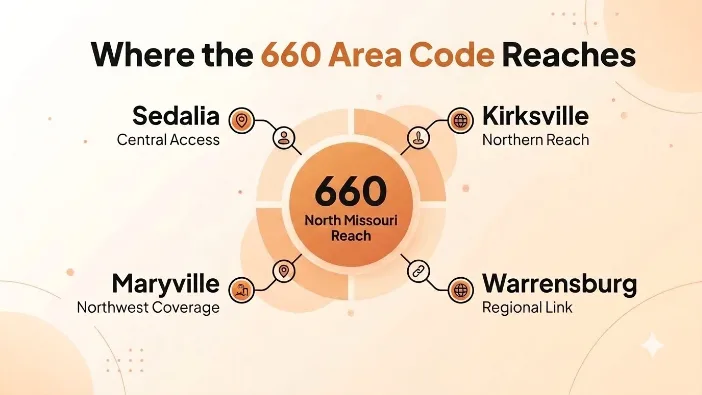
660 covers a broad swath of northern and west-central Missouri rather than a single city — a mix of college towns, county seats, and farm country stretching across the top third of the state.
- Sedalia — the largest city in the 660 footprint, in Pettis County
- Kirksville — an Adair County city near the Iowa border
- Maryville — a Nodaway County city in far northwest Missouri
- Chillicothe — a Livingston County city on the Grand River
- Marshall, Moberly, and Warrensburg — additional anchor cities across the same footprint
660 has no overlay — every number across this footprint, old or newly issued, still carries the same 660 prefix today. To the south and west, the Kansas City metro and St. Joseph answer to the separate 816 area code that 660 split away from in 1997.
Row-crop farming, livestock operations, and the grain co-ops that serve them anchor much of the 660 economy outside its handful of college towns and county seats, giving the region an identity built as much around agriculture as around any single city.
The entire 660 area code observes Central Time — UTC-6 (CST) in winter and UTC-5 (CDT) during Daylight Saving — the same clock as Kansas City, Chicago, and Dallas. West Coast teams calling area code 660 are two hours behind, so a mid-morning Pacific call lands right around lunchtime in Sedalia or Kirksville.
A full breakdown of how 660 fits alongside the state's other four area codes is in this Missouri area codes guide.
Near Warrensburg, in the same 660 footprint, Whiteman Air Force Base is home to the entire US fleet of B-2 Spirit stealth bombers, operated by the 509th Bomb Wing. The first B-2, nicknamed the "Spirit of Missouri," arrived at Whiteman on December 17, 1993, and the base has anchored the aircraft's global strategic missions ever since, giving this otherwise rural stretch of Missouri an outsized role in national defense.
660's Origin: Splitting from 816 in 1997
660 traces back to the 314 area code, the single area code assigned to the entire state of Missouri when the North American Numbering Plan launched in 1947. 816 split off from 314 that same year to cover western Missouri, including Kansas City, and for the next five decades it covered both the growing Kansas City metro and the rural northern half of the state together.
By the mid-1990s, cell-phone growth and telecom deregulation following the Telecommunications Act of 1996 pushed the combined 816 territory toward exhaustion, and on October 12, 1997, regulators split it again — Kansas City and St. Joseph kept the 816 area code, while the rural northern and northwestern two-thirds of the old territory became the new 660, drawn specifically to minimize disruption in the more densely populated urban core.
More than two and a half decades later, 660 still hasn't needed a second overlay of its own, even as the neighboring 816 region eventually added an overlay of its own to keep up with Kansas City's continued growth — a sign of just how much slower demand for new numbers has grown across 660's more rural footprint by comparison, a pattern described in the FCC's overview of area code overlays.
Chillicothe: The Real Home of Sliced Bread
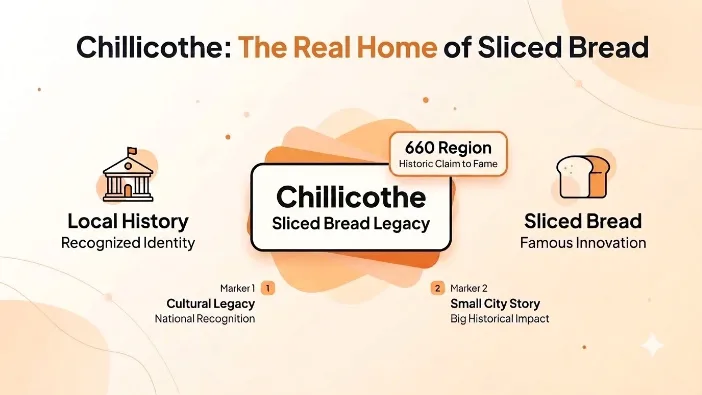
On July 7, 1928, the Chillicothe Baking Company became the first bakery in the country to sell bread sliced by machine, using a slicer invented by Missouri jeweler Otto Frederick Rohwedder. The town's connection to that milestone was largely forgotten until a local newspaper editor rediscovered a 1928 article about it in 2001, and Chillicothe has since embraced "Home of Sliced Bread" as its official slogan, complete with a downtown mural and an annual Sliced Bread Day that the Missouri General Assembly made official in 2018.
Kirksville and Maryville: Missouri's College Towns
Kirksville: Birthplace of Osteopathic Medicine
Andrew Taylor Still founded the American School of Osteopathy in Kirksville in 1892, the world's first osteopathic medical school, in protest of what he saw as an ineffective conventional medical system of the era. Unusually for the time, Still admitted both women and Black students from the school's earliest classes. The school Still founded has grown into A.T. Still University, which still operates its founding campus in Kirksville alongside two others, drawing thousands of students to the same city every year.
Maryville: Northwest Missouri State University
Maryville won a statewide competition in 1905 to host what became Northwest Missouri State University, founded as the Fifth District Normal School after the city offered 86 acres and $58,000 to secure it. The campus later earned a distinction few universities can claim: the Missouri Legislature designated it the official Missouri State Arboretum in 1993. Notable alumni include Jean Bartik, one of the original programmers of the ENIAC, the first general-purpose electronic computer, giving this small northwest Missouri campus a real link to the earliest days of modern computing.
Sedalia: Ragtime and the Missouri State Fair
Scott Joplin and Ragtime
Scott Joplin arrived in Sedalia in 1894 as a touring musician and stayed to study music theory at George R. Smith College. It was there that he composed "Maple Leaf Rag," published in 1899, which went on to sell more than a million copies and made Joplin the best-known name in the ragtime era he helped define. Sedalia still celebrates that connection with an annual ragtime festival held in Joplin's name.
The Missouri State Fair
The Missouri legislature created the state fair in 1899 and selected Sedalia to host it after the city offered 150 acres, the highest bid of any competing town. The first Missouri State Fair opened on September 9, 1901, drawing more than 25,000 visitors despite a severe drought that year, and Sedalia has hosted the fair every year since, making it one of the longest-running institutions anywhere in the 660 footprint.
How to Get a 660 Area Code Number
- Cloud phone platform — search available 660 numbers in real time and activate a line the same day, with no hardware and no technician visit.
- Port your existing number — already run a 660 line on another carrier? Move it over without downtime and keep the number active through the transition.
- Wireless SIM or landline carrier — valid for a single physical handset, but slower to provision and harder to scale seat by seat.
With letsdial, a 660 number provisions in under three minutes on a free trial, no credit card required, so a northern or west-central Missouri presence can be answering calls the same afternoon, whether that's a Sedalia office or a remote team representing the region from anywhere in the country, with no technician visit or new hardware required.
Call Trust in Rural Missouri
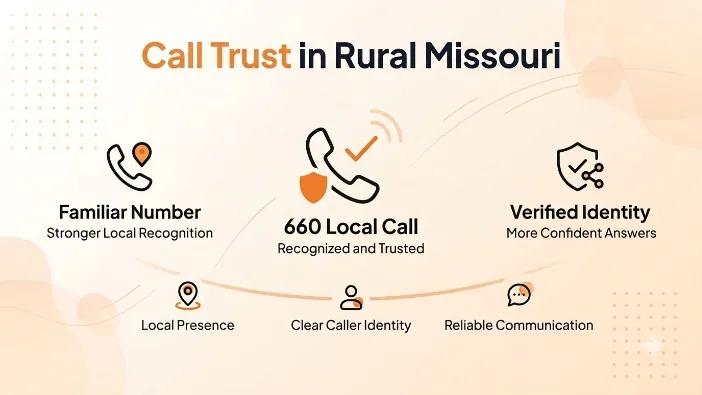
The 660 footprint runs on a mix of university-supplier relationships around Kirksville and Maryville, agricultural and grain-co-op business across the surrounding farm country, and small-town retail and healthcare competition in Sedalia and Chillicothe — settings where an unfamiliar out-of-area number gets screened before it's answered. A recognizable local prefix earns the first hearing, and because 660 has never split into a second overlay, it still reads as an unambiguous, single-region signal rather than one of two competing prefixes.
That screening habit is especially strong around Sedalia during Missouri State Fair season, when local vendors and out-of-town exhibitors alike field a spike in unsolicited calls, and around Warrensburg's military community near Whiteman Air Force Base, where residents are accustomed to verifying any unfamiliar caller before sharing information.
STIR/SHAKEN for a Single-Code Rural Market
Apply STIR/SHAKEN attestation so every outbound 660 call arrives verified with your registered business name on screen instead of a bare number. As a provider, letsdial registers text campaigns for 10DLC compliance from day one and warms new numbers before scaling volume, so a verified line reads as genuinely local rather than one more unidentified number in a market that leans heavily on personal, small-town trust, whether the recipient is a farm supplier, a hospital vendor, or a university office.
Conclusion
660 is northern and west-central Missouri's single, un-overlaid area code — not associated with any other state — covering Chillicothe's claim as the real home of sliced bread, Kirksville's status as the birthplace of osteopathic medicine, Maryville's Northwest Missouri State University, Warrensburg's Whiteman Air Force Base, and Sedalia's ragtime and state-fair history.
Standing up a line takes minutes on a cloud platform, with STIR/SHAKEN attestation so calls arrive verified rather than flagged. Put a 660 number in front of university partners, agricultural vendors, and local customers, and let a familiar prefix open the door first, with letsdial handling the setup end to end, whether the business is based in Sedalia, Kirksville, Maryville, or Chillicothe.
Frequently Asked Questions
Written by Aryan Khan · August 3, 2026
Reply to the author