Introduction
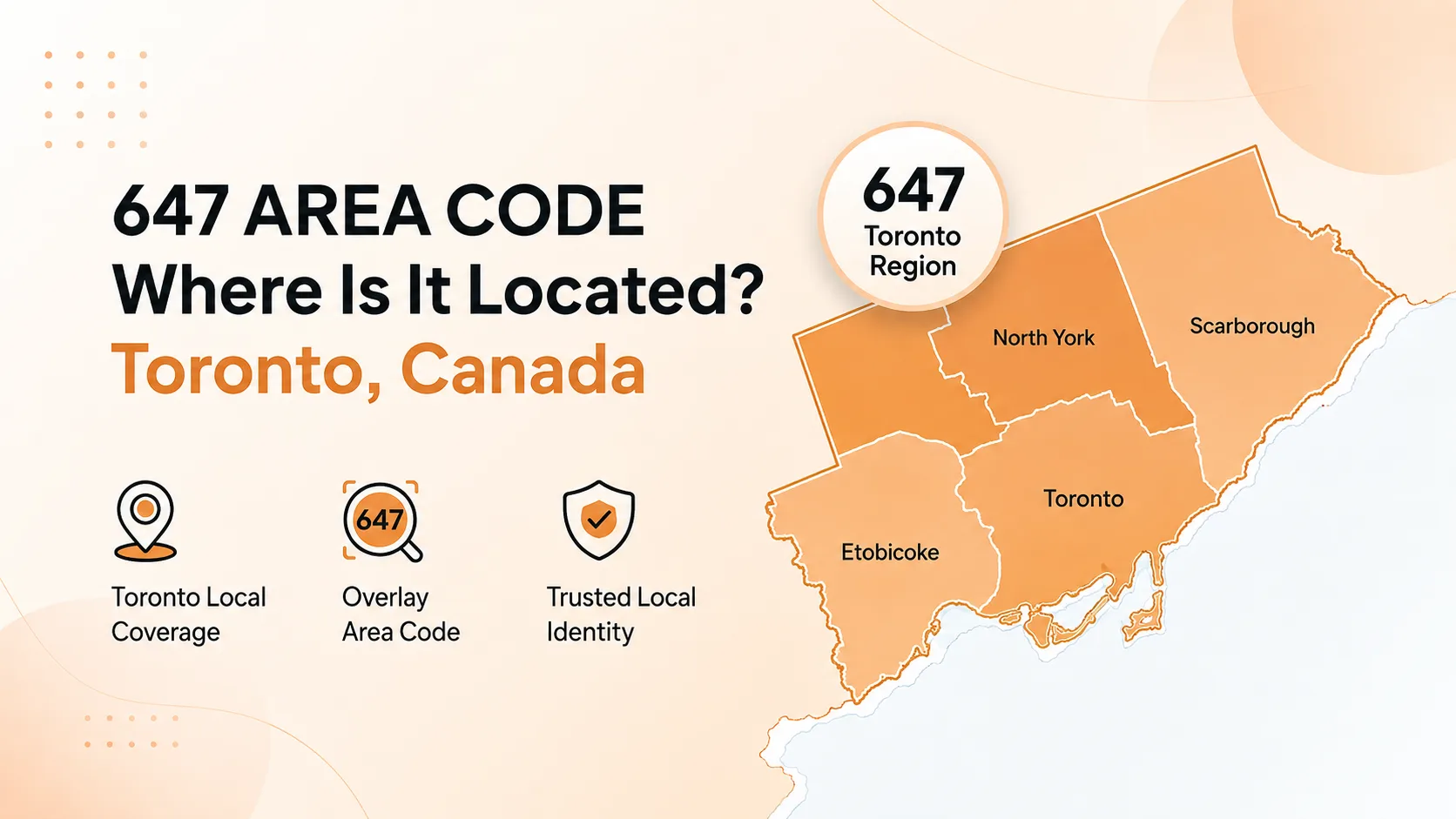
What area code is 647? It's in Canada, not the United States — Toronto, Ontario, sharing the exact same territory as the older 416 area code. 647 was Canada's first-ever overlay code, and it's now so tied to the city's identity that it helped give Toronto its most famous nickname.
This guide answers exactly where the 647 area code is located, how it relates to 416, the pop-culture and landmark history behind it, its 2001 launch, and how to get a Toronto number that gets answered.
- Province: Ontario, Canada
- Region: City of Toronto — an overlay covering the exact same footprint as 416
- Launched: March 25, 2001 (Canada's first-ever area code overlay)
- Time zone: Eastern Time (ET)
- Overlay: Yes — 416 and 647 share the same territory; every local call needs all 10 digits
Where the 647 Area Code Reaches
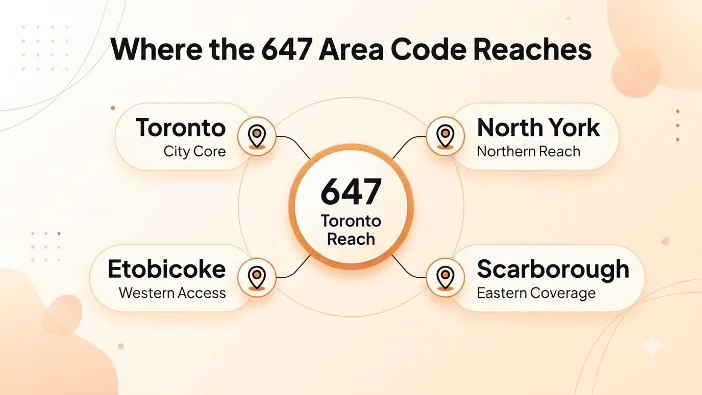
647 covers the entire amalgamated City of Toronto — the same downtown core, North York, Scarborough, Etobicoke, East York, and York that the 416 area code has always covered — because 647 is an overlay, not a separate region.
Because two full area codes now serve every Toronto address, ten-digit dialing has been mandatory across the city since the overlay went live, even for a call between two neighbors on the same street. There is no way to tell from the area code alone whether a number is older or newer, or which part of the city it's registered to — 416 and 647 numbers are functionally identical today.
The entire 647 area code observes Eastern Time — UTC-5 (EST) in winter and UTC-4 (EDT) during Daylight Saving — the same clock as New York and the rest of the Eastern time band. West Coast teams calling area code 647 are three hours behind, so late-morning Pacific outreach lands mid-afternoon in Toronto.
Toronto is Canada's most populous city and its financial capital, and the 647 footprint includes the Financial District along Bay Street, home to the Toronto Stock Exchange — the largest stock exchange in Canada and one of the largest in North America by market capitalization. That concentration of head offices and trading desks gives the 416/647 overlay an outsized share of the country's business call volume relative to its geographic footprint, even though Toronto Pearson International Airport itself sits just outside the city in neighboring Mississauga's 905 territory.
The 416/647 Overlay: Canada's First
647 went into service on March 25, 2001, as an overlay laid over the exact same Toronto territory 416 already covered — and it was the very first overlay ever activated anywhere in Canada, a template every other Canadian overlay since has followed. Rather than splitting Toronto's map into two smaller regions, regulators chose to layer a second code over the existing one, so no 416 customer had to change their number.
647 numbers were allocated disproportionately to the growing mobile-phone market and to competitive carriers offering cable and VoIP service, which is part of why 647 built a reputation as Toronto's "cell phone" area code even though the two codes are functionally identical today. Toronto has since added two further overlays on the same footprint — 437 in 2013 and 942 in 2025 — but 647 remains the original.
That distinction between an overlay and a split matters practically as well as historically: because 647 never took over a separate piece of the map, a business that's operated in Toronto since before 2001 could plausibly hold either a 416 or a 647 number today, depending purely on when a given line was first assigned rather than where in the city it's based.
To the north and east, the suburbs surrounding Toronto answer to the separate 905 area code, not 647 — a different numbering region entirely, despite sitting right next door.
"The Six": How 647 Helped Name Toronto
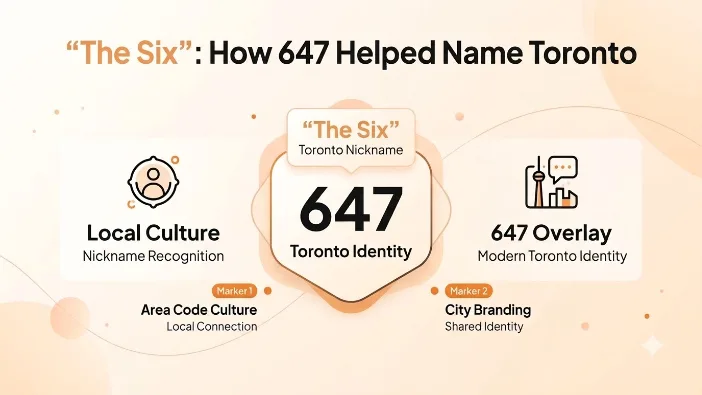
"The Six," now Toronto's best-known nickname worldwide, was coined by a member of the Toronto collective Prime Boys as shorthand for the city's six former boroughs — and for the digit shared by its two area codes, 416 and 647. Rapper Drake picked up the nickname and took it global, weaving it through his music and branding to the point that the number 6 has become inseparable from Toronto's cultural identity, all traceable back to the shared final digit of the city's original code and its first overlay.
That connection runs deeper than a passing reference — Drake's 2016 album "Views" leaned on the date 4/16 as a stand-in for the city itself, and the same numerical wordplay extends naturally to 647, since both codes end in the same digit that gave the nickname its name in the first place. Few area codes anywhere have become this directly entangled with a city's pop-culture identity.
The CN Tower and the University of Toronto
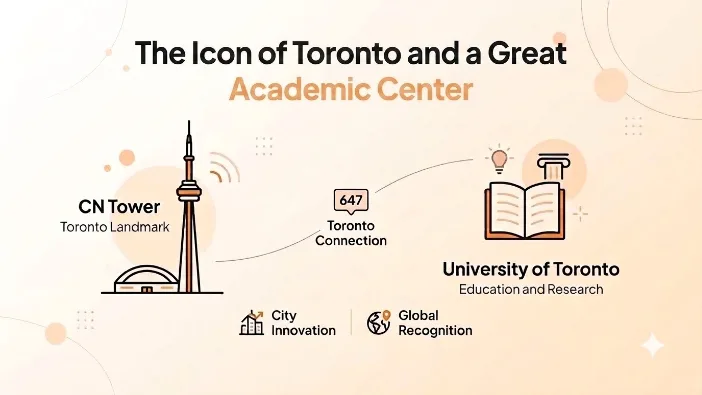
Two of Toronto's most recognizable institutions anchor opposite ends of the 647 footprint.
The CN Tower
The CN Tower, completed on April 2, 1975 and opened to the public in June 1976, stood as the world's tallest freestanding structure for over three decades until Dubai's Burj Khalifa surpassed it in 2009. It remains Toronto's most recognizable landmark and a fixture of the skyline visible from nearly every part of the 647 footprint. Its distinctive silhouette has appeared in countless films shot in the city, cementing its place as visual shorthand for Toronto worldwide long before Drake's music did the same thing for its area codes.
The University of Toronto
The University of Toronto was chartered in 1827 as King's College, making it the oldest university in Ontario, and it became a secular institution under its present name in 1850. Today it's consistently ranked among the top research universities in the world, anchoring a major student and research economy inside the same downtown footprint as the CN Tower and Toronto's Financial District. Decades of graduates have gone on to found or lead businesses across the city, giving U of T an outsized role in Toronto's broader economy well beyond the campus itself.
647 History
Toronto's area code originally covered a much larger stretch of southern Ontario before shrinking through a series of splits — 519 broke off in 1953, and the surrounding suburbs split off into 905 in 1993, narrowing 416 down to just the amalgamated City of Toronto.
Rather than split the city's map a third time as demand kept growing, Canadian regulators shifted to overlays, and 647 launched on March 25, 2001, as the country's first — a decision the Canadian Numbering Administrator documented as it oversaw relief planning for the region, confirmed in Wikipedia's overlay history. That overlay approach has defined Toronto numbering ever since, with 437 following in 2013 and 942 in 2025.
Call Trust in Toronto
The Toronto market runs on dense financial-district vendor channels, university and research-supplier relationships around U of T, and constant competition among small businesses across the city's neighborhoods — settings where an unfamiliar number gets screened before it's answered. A recognizable local prefix earns the first hearing, and because 647 has been part of Toronto's identity since 2001, it reads as genuinely local rather than out of area.
That screening habit is especially pronounced on Bay Street, where financial-services firms field a constant stream of unsolicited sales and recruiting calls and route anything unfamiliar straight to voicemail by default. A verified 647 or 416 number carrying an accurate business name on the caller-ID display is meaningfully more likely to get picked up in that environment than a bare, unlabeled number.
STIR/SHAKEN for a Canadian Overlay Code
Apply STIR/SHAKEN attestation so every outbound 647 call arrives verified with your registered business name on screen — Canada's CRTC mandated STIR/SHAKEN across Canadian carriers starting in 2021, the same authentication framework used in the US. As a provider, letsdial registers your calls for compliance from day one and warms new numbers before scaling volume, so a verified line reads as Toronto-local rather than out-of-area.
How to Get a 647 Area Code Number
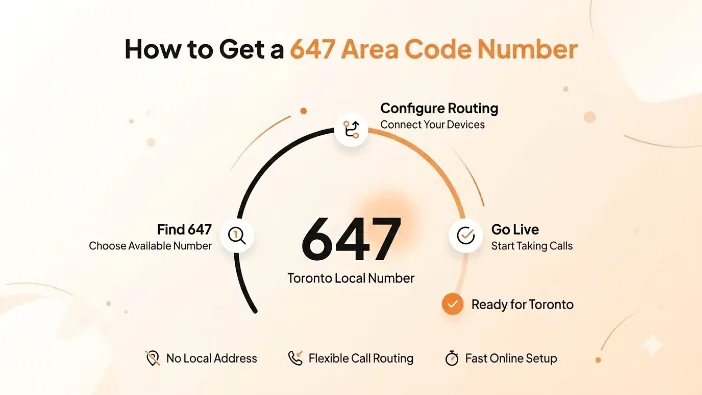
- Cloud phone platform — search available 647 or 416 numbers in real time and activate a line the same day, with no hardware and no technician visit.
- Port your existing number — already run a 647 line on another carrier? Move it over without downtime and keep the number active through the transition.
- Wireless SIM or landline carrier — valid for a single physical handset, but slower to provision and harder to scale seat by seat.
With letsdial, a 647 number provisions in under three minutes on a free trial, no credit card required, so a Toronto presence can be answering calls the same afternoon, whether that's a downtown office or a remote team representing the city from anywhere in North America.
Conclusion
647 is Toronto's first and most culturally significant overlay code — not a US area code — sharing the same territory as 416, helping name "The Six," and covering landmarks from the CN Tower to the University of Toronto.
Standing up a line takes minutes on a cloud platform, with STIR/SHAKEN attestation so calls arrive verified rather than flagged. Put a 647 number in front of Toronto clients, university partners, and financial-district vendors, and let a familiar prefix open the door first, with letsdial handling the setup end to end.
Frequently Asked Questions
Written by Aryan Khan · August 3, 2026
Reply to the author