Introduction
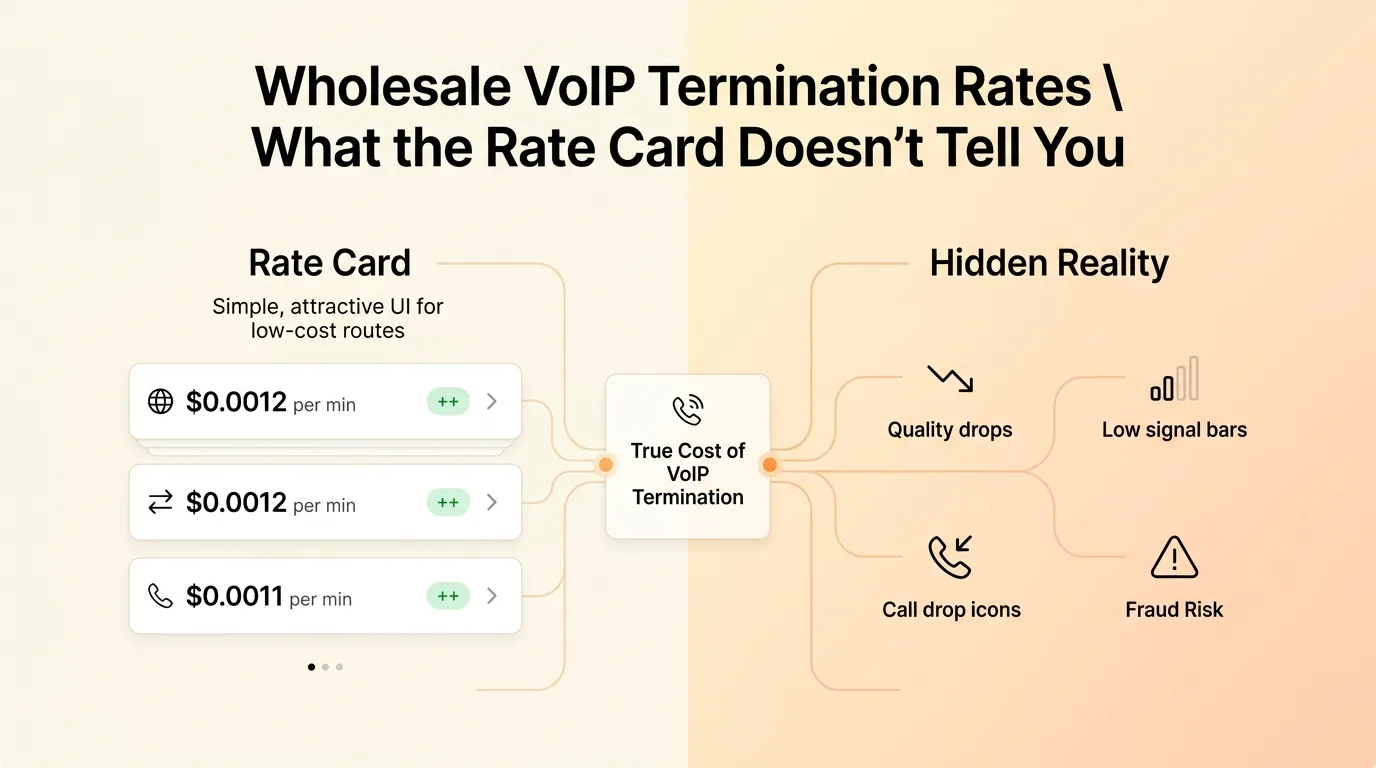
Most businesses shopping for wholesale call termination focus on two numbers: per-minute rate and country coverage. Both matter — but they represent the surface of a service that actually has five distinct components, each with its own quality variables, pricing model, and failure modes.
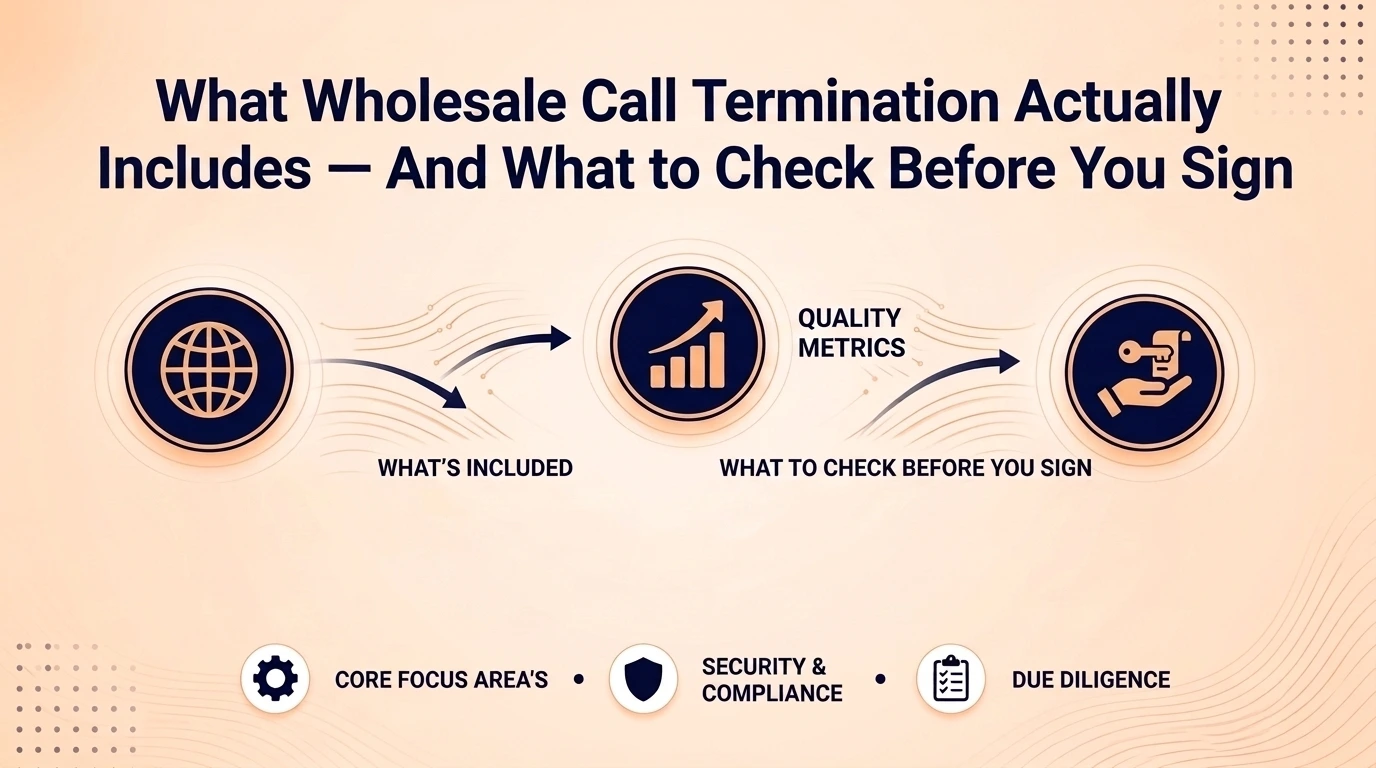
Getting the per-minute rate right while choosing a provider with poor VoIP peering or no quality floor on least-cost routing is like negotiating the price of a car without checking whether it has brakes. The savings show up in the first invoice; the problems show up in your call-quality metrics and CSAT scores three months later. This guide breaks wholesale call termination into its actual parts: what each component is, what it delivers, and the specific question to ask any provider before committing.
On this page:
- What Wholesale Call Termination Is
- The Five Services Inside Every Termination Package
- Service Breakdown: What to Check on Each
- Where It Has the Most Impact by Industry
- How Technology Is Changing Termination
- What a Strong Termination Package Looks Like
- Frequently Asked Questions
What Wholesale Call Termination Is
Wholesale call termination is the process of completing outbound voice calls — routing audio traffic from a VoIP network across carrier interconnects until it reaches the recipient on the public switched telephone network (PSTN) or another VoIP endpoint. The 'wholesale' part means the service is sold in bulk: high call volumes, bulk rate pricing, and capacity measured in concurrent channels or millions of minutes per month rather than per-seat plans.
It's the infrastructure layer underneath business phone systems, contact centers, SaaS platforms, and resellers — not a consumer product. Unlike retail VoIP, which prices by seat and bundles features for end users, wholesale call termination is bought by organizations that need to move large call volumes across many destinations without managing carrier relationships in each market directly. More detail sits on our letsdial page.
The Five Services Inside Every Termination Package
Wholesale call termination is not a single product — it's a bundle of five interconnected services. Most providers offer all five, but the quality and configuration of each varies significantly:
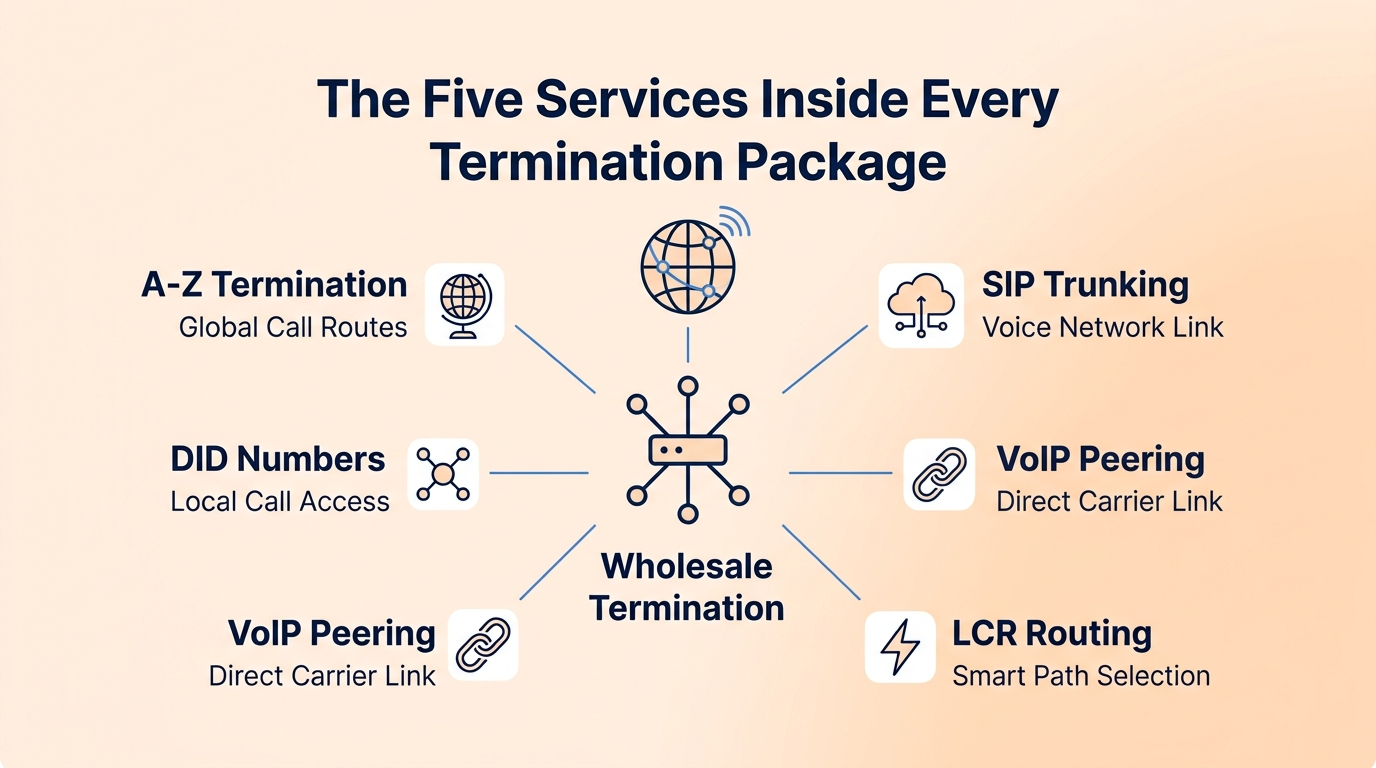
- A-Z termination — outbound call completion to any destination globally (A for Afghanistan to Z for Zimbabwe), routed through interconnected carrier networks.
- SIP trunking — the connection between your phone system or UCaaS platform and the carrier network, carrying voice and data over the internet and scaling in concurrent-channel increments (replacing legacy PRI lines).
- Direct Inward Dialing (DID) — local phone numbers in specific countries or cities that route inbound calls straight to your team; a caller sees a local number, the call lands in your system wherever your agents are.
- VoIP peering — a direct network-to-network connection between providers with no intermediary carrier, so calls travel fewer hops with lower latency and higher MOS.
- Least-cost routing (LCR) — an automated engine that selects the cheapest available path per call; the best implementations enforce a quality floor so no route below a minimum MOS is selected regardless of cost.
letsdial delivers all five components on every paid plan — A-Z termination, SIP trunking, DID numbers in 100+ countries, Tier-1 peering, and quality-weighted routing. More detail sits on our AI Contact Center page.
Service Breakdown: What to Check on Each
Each service has a specific question that separates providers who deliver on paper from those who deliver in production:
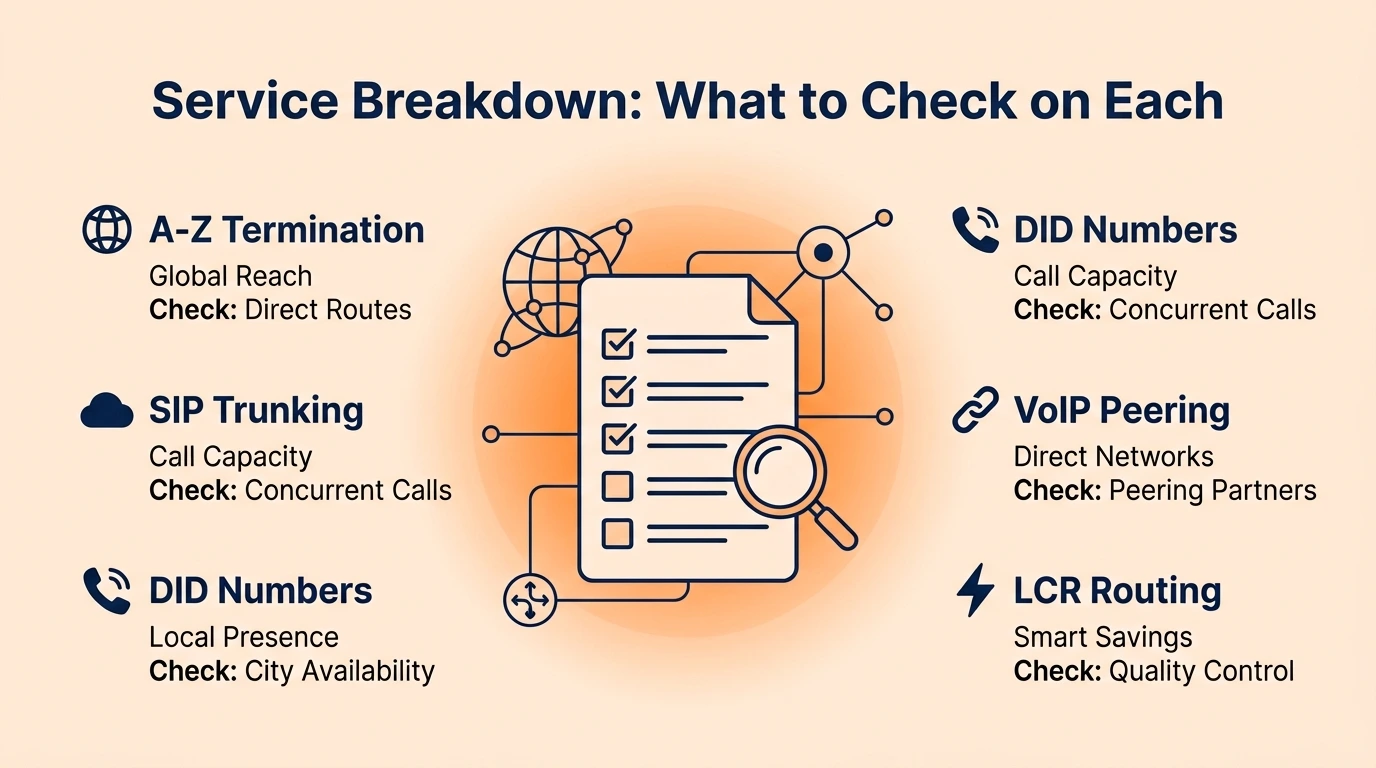
- A-Z termination — reaches customers in 200+ countries without local infrastructure. Ask: how many destinations have direct interconnects vs. resold routes?
- SIP trunking — eliminates legacy PRI lines and scales concurrent calls on demand. Ask: what is the maximum concurrent call capacity per trunk?
- DID numbers — local presence in any market without a physical office. Ask: are DIDs available in the specific cities or regions I need?
- VoIP peering — lower latency and better MOS on peered routes. Ask: which specific networks do you have direct peering agreements with?
- Least-cost routing — reduces per-minute costs without manual route management. Ask: does LCR enforce a minimum quality floor, or optimize cost only?
> [TIP] The LCR quality-floor question is the most important. Ask explicitly: 'Does your LCR enforce a minimum MOS score threshold, or does it select the cheapest available route regardless of quality?' The answer tells you immediately how the provider thinks about quality versus cost.
Where It Has the Most Impact by Industry
Wholesale call termination is the infrastructure layer for any operation making or receiving large call volumes. The impact varies by vertical — different compliance requirements, volume patterns, and geographic needs:
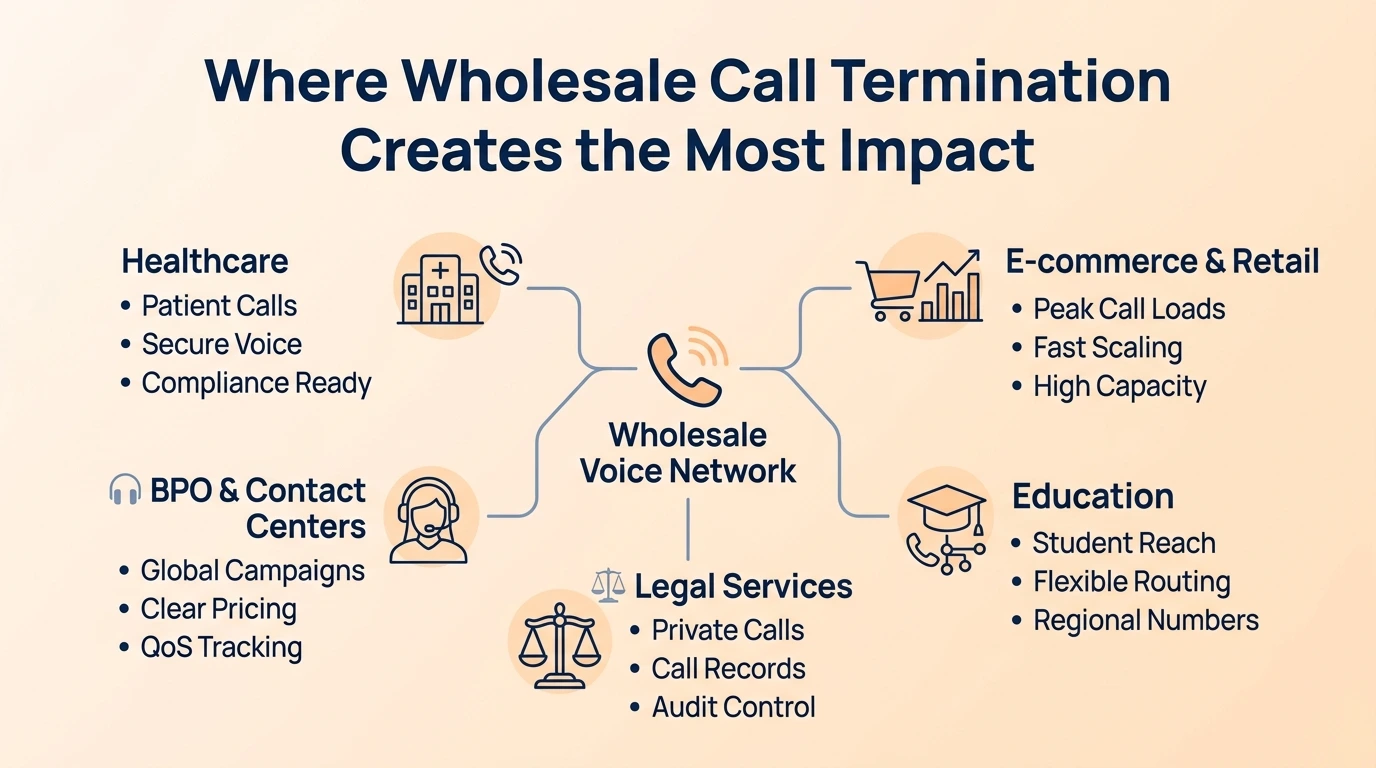
- Healthcare — high call volume between providers, insurers, and patients; requires HIPAA-compliant call recording and encrypted transmission.
- E-commerce & retail — seasonal spikes (Black Friday inbound queues) require elastic concurrent capacity without manual provisioning.
- BPO & contact centers — thousands of outbound calls daily across campaigns and geographies; requires per-minute rate transparency and real-time QoS dashboards per campaign.
- Legal & professional services — client confidentiality and documentation obligations require call recording with access controls and audit-ready storage.
- Education — multi-campus or remote student communication with high variability; needs DID numbers in student home regions and flexible trunk scaling.
> [NOTE] Cross-industry constant: every vertical above requires call recording, encrypted transmission, and scalable concurrent capacity. These are not premium features — they should be standard on every plan. Every letsdial paid plan includes call recording with PII redaction, AES-256 encryption, TLS 1.3 in transit, and SOC 2 Type II compliance.
How Technology Is Changing Termination
Three shifts are reshaping what wholesale call termination providers need to deliver over the next two to three years:
- Programmable APIs for real-time route control — providers are moving from static route tables to API-driven engines that can be configured, overridden, or redirected in real time, reducing reliance on manual configuration requests.
- 5G and IoT demand on voice infrastructure — 5G devices and IoT deployments generate new voice traffic patterns; providers building for this invest in network-edge capacity for distributed, low-latency sessions.
- Encryption as a baseline, not an add-on — regulatory and enterprise pressure is pushing TLS signaling and SRTP media encryption from optional configurations to baseline requirements.
What a Strong Termination Package Looks Like
A wholesale call termination package that holds up in production combines all five services with a specific set of baseline requirements. Use this as a minimum standard when evaluating providers:
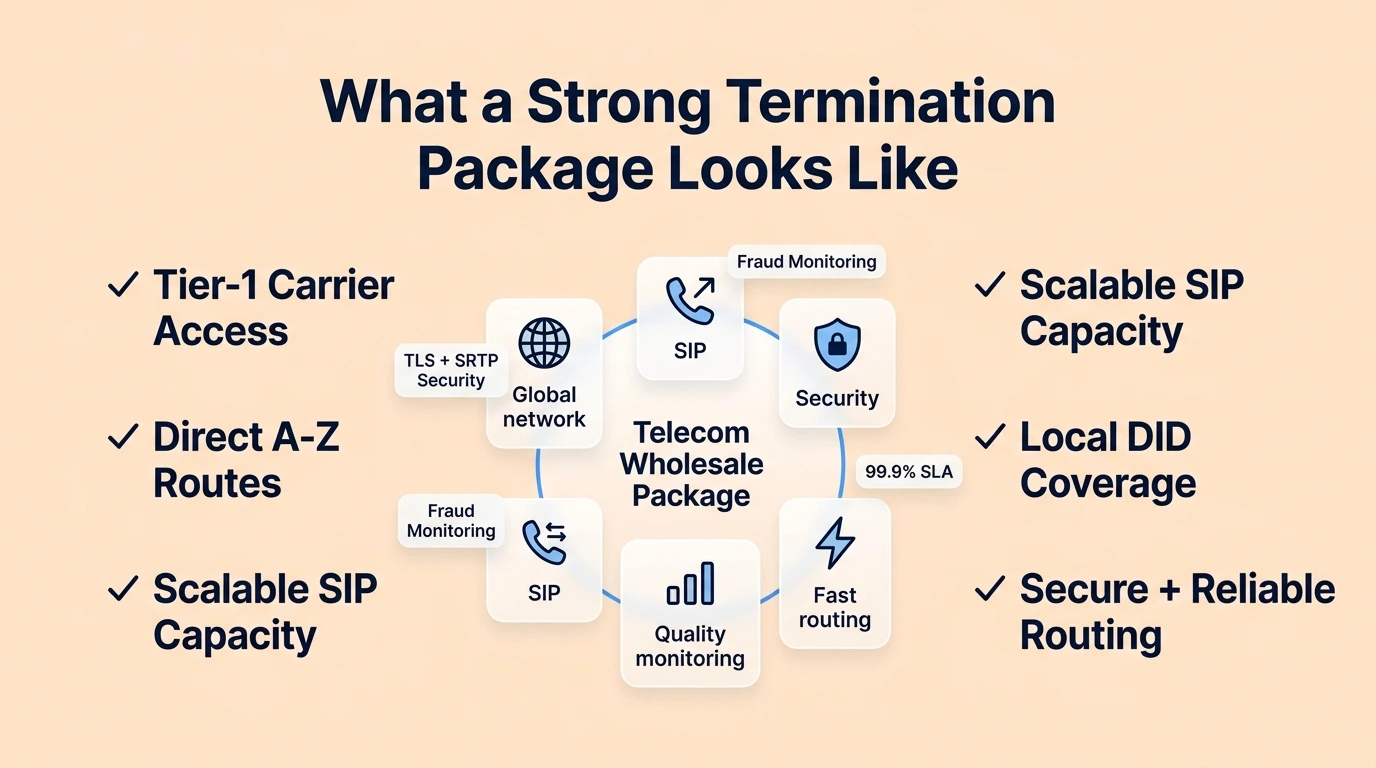
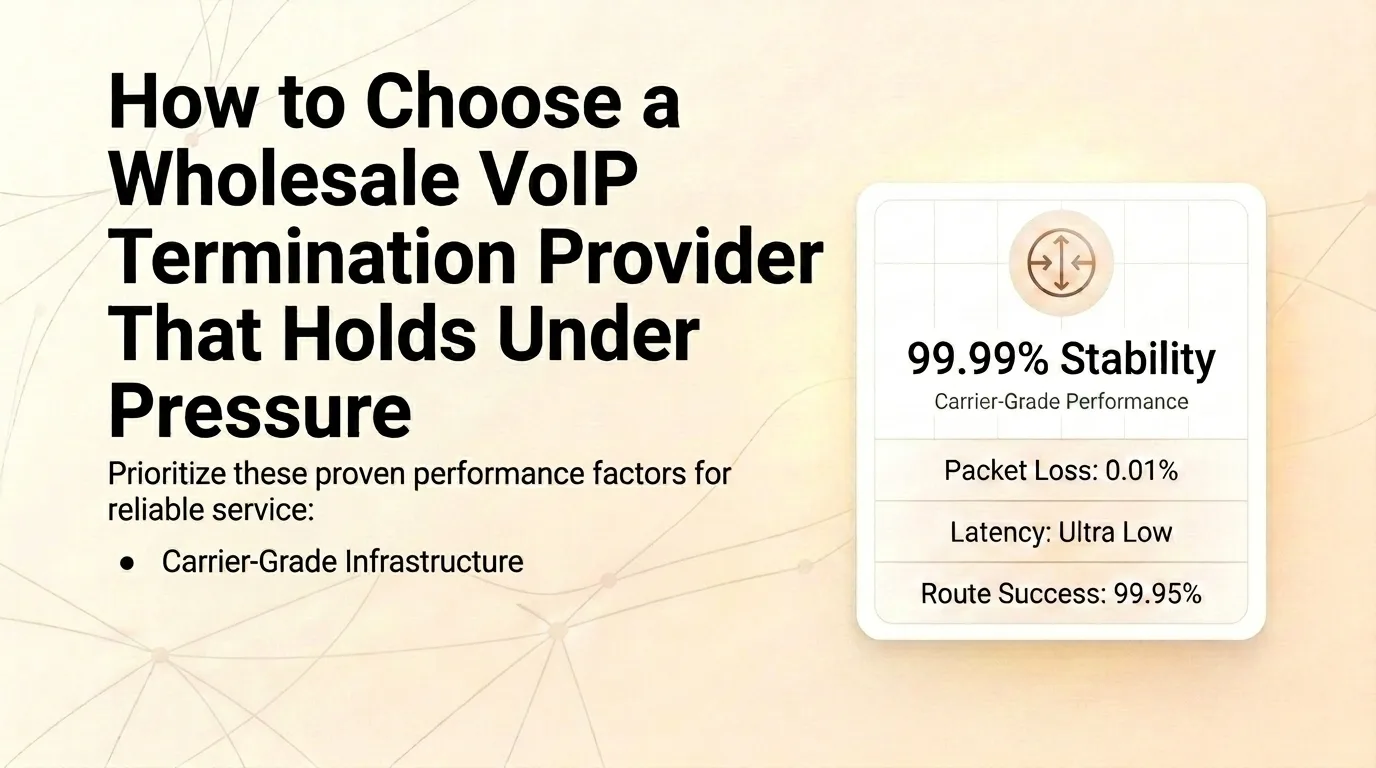
- Tier-1 carrier interconnects named specifically — not described as 'carrier-grade' without disclosure of which carriers.
- A-Z termination with direct interconnects in your target markets, not resold grey routes padded into the coverage count.
- SIP trunking with documented concurrent capacity and automated elastic scaling — no manual provisioning tickets for capacity changes.
- DID availability in the specific cities and regions you need, not just country-level coverage.
- VoIP peering agreements with carriers serving your primary destination markets.
- LCR with an enforced quality floor — MOS threshold documented in the SLA.
- TLS + SRTP encryption standard on every account — not a configuration request or upgrade.
- Real-time fraud monitoring and anomaly detection with automatic traffic suspension below a defined threshold.
- 99.9%+ uptime SLA with specific financial penalties for breach — not vague 'best effort' language.
Conclusion
letsdial delivers every item on this list across Tier-1 partners — Telin, MTT, Reliance Communications, Deutsche Telekom, China Mobile International, PLDT, and Telekom Slovenije — into 200+ countries, with DID numbers in 100+ countries on sign-up and free number porting both directions. The AI Contact Center stack shares the same routing engine as the voice infrastructure, under one invoice, with median setup under 3 minutes. See pricing. For how carriers settle these charges, see the FCC's intercarrier compensation overview.
Frequently Asked Questions
Written by Aryan Khan · June 30, 2026
Reply to the author