Introduction
Your sales rep hits dial. In the next 200 milliseconds, a routing decision is made that determines whether that call connects cleanly, connects with a three-second delay, or doesn't connect at all. Most businesses never think about that decision — until it starts costing them.
VoIP routes are the paths voice data takes across internet infrastructure from one endpoint to another. The route your call takes determines packet loss, latency, jitter, and ultimately whether your customer hears a professional-grade voice or a pixelated echo. This guide breaks down how VoIP routing actually works, what route types your business needs, the security risks on those routes, and what to require from any provider before you commit to a contract.
On this page:
- What a VoIP Route Is (And What It Isn't)
- The Three Types of VoIP Routes
- How VoIP Routing Works in Real Time
- Why Route Quality Determines Call Quality
- Security Threats Your VoIP Routes Face
- How to Choose a VoIP Route Provider
- Why letsdial Routes Calls Differently
- The Bottom Line on VoIP Routes
- Frequently Asked Questions
What a VoIP Route Is (And What It Isn't)
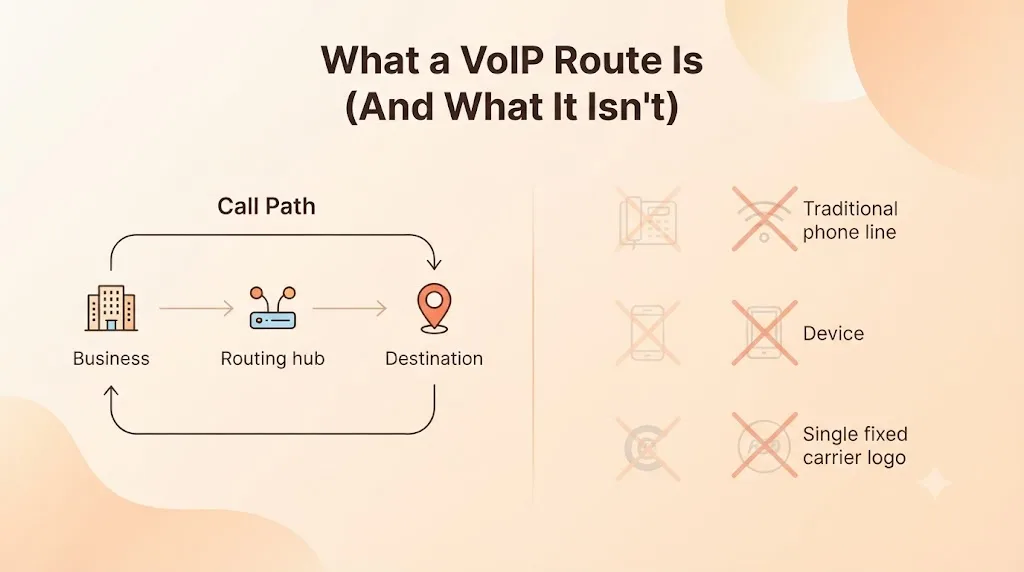
A VoIP route is the path a voice call travels across internet infrastructure. Unlike legacy phone lines that follow fixed copper circuits, VoIP calls are broken into data packets, sent across the internet, and reassembled at the other end. The route isn't fixed — it's selected in real time based on network conditions, routing protocols, Quality of Service (QoS) settings, and available bandwidth along each possible path.
A well-selected VoIP route delivers voice with packet loss under 0.5% and one-way latency under 150ms. A poorly selected route delivers choppy audio, echo, and dropped calls — all of which your customer notices immediately. More detail sits on our letsdial page.
The Three Types of VoIP Routes
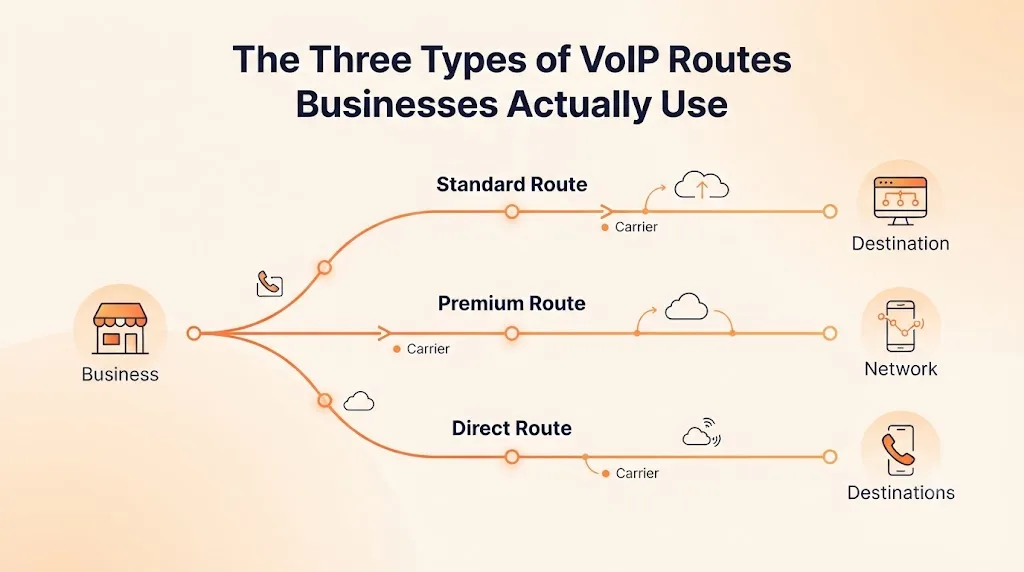
Not all routes serve the same purpose. Most businesses rely on three distinct types — and a strong provider handles all three reliably.
- Domestic routes handle calls within a single country's borders. They connect faster, cost less, and operate under one regulatory framework — ideal for regional sales and support teams.
- International routes carry calls across country borders. Quality varies significantly depending on whether the provider owns Tier-1 carrier paths or resells lower-grade routes through intermediaries. A few extra network hops can add hundreds of milliseconds of latency.
- Toll-free routes carry inbound calls at no cost to the caller — used for customer service lines and support queues where friction at the dial moment should be zero.
Each route type requires different QoS priorities, compliance handling, and infrastructure commitments. A vendor that handles one well doesn't automatically handle the others. letsdial routes calls to 200+ countries across Tier-1 carrier networks. More detail sits on our letsdial cloud phone platform page.
How VoIP Routing Works in Real Time
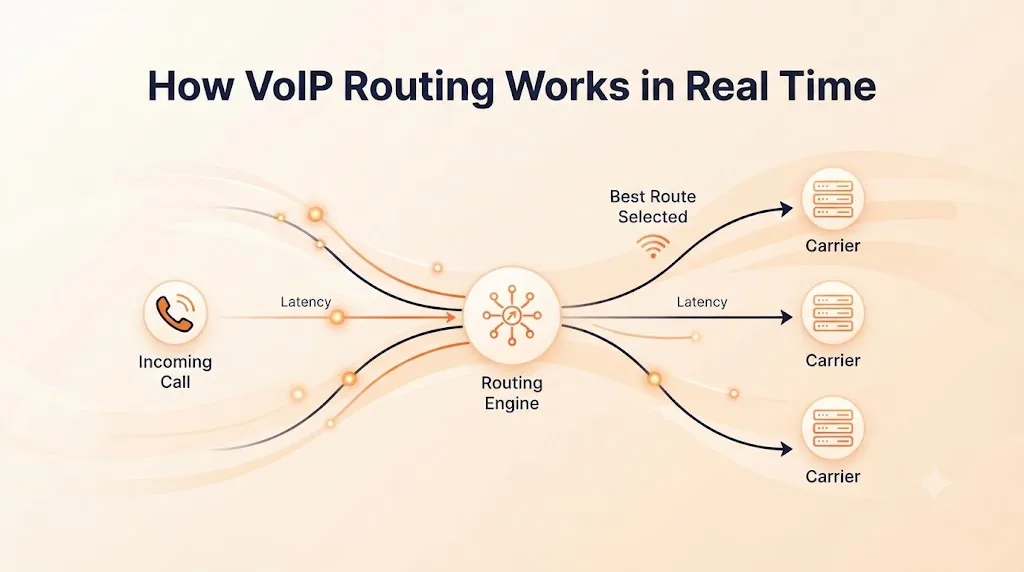
When a call is placed, the routing engine makes several decisions in milliseconds:
- The call request hits the provider's switch as a SIP (Session Initiation Protocol) signal.
- The switch queries available routes and scores them by latency, quality history, and cost.
- The route meeting the quality threshold at the lowest cost is selected.
- Voice data is broken into packets and sent across the selected path.
- QoS policies prioritize voice packets over competing internet traffic on that pipe.
- Packets reassemble at the destination and the call connects.
The phrase "least-cost routing" sounds like a cost-cutting mechanism. In a well-built system, it's cost optimization within a hard floor of quality requirements — the routing engine never selects a cheap route that fails the QoS threshold. That's the difference between a provider optimizing for margin and one optimizing for your call quality. And because the engine re-scores routes continuously, a path that starts degrading at 2pm won't still be carrying your calls at 3pm.
> [TIP] Ask before you sign: what happens if the primary route degrades mid-call? Failover to a secondary path should be automatic, sub-second, and testable. If the provider can't describe their failover architecture specifically, treat it as a red flag.
Why Route Quality Determines Call Quality
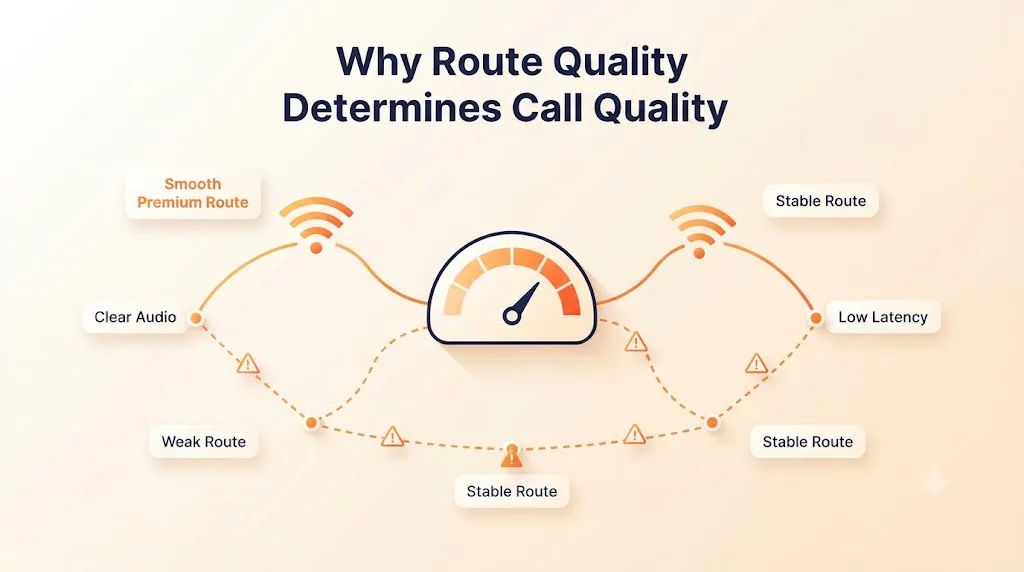
Every call quality complaint — choppy audio, echo, clipping, delay — traces back to what's happening on the route.
- Packet loss happens when voice data packets don't arrive. Even 1–2% makes audio sound like the speaker is talking through a wall. The acceptable ceiling: under 0.5%.
- Latency is the one-way delay between speaking and being heard. Under 150ms produces natural conversation; above 200ms, callers start talking over each other.
- Jitter is variation in packet arrival time. High jitter overwhelms the jitter buffer and produces robotic, stuttering audio that drives customers to hang up.
Providers running Tier-1 carrier connections have direct peering arrangements that reduce the number of network hops each call takes. Fewer hops mean less latency, less packet loss, and tighter jitter. The math is simple — a call that clears three hops instead of eight arrives with a fraction of the delay, and your customer hears the difference on the first word. For deeper detail on how the letsdial cloud phone platform handles call quality at the infrastructure level, tour the platform on a free trial.
Security Threats Your VoIP Routes Face
VoIP routes carry voice data across public internet infrastructure. The exposure is real, and the threats are specific.
- Eavesdropping — unencrypted call streams can be intercepted in transit. TLS encrypts the SIP signaling; SRTP encrypts the media stream. Both are required.
- SIP injection attacks — attackers send malformed SIP requests to manipulate routing tables. Strict SIP authentication and input validation block most attempts.
- Toll fraud — compromised SIP credentials let attackers dial international routes through your account. Real-time usage anomaly detection catches this before it scales.
- Denial-of-service attacks — flooding a SIP endpoint with junk traffic causes call failures. Network-layer firewalls and rate limiting protect the endpoint.
The baseline for any provider: AES-256 encryption at rest, TLS in transit, SIP authentication, and continuous intrusion detection. SOC 2 Type II certification gives you third-party validation that those controls are audited — see the full letsdial compliance posture.
How to Choose a VoIP Route Provider
Three questions cut through most provider evaluations fast.
- What carrier tier are your routes? Tier-1 carriers have direct interconnects; Tier-2 and Tier-3 providers buy transit, adding hops and latency. Ask for the carrier names — any provider unwilling to name partners is likely reselling Tier-2 routes.
- How does your failover work? Failover should be automatic, sub-second, and verifiable — not a slide-deck bullet point.
- What does your SLA actually cover? A real voice SLA covers uptime, maximum latency, and packet loss thresholds with documented remedies — not just network uptime.
Providers willing to answer all three specifically — with carrier names, failover documentation, and SLA language you can read before signing — are a different category from those who respond with testimonials.
Why letsdial Routes Calls Differently
letsdial carries calls across Tier-1 partner networks — Telin, MTT, Reliance Communications, Deutsche Telekom, China Mobile International, PLDT, and Telekom Slovenije. Calls reach 200+ countries, with local numbers available in 100+ countries on sign-up. STIR/SHAKEN attestation runs at the switch; encryption is AES-256 at rest and TLS 1.3 in transit; SOC 2 Type II, HIPAA-readiness, PCI DSS, and GDPR compliance are on every plan.
Every call on every paid plan is transcribed automatically. AI summaries, sentiment analysis, and an AI receptionist are included on every paid tier — zero per-minute AI fees. Cloud Phone, AI Contact Center, calls, SMS, video, and chat share one routing engine, one inbox, and one login. Port your existing numbers in for free — and out free if you ever leave.
> [TIP] Your call quality is decided before the first ring. letsdial puts Tier-1 carrier routing, full AI transcription, and carrier-grade compliance under one login — starting at $9.99/user/month with all AI features included. See pricing.
The Bottom Line on VoIP Routes
Call quality isn't decided by your handset or your headset — it's decided on the route, in the 200 milliseconds before the first ring. Packet loss, latency, and jitter all trace back to how many hops your voice data takes and which carrier tier owns those paths. Get the route right and everything downstream sounds professional.
Before you sign anything, make a provider name their carrier tier, describe their failover in specifics, and show you an SLA that covers latency and packet loss — not just network uptime. A vendor that answers all three plainly is running routes built for business calls, not margin. Start a free trial and hear Tier-1 routing on your own line.
Frequently Asked Questions
Written by Aryan Khan · June 30, 2026
Reply to the author