Introduction
Most businesses contacting a VoIP reseller don't know they're talking to one. They see a branded platform, a support number, and a monthly invoice — and assume they're dealing with the company that owns the infrastructure. That's exactly how good VoIP reselling works.
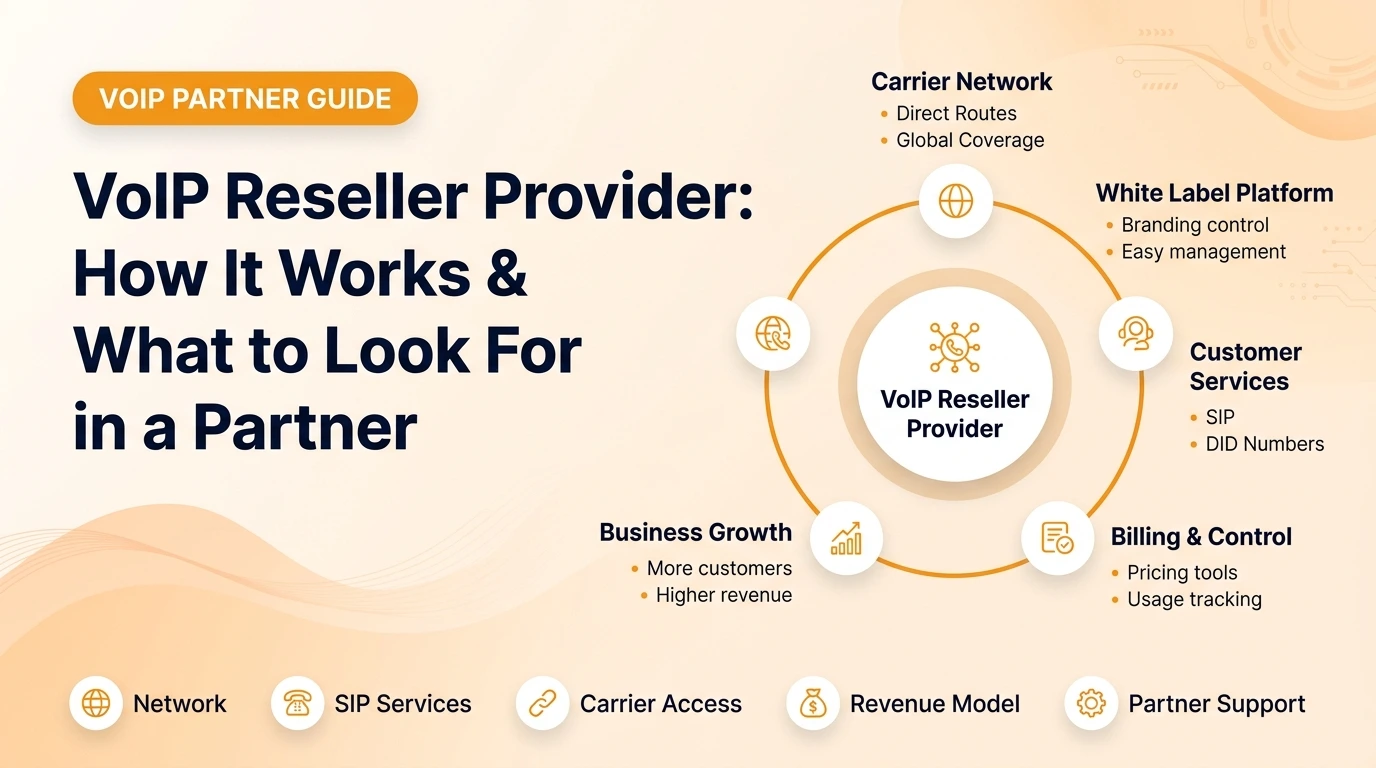
A VoIP reseller provider sits between the wholesale carrier and the end customer. It buys voice capacity from a larger telecom network, packages it under its own brand, and delivers it to businesses that need calls, numbers, and communication tools — without building a single switch or data centre. This guide covers how the reseller model works, what revenue models make sense at different scales, what to look for in a wholesale VoIP partner, and what the businesses you serve actually need delivered on day one.
On this page:
- What a VoIP Reseller Provider Is
- How the VoIP Reseller Model Works
- What VoIP Resellers Actually Sell
- Revenue Models — Per-User, Usage, and White-Label
- White-Label VoIP: What It Means in Practice
- How to Choose a Wholesale VoIP Partner
- Building a VoIP Reseller Business That Holds
- Why letsdial Works for Resellers
- Frequently Asked Questions
What a VoIP Reseller Provider Is
A VoIP reseller provider is a business that purchases wholesale voice and communication services from a carrier or platform, then packages and sells them to end customers — often under a different brand name. The reseller doesn't own the physical network. What it owns is the customer relationship, the billing, the support experience, and often the brand the customer sees. The underlying infrastructure — switches, carrier routes, data centres — belongs to the wholesale partner.
This model has been standard in telecom for decades. VoIP shifted it to software. Instead of leasing copper lines to resell, today's resellers deploy SIP trunks, cloud phone platforms, and contact centre software — sourced wholesale, delivered under their own label. More detail sits on our wholesale page.
How the VoIP Reseller Model Works
A reseller signs a wholesale agreement with a provider that has carrier-grade infrastructure. The provider grants access to voice capacity, phone numbers, and platform features. The reseller sets its own pricing, manages its own customers, and controls what the end user sees. The chain runs like this:
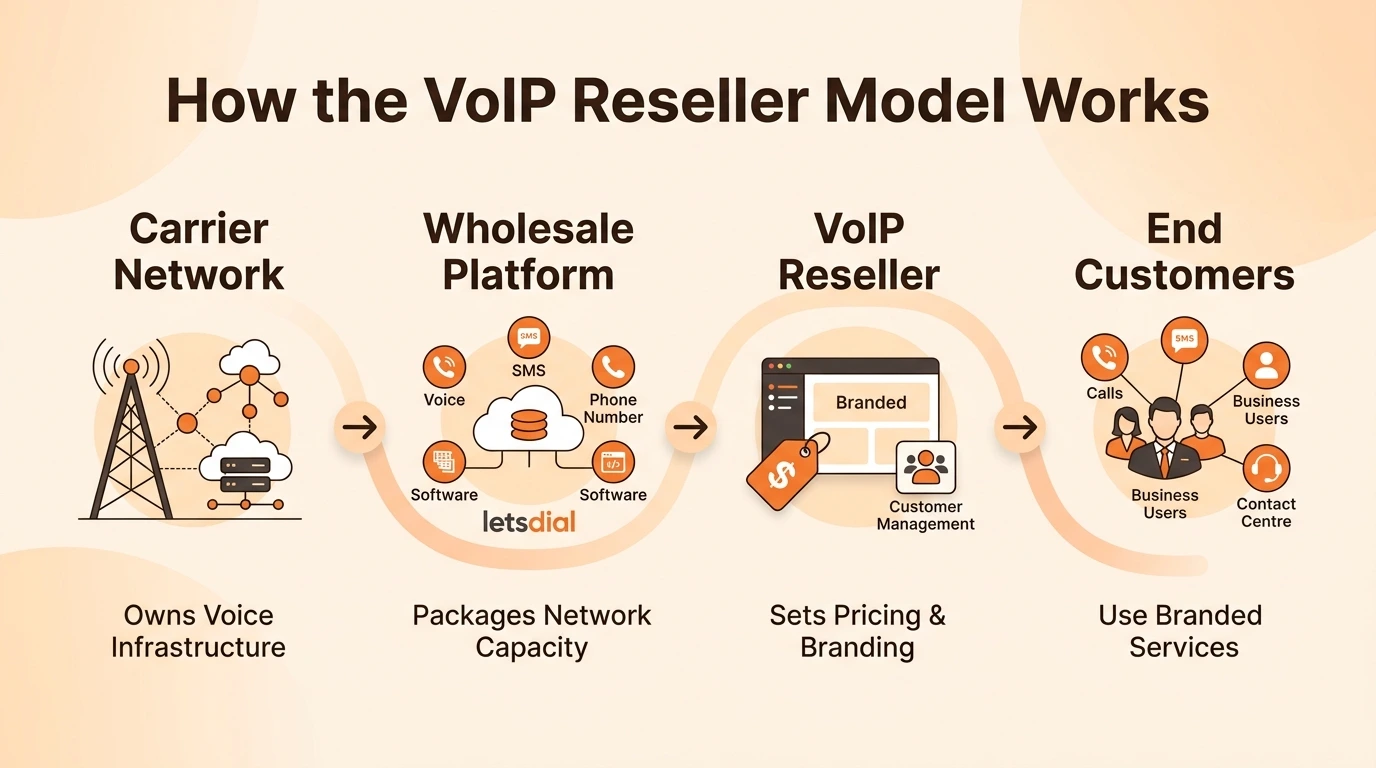
- A Tier-1 or Tier-2 carrier owns the network infrastructure.
- A wholesale platform (like letsdial) aggregates that capacity and packages it with software features.
- The VoIP reseller purchases access from the wholesale platform.
- The reseller's end customers make calls, send SMS, and run contact centre queues through the reseller's branded interface.
At no point does the end customer need to understand who built the underlying network. Their experience is defined entirely by the reseller's platform, pricing, and support quality. More detail sits on our letsdial platform page.
What VoIP Resellers Actually Sell
The core product is voice — inbound and outbound calling over the internet, delivered to any device. But most resellers bundle considerably more than raw calls:
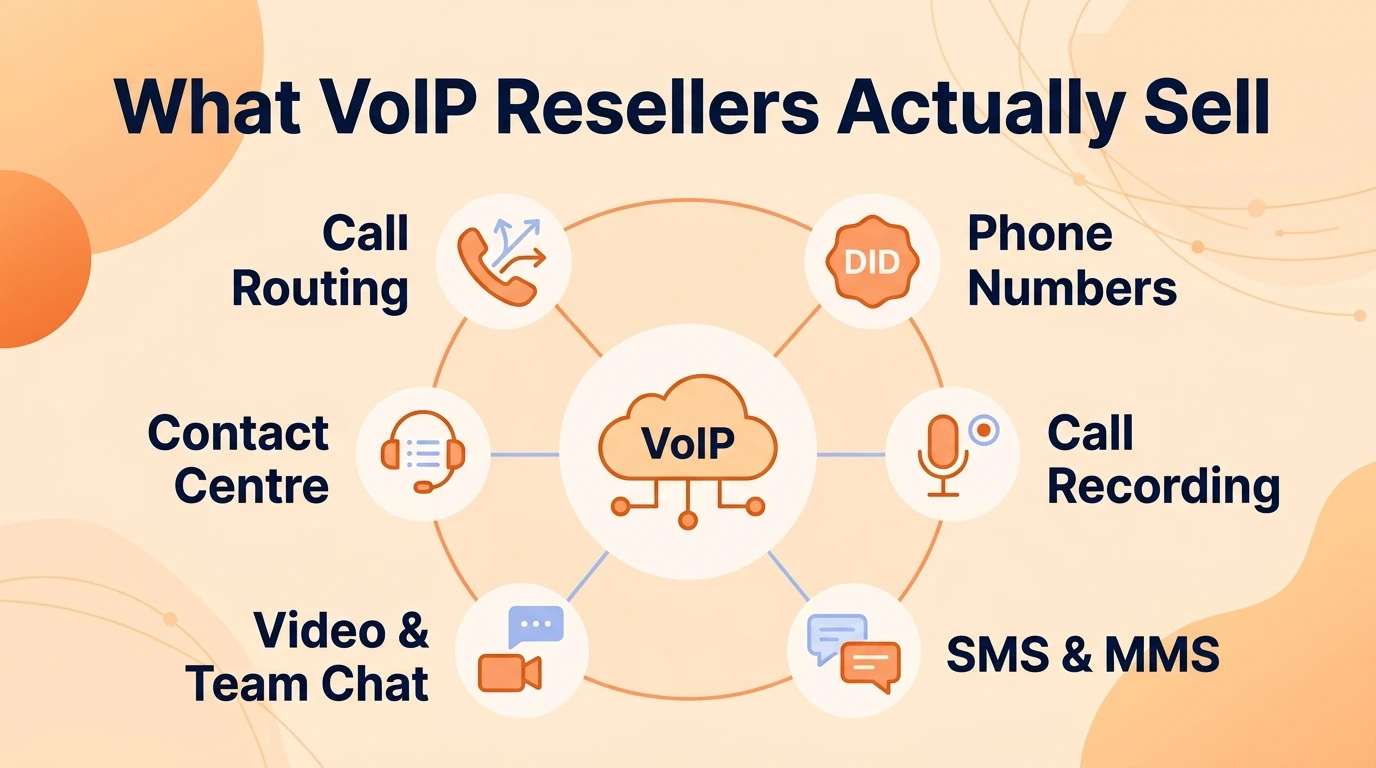
- Call routing and termination — connecting calls across domestic, international, and toll-free routes, with failover handled by the underlying network.
- Number provisioning and porting — assigning local, national, and toll-free DIDs and handling number transfers from previous carriers.
- Call recording and storage — capturing and retaining call audio for compliance, quality review, and coaching.
- SMS and MMS — two-way text messaging on the numbers customers already use for voice.
- Video and team communication — HD video rooms, internal chat, and shared inboxes alongside voice.
- Contact centre features — queues, IVR, auto-dialers, and reporting for teams handling call volume at scale.
The reseller's job is not to build these features — it's to select a wholesale partner that includes them, then package them into an offer that makes sense for the customer segments it serves. letsdial gives resellers carrier-grade voice, AI tools, and a full contact centre stack under one wholesale agreement.
Revenue Models — Per-User, Usage, and White-Label
How a reseller charges customers determines margin, churn risk, and how the business scales. The four most common models each suit a different type of reseller operation:
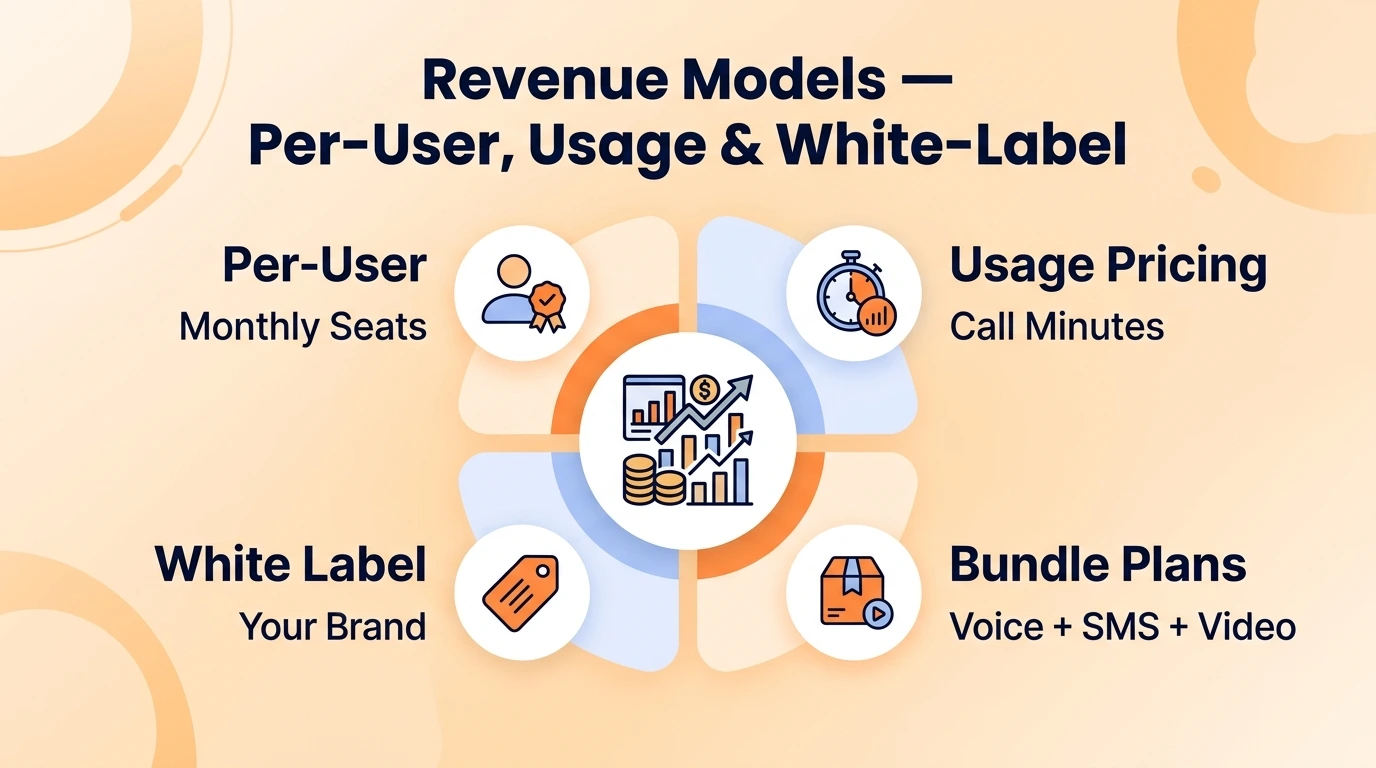
- Per-user licensing — charge per seat per month. Predictable and scales with seats; best for SMB and growing teams.
- Tiered usage pricing — charge per call-minute block. High margin with volume; best for high-volume outbound floors.
- Bundle packages — voice + SMS + video in one fee. Strong margin that reduces churn; best for teams wanting all-in-one.
- White-label resale — your brand on the platform. Highest margin and full control; best for agencies and managed IT providers.
Most resellers start with per-user licensing — it's predictable and easy to invoice. High-volume operations gravitate toward usage-based tiers where margin grows with call volume. White-label resellers running their own branded platform capture the highest margins but carry the most customer support responsibility.
White-Label VoIP: What It Means in Practice
White-label VoIP means the reseller's customers interact with a platform that carries the reseller's brand — not the wholesale provider's. The login screen, the mobile app, the invoice, the support email address: all of it looks like it comes from the reseller. The wholesale partner's name never appears in the customer experience, which protects the reseller's relationship and prevents direct poaching.
What white-labelling requires from the wholesale partner:
- Custom domain and branding support — logo, colours, and domain configuration.
- Suppression of the provider's name in all customer-facing interfaces and emails.
- Reseller-controlled pricing and billing — the provider invoices the reseller, not the end customer.
- API access for deeper integration into the reseller's own portals or CRMs.
> [WARN] Check before you sign: some platforms advertise white-label but still surface the provider's name in iOS/Android app store listings, email headers, or call metadata. Confirm every customer-facing touchpoint is fully suppressed before committing to a partner.
How to Choose a Wholesale VoIP Partner
The partner you choose determines what you can deliver. A reseller's reputation is built on the quality of the underlying network — and destroyed by its failures. Four criteria cut through most partner evaluations:
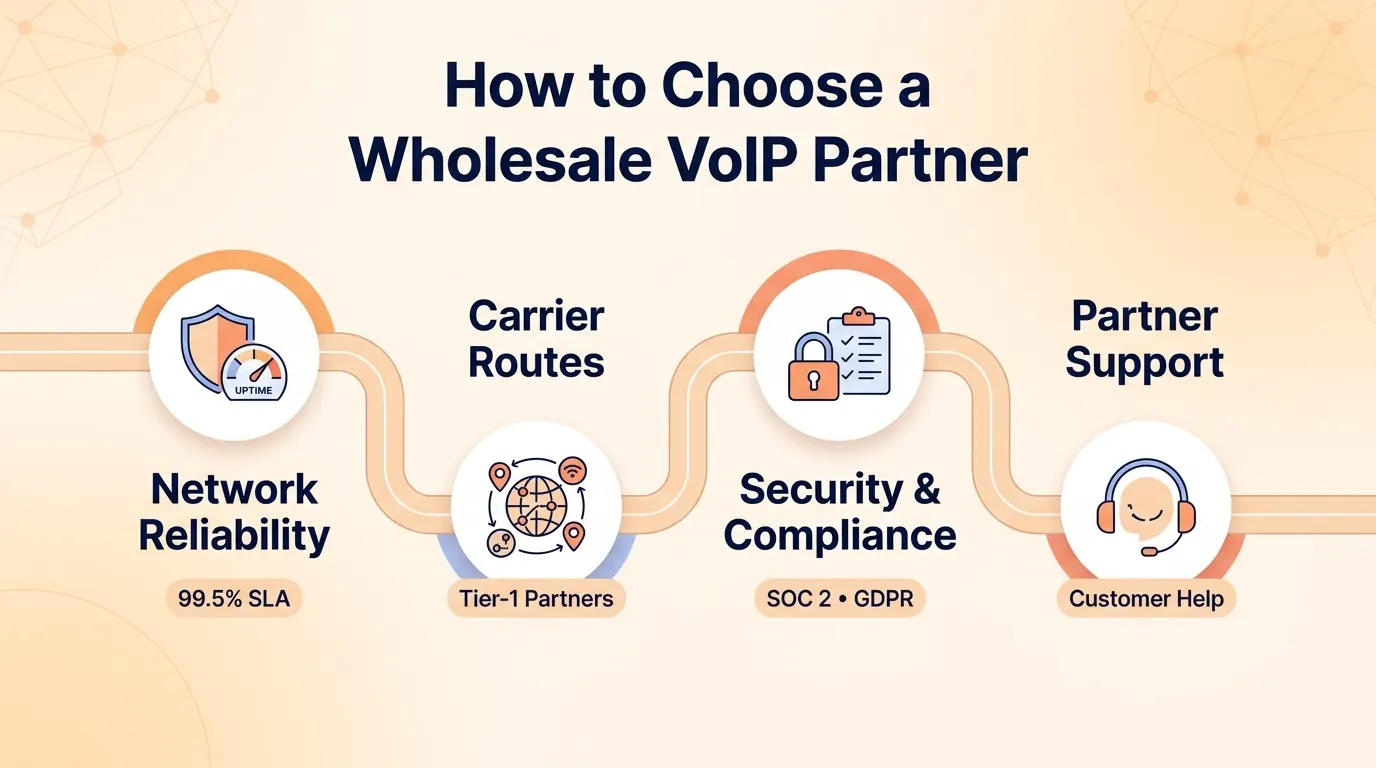
- Network reliability with a real SLA. 99.5% uptime is the floor, not a selling point. Ask for the SLA language, not just the number.
- Carrier-grade routes with named Tier-1 partners. Providers with direct interconnects deliver lower latency and more consistent call quality than those reselling Tier-2 or Tier-3 routes.
- Security and compliance covered by the platform. Selling to regulated industries requires SOC 2 Type II, HIPAA-readiness, PCI DSS, and GDPR already in place.
- Support that reaches your customers too. Confirm whether the partner's support is accessible for end-customer escalations, or whether you carry the full support burden yourself.
Tour the letsdial platform to see carrier-grade routing, compliance, and the full AI suite that comes with every plan.
Building a VoIP Reseller Business That Holds
Most reseller businesses that fail don't fail on technology. They fail on support, margin structure, or customer mix. A few operational decisions made early determine whether the business compounds or churns:
- Define your customer segment before you price. Pricing for a 5-seat startup looks different from a 200-seat contact centre — pick a segment and build support around it.
- Build 24-hour response capability before you acquire customers. Voice is synchronous; a downed phone system needs resolution in minutes, not hours.
- Tie customers to bundled value, not just price. Customers who stay because you're cheapest leave the moment someone is cheaper.
- Instrument everything from the start. Call quality metrics, ticket volume, churn rate by segment, and revenue per account tell you which customers are profitable.
Why letsdial Works for Resellers
letsdial carries calls across Tier-1 partner networks — Telin, MTT, Reliance Communications, Deutsche Telekom, China Mobile International, PLDT, and Telekom Slovenije — to 200+ countries, with local numbers in 100+ countries on sign-up and STIR/SHAKEN attestation at the switch. SOC 2 Type II, HIPAA-readiness, PCI DSS, and GDPR compliance are on every plan — AES-256 at rest and TLS 1.3 in transit are defaults, not add-ons.
Every call on every paid plan is transcribed automatically. AI summaries, sentiment analysis, an AI receptionist, and agent assist are included on every paid tier — zero per-minute AI fees. Cloud Phone, AI Contact Center, calls, SMS, video, and chat share one routing engine, one inbox, and one login. Number porting — in and out — is free both directions.
Conclusion
> [TIP] One wholesale agreement. Calls to 200+ countries. AI included on every plan. letsdial gives resellers carrier-grade infrastructure, full compliance, and a platform customers don't want to leave — starting at $9.99/user/month. See pricing.
Frequently Asked Questions
Written by Aryan Khan · June 30, 2026
Reply to the author