Introduction
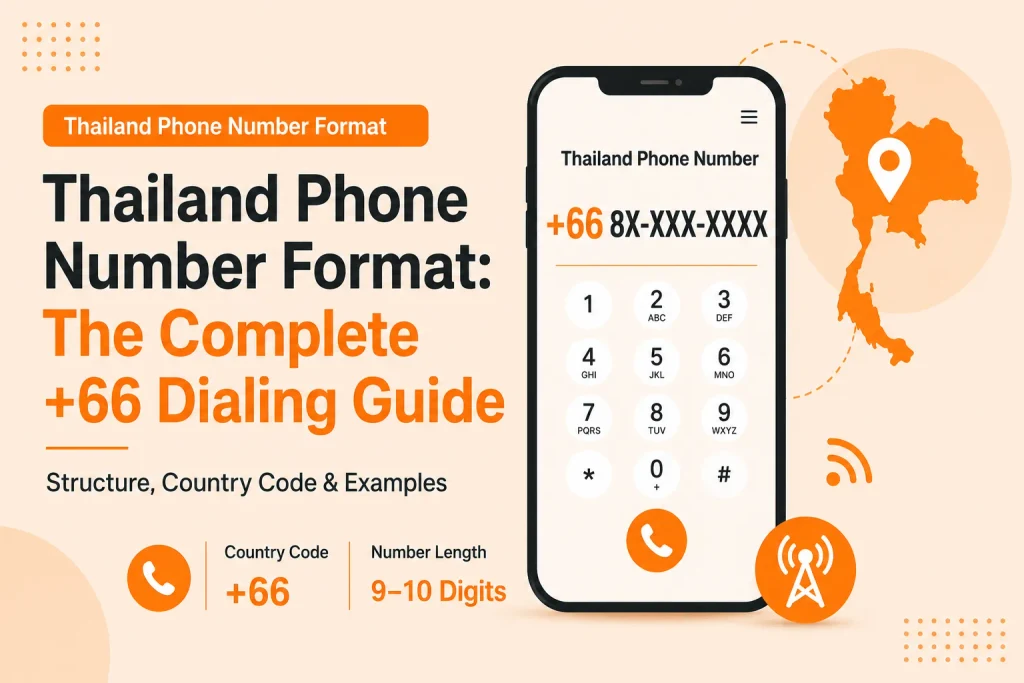
Thailand phone number format confuses more callers than almost any other Southeast Asian dialing code, because the digit count changes depending on whether you're reaching a mobile line or a landline. Get it wrong and a call to a supplier in Bangkok or a hotel in Phuket simply won't connect. This guide breaks down the +66 country code, the leading zero rule, and the mobile-versus-landline digit counts that trip up even frequent callers. By the end, you'll dial any Thai number correctly on the first try.
Key takeaways
- Thailand phone number format uses 9 digits after +66 for mobiles and 8 digits after +66 for landlines.
- The leading 0 in a domestic Thai number is always dropped once +66 is added in front of it.
- Bangkok's landline area code is really a single digit, 2, not the two-digit 02 seen in domestic writing.
- Thailand requires the complete number for every call, even within the same city, with no shortened local dialing.
Understanding the Thailand phone number format
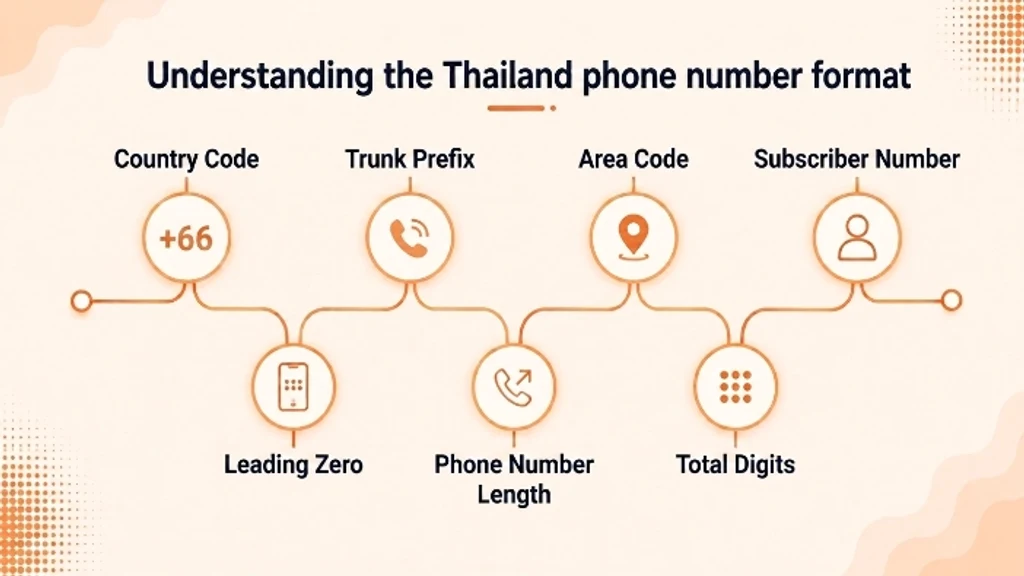
The Thailand phone number format breaks into three parts: the +66 country code, a prefix that identifies either a city or a mobile carrier, and a subscriber number. Every Thai number follows this basic pattern, whether it belongs to a noodle shop in Chiang Mai or a switchboard in Bangkok. The same structure shows up in the country code guide for Nigeria. What changes is the length of the prefix and subscriber number depending on the line type. Pair the Thailand country code with the wrong digit count and international routing rejects the call before it rings.
Most callers assume every country runs one consistent number length. Thailand does not — mobile and landline numbers carry different digit counts after the country code, and that single fact causes most misdialed calls into the country.
Mobile numbers carry 9 digits after the country code
Domestic format comes first
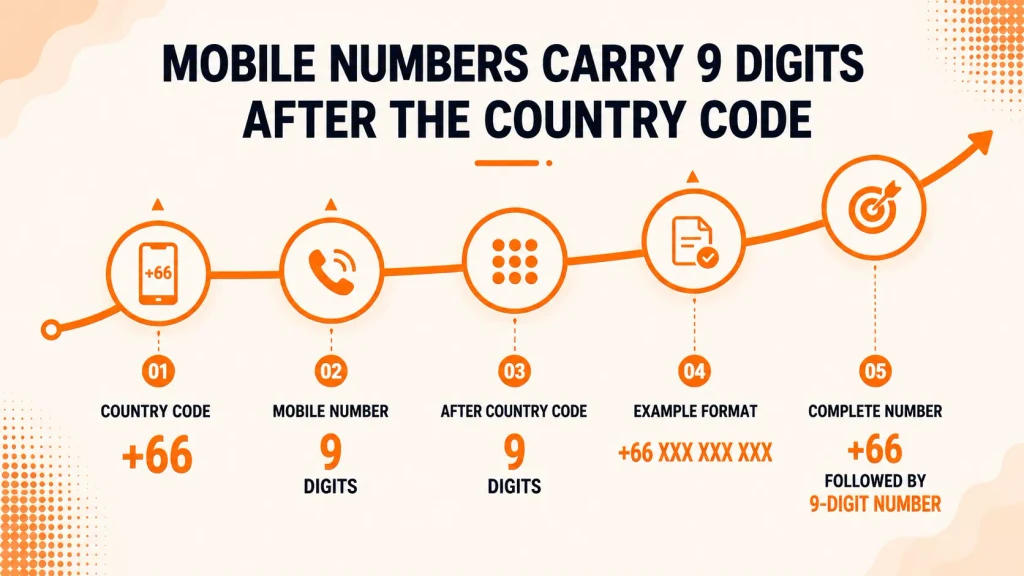
Written locally, a Thai mobile number looks like 08X-XXX-XXXX: a leading zero, a two-digit carrier prefix, and a seven-digit subscriber number. That is ten digits in total, and Thai callers dial every one of them even for a call across the street.
Dropping the zero for international calls
Remove the zero and add +66, and 081-234-5678 becomes +66 81 234 5678, nine digits after the country code. That single swap covers the mobile half of the Thailand phone number format.
- AIS — Thailand's largest network, prefixes largely in the 06, 08, and 09 ranges
- True Corporation — formed from the 2023 merger of True Move H and dtac, running both legacy prefix ranges
- NT Mobile — the smaller state-owned carrier, formed from the TOT and CAT merger
Number portability means an old prefix no longer guarantees which carrier actually owns the line today — the dialing format doesn't change either way.
Landline numbers carry 8 digits after the country code
The same Thailand phone number format logic applies here, just with one fewer digit once the country code is in place.
Bangkok's area code is really one digit
A Bangkok landline reads 02-XXX-XXXX domestically, which looks like a two-digit area code but is not. The first zero is the trunk prefix, and "2" is the entire Bangkok code, so the international version is +66 2 XXX XXXX rather than +66 02.
Provincial codes run two digits
Outside the capital, area codes take the shape 0XX and the subscriber number runs six digits instead of Bangkok's seven.
- Chiang Mai — 053 domestic, +66 53 internationally
- Phuket — 076 domestic, +66 76 internationally
- Chonburi / Pattaya — 038 domestic, +66 38 internationally
Toll-free and short service numbers skip the rule entirely
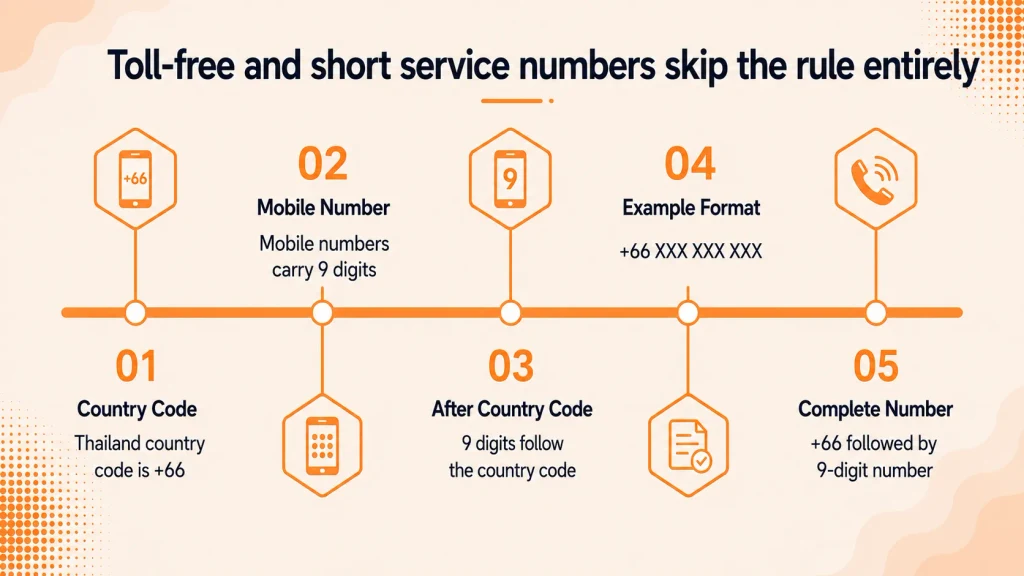
Thai toll-free numbers begin with 1800 and are free to dial from any landline inside the country, while some premium service lines begin with 1900. A separate category of four-digit short codes, such as 1155 for the Tourist Police and 1669 for ambulance dispatch, never take a country code, an area code, or the leading zero at all. Most guides to Thailand phone number rules skip this category entirely, yet it explains why certain short numbers on Thai signage never seem to fit the +66 pattern.
Reading a number someone sends you
Thai contacts rarely write their own numbers consistently, and a number pasted from an invoice, a hotel confirmation, or a WhatsApp message will not always show the +66 prefix. Apply the same Thailand phone number format rules in reverse: count the digits after any leading zero, treat nine digits as a mobile pattern and eight as a landline pattern, then rebuild the international version yourself if the sender left off the country code. A hotel confirmation showing 076-234-567 is a Phuket landline; a business card showing 089-123-4567 is a mobile.
How to call Thailand from abroad
Every international call into Thailand follows the same three-step sequence: dial your own country's exit code, dial Thailand's country code (66), then dial the local number with the leading zero removed.
- From the US or Canada — start with 011
- From the UK or most of Europe — start with 00
- From Australia — start with 0011
- From any mobile phone worldwide — the + sign handles the exit code automatically
Calling within Thailand has no shortcuts
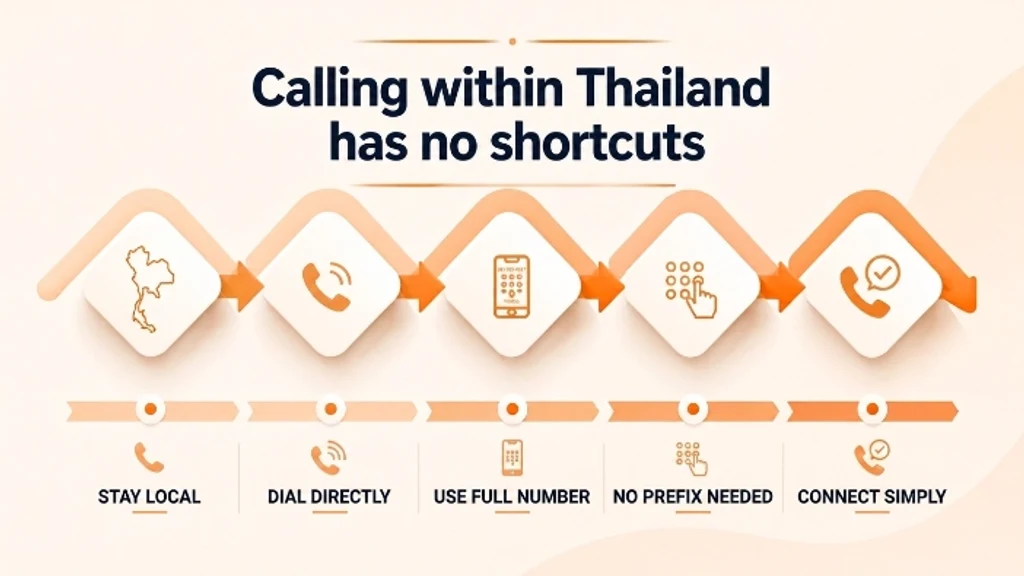
Many countries let a caller in the same city drop the area code and dial only the subscriber number. Thailand does not work that way — every domestic call, mobile or landline, same building or opposite coastline, uses the complete number with its leading zero intact. That single design choice is the most common thing first-time visitors get wrong.
Thailand time zone and the best time to call
Thailand runs on Indochina Time, a flat UTC+7 with no daylight saving adjustment, so the gap between Thailand and anywhere else never shifts twice a year the way it does across the US and Europe.
- US Eastern Time — 11 hours ahead in winter, 12 ahead in summer
- US Pacific Time — 14 hours ahead in winter, 15 ahead in summer
- UK (GMT/BST) — 6 to 7 hours ahead depending on the season
Standard Thai office hours run roughly 8:30 a.m. to 5:30 p.m. ICT, so an evening call from the US East Coast usually lines up with the start of the Thai business day.
Mistakes that break a call to Thailand
- Keeping the leading zero next to a +66 — the single most common error, and it fails the call outright.
- Writing Bangkok's code as "02" internationally instead of the correct single digit, "2".
- Assuming every Thai number is the same length — mobiles run nine digits after +66, landlines run eight.
- Guessing a carrier from an old prefix — portability has decoupled prefixes from networks for years.
Whether the goal is a Thai mobile number format lookup for one call home or a repeatable process for a support queue dialing Thailand daily, the same three rules apply: match the digit count to the line type, drop the zero only when +66 is present, and never assume a domestic shortcut exists — a pattern documented in Thailand's own numbering plan history.
Where this leaves you
Thailand phone number format rules reward a bit of memorization once, because the pattern never changes after that. Mobile numbers carry nine digits after +66, landlines carry eight, and every domestic call uses the complete sequence regardless of distance. Toll-free and short service codes sit outside the pattern entirely and only work from inside the country.
Getting comfortable with the Thailand phone number format now saves a repeated round of failed calls and re-typed numbers later. Businesses that call Thailand often tend to standardize this at the platform level rather than relying on every employee to remember the rule, and letsdial is one of the tools built for exactly that kind of consistency.
Frequently Asked Questions
Written by Aryan Khan · July 21, 2026
Reply to the author