Introduction
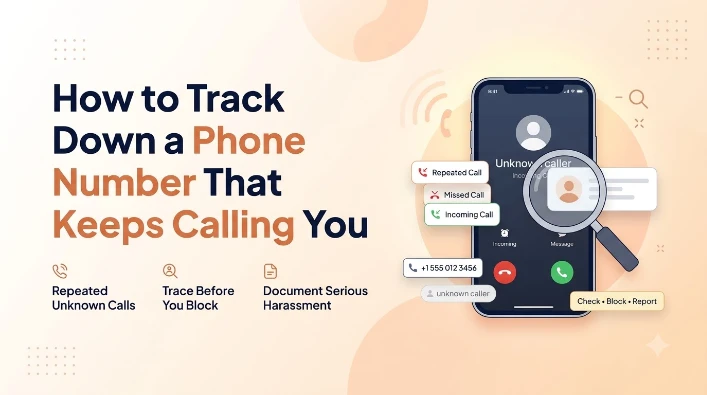
The same unfamiliar number has called three times this week, no voicemail left, no text explaining who it is. That's usually the moment someone starts trying to track it down, and the instinct to just call back and ask is often the wrong first move, since it confirms your own number is active to whoever's on the other end, scammer or not. A few minutes of tracing beforehand answers most of the question without ever picking up.
This guide walks through safer ways to trace an unknown number, starting with what the digits themselves reveal, moving through free lookup tools and reputation databases, and covering what to do when a number turns out to be spoofed or the calls cross into actual harassment.
What "Tracking Down a Number" Actually Covers
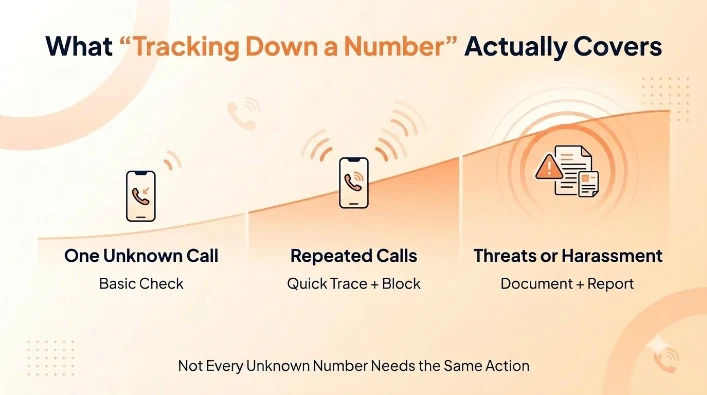
Not every unknown call warrants the same response, so it helps to separate the situation before picking a method. A single unfamiliar call is usually just curiosity. A number calling repeatedly with no message is worth a quick trace before deciding whether to block it. A number making threats or calling obsessively is a different category entirely, one where identifying the caller matters less than documenting and reporting what's happening as it continues.
Start With the Number Itself
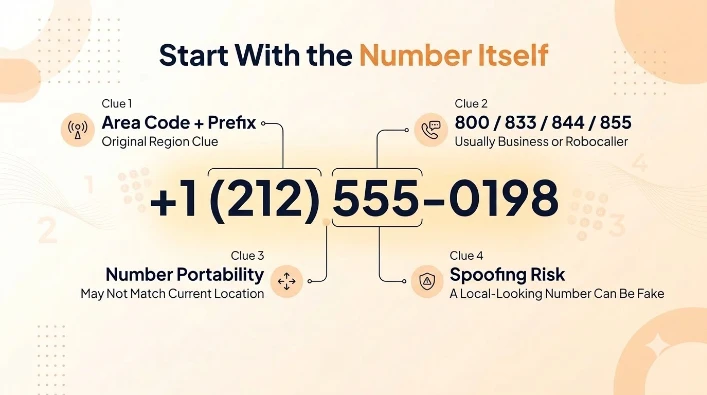
Before reaching for any tool, the digits themselves carry information. The area code and prefix, the first six digits total, generally indicate the region and carrier a number was originally issued to, even though number portability means someone can carry that number across the country after moving. A number formatted like a toll-free line (800, 833, 844, 855, 866, 877, 888) rules out a personal caller entirely and points toward a business, survey line, or robocaller instead.
One caveat worth knowing upfront: a caller ID showing a familiar-looking local number doesn't guarantee that's genuinely who's calling. Spoofing lets a caller display any number they choose, including ones that look like they belong to a neighbor or even your own contacts, specifically to make an unfamiliar or scam call look trustworthy enough to answer.
Neighbor Spoofing and the One-Ring Scam
Two specific scam patterns explain most of the unfamiliar-but-oddly-local calls people track down. The first, which the FCC has issued formal warnings about, is called neighbor spoofing, or NPA-NXX spoofing in industry terms: a scammer deliberately picks a number sharing your exact area code (NPA) and prefix (NXX) so the call looks like it's coming from someone a few blocks away, even when the actual call originates from another country entirely. It's a trust trick, nothing more, engineered specifically to raise the odds you'll answer.
The second is the one-ring or Wangiri scam, named from the Japanese for "one ring and cut." The call disconnects after a single ring, leaving a missed call from an unfamiliar, often international, number designed to bait a callback. Returning that call connects to a premium-rate line that racks up per-minute charges, sometimes split between the scammer and whatever carrier is hosting the premium number. The single most effective defense against both patterns is the same: never call back a number you don't recognize, trace it through search or a reputation database instead.
Free and Quick Ways to Trace a Number
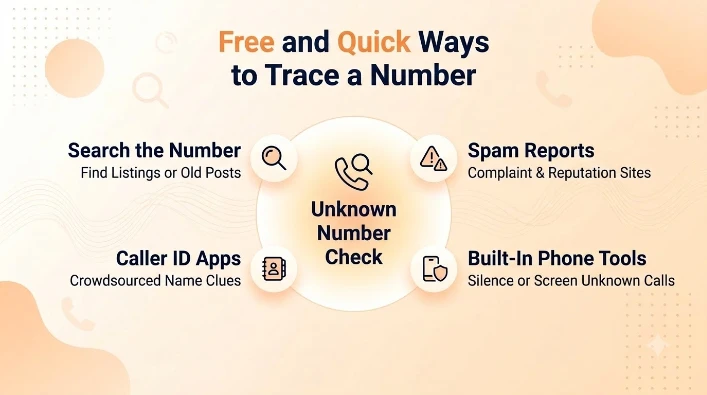
A handful of no-cost methods clear up most unknown numbers without installing anything. Searching the exact number in quotation marks in a search engine often surfaces complaint forums, business listings, or old classified posts where that same digit string has shown up before. Dedicated reputation and robocall-reporting sites let users flag numbers as telemarketing, scam, or spam, so a number with dozens of matching complaint reports is a strong signal even without a name attached. Caller ID apps add a crowdsourced layer on top of that, showing how a number is commonly saved across other users' contact lists.
Built-in phone features handle some of this automatically now, too. iPhone's Silence Unknown Callers routes anything not already in your contacts straight to voicemail instead of ringing, and Google's Call Screen on Pixel phones has an assistant answer first and show a live transcript of what the caller says before you decide whether to pick up. Neither identifies who's calling the way a dedicated trace does, but both cut down on the number of unknown calls that need tracing in the first place.
Cross-Checking the Number Against Social Media
If a trace turns up a name rather than just a spam label, checking whether that number links to an active social media account is a reasonable next step for confirming the identity is real rather than a scammer using a stolen or fabricated name. An account that's been active for years with a consistent history is a very different signal from no result at all.
When the Trail Leads to a Registered Line
Numbers that trace back to a real, non-spoofed line sometimes resolve through the same channels used for a more general phone number search, directories, people-search sites, and public business listings. The distinction that matters here is whether the number was ever meant to be found: a business line publishing its own number wants to be traced, while a personal cell showing up unexpectedly in the same search is a sign the number simply hasn't been scrubbed from an old public record.
Line type is worth checking too, since it changes what a trace can realistically confirm. A landline or postpaid mobile number tied to a long-standing carrier account tends to resolve to a name reliably, since that billing relationship has existed for years. A prepaid mobile number or a VoIP line purchased specifically for a scam campaign often has no comparable history behind it at all, which is why a trace on those numbers frequently dead-ends at "VoIP provider, no additional information" rather than a name.
Reporting Spam and Robocalls
Identifying a number isn't always the goal, sometimes stopping it matters more than knowing who's behind it. Forwarding a spam text to 7726 (SPAM) reports it directly to most carriers, and the FCC's guide to stopping unwanted robocalls and texts covers how to file a formal complaint, what the agency's rules on robocalls and spoofing actually prohibit, and which call-blocking features are built into iPhone and Android by default.
When It's More Than a Nuisance: Police Reports and Carrier Trace
Repeated threatening or harassing calls call for a different process than a spam trace. Filing a police report first gets an incident number, which most carriers require before they'll open a trace through what's often called an Annoyance Call Bureau. Many carriers also support a call-trace code, commonly *57, dialed immediately after a harassing call ends, which logs the number even if it was blocked or hidden from caller ID and forwards that log to law enforcement rather than back to the person who dialed it.
A useful clarification here is who actually holds the tracing ability at this stage: it isn't the police department itself, since a department has no direct access to carrier call records. The carrier performs the trace and hands the result to law enforcement, which is exactly why the incident number matters so much, it's the credential that makes the carrier act at all rather than treat the request as an ordinary customer inquiry. Keeping a simple log, date, time, call length, and anything the caller said, gives that eventual police report far more to work with than a vague description of "repeated calls" would.
Conclusion
Tracking down an unknown number usually starts small: read what the digits themselves suggest, run a quick search, check a reputation database, and see whether the trail connects to a real name or social presence. Most numbers resolve at that stage. The ones that don't, spoofed numbers or calls that escalate into harassment, need a different track entirely, one that runs through a carrier's Annoyance Call Bureau and a police report rather than another lookup tool.
For a business fielding calls from numbers customers don't recognize, the fix runs the other direction: a Letsdial number with verified caller ID and call analytics means the business itself never becomes the unidentified number someone else is trying to trace, and every inbound call gets logged with enough detail that a customer's call history is never a mystery on your end either. Set up a Letsdial number today and make sure your business is always the caller people recognize.
Frequently Asked Questions
What does dialing *57 actually do?
It's a call-trace code supported by many U.S. carriers that logs the number of the last incoming call, even if it was hidden from caller ID, and forwards that log to law enforcement rather than displaying it to you directly.
Frequently Asked Questions
Written by Aryan Khan · August 12, 2026
Reply to the author