Introduction
The 801 area code is the number the Wasatch Front has answered to since the dawn of direct dialing — the original prefix for the entire state of Utah, now concentrated along the urban corridor that runs from Ogden through Salt Lake City to Provo. It is the number locals recognize on sight, the one that reads as home in the valleys beneath the Wasatch Range.
This guide walks through where the 801 area code reaches, the industries that define its economy — state government, the Silicon Slopes tech corridor, two flagship universities, and finance — its Mountain Time calling window, the overlay that now shares its territory, and how to put a Wasatch Front number in front of customers in minutes.
Where the 801 Area Code Reaches
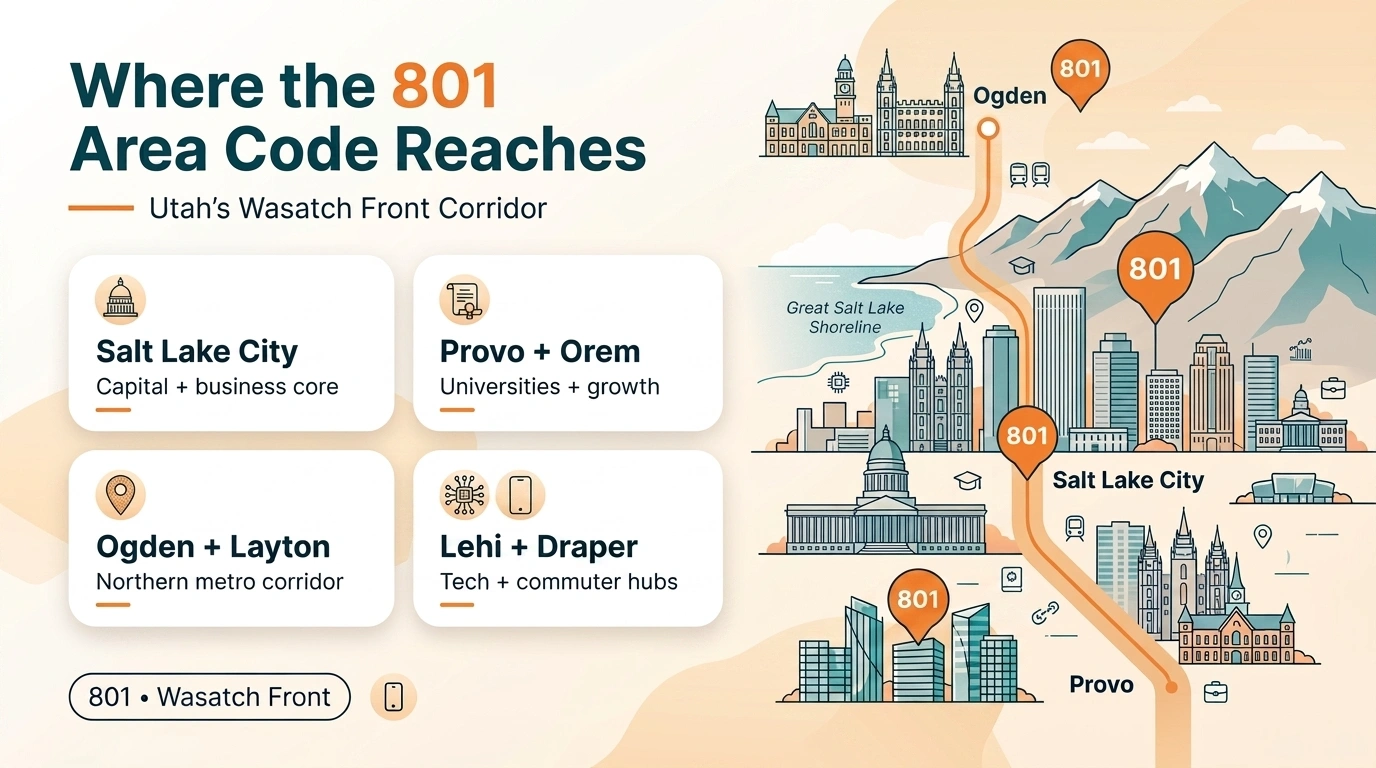
The 801 area code covers the Wasatch Front, Utah's most populous urban corridor, a dense strip of cities pinned between the Great Salt Lake and the mountains. It is a compact metropolitan footprint rather than a sprawling rural code.
- Salt Lake City — the state capital and largest city, anchoring government, finance, and the University of Utah
- Provo — home to Brigham Young University and the southern anchor of the corridor
- Ogden — the northern rail and manufacturing hub above the Salt Lake Valley
- West Valley City and Sandy — the largest suburbs filling out the Salt Lake metro
- Orem and Lehi — Utah County growth cities inside the tech corridor
- Layton and Draper — commuter and technology suburbs at the corridor's north and south ends
Because the corridor is so concentrated, an area code 801 line signals a genuine Wasatch Front presence rather than a generic out-of-state number. From Ogden to Provo, a single prefix identifies a business as local across the whole metropolitan spine. The 385 area code guide covers the neighbouring ground.
Salt Lake City, Government, and Finance
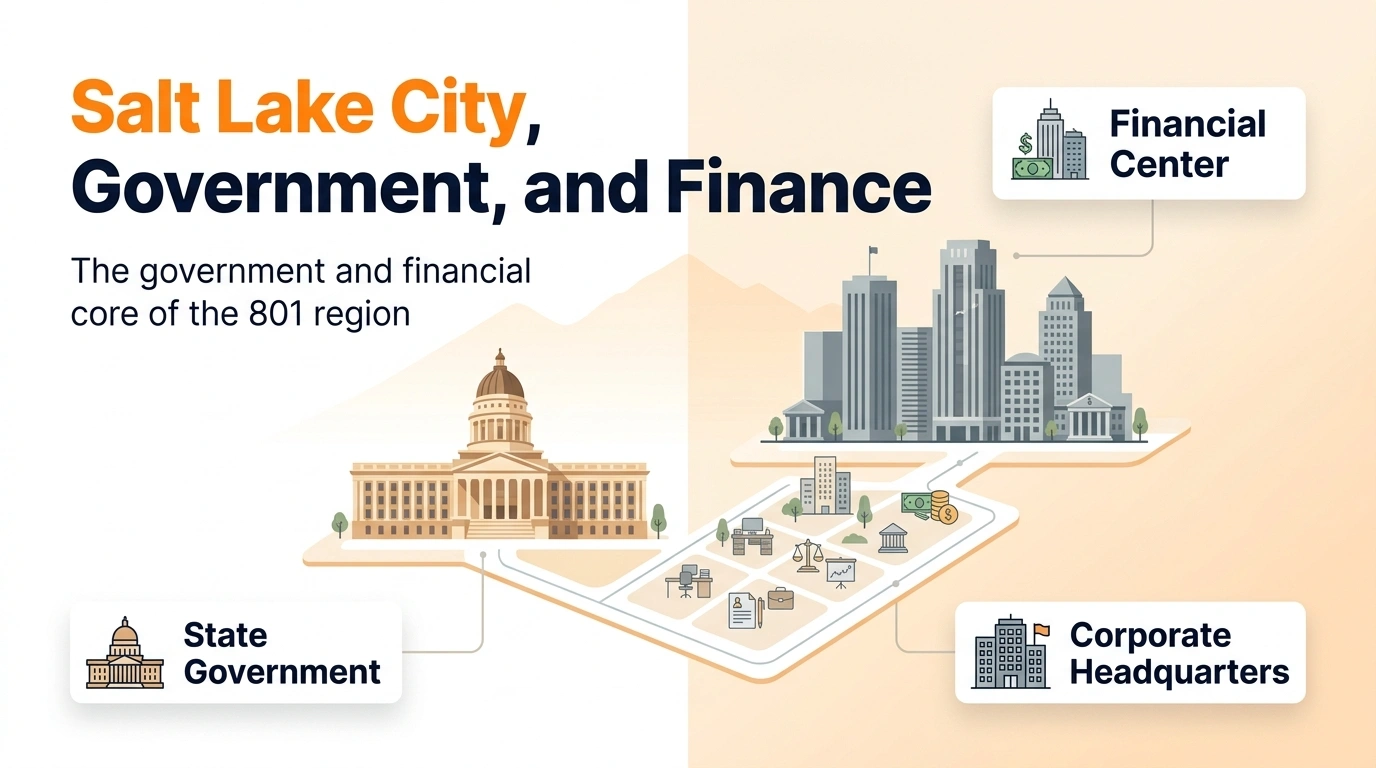
Salt Lake City anchors the 801 area code as the state capital and its largest metropolitan market. State government, finance, and the global headquarters of The Church of Jesus Christ of Latter-day Saints form the economic spine of the Salt Lake Valley.
The State Capital
The capitol complex and the surrounding agencies add thousands of government, legal, and contracting jobs to the metro. Utah's official portal at utah.gov lists the agencies, permits, and business filings that govern operators and vendors across the state.
Finance and Headquarters
Salt Lake City has grown into a regional financial center, with banking, wealth management, and a cluster of corporate headquarters downtown. The city's role as the seat of a major global institution keeps professional services central to the 801 workforce. More detail sits on our Utah area codes page.
Silicon Slopes and the Technology Corridor
The stretch of the 801 area code between Lehi and Draper has earned the nickname "Silicon Slopes," one of the fastest-growing technology corridors in the country. Major software and SaaS employers such as Adobe, Qualtrics, and Ancestry cluster along the Point of the Mountain between Salt Lake and Utah counties.
A Fast-Growing SaaS Base
The corridor has drawn venture capital, engineering talent, and a wave of startups that treat the Wasatch Front as a genuine tech hub rather than a satellite market. Software, cloud services, and data companies fill the office parks that line the freeway through Lehi and Draper.
For a business working the whole corridor, the 801 area code shares its map with the 385 area code overlay added in 2009 — both prefixes ring every Wasatch Front city, so a modern number can wear either code.
Why a Local Line Matters
In a market this dense with outreach, a recognizable local number gets answered faster. Vendors and partners along the corridor pick up a familiar 801 line ahead of an unknown out-of-state caller, and that first impression often decides whether the conversation happens at all.
Universities and the Talent Pipeline

Higher education anchors much of the 801 economy, led by two flagship institutions. The University of Utah in Salt Lake City drives research, a major academic medical system, and startup activity across the northern corridor.
Brigham Young University in Provo enrolls tens of thousands of students and feeds a steady pipeline of graduates into the Silicon Slopes tech corridor and the region's professional economy. Together the two universities keep the Wasatch Front supplied with the engineers, analysts, and healthcare workers its employers depend on.
Beyond the flagships, a network of colleges and technical schools fills out the corridor's education map, reinforcing why reliable local phone service matters for recruiters, admissions offices, and campus vendors reaching families across Utah.
Aerospace, Mining, and Industry
Beyond tech and government, the 801 footprint carries a deep industrial base. Aerospace and defense manufacturers operate across the northern corridor around Ogden, while mining and materials extraction remain long-standing pillars of the Utah economy.
Rail connections through Ogden tie the corridor to the national freight network, and the manufacturing plants that ring the Salt Lake Valley keep a working-economy character alongside the software offices to the south. That mix gives the Wasatch Front a broad employer base rather than a single dominant industry.
Time Zone and Calling Hours for the 801 Area Code
The entire 801 area code observes Mountain Time — UTC-7 (MST) in winter and UTC-6 (MDT) during Daylight Saving. The Wasatch Front shares the clock with Denver, Phoenix in summer, and the rest of the Mountain West.
East Coast teams calling area code 801 are two hours ahead, so late-morning outbound campaigns on the Eastern seaboard land during the early Wasatch Front workday — plan around the two-hour gap to catch the full business day.
801 History
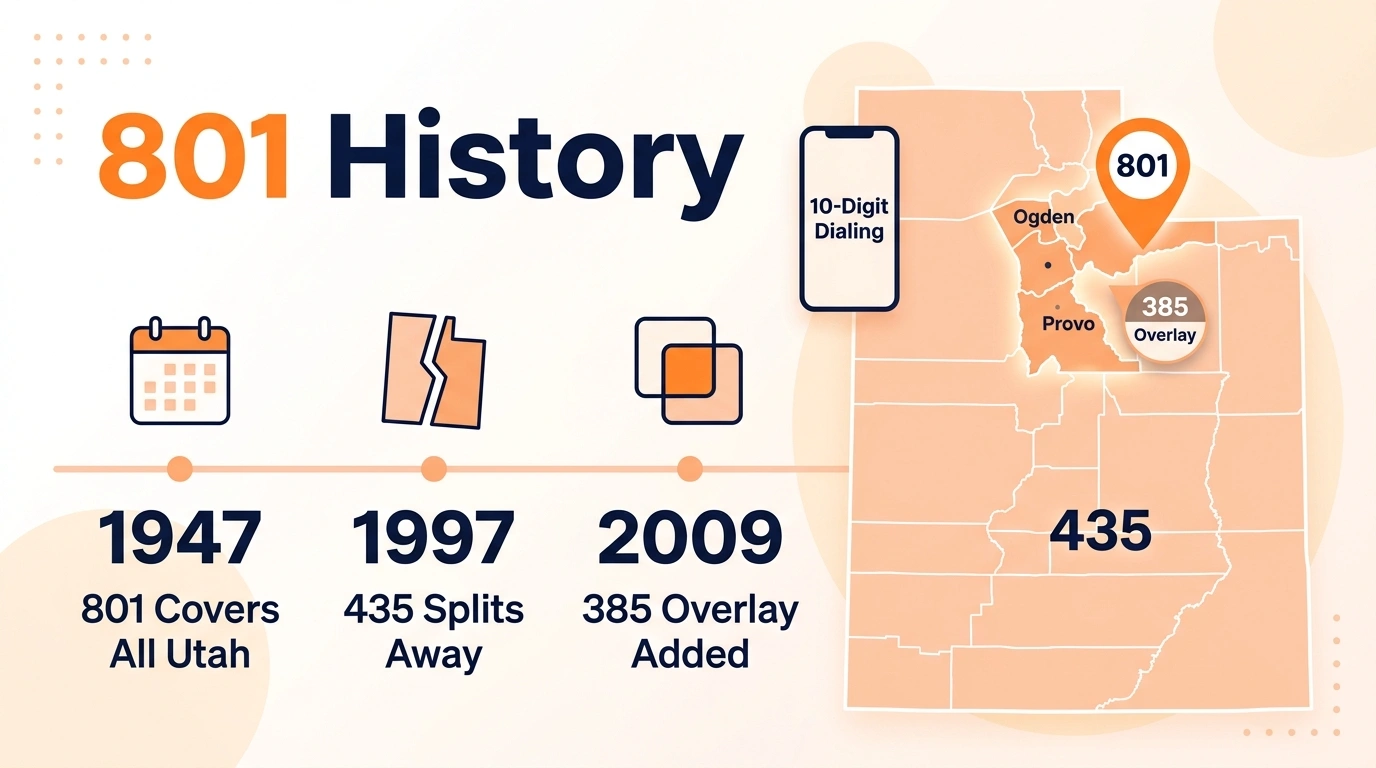
The 801 area code is Utah's original area code, assigned in 1947 as one of the first prefixes in the North American numbering plan, and it covered the entire state by itself for decades. For most of the twentieth century, a single code answered from the Wasatch Front to the remotest desert county.
By the 1990s, growth in wireless lines and second numbers had drained the supply. In 1997 the rural remainder of the state split off to the new 435 code, leaving 801 on the populous urban corridor. In 2009 the 385 overlay was added on top of the same Wasatch Front territory for more numbering capacity, so 801 and 385 now share the map and ten-digit dialing is standard. A full breakdown of Utah area codes covers all three side by side.
How to Get an 801 Area Code Number
- Cloud phone platform — search available 801 numbers in real time and activate a line the same day, with no hardware and no technician visit.
- Port your existing number — already run an 801 line on another carrier? Move it over without downtime and keep the number active through the transition.
- Wireless SIM or landline carrier — valid for a single physical handset, but slower to provision and harder to scale seat by seat.
With letsdial, an area code 801 number provisions in under three minutes on a free trial, no credit card required, so a Wasatch Front presence can be answering calls the same afternoon.
Call Trust in the Wasatch Front Market
The 801 area code market runs on institutional relationships — state contracts, tech procurement, and university vendor channels — where an unknown out-of-state number gets screened before it is answered. A recognizable local prefix earns the first hearing, and in a corridor that fields constant cold outreach, that first impression often decides whether the call connects.
STIR/SHAKEN for Government, Tech, and Education
Apply STIR/SHAKEN attestation so every outbound 801 call arrives verified with your registered business name on screen. With letsdial, register text campaigns for 10DLC compliance from day one and warm new numbers before scaling volume.
A verified area code 801 line that displays a real business name reads as Wasatch Front-local rather than out-of-area — the difference between a procurement officer picking up and routing the call to voicemail. That record is published in full as utah.gov.
Conclusion
The 801 area code carries more history than almost any prefix in the Mountain West — Utah's original statewide line since 1947, now concentrated on the Wasatch Front and paired with a modern overlay, but still the number the region recognizes first. From Salt Lake City's capitol to the Silicon Slopes corridor and the campuses in Provo, it identifies a business as genuinely local.
Standing up a line takes minutes on a cloud platform, with STIR/SHAKEN attestation so calls arrive verified rather than flagged. Put a Wasatch Front number in front of state agencies, tech buyers, and university vendors, and let a familiar prefix open the door before the first word is spoken.
Frequently Asked Questions
Written by Aryan Khan · August 28, 2024
Reply to the author