Introduction
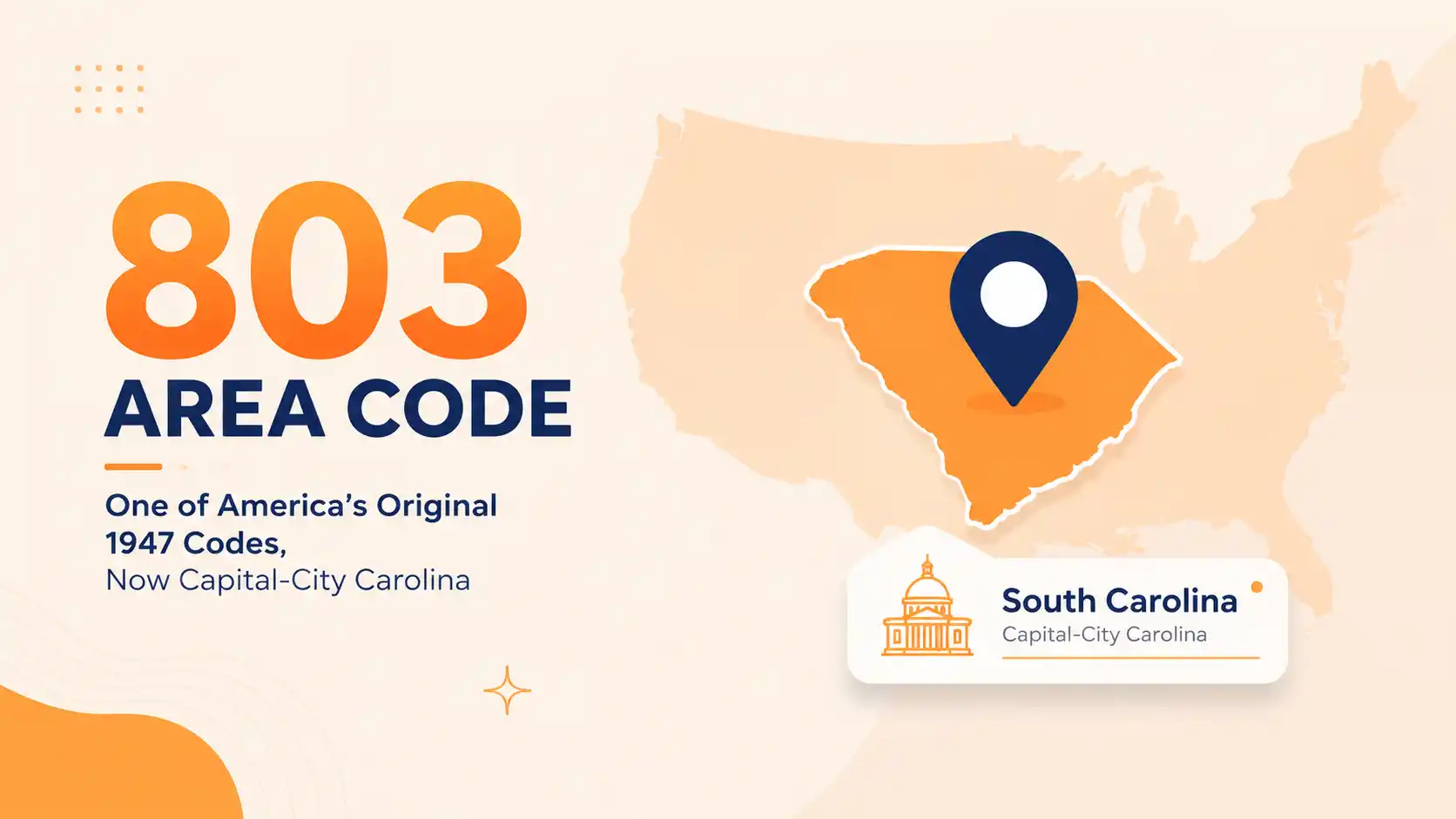
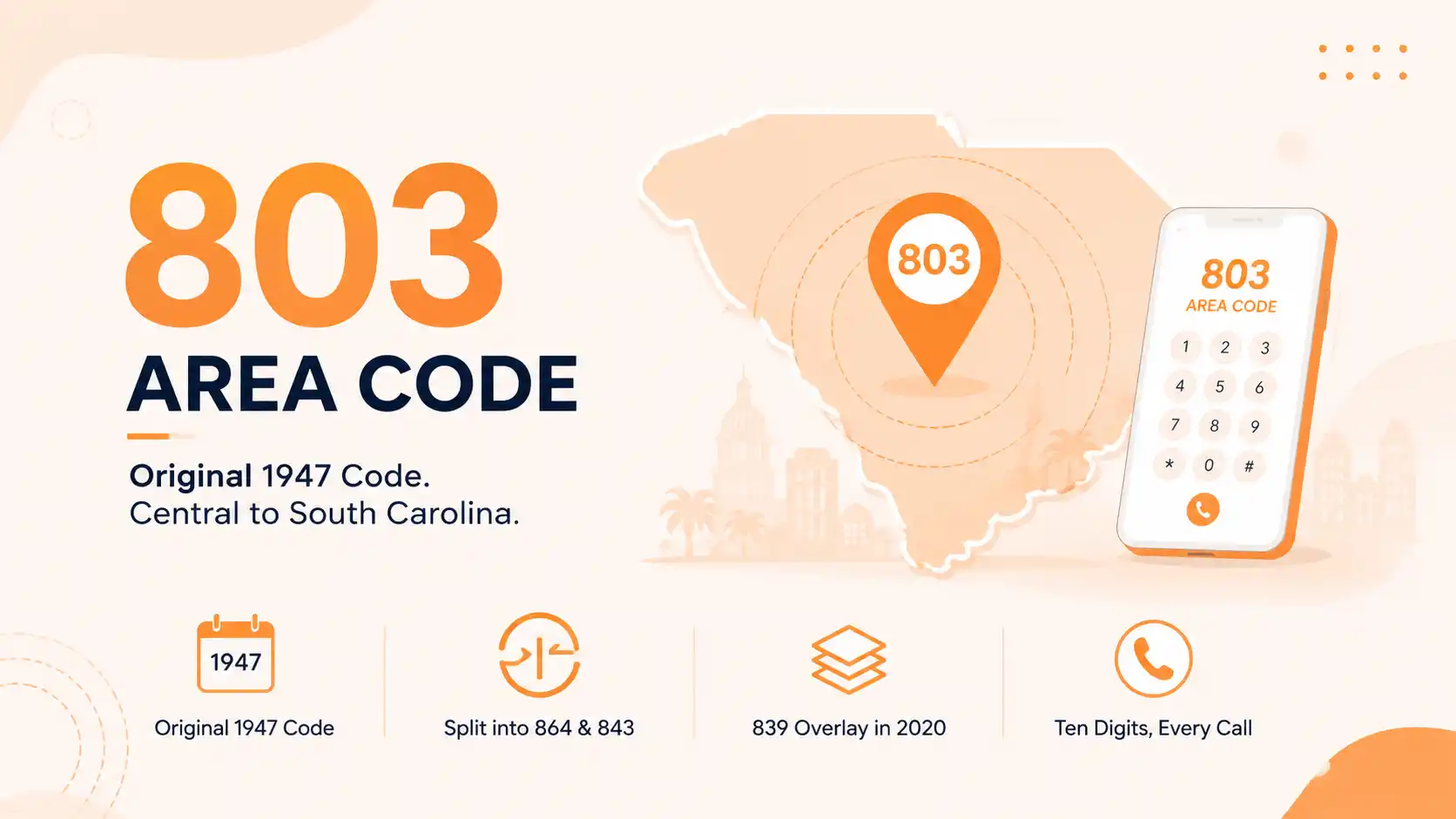
Most area codes were invented to fix a shortage. 803 was there at the start — one of the original 86 codes assigned in 1947, and for nearly half a century the only one in all of South Carolina. It's been pared down twice since, split off into 864 and 843 as the state grew, and it now shares its remaining territory with a 2020 overlay code, 839. What's left still anchors the heart of the state: Columbia, the capital and largest city; Fort Jackson, the Army's largest basic-training post; and Rock Hill, riding the overflow of Charlotte's growth just across the state line.
State government vendors, military contractors, healthcare providers, and the manufacturing supply chain across the Midlands all benefit from a local 803 number. Fort Jackson's contractor community, the USC system's procurement network, the Savannah River Site's extensive contractor base, and the growing technology corridor in Columbia all respond better to South Carolina numbers than to out-of-state codes. Rock Hill's proximity to Charlotte also creates cross-border business where local identity matters. A business calling into any of these networks from an out-of-state number risks being screened out before a human ever picks up — procurement offices and base contractors in particular tend to let unfamiliar area codes go to voicemail, or not answer at all.
- One of the original 86 area codes assigned nationwide in 1947 — South Carolina's only code for 48 years
- Split to create 864 (1995, the Upstate) and 843 (1998, the coast); overlaid by 839 in 2020
- Covers Columbia, Fort Jackson, Aiken, Orangeburg, and Rock Hill in South Carolina's Midlands
1947 Origins, the 864/843 Splits, and the 839 Overlay
One of the First 86
When the continent was first carved into area codes in 1947, South Carolina got exactly one: 803. It covered the entire state for 48 years.
Splitting Off 864 and 843
Growth forced two splits — 864 carved off the Upstate around Greenville in 1995, and 843 took the coast around Charleston in 1998. 803 settled into the central core it holds today.
The 839 Overlay Arrives in 2020
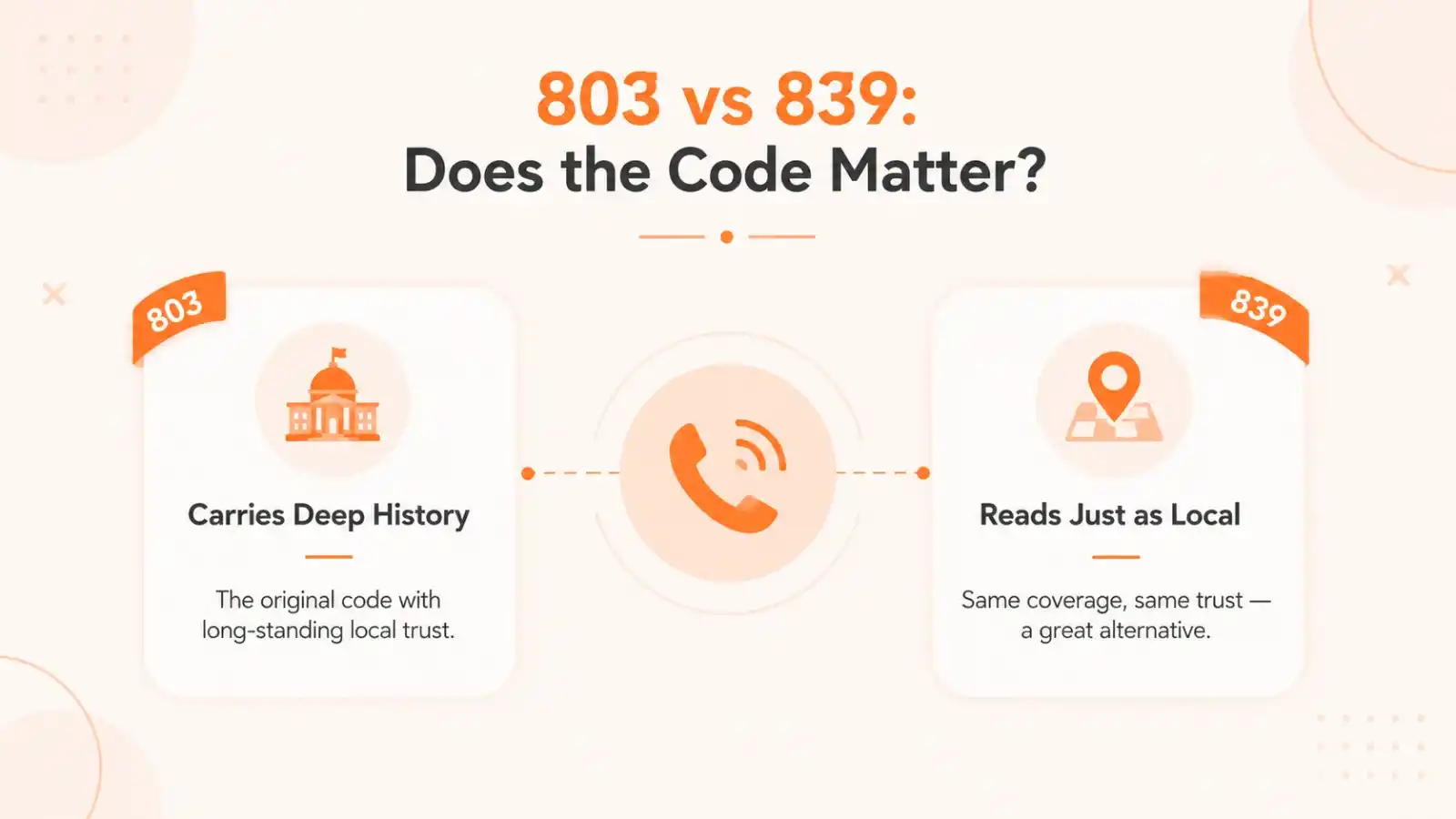
When central-state numbers ran low, 839 went live in May 2020 as an overlay across the identical map, with mandatory 10-digit dialing taking effect that April ahead of it. 839 covers the exact same towns as 803 — it isn't a new territory, just a second pool of numbers layered over the same one. If 803 inventory is tight for a specific prefix, a clean 839 number carries no real penalty; the two read as equally local to anyone in the Midlands.
As the original statewide code, 803 still reads as long-established to anyone who grew up in the Midlands, which is worth grabbing if it's available — but for a business without decades of local history to lean on either way, the difference is mostly cosmetic. The 839 guide covers the neighbouring ground.
Columbia: State Government, USC, and Fort Jackson
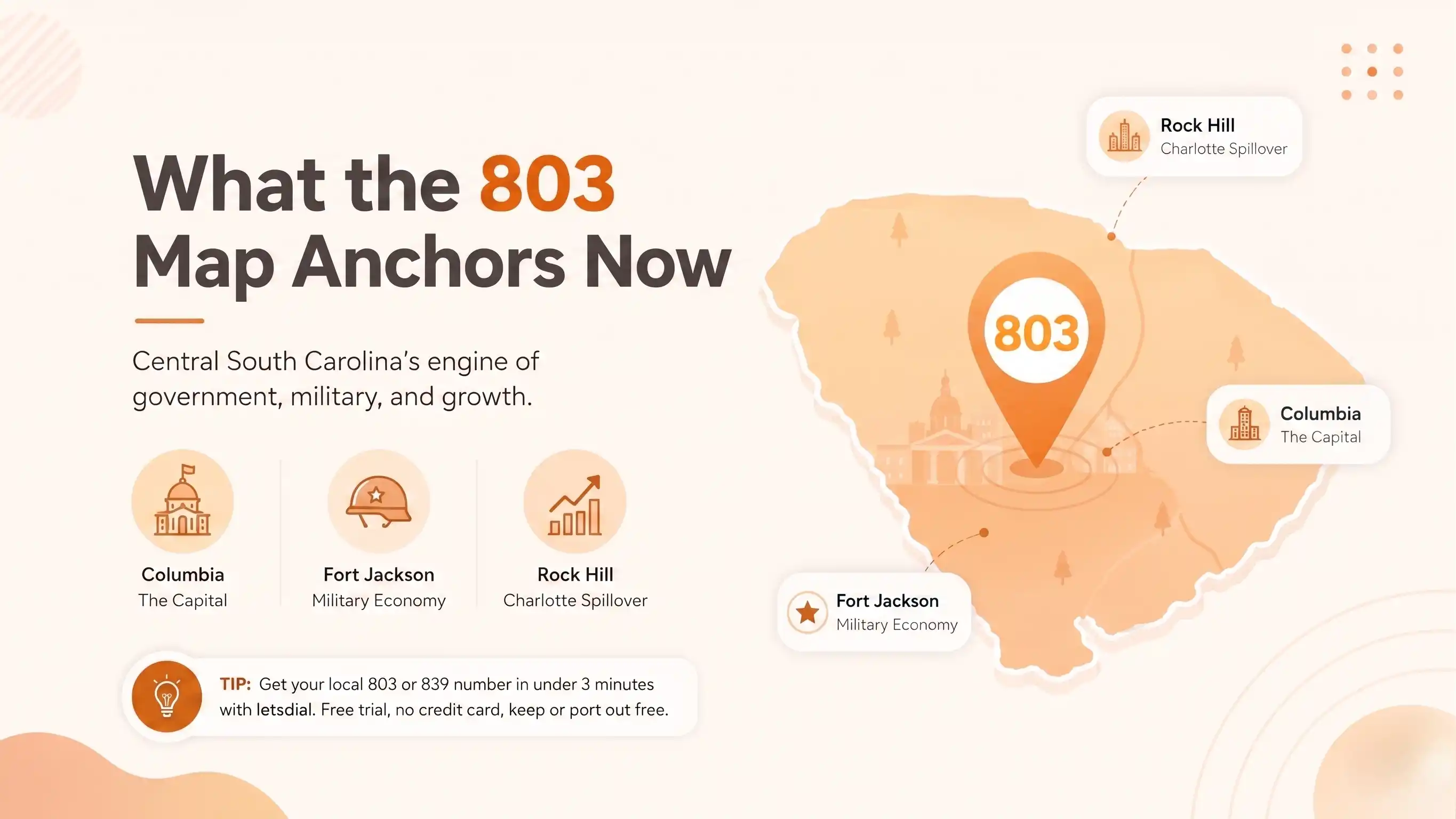
Central South Carolina packs government, military, and higher education into one code, with Columbia — the state capital and largest city — at its center.
State Government and the Capitol
Columbia's state government economy is sustained by the South Carolina State House, the state executive agencies, the General Assembly, and the court system — all headquartered in the 803 footprint. State government employment is one of the largest payroll categories in Richland County, and the professional services, legal, lobbying, and contractor ecosystem surrounding state government creates substantial B2B demand year-round. That demand tends to be concentrated in a fairly small radius around the State House and the Vista district, which makes a recognizable Columbia number a meaningfully bigger trust signal for firms courting state agency business than it would be in a metro where government offices are scattered across several counties.
Fort Jackson and the Military Economy
Columbia is home to Fort Jackson, the Army's largest basic-training post. That base anchors a steady economy of services, housing, and contractors around it, feeding a recurring cycle of new trainees, permanent staff, and family relocations that keeps local business demand more stable than a typical mid-sized city. Fort Jackson trains roughly 35,000 basic training recruits a year — about half of all soldiers entering the Army — and the families visiting for graduation ceremonies alone generate a predictable, recurring spike in hotel bookings, restaurant traffic, and local retail spending several times annually.
The University of South Carolina
The University of South Carolina in Columbia is the state's flagship public university, enrolling more than 35,000 students and employing thousands of faculty and staff in the 803 footprint. USC's Darla Moore School of Business, School of Law, and medical school are regionally significant institutions that anchor Columbia's professional services and healthcare economy, and the university's research programs in public health, engineering, and law attract grant funding and corporate research partnerships to the metro. Game days at Williams-Brice Stadium alone bring in tens of thousands of visitors several weekends each fall, a recurring surge that local hospitality, restaurant, and short-term rental businesses plan their year around.
> [TIP] Note: Serving central South Carolina from afar? letsdial provisions a local 803 or 839 number in under three minutes on a free trial — no credit card, and the number is yours to keep or port out free. More detail sits on our letsdial page.
The Savannah River Site, Rock Hill, and the I-77 Corridor
The Savannah River Site
The Savannah River Site in Aiken County is a Department of Energy nuclear facility that processes tritium for the nation's nuclear weapons stockpile and manages nuclear waste from decades of weapons production. The site employs thousands of workers in highly skilled nuclear science, engineering, and environmental remediation roles, making it one of the largest federal employers in the 803 region, with Savannah River Nuclear Solutions and its subcontractors representing a significant defense and energy sector presence in the western footprint.
The facility's cleanup and construction contracts also draw a steady stream of specialty engineering firms and skilled-trades contractors into Aiken and Barnwell counties, work that tends to run on multi-year federal timelines rather than the boom-and-bust cycle typical of private manufacturing.
Rock Hill and the Charlotte Spillover
To the north, Rock Hill rides the growth of the Charlotte metro just over the state line — a fast-expanding suburb pulling in residents, business, and construction. The I-77 corridor running north from Columbia through Rock Hill into Charlotte has become a manufacturing and logistics hub, and Rock Hill's proximity to Charlotte has drawn distribution centers and corporate operations seeking lower South Carolina costs compared to North Carolina's higher-demand markets.
Winthrop University adds a steady student population and event traffic to Rock Hill's own downtown, and the city's cycling and outdoor-recreation reputation — built around the Rock Hill Outdoor Center and its BMX and mountain-biking facilities — has become its own modest tourism draw, distinct from the manufacturing growth along the interstate.
Phone Number Format and Dialing Rules
All 803 and 839 numbers follow the NANP 10-digit format: 803-XXX-XXXX or 839-XXX-XXXX. Because the two codes overlay the same geography, every local call in the Midlands requires all 10 digits — dialing just 7 digits will no longer connect, a change that took effect in April 2020 alongside the 839 launch. For US long-distance calls from outside the region, dial 1 + the area code + the 7-digit number; for international calls, dial +1 followed by the 10-digit number. The entire 803/839 territory sits in the Eastern Time zone.
Businesses that still have the old 7-digit number printed on signage, invoices, or vehicle wraps from before the 2020 mandate should treat updating that material as a priority — a caller who dials only 7 digits out of habit will get a recorded intercept message instead of reaching the business, and there's no way to route around that gap the way there was with earlier voluntary 10-digit dialing regions.
Getting an 803 Number for Your Business
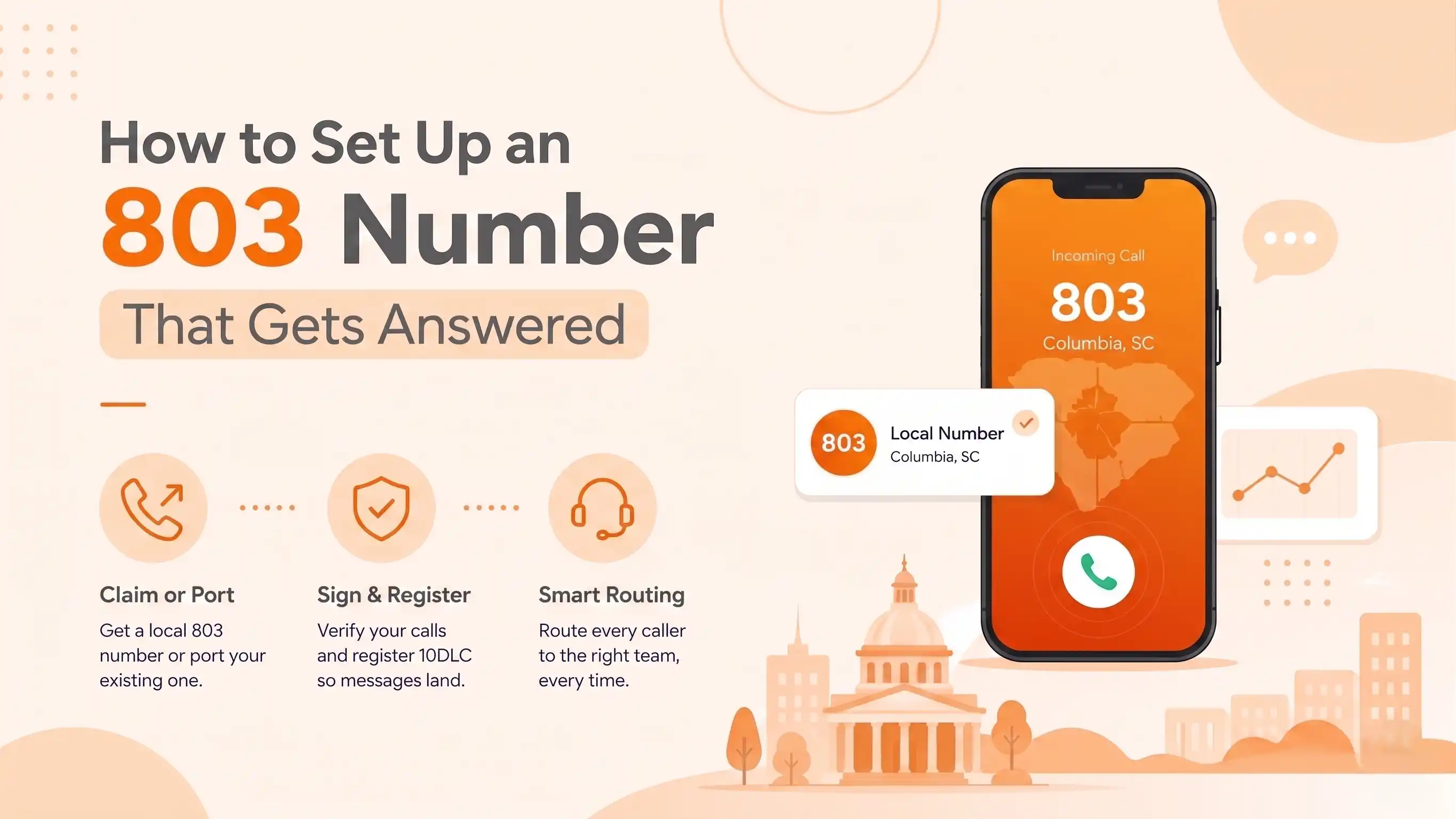
Setting up an 803 number that actually gets answered takes a bit more than just claiming one: That record is published in full as public record for area code 803.
- Claim or port the right line — grab an open 803 number, or port the one already on your listings so you keep its history. A cloud phone provider can port numbers in and out for free, in both directions.
- Sign your calls and register for texting — apply A-level STIR/SHAKEN attestation so your calls clear as verified instead of showing "Spam Likely," and register your line for 10DLC so business texts land reliably.
- Route each caller to the right place — a Columbia government inquiry and a Rock Hill service call shouldn't ring the same desk. A contact center that routes by caller intent sends each one where it belongs.
- Match your outbound caller ID to what recipients expect — a state agency contact or Fort Jackson contractor list is far more likely to answer an 803 or 839 number than an out-of-region area code, so pulling your outbound line from the same overlay pool you're calling into measurably improves pickup rates.
Conclusion
The 803 area code is one of the country's originals, now anchoring capital-city Carolina — the statehouse and USC, the Army's biggest training post, the Savannah River Site's nuclear and energy operations, and a Charlotte-fed boom up in Rock Hill. Take a recognizable 803 number if one's available, or a clean 839 — both read as equally local across the Midlands, and either one carries the trust a heritage numbering region earns once every call is signed and routed correctly.
letsdial provisions 803 and 839 numbers in minutes on a free trial with automatic STIR/SHAKEN attestation and free porting in both directions.
Frequently Asked Questions
Written by Aryan Khan · June 18, 2026
Reply to the author