Introduction
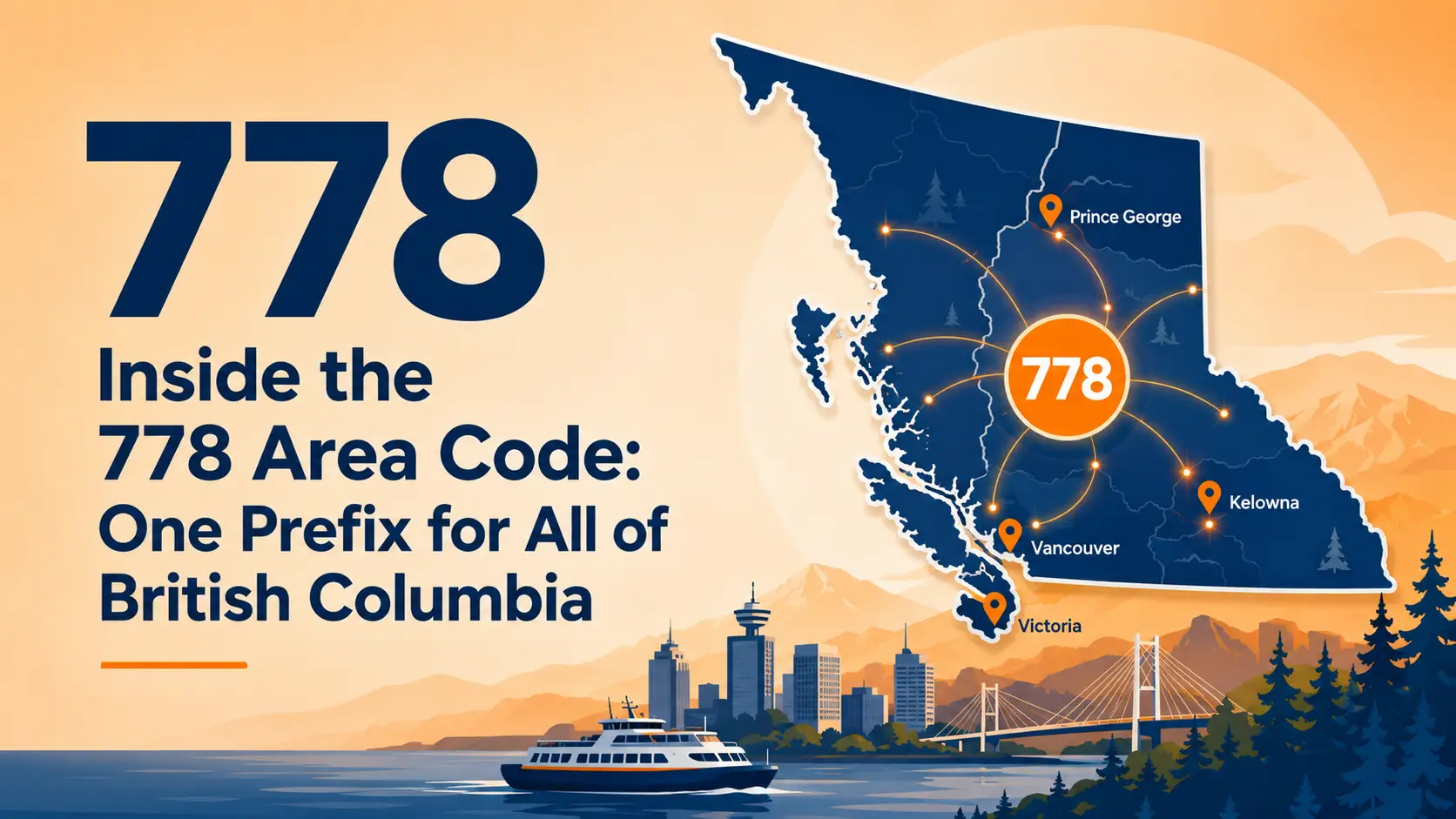
A call or text from a **778 area code** number could be coming from almost anywhere in British Columbia — Vancouver, Victoria, Surrey, Kelowna, or a small town hundreds of miles from the coast. Unlike most of the codes covered on this site, 778 isn't tied to one metro area or even one region; it now blankets an entire Canadian province.
That province-wide reach makes 778 one of the more unusual area codes in North America. Rather than describing a single split or a single overlay, its story is one of gradual expansion, growing to cover more and more of British Columbia as demand for numbers kept climbing.
The sections below cover where 778 actually reaches today, how it grew from a Vancouver-area overlay into a provincewide one, its time zone, scam patterns worth watching for, and the practical steps for activating a 778 number for a business.
All of British Columbia Now Falls Under 778
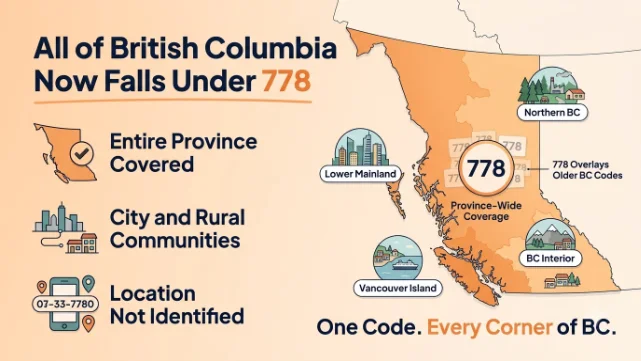
The 778 area code covers **the entire province of British Columbia**, from the dense Lower Mainland around Vancouver to Vancouver Island, the BC Interior, and the province's northern reaches. It's the only area code on this site that spans an entire province or state rather than a specific region within one — a full breakdown of how BC's dialing works is in this Canada country code guide.
That province-wide scope exists because 778 isn't a standalone code with its own dedicated territory — it's an overlay layered on top of BC's older area codes, and its footprint has actually grown over time as more of the province needed number relief.
Because of that structure, a 778 number tells you almost nothing about which part of British Columbia a call is coming from. It could just as easily be a downtown Vancouver office tower or a small business in a Interior town hundreds of kilometers away.
Vancouver to Kelowna: Cities Sharing the 778 Overlay
The 778 footprint includes:
- Vancouver and the Lower Mainland — Surrey, Burnaby, Richmond, and the dense urban core around BC's largest city
- Victoria — the provincial capital, located on Vancouver Island
- Kelowna — the Okanagan Valley's largest city, known for wine country and tourism
- Kamloops, Nanaimo, and Prince George — regional hubs serving BC's Interior and northern communities
- The rest of British Columbia, since the 778 overlay now extends provincewide rather than covering only specific cities
Because 778 shares its territory with several other area codes rather than defining a region of its own, thinking of it as "British Columbia's second, third, fourth, or fifth number" is more accurate than trying to associate it with any one city.
British Columbia's overlay stack didn't stop at 778 either — the province later layered the 236 area code on top of the same territory as a further overlay, one of several codes now sharing address-level overlap with 778.
Time Zones Vary Slightly Across the 778 Footprint
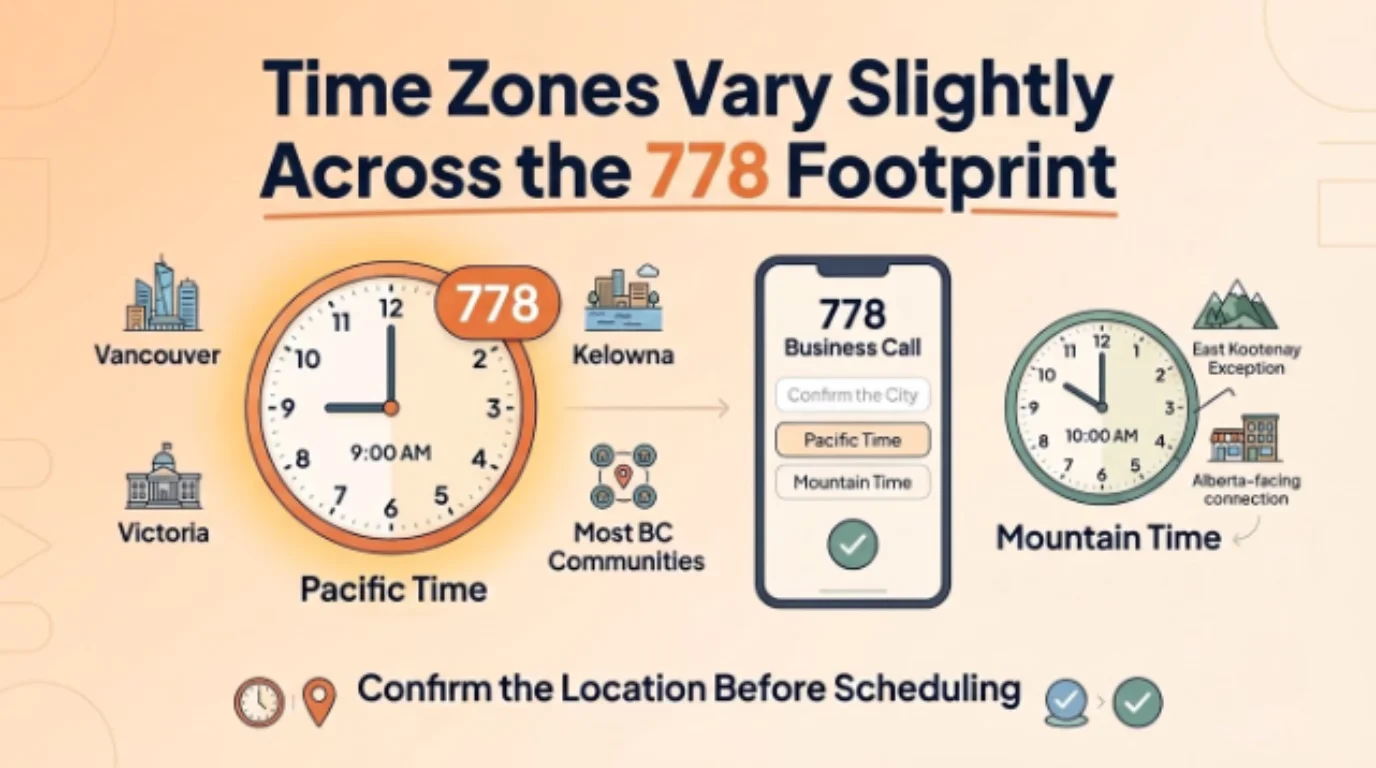
Most of British Columbia, and the vast majority of the 778 area code, operates on the **Pacific Time Zone (PT)**, matching Seattle and the rest of the West Coast. This covers Vancouver, Victoria, Kelowna, and the great majority of the province's population.
There is one notable exception worth knowing about: a handful of communities in BC's East Kootenay region, near the Alberta border, observe **Mountain Time (MT)** instead, since their economic ties run more toward Calgary and the 403 area code than toward Vancouver.
Because 778 numbers can be issued anywhere in the province, businesses calling into this area code from outside BC should confirm which specific city they're reaching if scheduling precision matters, rather than assuming Pacific Time applies universally.
From One Overlay to a Whole Province: How 778 Grew
Understanding 778 means tracing how it expanded well beyond its original scope over the better part of two decades:
**1947 — A Single Code for the Whole Province.** British Columbia was originally served entirely by area code 604, assigned as part of the earliest North American numbering plan.
**1988 — 250 Splits Off.** As Vancouver's Lower Mainland grew, the rest of the province split away into its own **250 area code**, leaving 604 to cover the metro Vancouver region alone.
**2001 — 778 Launches as a Vancouver-Area Overlay.** Rather than split 604 a second time, regulators introduced 778 as an overlay on November 3, 2001, layered specifically on the Lower Mainland's existing 604 territory — part of how Canadian numbers fit into the wider North American Numbering Plan.
**2007 — The Overlay Expands Provincewide.** As number demand grew across the rest of British Columbia too, the CRTC extended 778 on July 4, 2007, to also overlay the 250 region, giving it province-wide reach for the first time. That full timeline mirrors the overlay pattern described in the FCC's overview of area code overlays.
**Since Then — Joined by Even More Codes.** British Columbia has since added additional overlay codes — 236, 672, and 257 — meaning up to five different area codes can now serve the exact same address in some parts of the province, all requiring mandatory 10-digit dialing.
Recognizing a Suspicious 778 Call
Because 778 covers such an enormous and varied territory, it's a common target for scammers who count on recipients not knowing exactly where a given call originated. A call from a 778 number could plausibly be a downtown Vancouver business or a small Interior town, giving fraudulent callers wide latitude to invent a believable story.
Canadian phone scams frequently impersonate government agencies specific to the country, including the Canada Revenue Agency and Immigration, Refugees and Citizenship Canada, both common in reported scam calls across British Columbia.
The broader warning signs common to any spoofed area code apply here as well:
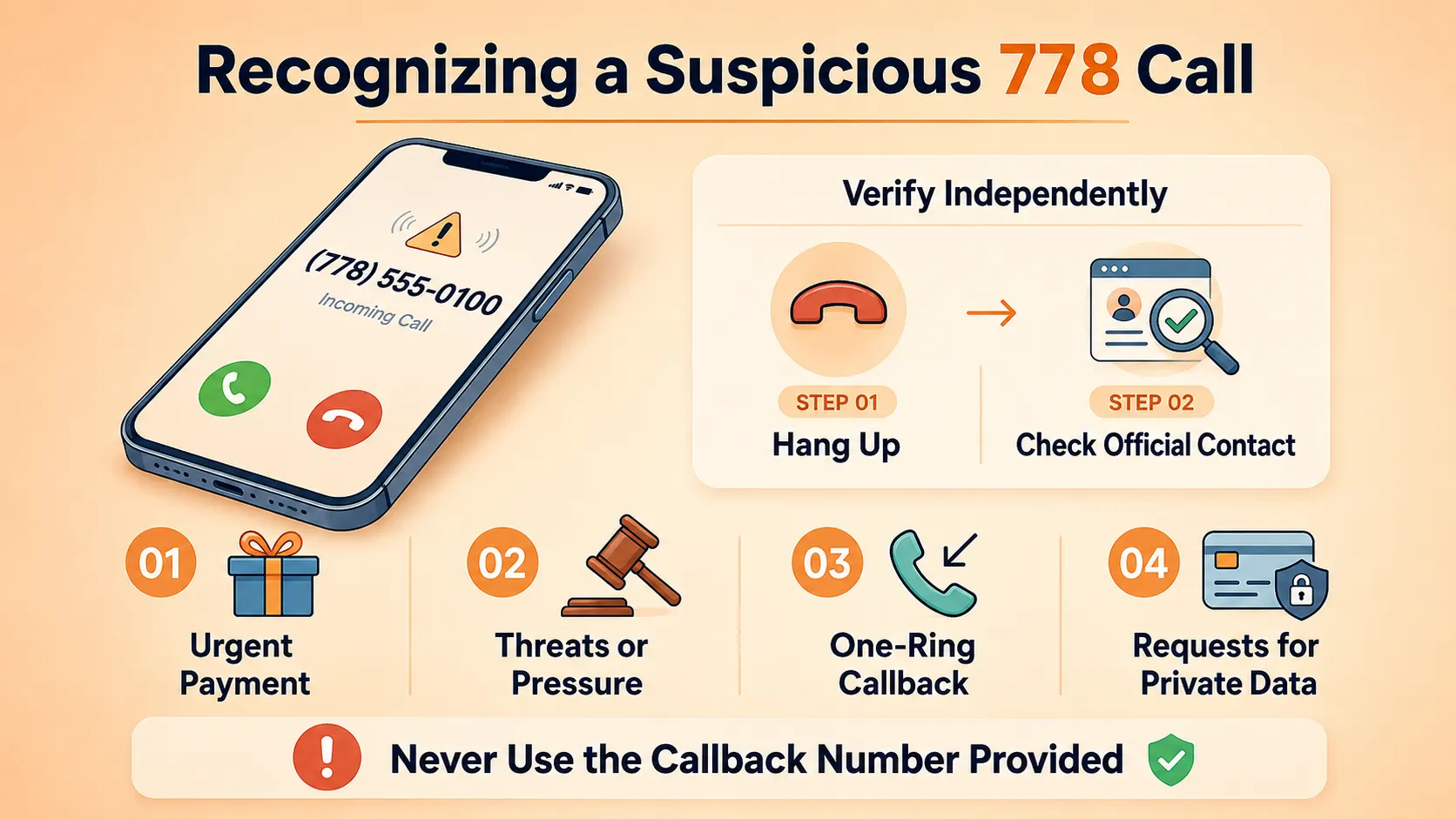
- **Urgent demands for immediate payment**, especially via gift cards, wire transfers, or cryptocurrency
- **Threats of arrest, deportation, or legal action** meant to pressure a fast decision
- **One-ring "wangiri" calls** designed to bait a costly callback
- **Requests for Social Insurance Numbers, banking details, or one-time verification codes** from an unsolicited caller
If a 778 call feels off, hang up and contact the organization directly using a number pulled from their official website, not a callback number the caller supplies.
What a 778 Number Offers a BC-Focused Business
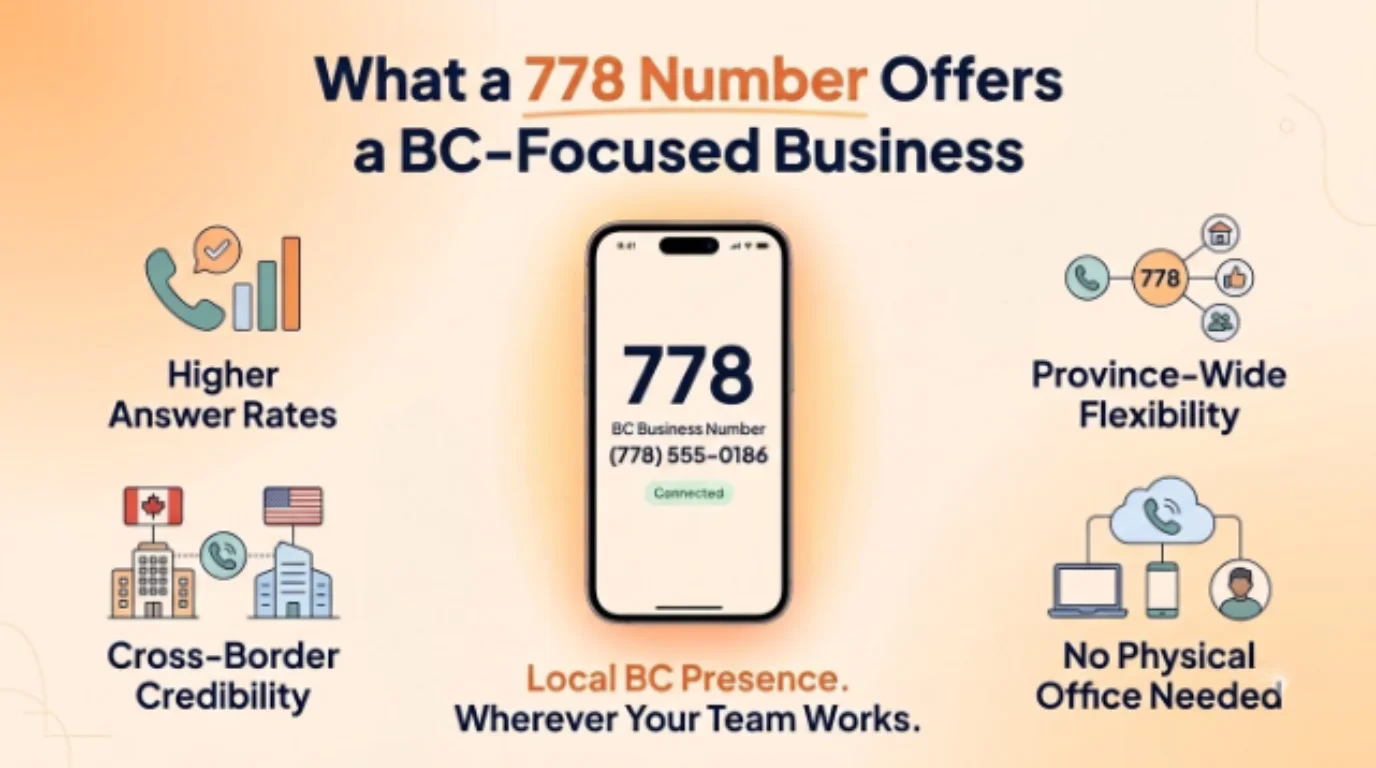
Even without a physical office anywhere in British Columbia, a 778 number carries real advantages for businesses serving this market:
**Higher answer rates.** BC residents consistently pick up calls from familiar-looking local area codes more readily than unfamiliar toll-free or out-of-country numbers, which matters for sales outreach and appointment confirmations.
**Flexibility across an entire province.** Because 778 isn't tied to any specific city, a single number can plausibly represent a business serving customers anywhere from Vancouver to Prince George without needing separate lines for each region.
**Credibility for cross-border businesses.** U.S.-based companies expanding into the BC market can use a 778 number to signal genuine local presence to Canadian customers without opening a physical office north of the border.
**No physical office required.** A cloud-based phone system lets you activate a 778 number without leasing space anywhere in British Columbia, with calls routing to your team wherever they're actually working.
Setting Up a 778 Number With LetsDial
Claiming a local 778 number doesn't require a British Columbia address or a contract with a legacy Canadian carrier. With a cloud phone platform like LetsDial, the process takes only a few minutes.
Legacy providers historically required an in-country billing address and a technician-scheduled installation before a number tied to a specific overlay code went live. Cloud platforms remove that friction, since the number functions as a software-routable line rather than a physical connection.
- **Sign up** for a LetsDial account and choose a calling plan sized to your team.
- **Search available 778 numbers** in the number picker, filtering by city — Vancouver, Victoria, Kelowna, and more — or by vanity options.
- **Select your number** and assign it to a user, department, or auto-attendant/IVR flow.
- **Configure call routing** — business hours, forwarding, voicemail-to-email, and SMS — directly from the dashboard, no hardware required.
- **Activate** — your 778 number goes live immediately across desktop, mobile, and desk phone apps.
Because the number lives in the cloud, you can pair a 778 line with numbers from other Canadian or U.S. markets to manage several regions from a single platform. LetsDial's business phone number plans and pricing make it easy to get started if you need coverage beyond 778.
778 Snapshot
- Region: All of British Columbia (Vancouver, Victoria, Kelowna, and beyond)
- Country: Canada
- Time Zone: Pacific Time (PT), with Mountain Time (MT) in the East Kootenay
- Overlay Launched: November 3, 2001 (Lower Mainland only)
- Expanded Provincewide: October 27, 2007
- Shared With: 604, 250, 236, 672, 257
- Dialing Requirement: 10-digit dialing required
- Notable Trait: Only provincewide area code covered on this site
Conclusion
The 778 area code has grown from a Vancouver-area overlay in 2001 into a code covering the entirety of British Columbia today, expanding alongside the province's population and joined along the way by three additional overlay codes. That growth pattern — expansion rather than a one-time split — sets it apart from nearly every other area code discussed on this site.
For residents, that history explains why a 778 caller ID reveals almost nothing about which part of BC someone is calling from. For businesses targeting the British Columbia market, a 778 number remains a flexible way to establish provincewide reach without committing to any single city, and a platform like LetsDial can have one active in minutes.
778 Area Code FAQ
Written by Aryan Khan · August 5, 2026
Reply to the author