Introduction
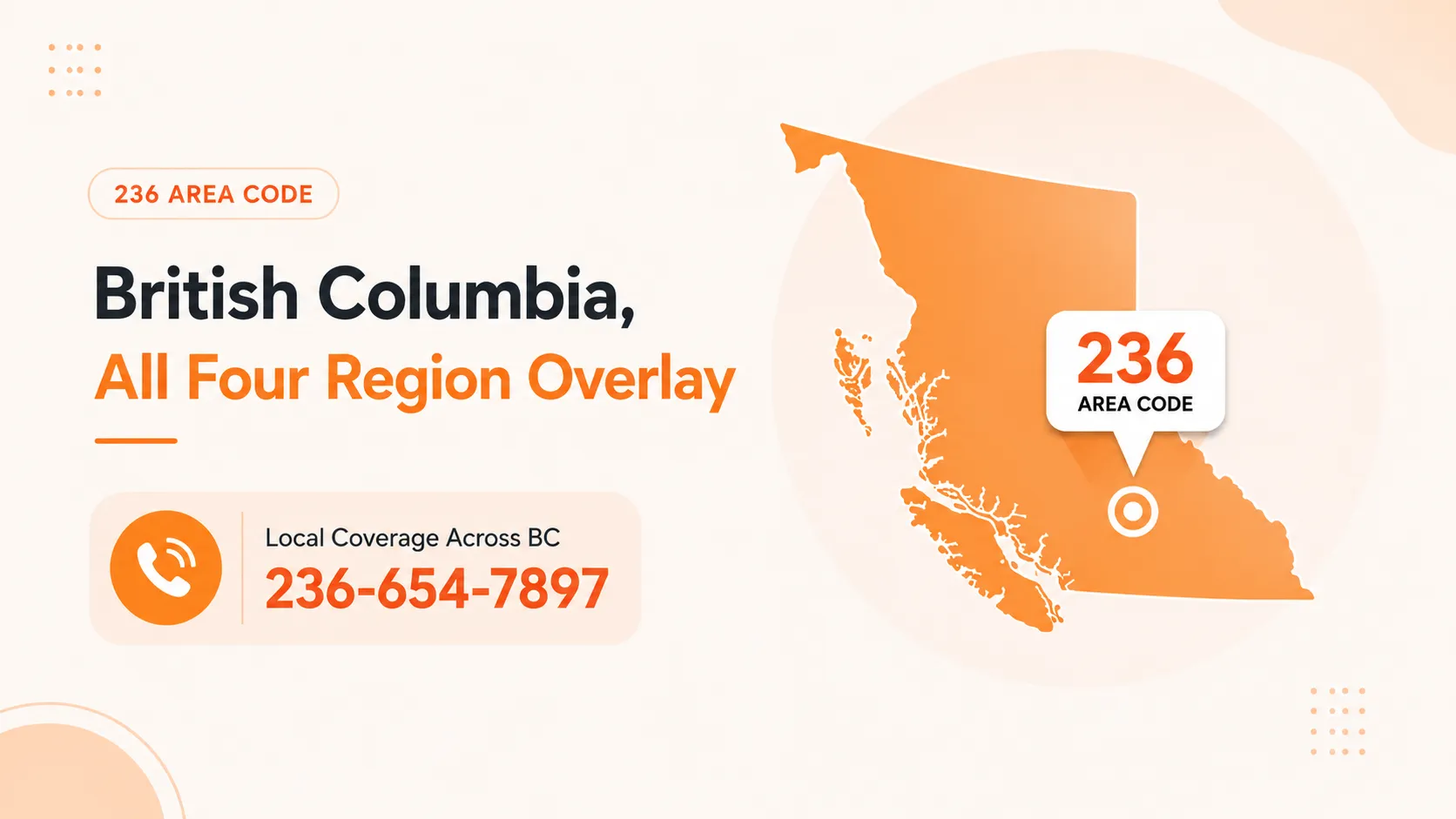
The 236 area code is a province-wide overlay for British Columbia, Canada, sharing the same footprint as 604, 250, and 778. Vancouver is Canada's third-largest city and the country's Pacific gateway — home to major technology companies, the entertainment industry, natural resources firms, and a thriving port and logistics sector.
Businesses in BC's tech, film, natural resources, and logistics sectors benefit from a 236, 604, 250, or 778 number that signals BC presence to Canadian clients. Vancouver's tech community, known as 'Silicon North,' and its international port make local Canadian phone identity especially valuable for companies working the North American Pacific corridor.
- Type: province-wide overlay shared with 604, 250, and 778 — no BC address is excluded
- Launched: June 1, 2013, as the second province-wide overlay added to British Columbia
- Dialing: 10-digit local dialing is mandatory everywhere in the province
Where the 236 area code reaches
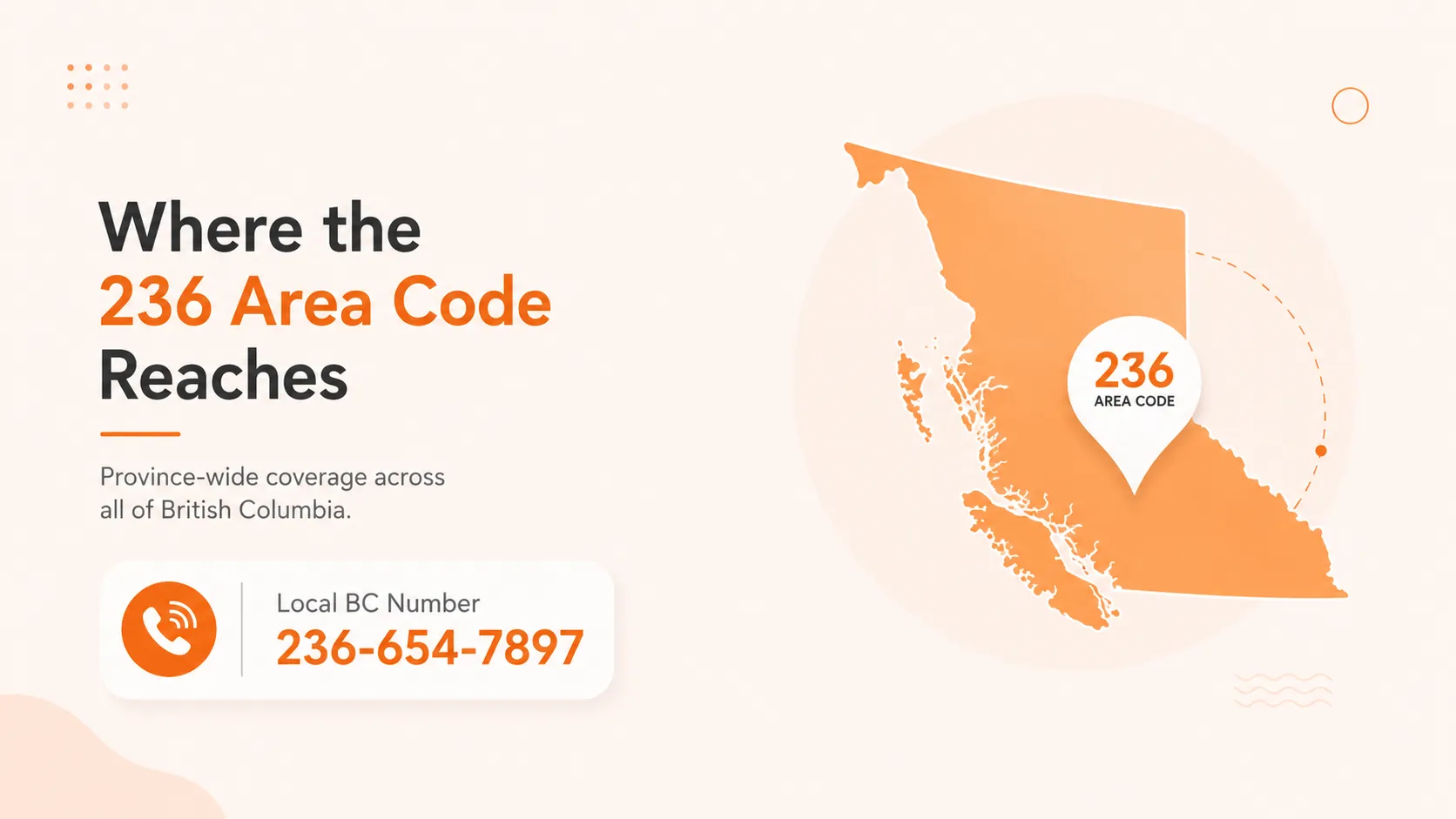
236 reaches every part of the province, from downtown Vancouver to a rural address in the Peace River region — no BC location falls outside the overlay.
- Metro Vancouver — Vancouver, Burnaby, Surrey, Richmond, Langley, Coquitlam, North Vancouver, West Vancouver, and Delta
- Fraser Valley — Abbotsford, Chilliwack, Mission, and the agricultural corridor east of Vancouver
- Vancouver Island — Victoria (the provincial capital), Nanaimo, Courtenay, and Campbell River
- Interior BC — Kelowna and the Okanagan Valley, Kamloops, Penticton, and Vernon
- Northern BC — Prince George, Fort St. John, Dawson Creek, Terrace, and Prince Rupert
- Boundary and Kootenays — Cranbrook, Nelson, Trail, and the Rocky Mountain corridor
All four BC area codes — 604, 250, 778, and 236 — ring every part of the province, and there are no sub-zones or geographic splits within the 236 overlay itself. A 236 number is as local in Prince George as it is in Vancouver.
Time zones across the footprint
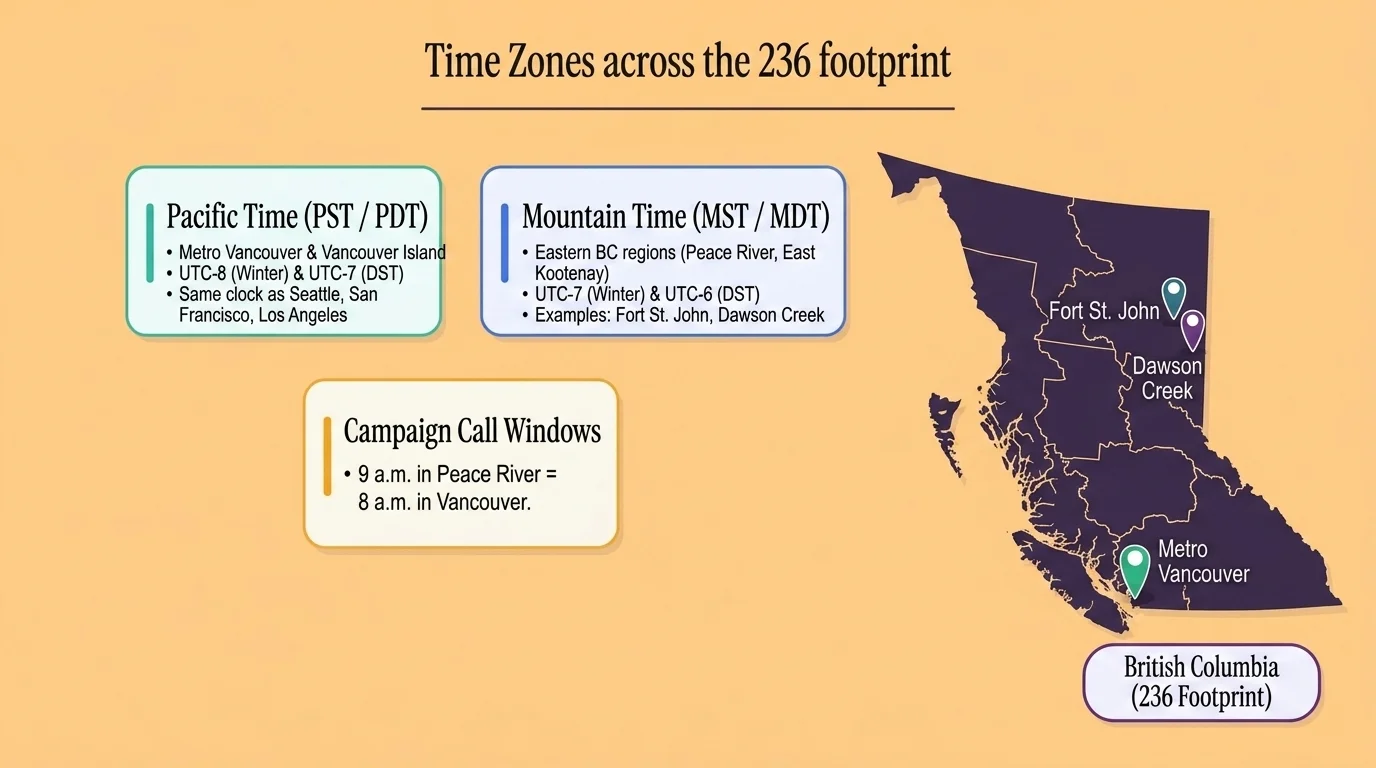
Most of British Columbia observes Pacific Time — UTC-8 in winter (PST) and UTC-7 during Daylight Saving (PDT) — putting Metro Vancouver and Vancouver Island on the same clock as Seattle, San Francisco, and Los Angeles. The Peace River region — Fort St. John and Dawson Creek — and parts of the East Kootenay instead run on Mountain Time (UTC-7 in winter, UTC-6 on DST). If a campaign covers all of BC, plan calling windows around both zones: a 9 a.m. open in the Peace River region is only 8 a.m. in Vancouver.
> [TIP] Note: Tag 236 contacts in your CRM with their specific BC city, not just the province, so scheduled call campaigns never dial a Peace River contact an hour before their business day starts. More detail sits on our SaaS phone system page.
Metro Vancouver: Canada's tech hub and Pacific gateway
Vancouver anchors one of the most technology-concentrated urban areas in North America. Amazon, Microsoft, Electronic Arts, SAP, and Apple all operate major Vancouver offices, and homegrown companies span fintech, gaming, AI, and SaaS across the Lower Mainland. For the SaaS and gaming companies clustered here, a SaaS phone system with a local 236 number matters as much as the product itself when courting Canadian enterprise clients.
The Port of Vancouver and the trade economy
The Port of Vancouver is Canada's largest port by tonnage and one of the busiest on the Pacific coast, handling bulk commodities, containers, and resources destined for Asian markets. Trade, logistics, finance, and legal services tied to the port generate consistent professional call demand across Metro Vancouver year-round.
That trade volume pulls in a wide band of B2B service providers — customs brokers, freight forwarders, marine insurers, and commercial law firms — all of whom rely on being reachable at Vancouver hours by counterparts across the Pacific. A local BC number matters here in a way it wouldn't for a purely domestic business, since Asian trading partners screening for a legitimate Canadian presence look for exactly that kind of local caller ID before returning a call.
Film and television production
Metro Vancouver and the Fraser Valley rank among North America's largest film and television production markets, behind Los Angeles and New York — a status that earned the region its Hollywood North nickname. Production companies, studios, vendors, and crew networks operate across the Lower Mainland under BC phone numbers, making entertainment one of the most active business segments in the 236 region. More detail sits on our letsdial page.
Vancouver Island, the Okanagan, and Interior BC
Victoria is British Columbia's provincial capital, hosting the BC Legislative Assembly and the provincial ministries and contractors that cluster around any seat of government, alongside tourism, technology, and defence. Nanaimo, Courtenay, and Campbell River round out the Island economy with forestry, fishing, retail, and healthcare.
The Okanagan Valley
The Okanagan Valley — centered on Kelowna, Vernon, and Penticton — is Canada's premier wine country, with more than 200 licensed wineries drawing visitors from across the country. Kelowna also hosts a growing tech sector, with remote workers and companies drawn by lifestyle, lower costs relative to Vancouver, and reliable connectivity.
Kamloops and Northern BC
Kamloops serves as the commercial hub for the Thompson-Nicola region, with healthcare, retail, education at Thompson Rivers University, and resource industry services. Prince George anchors the northern interior with forestry, mining, and transportation logistics — a local BC prefix signals community belonging in markets where trust is built regionally rather than nationally.
That regional-trust dynamic runs deeper in Northern BC than anywhere else in the province. A supplier calling into Fort St. John's oil and gas sector, or a recruiter reaching out to Prince George's forestry workforce, is competing against decades of relationships built on word of mouth in towns where everyone eventually works with everyone else. An unfamiliar out-of-province area code is an instant tell that a caller doesn't understand that dynamic — a 236, 604, 250, or 778 number at least clears the first bar.
History: how BC ended up with four area codes
604 was one of the original North American area codes, assigned in 1947 to cover all of British Columbia from the outset. It remained the province's sole code for four decades as Vancouver's population and business activity grew.
250 split off the Interior in 1996
As Metro Vancouver's number demand grew through the 1990s, 250 was created on October 19, 1996 to serve all of BC outside the Lower Mainland — Vancouver Island, the Interior, and Northern BC — leaving 604 for Metro Vancouver and the Fraser Valley.
778 and 236 added as province-wide overlays
Rather than splitting the province again, regulators added 778 on November 3, 2001, initially as an overlay on just 604's Metro Vancouver and Fraser Valley territory, then expanded it on July 4, 2007 to overlay all of BC, including the 250 region. When that expanded pool began to fill, 236 was introduced on June 1, 2013 as a second province-wide overlay. All four codes now cover the entire province, and 10-digit dialing is mandatory everywhere in BC.
How to get a 236 number
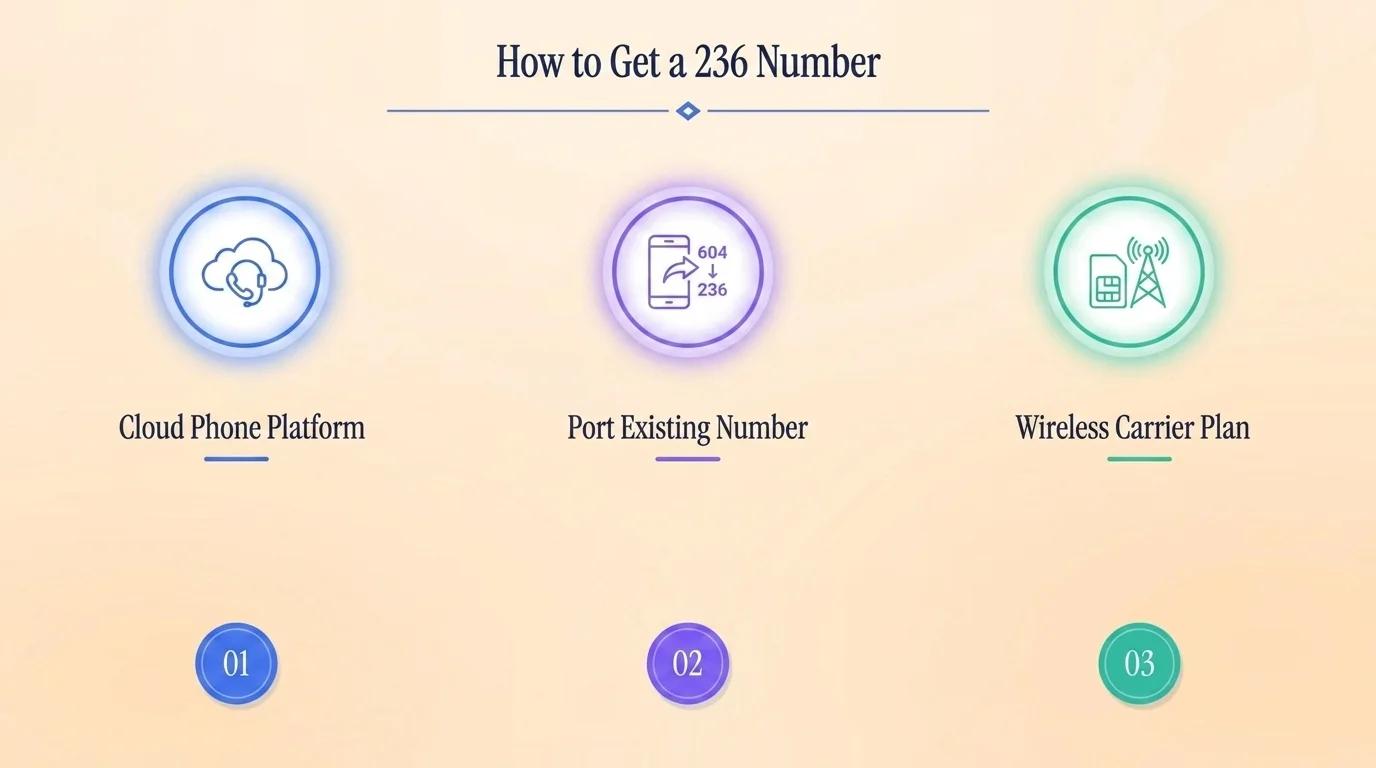
Any of the four BC codes — 604, 250, 778, or 236 — works as a local number in any BC market, and 236 has wider availability than the legacy codes. Three paths exist; only a cloud phone platform gives you an active line the same day.
- Cloud phone platform — search available 236 numbers in real time, claim one, and assign it to a seat or team. letsdial activates a 236 line in under three minutes on a free trial, no credit card required.
- Port your existing number — already have a BC number on another carrier? Port it in without downtime. letsdial ports numbers in and out at no charge, and the line stays active through the full transfer.
- Wireless SIM or carrier plan — valid for a physical handset or a SIM-based business line, but significantly slower to activate and harder to scale across multiple seats.
> [TIP] Note: Canada shares the +1 country code with the United States, so a US caller dialing a 236 number reaches British Columbia like a domestic long-distance call — no international prefix or added charges on most plans that include Canada.
Call signing in Canada: what the CRTC requires
Canada's CRTC mandated STIR/SHAKEN call authentication for carriers, the same framework the FCC introduced in the US. It verifies that the caller ID on an outbound call matches a carrier-provisioned account, assigning an attestation level of A (fully verified), B (partial), or C (gateway only). A freshly provisioned 236 number has no call history — without A-level attestation from day one, heavy outbound dialing in the first weeks is the fastest route to a Spam Risk label across BC.
> [TIP] Note: letsdial applies STIR/SHAKEN attestation automatically — your 236 number arrives with its trust signals already in place, so outbound calls display a verified business name from the very first dial.
236 is officially documented under the North American Numbering Plan, which governs area code assignments across the US, Canada, and the Caribbean. That record is published in full as North American Numbering Plan.
Conclusion
The 236 area code delivers province-wide BC phone coverage as an overlay on 604, 250, and 778, reaching Metro Vancouver, the Fraser Valley, Vancouver Island, and communities across the province. This guide has covered the overlay structure, Vancouver's technology and resources economy, and why BC phone identity matters for Pacific corridor business.
letsdial provisions 236 numbers in minutes on a free trial with no hardware required. Activate a British Columbia number today and establish the Canadian Pacific presence that resonates with the technology, resource, entertainment, and logistics businesses that define Vancouver's commercial identity.
Frequently Asked Questions
Written by Aryan Khan · June 20, 2026
Reply to the author