Introduction
714 has a claim almost no other code in this series can match: it's the parent territory behind two other area codes covered here, San Diego's 619 and the Inland Empire's 909, both carved directly out of its original 1951 footprint. If a 714 call just reached you, or you're weighing one for your own business, this code sits at the center of one of Southern California's longest chains of splits.
This guide covers exactly what 714 holds today, the sequence of splits that whittled a region once covering half of Southern California down to Orange County, which cities and landmarks anchor the territory now, and what dialing here requires. We'll close with the scam tactics that try to trade on this well-known code's reputation.
The Orange County Map Today
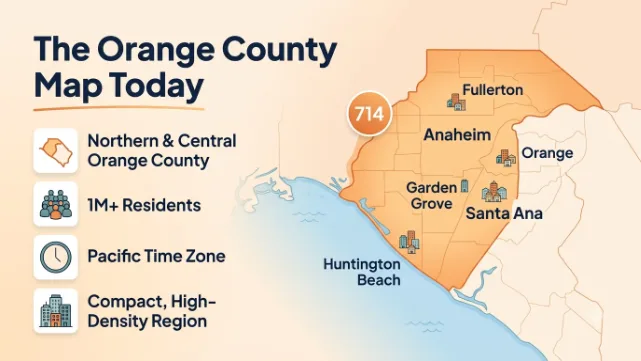
714 now covers the northern and central half of Orange County, a compact but densely populated stretch of coastal Southern California.
The territory reaches Anaheim, Santa Ana, Huntington Beach, Fullerton, Garden Grove, Orange, Fullerton, and a string of connected suburbs, almost entirely within Orange County with only a small spillover into neighboring Los Angeles County. Everything in the footprint sits in the Pacific time zone. Despite its relatively small geographic footprint compared with some of the sprawling rural codes covered elsewhere in this series, Orange County's dense population means 714 reaches well over a million residents packed into a fraction of the land area, making it one of the most tightly packed territories in this entire series by population per square mile.
Every Code That Broke Away
714's history reads less like a single split and more like a family tree, with three separate departures reshaping its borders over four decades.
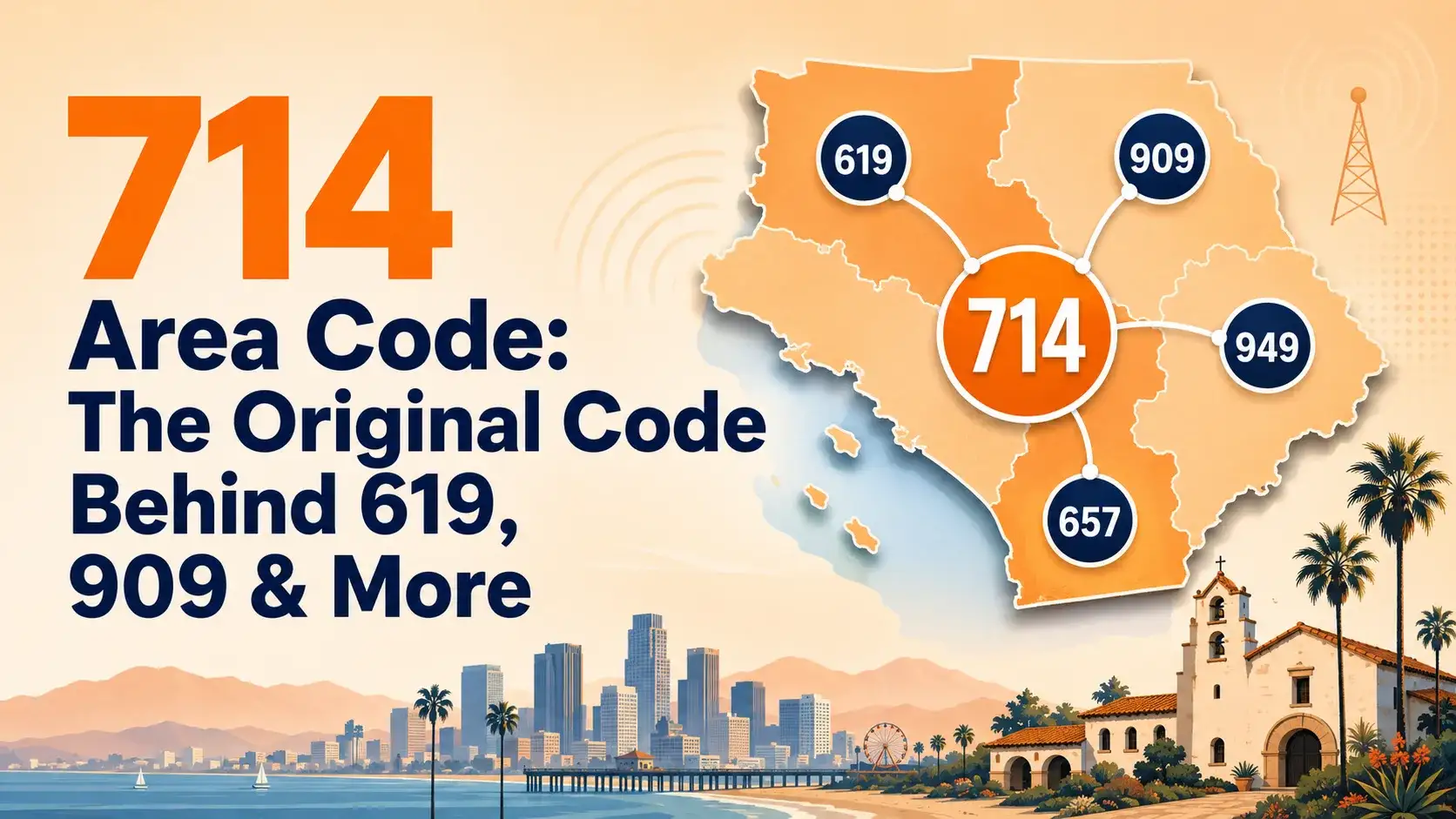
When 714 launched in 1951, split from the original 213 code, it covered a stretch of Southern California far larger than Orange County alone, reaching into San Diego, Imperial County, and the deserts of Riverside and San Bernardino. The first departure came in 1982, when San Diego and Imperial County broke away entirely to form 619. A decade later, in 1992, the fast-growing Inland Empire, covering eastern Los Angeles, Riverside, and San Bernardino counties, split off as 909. A third cut followed in 1998, when southern Orange County itself split away to become 949, trimming 714 down to the northern and central portion of the county it holds today.
Anaheim's Global Landmarks and Little Saigon
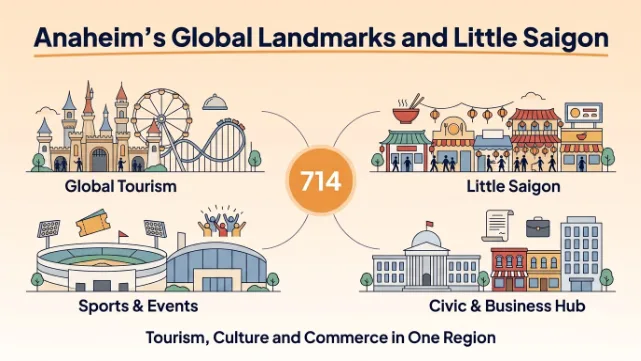
Few area codes anywhere pack in as much internationally recognized tourism as the territory behind a 714 number.
Anaheim is home to Disneyland, the original Disney theme park and one of the most visited tourist attractions on Earth, alongside Angel Stadium and the Honda Center, home ice for the Anaheim Ducks. Just south, Westminster and Garden Grove make up the heart of Little Saigon, the largest concentration of Vietnamese Americans outside Vietnam itself, built by refugees who settled in the area following the Vietnam War and grew it into a major cultural and business hub. Buena Park adds Knott's Berry Farm, one of the oldest theme parks in the country, while Santa Ana anchors the county seat with a mix of government offices and a historic downtown core. For a business, that mix means a single 714 number can plausibly reach a theme-park vendor, a Little Saigon restaurant supplier, and a county government contractor all within the same compact territory.
Life With the 657 Overlay
By the mid-2000s, Orange County's own growth had caught up with 714's remaining number supply, prompting one more change to the territory.
Rather than split the region a fourth time, regulators added 657 as an overlay directly on top of the existing 714 footprint, with service beginning September 23, 2008. That decision let every existing 714 number stay exactly as it was, while new lines began drawing from the fresh 657 pool instead. Mandatory 10-digit dialing followed alongside the overlay, requiring every local call in the region to include the full area code from that point on.
Dialing Through Four Decades of Change
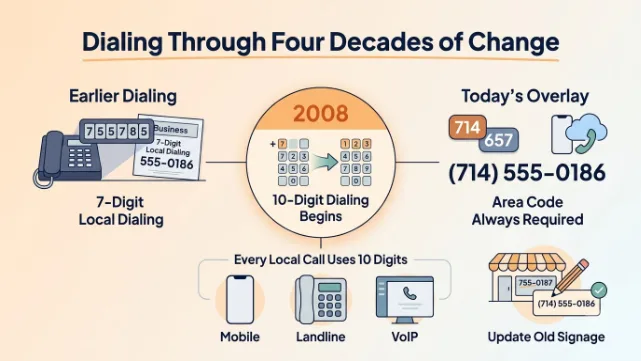
Because 714 now shares its footprint with 657, dialing across the region follows the same rule every overlay area does.
Every local call, whether from a mobile phone, landline, or VoIP line, requires the full 10-digit number, area code included, a rule that's been in place since 2008. That applies to a call between two neighboring Anaheim households just as much as it does to a call across the county, regardless of which of the two codes either side carries. Businesses that still display an old seven-digit number on signage or printed materials should update it, since a caller trying that shortcut will hit an error instead of reaching the business.
Local Trust in a Tourism-Heavy Market
In a region built around some of the most visited attractions in the world, a local area code still carries real weight for the businesses serving residents rather than tourists.
Hospitality suppliers working with Anaheim's resort district, restaurants and grocers serving Little Saigon's tight-knit community, and retailers courting Santa Ana or Fullerton shoppers all benefit from a number that reads as genuinely local to the county. Local numbers consistently earn higher answer rates than toll-free or out-of-area lines, a trust factor that matters just as much here as it does anywhere else, similar to how a business builds regional credibility with a matching prefix the way a San Diego company leans on its 619 number, a code that, fittingly, once belonged to this very same 714 territory.
Claiming a 714 Number Today
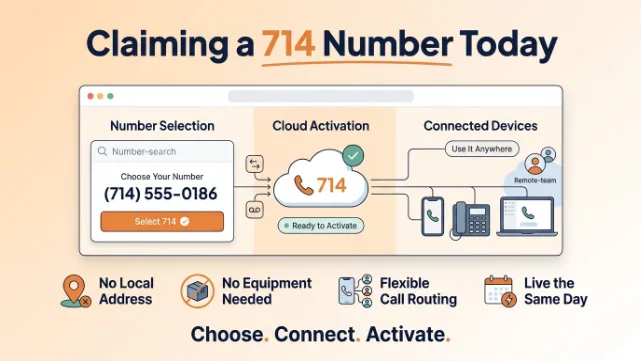
Getting a 714 number doesn't require an Orange County address or a long-term carrier contract.
Cloud-based virtual phone providers, letsdial included, let you select an available 714 number and connect it to any device — a cell phone, desk phone, or softphone app — usually going live the same day. Most plans bundle call forwarding, voicemail transcription, and multi-user routing, so a small remote team can run a 714 line the same way a fully staffed Anaheim office would. There's no equipment to buy or technician visit required, the same self-service setup covered in our guide to claiming a Napa Wine Country 707 number for a very different kind of Northern California market.
Scams That Exploit a Tourist Destination's Trust
A widely recognized area code tied to one of the world's most visited destinations is exactly the kind of number scammers want to spoof.
"Neighbor spoofing" shows up across Orange County the same way it does elsewhere, with fraudsters faking a local 714 or 657 number so it looks like it's coming from a nearby business or government office. Reported scripts in this region include fake theme-park ticket and vacation-package scams targeting visitors, immigration and consulate impersonation calls aimed at Little Saigon's community, and utility shutoff threats impersonating Southern California Edison. Because so many visitors pass through the region each year without knowing local numbers well, scammers occasionally tailor scripts specifically toward tourists booking travel. If an unexpected 714 or 657 call pressures you for payment or personal information, hang up and contact the organization directly through its official website. The FCC's guide to caller ID spoofing explains how to verify and report suspicious calls like these.
Closing Thoughts on 714
714 has given up more territory than almost any other code covered in this series, splitting off San Diego as 619 in 1982 and the Inland Empire as 909 in 1992 before losing southern Orange County to 949 in 1998 and finally picking up its own overlay, 657, in 2008. What remains is a compact but globally recognized stretch of Orange County anchored by Disneyland, Little Saigon, and one of the densest populations in this entire series.
For businesses, a 714 number is a fast, low-cost way to build genuine Orange County credibility without opening a physical office there. Dial all 10 digits, stay alert for spoofed calls trading on the region's tourism reputation, and pick a provider that can get your number active without delay.
Frequently Asked Questions
Written by Aryan Khan · August 13, 2024
Reply to the author