Introduction
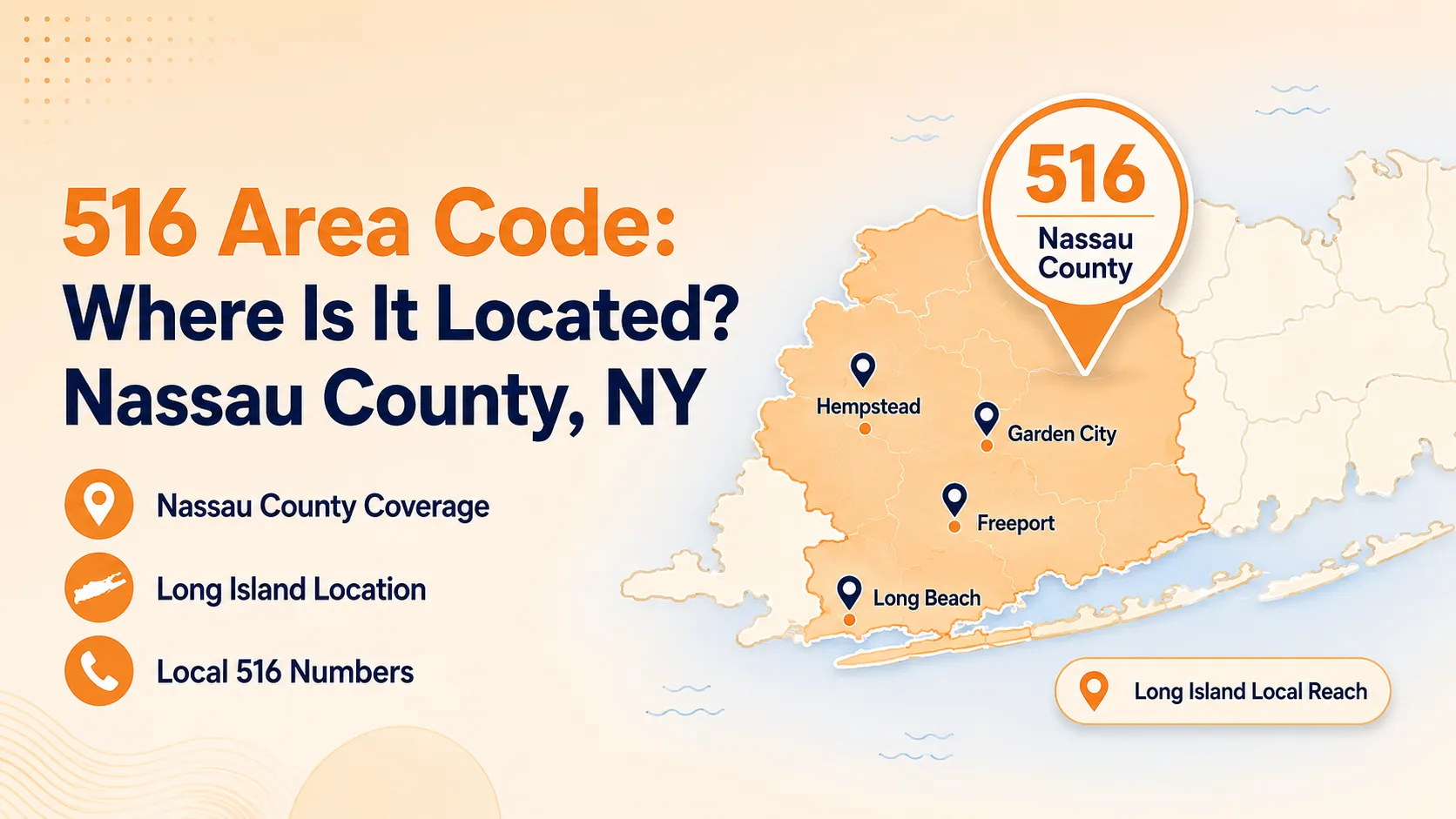
What area code is 516? It's in the USA — Nassau County, on Long Island, just east of New York City. 516 covers the entire county, from Hempstead and Long Beach out to Great Neck and Oyster Bay, and it's been Long Island's original prefix since the region first got its own numbering territory.
This guide answers exactly where the 516 area code is located, how it relates to the newer 363 overlay, the suburban and aerospace history behind it, its 1951 origin, and how to get a Nassau County number that gets answered.
Where the 516 Area Code Reaches
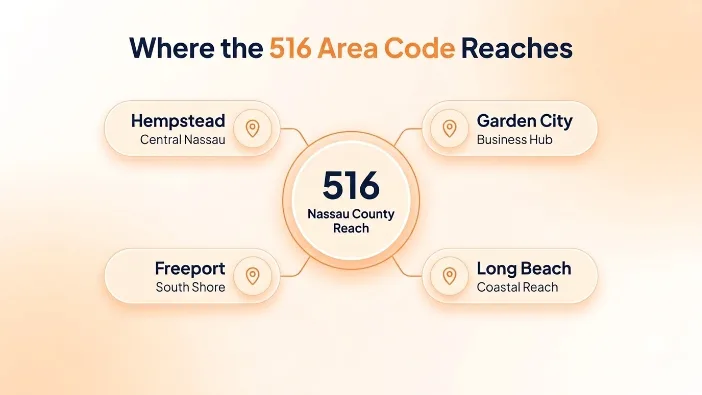
516 covers all of Nassau County, New York — the county immediately east of New York City on Long Island, sharing its entire territory with the newer 363 overlay rather than a separate region.
- Hempstead — the largest town in Nassau County and the county's demographic and commercial hub
- Garden City — a planned, tree-lined village known for its historic architecture and top-ranked schools
- Long Beach — a barrier-island city with a public boardwalk and a year-round beach community
- Levittown — the mass-produced postwar suburb credited as a model for American suburban development
- Great Neck and Manhasset — affluent North Shore communities along Long Island's "Gold Coast"
- Hicksville and Mineola — dense residential and commercial hubs along the Long Island Rail Road's main line
Suffolk County, immediately to the east, is not part of this footprint — it split into its own 631 area code in 1999, so a 516 number is specifically a Nassau County line, not a wider Long Island one. Brooklyn, Queens, and the rest of the city sit under separate overlapping codes like the 347 area code, a distinct numbering territory from Nassau's own.
Manhattan itself sits under a separate numbering plan built around the 646 area code, yet another example of how New York City and its surrounding suburbs each keep their own distinct prefix rather than sharing one across the metro.
The entire 516 area code observes Eastern Time — UTC-5 (EST) in winter and UTC-4 (EDT) during Daylight Saving — the same clock as the rest of New York City. West Coast teams calling into Nassau County are three hours behind, so a mid-morning Pacific call lands right around lunchtime on Long Island.
Oyster Bay, on the county's North Shore, was home to President Theodore Roosevelt's Sagamore Hill estate, now preserved as a National Historic Site, while Freeport's Nautical Mile still runs a working fishing fleet and waterfront seafood restaurants along the Woodcleft Canal. Between the Gold Coast estates, the working waterfront, and the dense commuter suburbs further inland, the 516 footprint covers a genuinely wide range of Nassau County life.
The 516/363 Overlay: Nassau County's Newest Numbers
363 is an overlay, not a split — it lays a second set of numbers over the exact same Nassau County footprint 516 has always covered, rather than dividing the county into two smaller regions. New York's Department of Public Service approved the 363 overlay in January 2022, and it went into effect in the second quarter of 2023 once 516's own number pool ran low.
Because two codes now serve the same towns, ten-digit dialing is mandatory everywhere in Nassau County, even between two numbers on the same block. Every 516 number in service before the overlay kept its digits unchanged — 363 only applies to new lines assigned since the overlay took effect.
Levittown and the Birth of the American Suburb
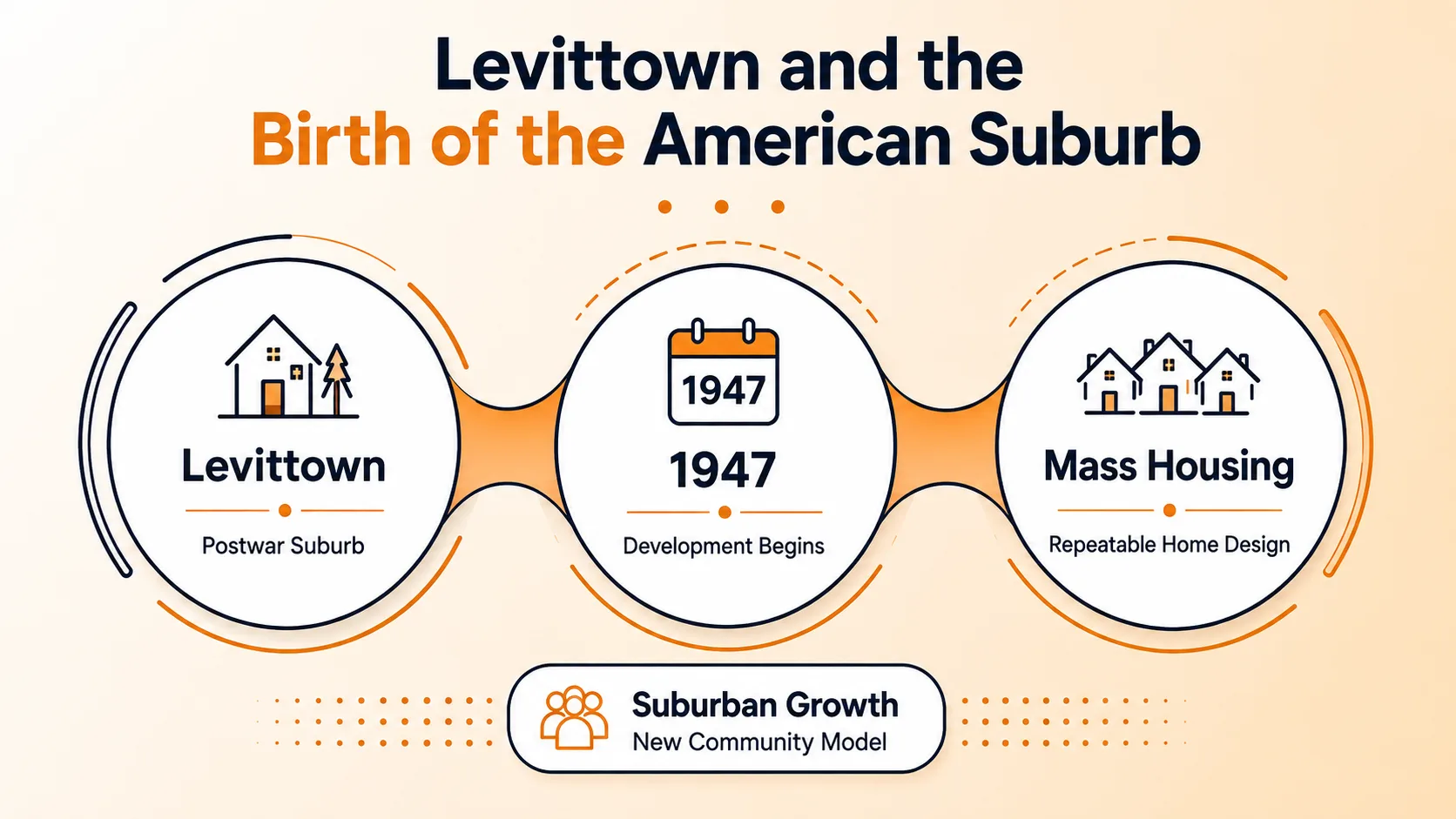
Nassau County carries a genuinely unique place in American housing history, and it starts with a single planned community inside the 516 footprint.
Levitt & Sons and Mass-Produced Housing
Levittown, built starting in 1947 by the firm Levitt & Sons on roughly 4,000 acres of former potato fields, is widely credited as America's first mass-produced suburb. Using assembly-line construction techniques, the company built more than 30 homes a day at its peak, eventually completing over 17,000 low-cost houses along with the shopping centers, playgrounds, and schools needed to support them — a template that suburban developers across the country copied for decades afterward.
The development targeted returning World War II veterans specifically, offering low-cost homes financed through GI Bill mortgages at a moment when the country faced a severe postwar housing shortage. That combination — mass production, affordability, and veteran-focused financing — is what made Levittown a national model rather than just a large local development, and its name became a generic term used for similar planned communities built elsewhere in the following decade.
Garden City's Planned Beginnings
Garden City, incorporated decades before Levittown, was itself one of the country's earliest planned communities, laid out in the 1870s with wide tree-lined streets and uniform architecture — a different, older model of planned suburban living that still defines the village's character today.
Grumman, Hofstra, and Nassau County's Economy
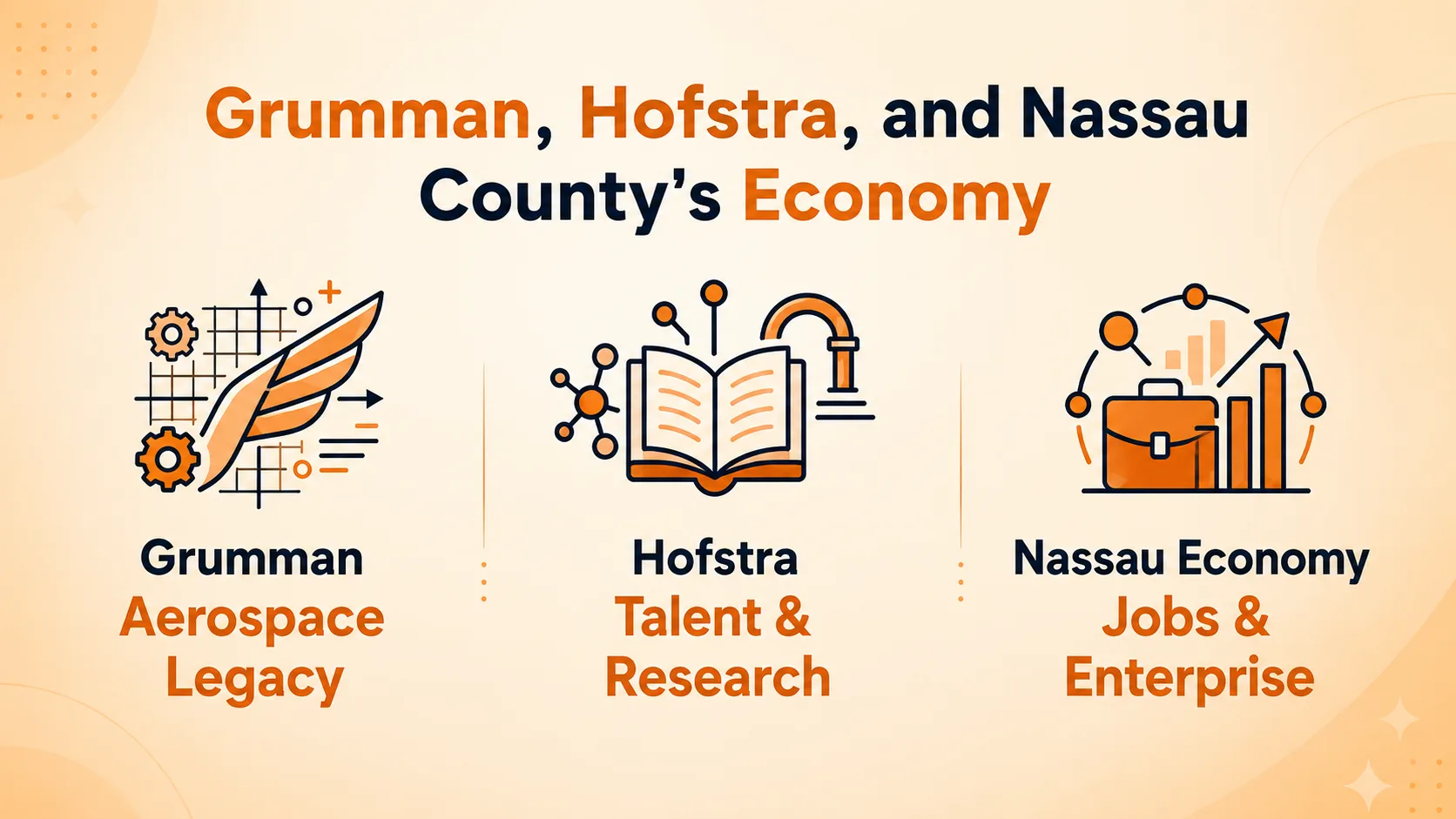
Beyond its housing history, the 516 footprint carries a genuine aerospace legacy and a major private university.
Grumman Aerospace in Bethpage
Grumman relocated its aircraft business to Bethpage in 1936, and the company grew into Long Island's largest employer through the middle of the 20th century. Grumman engineers designed and built the Apollo Lunar Module that carried astronauts to the moon, along with the Navy's F-14 Tomcat fighter and E-2C Hawkeye surveillance aircraft — Northrop Corporation acquired Grumman in 1994, and Northrop Grumman still maintains a presence in Bethpage today.
Hofstra University in Hempstead
Hofstra University began in 1935 as an extension of New York University, separated into independent Hofstra College in 1937, and gained full university status in 1963. Today it's Long Island's largest private university, adding a steady student and faculty population to Hempstead's economy alongside the county's suburban and aerospace history.
Adelphi University adds a second major private institution to the same footprint — chartered in 1896, it later relocated from Brooklyn to its present Garden City campus, making it Long Island's oldest private coeducational university and predating both Hofstra and Levittown by decades.
516 History
The 516 area code was assigned in 1951, when Nassau and Suffolk counties were split off from New York City's original numbering territory to form their own combined numbering plan area, covering all of Long Island outside the city itself.
That combined Nassau-Suffolk territory held for nearly five decades before 1999 growth forced a geographic split: Suffolk County broke off into its own new area code, leaving 516 to cover only Nassau County going forward. Continued growth from wireless numbers and business lines eventually pushed 516 toward exhaustion again, leading to the 363 overlay roughly two decades later. A full breakdown of how 516 fits alongside the rest of the state's prefixes is in this New York area codes guide.
How to Get a 516 Area Code Number
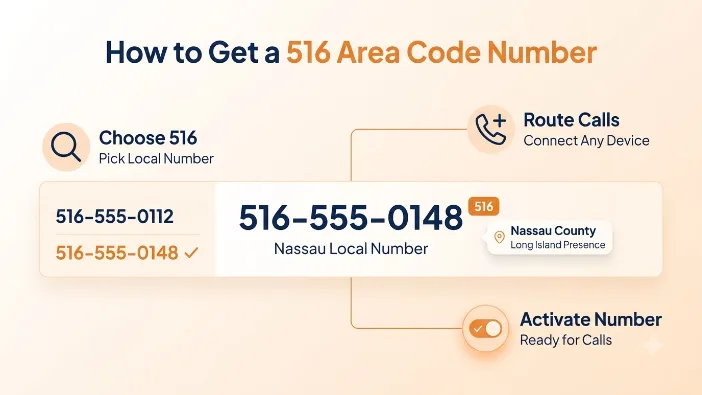
- Cloud phone platform — search available 516 or 363 numbers in real time and activate a line the same day, with no hardware and no technician visit.
- Port your existing number — already run a 516 line on another carrier? Move it over without downtime and keep the number active through the transition.
- Wireless SIM or landline carrier — valid for a single physical handset, but slower to provision and harder to scale seat by seat.
With letsdial, a 516 number provisions in under three minutes on a free trial, no credit card required, so a Nassau County presence can be answering calls the same afternoon, whether that's a Hempstead storefront or a remote team representing Long Island from anywhere in the country.
Porting an existing 516 line into a new platform works the same way in reverse: the number stays live the entire time, so a business that's already printed the number on signage, contracts, and directory listings doesn't lose any of that history switching providers.
Call Trust in Nassau County
The Nassau County market runs on dense suburban retail competition, university and research-vendor channels around Hofstra and Adelphi, and a steady stream of aerospace and defense-supplier relationships tied to the county's Grumman legacy — settings where an unknown or out-of-area number gets screened before it's answered. A recognizable local prefix earns the first hearing, and 516 in particular carries extra weight as the county's original, longest-standing code.
That screening habit runs especially deep in a county this densely populated and this close to New York City — residents and local businesses field a high volume of out-of-area sales and scam calls simply by virtue of being part of the greater metro area, so a number that reads as genuinely Nassau County local carries real weight against that background noise.
STIR/SHAKEN for a Newer Overlay Code
Apply STIR/SHAKEN attestation so every outbound 516 call arrives verified with your registered business name on screen. As a provider, letsdial registers text campaigns for 10DLC compliance from day one and warms new numbers before scaling volume, so a verified line reads as Nassau County-local rather than out-of-area, whether it's on the older 516 code or the newer 363 overlay.
Conclusion
516 is Nassau County's original area code — not a wider Long Island code, not a New York City code, and not tied to any other state — covering Hempstead's commercial core, Levittown's suburban legacy, Garden City's planned streets, and the Grumman aerospace history that still runs through Bethpage. Nearly seventy-five years after its 1951 assignment, it remains the region's most recognized and trusted prefix.
Standing up a line takes minutes on a cloud platform, with STIR/SHAKEN attestation so calls arrive verified rather than flagged. Put a 516 number in front of Nassau County customers, university contacts, and aerospace-supplier vendors, and let a familiar prefix open the door first, with letsdial handling the setup end to end.
Frequently Asked Questions
Written by Aryan Khan · August 3, 2026
Reply to the author