Introduction
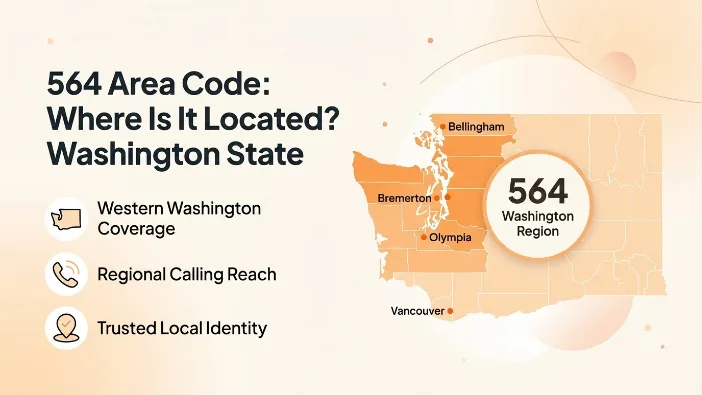
What area code is 564? It's in the USA — western Washington state, an overlay covering the same ground as both the 360 and 206 area codes. 564 reaches Olympia, Vancouver, Bellingham, and, as of 2025, the Seattle metro itself.
This guide answers exactly where the 564 area code is located, the unusual two-code overlay it shares its territory with, the capital-city and river-port history behind it, when it actually started, and how to get a Washington number that gets answered.
Where the 564 Area Code Reaches
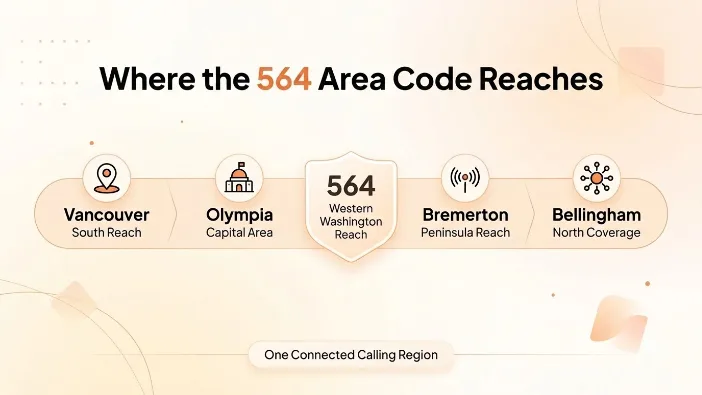
564 covers a wide stretch of western Washington state, sharing its territory with two separate older codes rather than just one.
- Olympia — the Washington state capital, part of the original 360 territory
- Vancouver — a Columbia River city directly across from Portland, Oregon, also in the 360 territory
- Bellingham — a Whatcom County city near the Canadian border, in the 360 territory
- Seattle — the state's largest city, added to 564's overlay footprint starting in 2025
- Tacoma and Bremerton — Puget Sound cities that fall within the wider 564 overlay region
Because 564 overlays both 360 and 206 rather than a single region, its practical footprint is genuinely enormous — it stretches from the Canadian border in the north, down through the entire Puget Sound basin, and out to the Pacific coast and the Columbia River in the south, a wider geographic reach than most single overlay codes cover.
The entire 564 area code observes Pacific Time — UTC-8 (PST) in winter and UTC-7 (PDT) during Daylight Saving — the same clock as the rest of Washington state. East Coast teams calling into western Washington are three hours ahead, so a late-afternoon Eastern call lands right around lunchtime in Olympia.
A full breakdown of how 564 fits alongside the 360 area code it overlays is covered in more depth in that guide.
The same applies to the 206 area code that 564 also overlays, with its own history and footprint covered in that guide as well.
564's Unique Overlay: Two Codes, One Overlay
564 is genuinely unusual among US overlay codes — it doesn't sit on top of a single older area code, it overlays two: 360, which covers western Washington outside the immediate Seattle metro, and 206, which covers Seattle itself. Most overlay codes serve one region layered over one parent code; 564 layers over both at once.
That structure exists because Washington's Utilities and Transportation Commission rolled 564 out in phases. It first went live as the 360 overlay in 2017, and the commission later extended it to overlay 206 as well, so a single 564 number today could plausibly be issued anywhere from Bellingham to downtown Seattle.
For businesses and residents, that means a 564 number no longer functions as a reliable clue about which part of the state a caller is actually in — a role area codes traditionally played but that 564's dual-overlay structure has effectively erased across a huge share of western Washington.
Olympia: Washington's Capital Since 1853
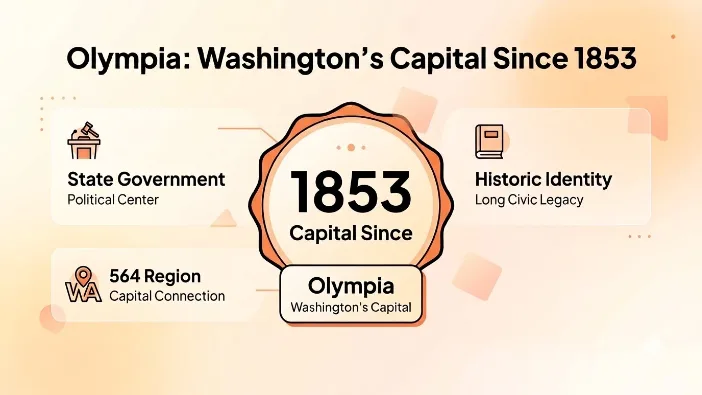
Olympia has served as Washington's capital since 1853, back when the region was still Washington Territory, more than three decades before statehood. The Legislative Building, completed in 1928, stands 287 feet tall and is the tallest masonry-dome building in North America, anchoring the state capitol campus that still runs Washington's government today. That long-running government presence makes Olympia a genuine outlier inside the 564 footprint — a mid-sized city whose economy runs almost entirely on state agencies, lobbying firms, and the vendors that serve them, rather than the tech or port industries that define much of the rest of western Washington.
Bellingham and Vancouver, WA
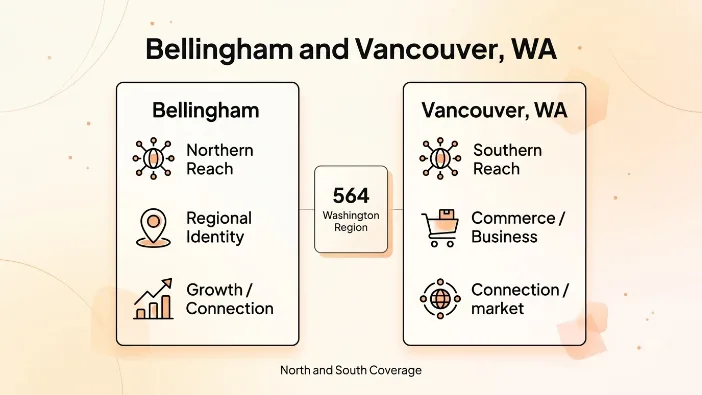
Two very different cities at opposite ends of the 564 footprint carry their own distinct identities.
Western Washington University in Bellingham
Western Washington University was founded in 1893 as the New Whatcom Normal School, and it has grown into one of the largest public universities in the state, anchoring Bellingham's economy alongside its proximity to the Canadian border just a few miles north. That border proximity gives Bellingham a genuine cross-border trade and tourism economy of its own, distinct from the university-town identity WWU brings to the same city.
Fort Vancouver's 1825 History
Vancouver, Washington is frequently confused with Vancouver, British Columbia, but the two are entirely separate cities in different countries — Washington's Vancouver actually predates its Canadian namesake by decades. The Hudson's Bay Company opened Fort Vancouver on the Columbia River in 1825, running trading operations across a territory that stretched from Russian Alaska to Mexican California, before the company withdrew north to Victoria, BC in 1860 following the 1846 Oregon Treaty border settlement. The fort's site is preserved today as Fort Vancouver National Historic Site.
Modern Vancouver sits directly across the Columbia River from Portland, Oregon, and the two cities function as a single metro area in practice even though they sit in different states — a business in Vancouver's 564 footprint often serves customers on both sides of the river without a second thought.
564 History
564 has an unusually long history for an area code that only recently went into service. Regulators first proposed it in 1999 to relieve the crowded 360 area code, but the actual rollout was delayed for nearly two decades before 564 finally launched as the 360 overlay on August 28, 2017.
In June 2023, Washington's Utilities and Transportation Commission ordered the next phase of the rollout, extending 564 to overlay the Seattle-area 206 code as well. Starting June 10, 2025, new numbers and additional lines requested in the 206 region became eligible for a 564 number, making 564 the first area code in state history to overlay two separate parent codes at once.
That two-decade gap between 564's 1999 proposal and its eventual 2017 launch reflects just how aggressively Washington regulators worked to conserve the existing 360 number pool before finally accepting that an overlay was unavoidable — a pattern of delayed overlay activation seen in several other states facing similar growth pressure.
How to Get a 564 Area Code Number
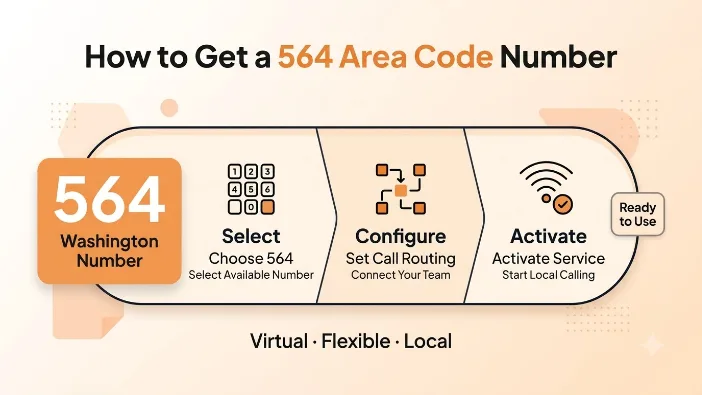
- Cloud phone platform — search available 564 numbers in real time and activate a line the same day, with no hardware and no technician visit.
- Port your existing number — already run a 564 line on another carrier? Move it over without downtime and keep the number active through the transition.
- Wireless SIM or landline carrier — valid for a single physical handset, but slower to provision and harder to scale seat by seat.
With letsdial, a 564 number provisions in under three minutes on a free trial, no credit card required, so a western Washington presence can be answering calls the same afternoon, whether that's an Olympia office or a remote team representing the region from anywhere in the country.
That same setup works just as well for a business targeting the Seattle side of 564's footprint specifically — a vendor selling into the 206 region doesn't need a downtown Seattle office to answer on a genuinely local 564 number.
Porting an existing 564 line into a new platform works the same way in reverse: the number stays live the entire time, so a business that's already printed the number on signage, contracts, and directory listings doesn't lose any of that history switching providers, no matter which part of the overlay it was originally issued from.
Call Trust in Western Washington
The 564 footprint runs on a mix of state-government vendor channels around Olympia, university-supplier relationships around Bellingham, and cross-border trade traffic near Vancouver — settings where an unfamiliar out-of-area number gets screened before it's answered.
Because 564 is still newer and less recognized than the 360 and 206 codes it overlays, residents are somewhat more likely to let an unfamiliar 564 call go to voicemail by default, which makes verified caller ID even more important for a legitimate business trying to get through on it.
That recognition gap should narrow over time as more numbers get assigned across both the 360 and 206 territories, but for now a 564 caller ID is competing against decades of familiarity built up by the two older codes it overlays.
STIR/SHAKEN for a Newer Overlay Code
Apply STIR/SHAKEN attestation so every outbound 564 call arrives verified with your registered business name on screen instead of a bare number. As a provider, letsdial registers text campaigns for 10DLC compliance from day one and warms new numbers before scaling volume, so a verified line reads as genuinely western Washington-local rather than one more unrecognized number.
Conclusion
564 is western Washington's most unusual overlay code — the only one in state history to sit on top of two separate parent codes, 360 and 206, covering everything from Olympia's state capitol to Bellingham's university campus to Vancouver's centuries-old river-port history. Proposed in 1999 and finally launched in 2017, then expanded to cover Seattle itself in 2025, it's been nearly three decades in the making.
Standing up a line takes minutes on a cloud platform, with STIR/SHAKEN attestation so calls arrive verified rather than flagged. Put a 564 number in front of government, university, and cross-border trade contacts, and let a familiar prefix open the door first, with letsdial handling the setup end to end, whether the business is based in Olympia, Bellingham, Vancouver, or Seattle itself.
Frequently Asked Questions
Written by Aryan Khan · August 3, 2026
Reply to the author