Introduction
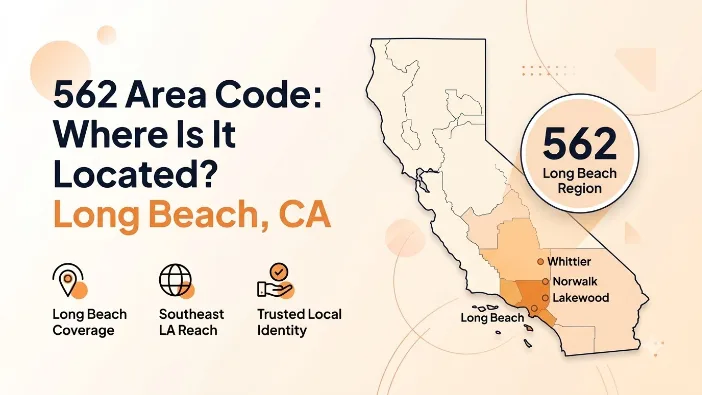
What area code is 562? It's in the USA — southeast Los Angeles County and northern Orange County, California, centered on Long Beach. 562 covers Long Beach, Whittier, Downey, Lakewood, and Norwalk, sitting between the LA and Orange County metro areas without belonging fully to either.
This guide answers exactly where the 562 area code is located, why it's one of the few Southern California codes with no overlay, the port and university history behind it, its 1997 split from 310, and how to get a local number that gets answered.
Where the 562 Area Code Reaches
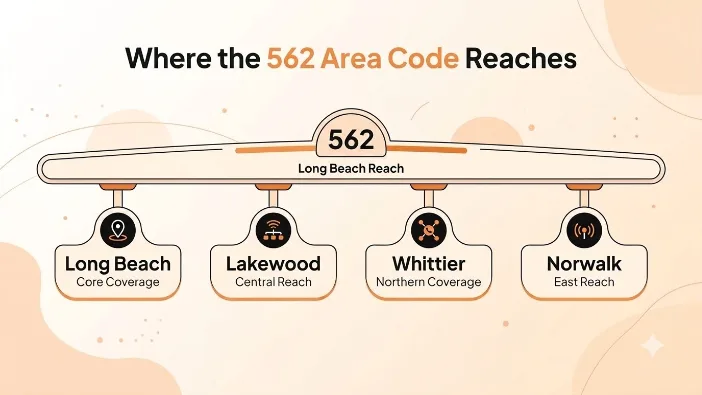
562 covers a dense stretch of southeast Los Angeles County and a slice of northern Orange County, anchored by Long Beach and stretching inland through a string of mid-sized suburban cities.
- Long Beach — the region's largest city and home to one of the busiest container ports in the country
- Whittier — a foothill city where Richard Nixon was raised
- Downey — a Los Angeles County city with deep aerospace-manufacturing roots
- Lakewood — a large mid-century planned suburb built in the early 1950s
- Norwalk — a Los Angeles County city near the Orange County line
Between these anchor cities, 562 also covers Bellflower, Cerritos, Signal Hill, Paramount, Pico Rivera, and dozens of other dense suburban communities that don't fit neatly into either the Los Angeles or Orange County identity most people expect from Southern California.
The entire 562 area code observes Pacific Time — UTC-8 (PST) in winter and UTC-7 (PDT) during Daylight Saving — the same clock as the rest of California. East Coast teams calling into the 562 region are three hours ahead, so a late-afternoon Eastern call lands right around lunchtime in Long Beach.
To the west, Los Angeles and the South Bay answer to the 310 area code that 562 originally split from.
A full breakdown of how 562 fits alongside the rest of the state's prefixes is in this California area codes guide.
562's Origin: No Overlay, Just a Split from 310
Unlike most crowded Southern California area codes, 562 has never needed an overlay — it remains the single, original code for its entire territory. 562's own history has an unusual twist: regulators first proposed it in 1995 as a cellular-only overlay for 310, but wireless carriers sued the California Public Utilities Commission to block the plan, worried that separating cell numbers from home numbers into a different area code would create a stigma and hurt sales, echoing a similar fight that had just played out in New York City over the 917 overlay.
Both 310 and 562 ultimately trace back to the old 213 area code, which once covered the entire Los Angeles basin before splitting apart across the early 1990s.
That cellular-overlay plan was scrapped, and regulators went with a conventional geographic split instead — 562 launched on January 25, 1997, taking over the southeast LA County and North Orange County portion of 310's territory rather than sharing it as an overlay. The California Public Utilities Commission's official report on the split documents the full history.
The Port of Long Beach and the Queen Mary
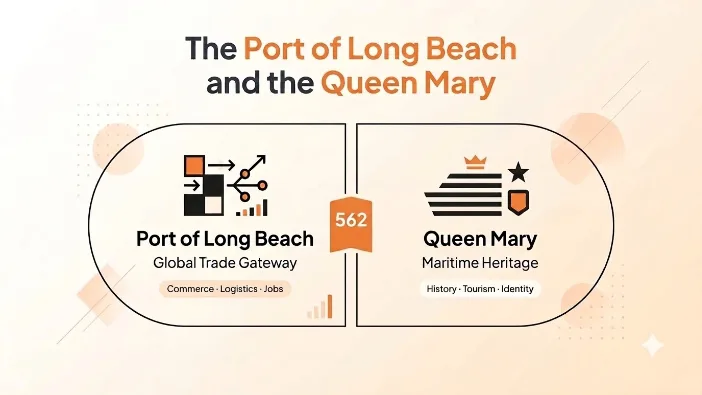
Long Beach's identity is built around two very different maritime landmarks that both sit inside the 562 footprint.
The Port of Long Beach
The Port of Long Beach spans 3,200 acres with 25 miles of waterfront, sits directly adjacent to the Port of Los Angeles, and regularly ranks as one of the two busiest container ports in the entire United States. Together the two ports form one of the largest cargo-shipping complexes in North America, and that logistics and trade economy touches nearly every business in the surrounding 562 footprint in some way — trucking, warehousing, customs brokerage, and freight forwarding all cluster around the port and ripple outward into Whittier, Downey, and Norwalk.
The Queen Mary
The RMS Queen Mary, launched from Scotland in 1936 and winner of the transatlantic speed record known as the Blue Riband that same year, completed her final voyage in 1967 and has remained permanently moored in Long Beach ever since, now operating as a hotel and event venue that draws visitors from across Southern California. The ship's presence gives Long Beach a genuinely distinctive tourism identity that no other city in the 562 footprint shares, one built around ocean-liner history rather than beaches or theme parks.
CSULB and Whittier's Nixon Legacy
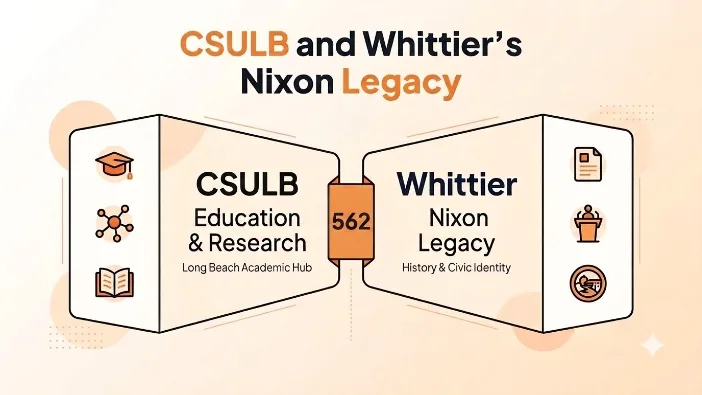
Beyond the waterfront, the 562 footprint carries a major public university and a genuine presidential connection.
California State University, Long Beach
California State University, Long Beach was founded in 1949 under Governor Earl Warren and has grown into one of the largest and highest-ranked campuses in the entire CSU system, anchoring Long Beach's education and research economy alongside its port and shipping industries. The university's enrollment now numbers in the tens of thousands, making it one of the largest single employers and economic anchors anywhere in the 562 footprint outside the port itself.
Richard Nixon's Whittier
Richard Nixon was born in nearby Yorba Linda in 1913, but his family moved to Whittier in 1922, and he was raised there for the rest of his childhood — Whittier College, where Nixon later studied, still anchors the city's identity as the place that shaped the future president well before Yorba Linda's official birthplace site did. Whittier's downtown and the surrounding foothill neighborhoods still carry that early-20th-century character today, giving the city a genuinely distinct identity within the wider 562 footprint.
562 History
The land now covered by 562 was originally part of the old 213 area code, which covered the entire Los Angeles basin. On November 2, 1991, most of the western and southern portions of that territory split off to form 310, taking southeast LA County and northern Orange County along with the Westside and South Bay.
310's own rapid growth through the mid-1990s pushed regulators toward relief again, and after the cellular-overlay plan was scrapped, 562 launched on January 25, 1997, as a conventional geographic split — giving Long Beach, Whittier, and the surrounding cities their own dedicated area code that has never needed an overlay since.
How to Get a 562 Area Code Number
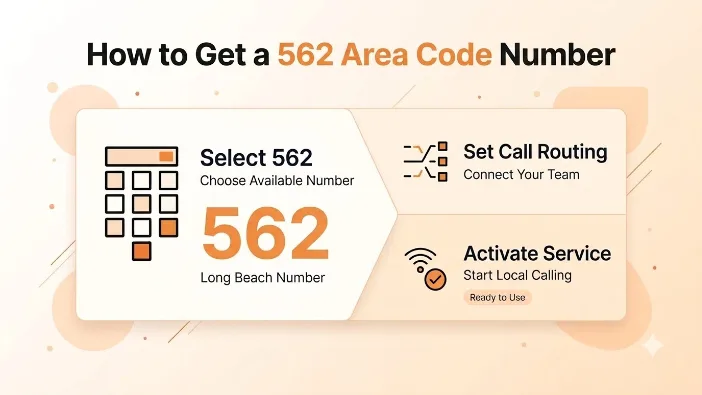
- Cloud phone platform — search available 562 numbers in real time and activate a line the same day, with no hardware and no technician visit.
- Port your existing number — already run a 562 line on another carrier? Move it over without downtime and keep the number active through the transition.
- Wireless SIM or landline carrier — valid for a single physical handset, but slower to provision and harder to scale seat by seat.
With letsdial, a 562 number provisions in under three minutes on a free trial, no credit card required, so a Long Beach-area presence can be answering calls the same afternoon, whether that's a Long Beach office or a remote team representing the region from anywhere in the country.
That same setup works just as well for a business serving the port's logistics economy specifically — a freight forwarder or customs broker doesn't need a physical office near the port itself to answer on a genuinely local 562 number.
Porting an existing 562 line into a new platform works the same way in reverse: the number stays live the entire time, so a business that's already printed the number on signage, contracts, and directory listings doesn't lose any of that history switching providers.
Call Trust in Southeast LA and North Orange County
The 562 footprint runs on a mix of port-and-logistics vendor relationships, university-supplier channels around CSULB, and dense suburban small-business competition — settings where an unfamiliar out-of-area number gets screened before it's answered.
That competitive density cuts across a huge range of industries at once — freight brokers competing for port business, contractors competing across a dozen adjoining suburbs, and retailers competing along the same commercial corridors — so a number that reads as genuinely local carries real weight against a background of near-constant cold outreach.
A recognizable local prefix earns the first hearing across that varied economy, and because 562 has never split into an overlay, it still reads as an unambiguous, single-region signal in a part of California where many neighboring codes now require guessing between two or three overlays.
STIR/SHAKEN for a Dense Logistics Market
Apply STIR/SHAKEN attestation so every outbound 562 call arrives verified with your registered business name on screen instead of a bare number. As a provider, letsdial registers text campaigns for 10DLC compliance from day one and warms new numbers before scaling volume, so a verified line reads as genuinely local rather than one more unidentified number in a region that fields heavy freight and logistics call volume.
Conclusion
562 is southeast Los Angeles County and north Orange County's single, un-overlaid area code — covering the Port of Long Beach's shipping economy, the Queen Mary's permanent Long Beach mooring, CSULB's growing campus, and Whittier's connection to Richard Nixon. Nearly three decades after its 1997 split from 310, it remains the sole, unambiguous prefix for the entire region.
Standing up a line takes minutes on a cloud platform, with STIR/SHAKEN attestation so calls arrive verified rather than flagged. Put a 562 number in front of port and logistics vendors, university partners, and local customers, and let a familiar prefix open the door first, with letsdial handling the setup end to end, no matter which part of the footprint the business calls home.
Frequently Asked Questions
Written by Aryan Khan · August 3, 2026
Reply to the author