Introduction
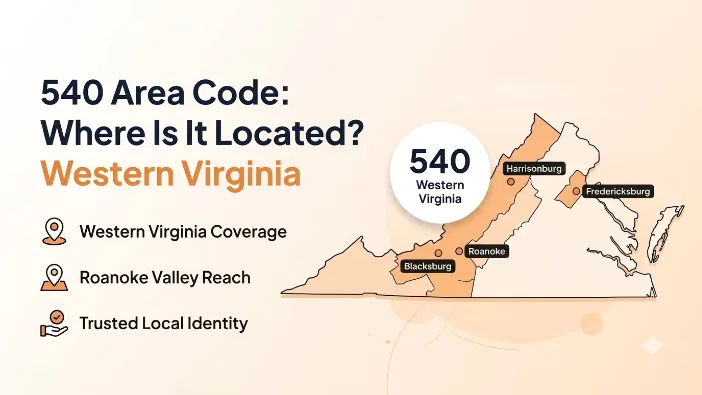
What area code is 540? It's in the USA — western and central Virginia, covering a wide stretch of the state from the Shenandoah Valley down through Roanoke and out to Fredericksburg. 540 reaches Roanoke, Harrisonburg, Winchester, Staunton, Blacksburg, and Fredericksburg, spanning more than 40 counties across the western half of the state.
This guide answers exactly where the 540 area code is located, how it relates to the newer 826 overlay, the university and railroad history behind it, its 1995 split from 703, and how to get a western Virginia number that gets answered.
Where the 540 Area Code Reaches
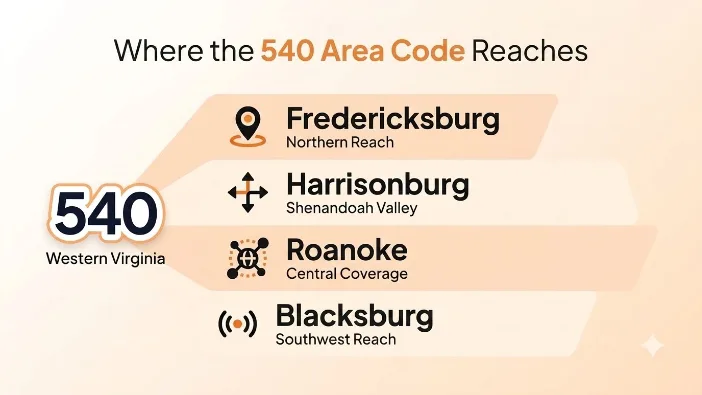
540 covers western and central Virginia — the Shenandoah Valley, the Blue Ridge Mountains, and the Roanoke and Fredericksburg regions — sharing its entire territory with the newer 826 overlay across more than 40 counties rather than a separate region.
- Roanoke — the largest city in western Virginia and a historic railroad hub
- Harrisonburg — a Shenandoah Valley city anchored by James Madison University
- Blacksburg — home to Virginia Tech, one of the state's largest universities
- Winchester and Staunton — Shenandoah Valley cities with deep Civil War-era history
- Fredericksburg — a central Virginia city roughly midway between Richmond and Washington, DC
Between these anchor cities, 540 also covers dozens of smaller Blue Ridge and Shenandoah Valley towns across more than 40 counties, from Culpeper and Front Royal in the north down through Christiansburg and Radford near the West Virginia and Tennessee borders.
The entire 540 area code observes Eastern Time — UTC-5 (EST) in winter and UTC-4 (EDT) during Daylight Saving — the same clock as the rest of Virginia. West Coast teams calling into western Virginia are three hours behind, so a mid-morning Pacific call lands right around lunchtime in Roanoke.
To the east, Arlington, Fairfax, and the rest of Northern Virginia answer to the separate 703 area code that 540 originally split from, and to the southwest, the 276 area code covers the far corner of the state that split from 540 in its own right.
South of the 540 footprint, Lynchburg and Charlottesville answer to the 434 area code, which split from 804 in 2001 and covers the neighboring central Virginia corridor those cities anchor.
A full breakdown of how 540 fits alongside the rest of the state's prefixes is in this Virginia area codes guide.
The 540/826 Overlay: One Region, Two Codes
826 is an overlay, not a split — it lays a second set of numbers over the exact same western Virginia footprint 540 has always covered, rather than dividing the region into two smaller areas. The Virginia State Corporation Commission approved the overlay in June 2020, mandatory ten-digit dialing began May 14, 2022, and new lines could start receiving 826 numbers on June 14, 2022.
Every 540 number in service before the overlay kept its digits unchanged — 826 only applies to new lines assigned since the overlay took effect, and it's why a call between two numbers on the same Roanoke street now needs all ten digits.
Virginia Tech and James Madison University
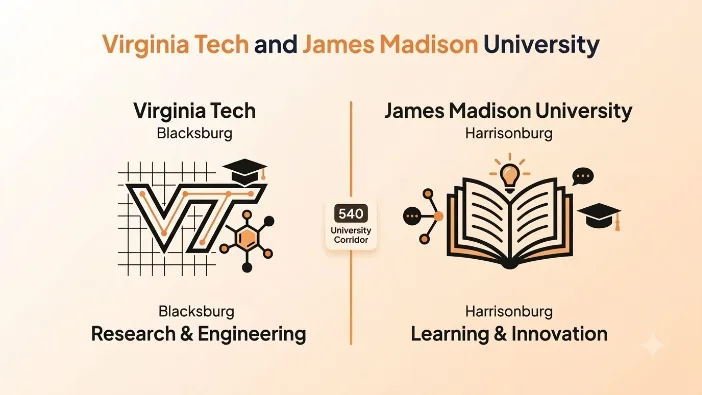
Two of Virginia's largest public universities sit inside the 540 footprint, each anchoring a different part of the region's economy.
Virginia Tech in Blacksburg
Virginia Tech was established in Blacksburg in 1872 as a land-grant college, building on the earlier Preston and Olin Institute founded in 1854. Today it's one of Virginia's largest universities, and its engineering and agricultural research programs make Blacksburg a genuine research hub tucked into the Blue Ridge foothills, drawing faculty, graduate researchers, and corporate research partners into a town that would otherwise be a small mountain community.
James Madison University in Harrisonburg
James Madison University was founded in Harrisonburg in 1908, originally as a state teachers college for women, and has since grown into one of the largest universities in the Shenandoah Valley. The campus gives Harrisonburg a steady student population layered on top of the valley's broader agricultural economy, and the school's continued growth over the past century has made it one of the largest employers in the region alongside the valley's farms and food-processing companies.
Roanoke and the Shenandoah Valley's Economy
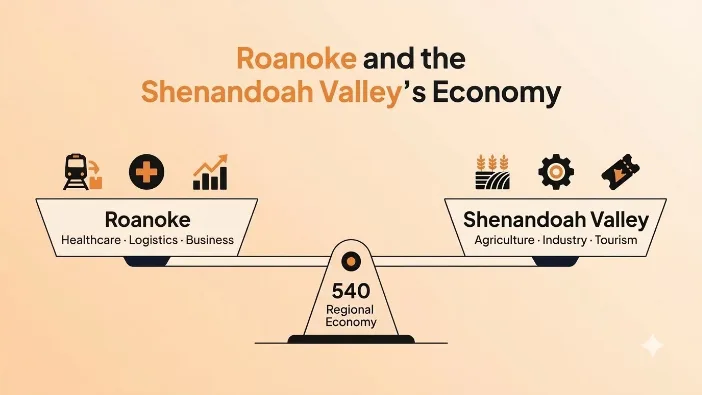
Beyond its university towns, the 540 footprint carries a genuine railroad legacy in Roanoke and a longstanding agricultural economy across the Shenandoah Valley.
Norfolk Southern's Railroad Legacy
Roanoke's first train arrived on November 1, 1852, and the Norfolk and Western Railway established its headquarters in the city in 1882, sparking an economic boom built around locomotive manufacturing and heavy rail repair. Norfolk and Western merged with the Southern Railway in 1982 to form Norfolk Southern, and while the corporate headquarters eventually moved elsewhere, the railroad still employs workers in Roanoke and the city's rail heritage remains central to its identity. The old Norfolk and Western shops that once built and repaired steam locomotives helped make Roanoke the largest city in western Virginia, a status it still holds today.
The Shenandoah Valley's Agricultural Economy
The Shenandoah Valley running through Winchester, Staunton, and Harrisonburg has been one of Virginia's most productive agricultural regions for generations, known especially for apple orchards, poultry, and dairy farming, and the Blue Ridge Mountains framing the valley's eastern edge give the region a tourism draw that runs alongside its farm economy. Skyline Drive, the scenic highway running the length of Shenandoah National Park along the Blue Ridge crest, draws visitors from across the mid-Atlantic every fall for leaf-peeping season, adding a seasonal tourism spike to towns along the park's edge.
540 History
The 540 area code went into service on July 15, 1995, split off from the 703 area code once Northern Virginia's rapid growth had made the combined territory too crowded to share. The split kept 703 for the dense Washington, DC suburbs and gave western and central Virginia their own dedicated numbering territory.
In 2001, the 276 area code split off from 540's southwestern corner as demand kept growing, narrowing 540's footprint to its current western and central Virginia shape. Continued growth from wireless numbers eventually pushed even that smaller territory toward exhaustion two decades later, leading regulators to add the 826 overlay in 2022 rather than split the region a second time.
How to Get a 540 Area Code Number
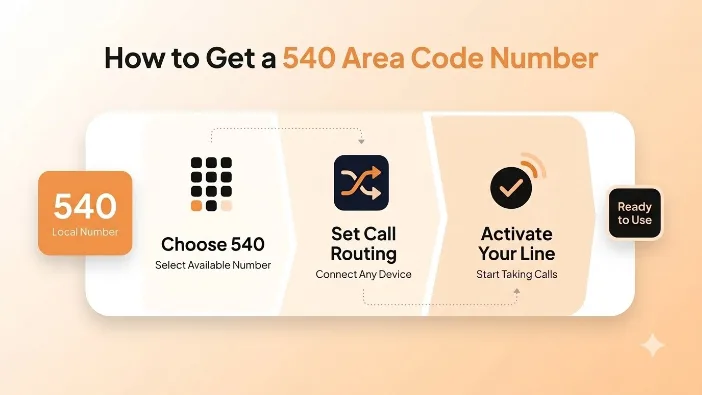
- Cloud phone platform — search available 540 or 826 numbers in real time and activate a line the same day, with no hardware and no technician visit.
- Port your existing number — already run a 540 line on another carrier? Move it over without downtime and keep the number active through the transition.
- Wireless SIM or landline carrier — valid for a single physical handset, but slower to provision and harder to scale seat by seat.
With letsdial, a 540 number provisions in under three minutes on a free trial, no credit card required, so a western Virginia presence can be answering calls the same afternoon, whether that's a Roanoke office or a remote team representing the region from anywhere in the country.
That same setup works just as well for a business serving the university towns specifically — a vendor selling into Virginia Tech or JMU doesn't need a physical office in either Blacksburg or Harrisonburg to answer on a genuinely local 540 number.
Porting an existing 540 line into a new platform works the same way in reverse: the number stays live the entire time, so a business that's already printed the number on signage, contracts, and directory listings doesn't lose any of that history switching providers.
Call Trust in Western Virginia
The 540 footprint runs on a mix of university-vendor channels around Virginia Tech and JMU, agricultural-supplier relationships across the Shenandoah Valley, and a steady stream of rail and logistics business tied to Roanoke's transportation history — settings where an unfamiliar out-of-area number gets screened before it's answered.
That screening habit runs especially deep across the Shenandoah Valley's spread-out farm towns, where residents are used to dealing with genuinely local vendors and suppliers and treat an unfamiliar out-of-state number with real suspicion, particularly around harvest and delivery scheduling calls.
A recognizable local prefix earns the first hearing across that varied economy, and 540 in particular carries weight as the region's original, decades-old code rather than the newer overlay.
STIR/SHAKEN for a Growing Overlay Region
Apply STIR/SHAKEN attestation so every outbound 540 call arrives verified with your registered business name on screen instead of a bare number. As a provider, letsdial registers text campaigns for 10DLC compliance from day one and warms new numbers before scaling volume, so a verified line reads as genuinely western Virginia-local rather than one more unidentified 540 or 826 call.
Conclusion
540 is western and central Virginia's original area code — covering Virginia Tech's research campus in Blacksburg, James Madison University in Harrisonburg, Roanoke's railroad legacy, the Shenandoah Valley's agricultural heartland, and Skyline Drive's fall tourism season, all sharing the same numbering pool with the newer 826 overlay.
Standing up a line takes minutes on a cloud platform, with STIR/SHAKEN attestation so calls arrive verified rather than flagged. Put a 540 number in front of university partners, agricultural suppliers, and logistics vendors, and let a familiar prefix open the door first, with letsdial handling the setup end to end. Whether the business is based in a Roanoke office park or serving the Shenandoah Valley's fall tourism season from a remote team anywhere in the country, the same 540 — or its 826 overlay sibling — reads as genuinely western Virginia local.
Frequently Asked Questions
Written by Aryan Khan · August 16, 2024
Reply to the author