Introduction
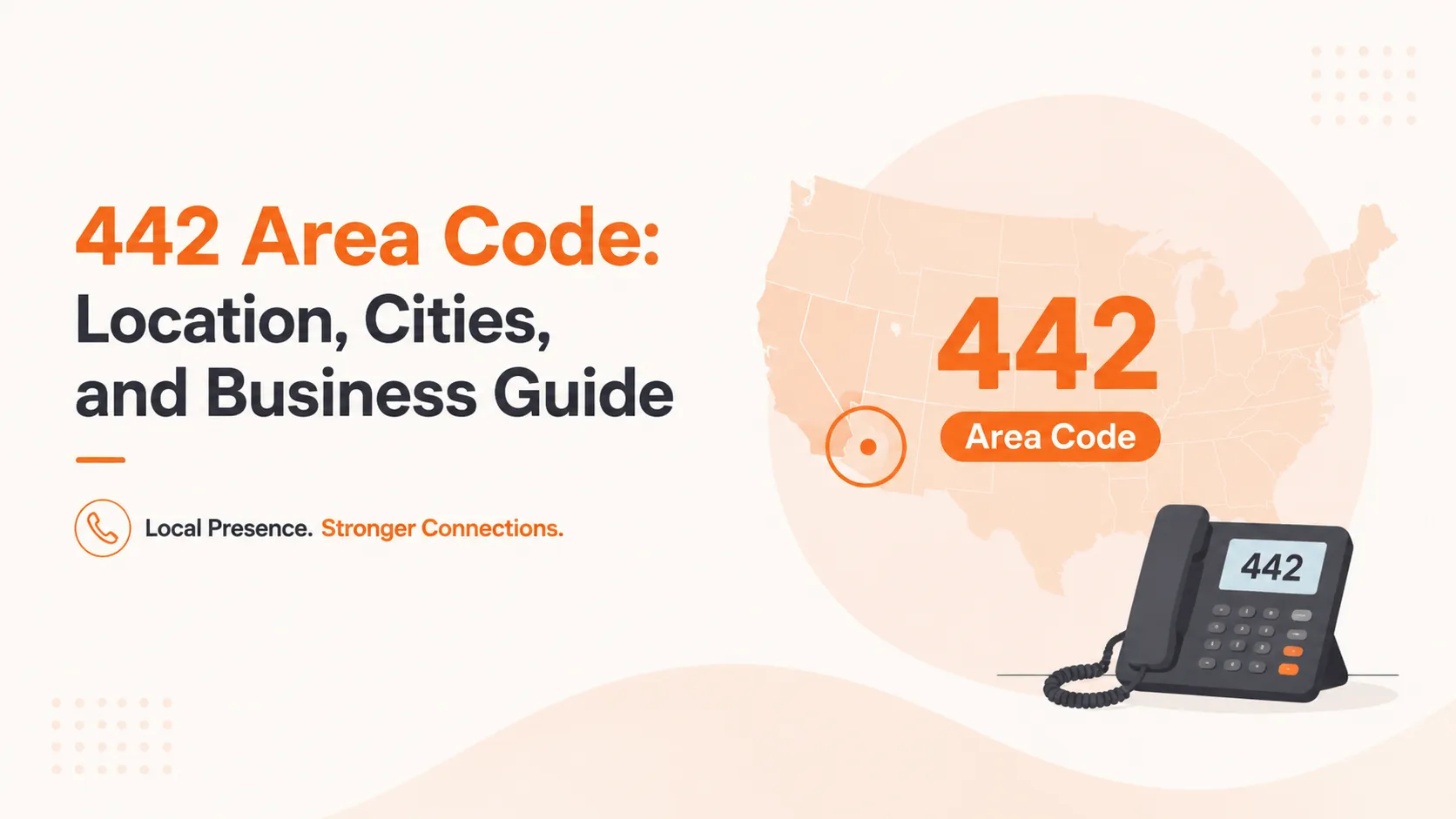
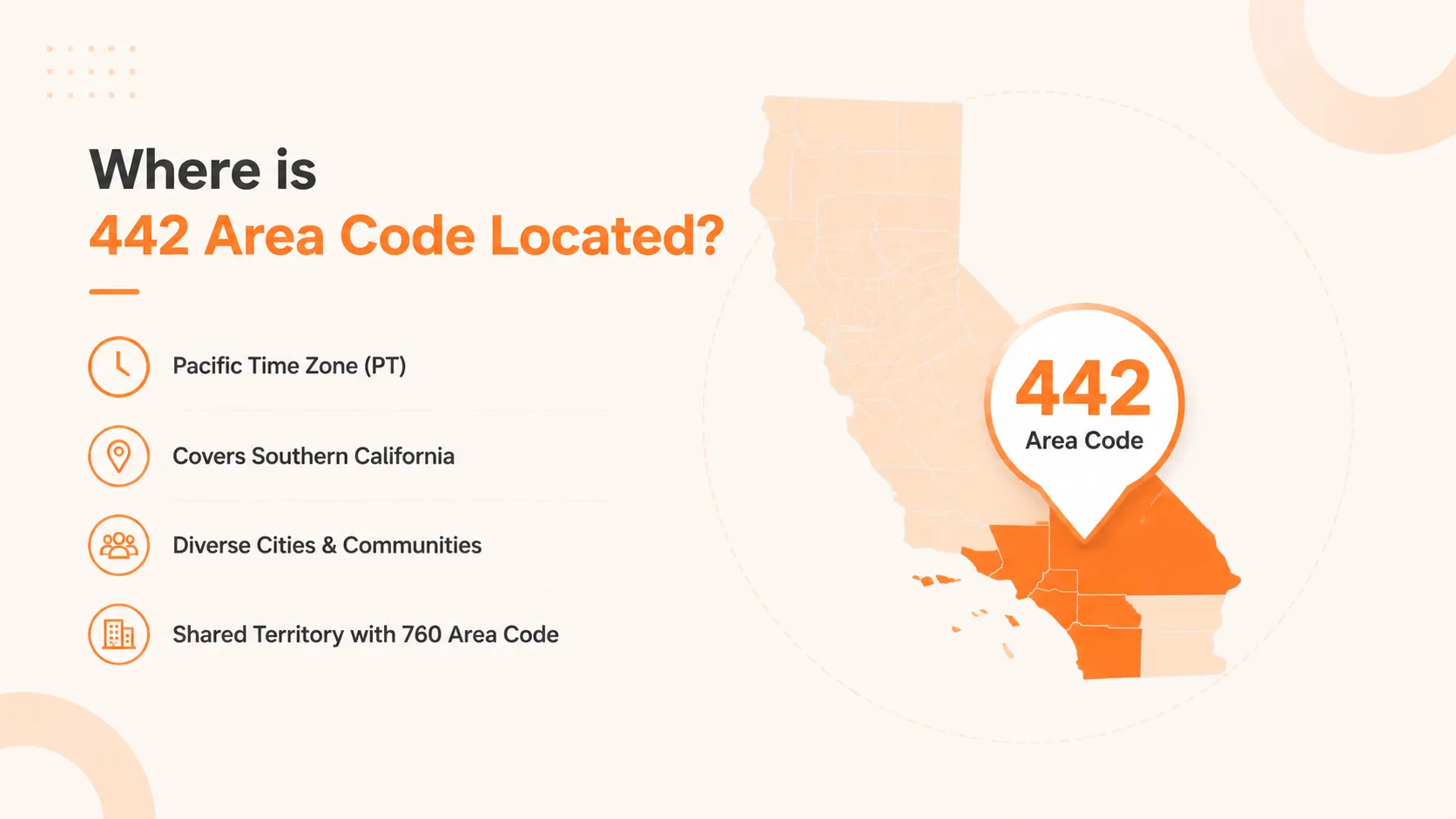
Where is the 442 area code? It's in the USA — Southern and Eastern California, not Mexico. 442 is an overlay of the established 760 area code, covering the exact same geographic footprint across the Coachella Valley, the Inland Empire desert communities, North San Diego County, and the Imperial Valley. Introduced in 2009, 442 brought fresh numbering capacity to one of California's most geographically extensive area code regions, and the combined 442/760 coverage area spans more square miles than several entire US states.
What the 442 Area Code Covers
Area code 442 shares the same territory as 760. The coverage area includes the Coachella Valley cities of Palm Springs, Palm Desert, Indio, La Quinta, and Cathedral City. Moving north, the High Desert communities of Victorville, Hesperia, and Apple Valley form a large residential and logistics zone along the I-15 corridor. To the south, North San Diego County cities including Oceanside, Escondido, Vista, and San Marcos fall within the 442/760 footprint, along with the Imperial Valley border region anchored by El Centro — the coverage runs close to, but does not cross, the US-Mexico border.
A full California area codes breakdown maps how 442 fits alongside the state's other overlay regions.
The Coachella Valley portion also takes in Rancho Mirage and Indian Wells, home each March to the BNP Paribas Open, one of the largest combined men's and women's tennis tournaments outside the four Grand Slams. To the north, Yucca Valley and Twenty-Nine Palms sit at the edge of Joshua Tree National Park, giving the 442/760 footprint a direct link to one of the most visited national parks in the California desert.
The Coachella Valley's summer climate is genuinely extreme — Palm Springs regularly sees highs well above 110°F in July and August — which has shaped the region's economy around a distinct seasonal rhythm. A large "snowbird" population of part-time residents arrives each October and leaves by April, roughly doubling the valley's working population for half the year and driving a hospitality and retail hiring cycle that peaks and contracts on a predictable annual schedule most other California metros don't share.
This geographic diversity creates a remarkably varied economic and communication landscape within a single area code. A resort hotel in Palm Desert, a logistics warehouse in Victorville, a marine base near Oceanside, and an agricultural operation in El Centro all share the same area code despite being hundreds of miles apart. The region operates on Pacific Time throughout.
Phone Number Format and Dialing Guide
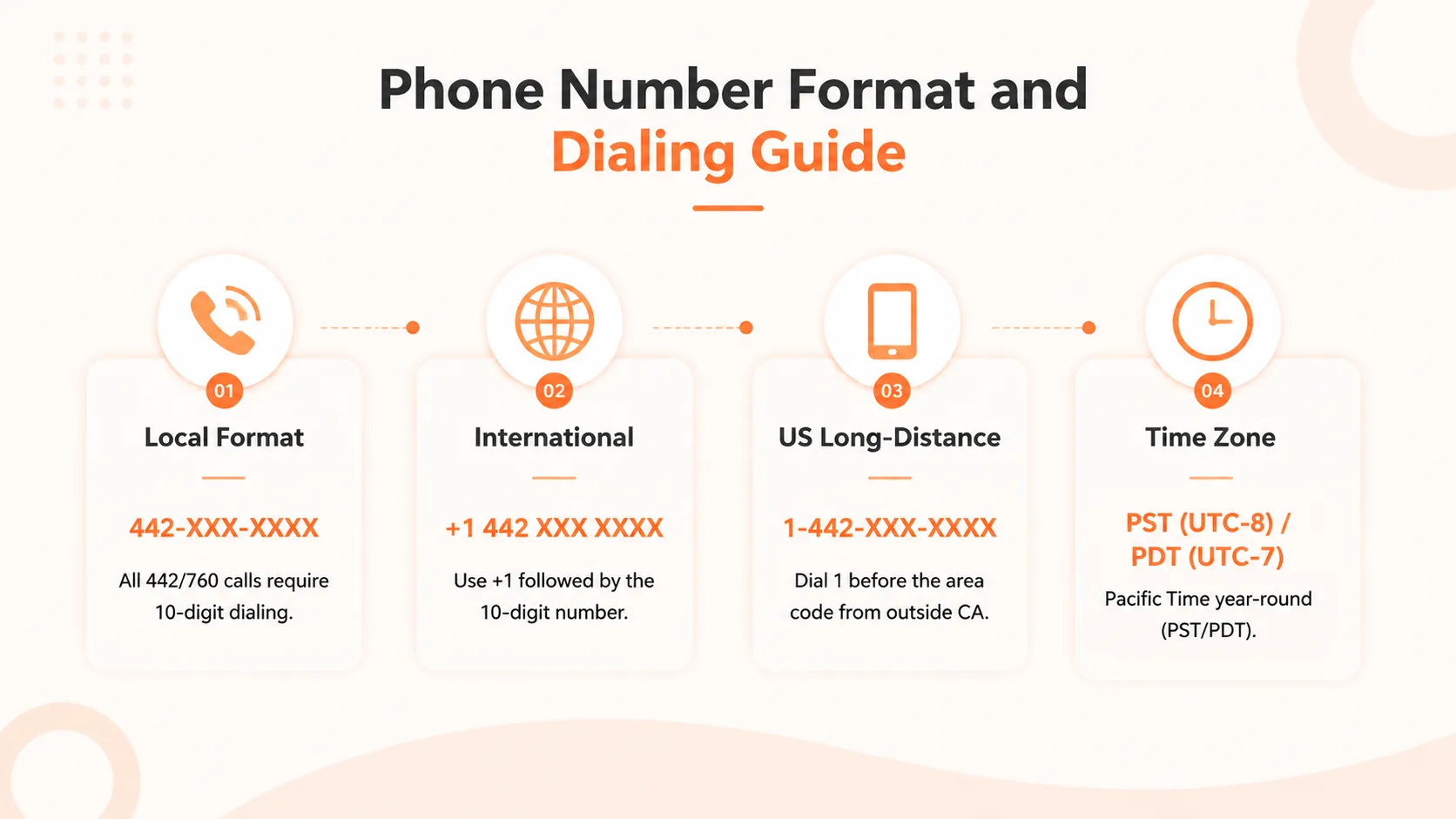
All 442 area code numbers, whether assigned to a cell phone or a landline, follow the NANP 10-digit format: 442-XXX-XXXX. Because 442 is an overlay of 760, mandatory 10-digit dialing applies to all calls within the coverage region, including text messages between two local numbers. For international callers, the dialing format is +1 442 XXX XXXX. For US long-distance calls from outside California, dial 1-442-XXX-XXXX.
760 itself split off from San Diego's 619 area code on March 22, 1997, giving inland and desert Southern California its own numbering territory for the first time. That single geographic split held for over a decade before wireless growth pushed the region toward exhaustion, and 442 arrived in 2009 as an overlay rather than a second split, so no existing 760 customer had to change their number.
Industries and Economy in the 442 Region
Tourism and hospitality are the dominant industries of the Coachella Valley portion of the 442 region. Palm Springs and the surrounding desert cities collectively host hundreds of luxury resorts, golf courses, and event venues. The Coachella Valley Music and Arts Festival and Stagecoach bring hundreds of thousands of visitors to Indio each spring. The High Desert communities along the I-15 corridor are driven primarily by logistics, distribution, and manufacturing.
Palm Springs carries a distinct mid-century modern identity, built during the 1950s and 60s when the city became a favored desert retreat for Hollywood stars including Frank Sinatra and the Rat Pack, and that architectural legacy — walls of glass, low rooflines, and clean geometric forms — still draws design tourism and an annual Modernism Week that fills the city's hotels every February. College of the Desert in Palm Desert and Palm Springs International Airport round out the valley's education and transportation infrastructure.
Victorville anchors the High Desert's logistics economy from the Southern California Logistics Airport, a former Air Force base converted into a major aircraft storage, maintenance, and cargo facility that takes advantage of cheap land and dry desert air ideal for storing airliners long-term. Near the region's southern edge, Camp Pendleton, one of the largest Marine Corps installations on the West Coast, sits just north of Oceanside and drives much of North San Diego County's defense-contractor and veteran-services economy. The Imperial Valley, at the region's far southeastern edge, is one of the most productive winter vegetable-growing regions in the country, irrigated by the All-American Canal and shipping produce nationwide through the coldest months of the year.
El Centro, the Imperial Valley's largest city, regularly posts some of the highest recorded temperatures in the continental United States and sits not far from the Salton Sea, California's largest lake, formed by an early-1900s engineering accident when the Colorado River breached an irrigation canal and flooded the below-sea-level basin for nearly two years before the breach was sealed. That same below-sea-level geography is what makes the Imperial Valley's irrigated farmland so productive, even as the surrounding desert stays some of the driest terrain in North America.
North San Diego County adds yet another distinct economy to the same area code — Escondido and San Marcos anchor a growing biotech and life-sciences cluster spun out of proximity to San Diego's larger research hubs, while Oceanside's beaches and pier draw a steady tourism trade separate from the desert resorts further inland. Few US area codes stretch across four such different regional economies — resort tourism, military logistics, biotech, and agriculture — under a single set of ten digits.
Getting a 442 Area Code Phone Number
Obtaining a 442 area code phone number is straightforward through a traditional carrier or a cloud VoIP provider. For businesses outside the region that want to project a local Coachella Valley, High Desert, or North San Diego County presence, VoIP platforms like letsdial allow you to activate a 442 number in minutes on either a cell phone or a desk line — no California office required. Because the 442/760 footprint covers such varied local economies, the same number can plausibly represent a resort concierge, a logistics dispatcher, or an agricultural supplier, so businesses in any of those industries read as equally local on caller ID.
Porting an existing 442 or 760 number into a new provider works the same way in reverse — the line stays live throughout the switch, so a business that's already printed the number on signage or listings doesn't lose any of that history changing platforms.
Spam, Robocalls, and How to Stay Safe
Like all US area codes, 442 numbers are targeted by caller ID spoofing campaigns, and calls from the 442 area code get reported as scams often enough that many residents let unfamiliar numbers go to voicemail by default. Common fraud tactics include fake resort vacation offers exploiting the Coachella Valley's tourism reputation, robocalls impersonating regional utility companies, and phishing calls or text messages targeting seniors in the region's large retirement population with Social Security or Medicare fraud schemes. Register at donotcall.gov and report suspicious calls to the FTC at reportfraud.ftc.gov.
The Future of the 442 Area Code
The 442 overlay was introduced because the 760 number pool was approaching exhaustion after sustained demand growth across its enormous geographic footprint. High Desert population growth driven by migration from more expensive LA County communities, continued Coachella Valley resort and residential development, and expanding logistics sector demand all sustain consistent pressure on available numbers. Even with 442 in place, a footprint this large and this economically varied is likely to need further numbering relief again as the region keeps growing.
Conclusion
442 covers one of California's largest and most varied area code footprints — the Coachella Valley's resort economy, the High Desert's logistics corridor, and North San Diego County's coastal communities, all sharing the same numbering pool as 760. It is a US area code, not a Mexican one, despite its footprint running close to the border.
Getting a local 442 line takes minutes through a cloud VoIP provider, no California office required. 442 is officially documented under the North American Numbering Plan, which governs area code assignments across the US, Canada, and the Caribbean.
Frequently Asked Questions
Written by Aryan Khan · June 27, 2026
Reply to the author