Introduction
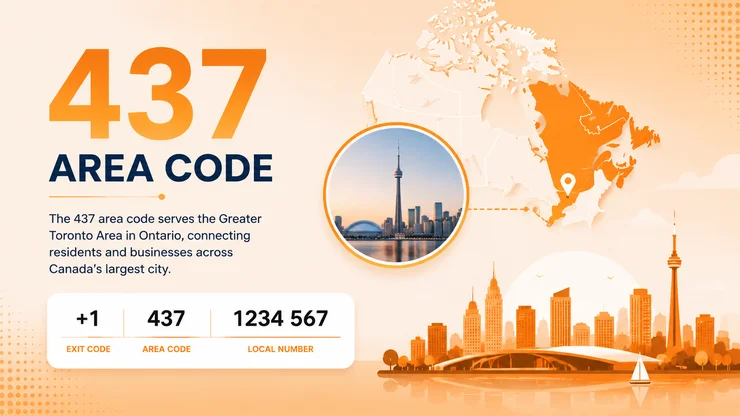
Toronto is Canada's largest city, with roughly 2.8 million residents in the city proper and well over 6 million people across the wider Greater Toronto Area. The 437 area code is one of four overlay codes now assigned to that single, unified numbering area — a structure that exists because a city this size burns through phone numbers faster than any single code can supply.
- Province: Ontario, Canada
- Region: City of Toronto — an overlay covering the exact same footprint as 416, 647, and 942
- Launched: March 25, 2013 (the second overlay added to Toronto's numbering area)
- Time zone: Eastern Time (ET)
- Overlay: Yes — 416, 647, 437, and 942 all share Toronto's territory; every local call needs all 10 digits
Both the UN and the BBC have named Toronto the most diverse city in the world: immigrants make up roughly 47% of the population, more than 250 ethnicities and 175 languages are represented, and no single ethnic or racial group holds a majority — a genuinely global customer base for any business a 437 number reaches.
437 isn't a separate slice of Toronto geography; it's an overlay, meaning it shares the exact same footprint as the older 416 and 647 codes, and, since 2025, the newer 942 code as well. Businesses and residents request a 437 number for the same reasons they'd want any Toronto number: local presence, familiarity to callers, and simple availability, since 416 numbers in particular have been effectively exhausted for years.
Key Takeaways
- 437 is an overlay code that shares Toronto's full footprint with 416, 647, and 942 — not a separate geographic area
- Introduced March 25, 2013, as the second overlay added to Toronto's numbering area
- Mandatory 10-digit dialing applies to every local call in Toronto, regardless of which of the four codes is involved
Where 437 Lives: Overlay Status and Toronto's Geography
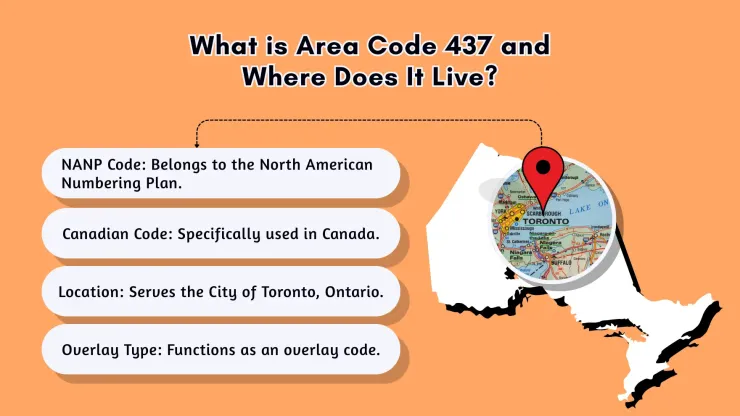
The 437 area code covers the entire City of Toronto — the same footprint as 416, 647, and 942. Because it's an overlay rather than a geographic split, there's no "437 side of town": a 437 number can be assigned anywhere in the amalgamated city, from Old Toronto's downtown core to North York, Scarborough, Etobicoke, and York.
The territory itself is one of North America's largest and most diverse urban economies. Toronto's Bay Street financial district is headquarters to all five of Canada's largest banks — RBC, TD, Scotiabank, BMO, and CIBC — and the Toronto Stock Exchange, Canada's largest, anchors a downtown core that also hosts Canadian offices for global technology companies including Google, Microsoft, and Amazon. Add a dense concentration of universities, hospitals, and cultural institutions, plus one of the most diverse populations in the world, and it's easy to see why continued growth keeps driving demand for new phone numbers.
The CN Tower, opened on June 26, 1976 at 553.3 metres, held the record for the world's tallest freestanding structure for 32 years before Dubai's Burj Khalifa surpassed it in 2007 — it remains Toronto's most recognizable landmark and the anchor of the downtown skyline that the 437 area code identifies with.
Toronto Pearson, just outside city limits in neighboring Mississauga, is Canada's busiest airport by a wide margin, handling more than 47 million passengers in 2025 alone — nearly 30% of all air passengers in the country — and its cargo and business-travel volume feeds directly into the Bay Street and downtown Toronto economy that a 437 number represents. The 905 guide covers the neighbouring ground.
A Brief History: How Toronto Ran Out of Numbers Four Times
- 1947: 416 assigned as one of the original 86 North American area codes, covering all of southern Ontario
- October 2, 1993: 416 reduced to the amalgamated City of Toronto proper as the surrounding suburbs split off into the new 905 area code
- March 5, 2001: 647 launched as Canada's first overlay, layering on top of 416 rather than splitting the map again
- March 25, 2013: 437 followed as the second overlay
- April 26, 2025: 942 became the third overlay, the newest addition to Toronto's numbering area
Each addition came from the same driver: explosive growth in mobile phones, VoIP lines, and business numbers outpacing the supply available under the existing codes. With four codes now sharing one footprint, Toronto's numbering plan area — regulated under the North American Numbering Plan — is among the most heavily overlaid in North America. Demand shows no sign of slowing, though regulators haven't announced a fifth code yet. More detail sits on our letsdial page.
10-Digit Dialing and Overlay Rules
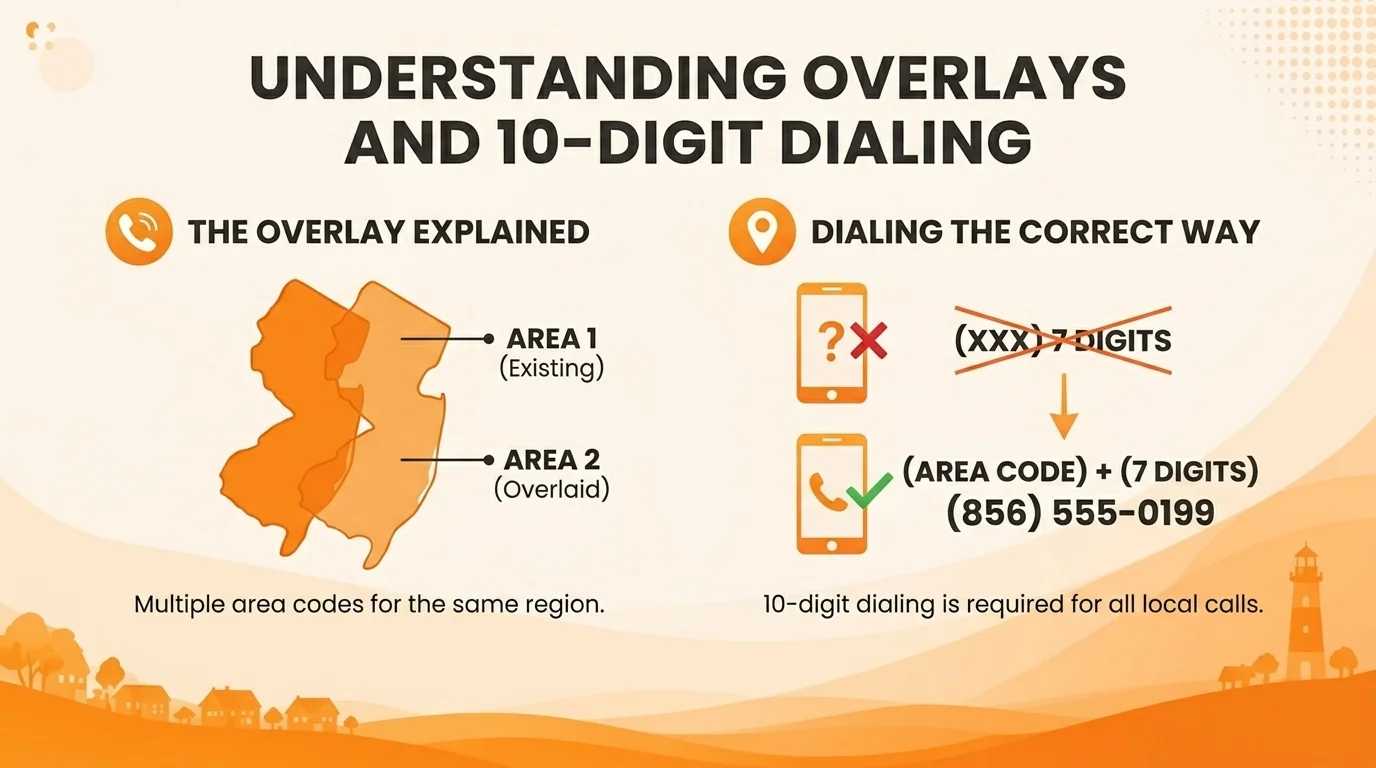
Because 437 shares its territory with three other codes, Toronto requires mandatory 10-digit local dialing — the area code plus the full seven-digit number — for every call, even between two numbers on the same street. Seven-digit dialing hasn't worked in Toronto since the 647 overlay arrived in 2001, and it won't work for 437, 905, or 942 numbers either.
- Local Toronto call (416, 647, 437, or 942): dial all 10 digits, e.g., 437-XXX-XXXX
- Long distance within Canada or to the US: 1 + 10 digits
- International calls into Toronto: 011 + 1 (country code) + the 10-digit number
This rule applies uniformly across every overlapping code, which is why callers should always save contacts with the full area code attached rather than assuming a local seven-digit number will still connect. Toronto also sits entirely in the Eastern Time Zone (UTC-5 in winter, UTC-4 during daylight saving), the same as New York — a detail worth knowing for US businesses scheduling outbound calls to a 437 number, since standard 9 a.m.-to-5 p.m. Eastern business hours apply.
Why a 437 Number Is Valuable for Business
A 437 number gives a business genuine standing in one of North America's largest economies without requiring an office lease in Toronto. That matters for any company selling into the city's financial, technology, or professional-services sectors, where a recognizable local caller ID still carries weight with prospects and clients.
That standing runs deeper than banking. The University of Toronto, founded by royal charter in 1827 as King's College, is Canada's top-ranked university and one of the most research-intensive institutions in the world, with more than $1.45 billion in annual research funding. Its researchers Frederick Banting and Charles Best discovered insulin there in 1921 — one of the most consequential medical breakthroughs of the 20th century — and that research legacy still feeds a dense biotech, pharmaceutical, and healthcare-services cluster across the city today, alongside the finance and technology sectors that dominate downtown Bay Street. A 437 number reaching into that research and healthcare economy carries the same local credibility as one reaching into banking.
- Establishes a credible local presence for Bay Street, downtown, or GTA-wide outreach
- Builds trust with Toronto customers who are more likely to answer a local number
- Improves the effectiveness of local marketing and advertising campaigns
- Makes a business easier to reach for existing Toronto customers
- Projects a professional, established image to partners and vendors
The businesses that benefit most tend to fall into a few groups: professional services firms (law, accounting, consulting) courting Bay Street clients, e-commerce sellers shipping into the GTA, and remote-first or US-based companies that want a genuine Toronto presence without opening a physical office. In every case, the number does the work of a local address without the overhead of one.
Cross-border businesses in particular gain from picking the number over the alternative of running everything through a US line. A Toronto caller ID reduces the hesitation a Canadian buyer feels dealing with what looks like a foreign company, and it sidesteps the currency and calling-plan confusion that can come with dialing a US number from inside Canada. For a US company already selling into Ontario, a 437 line is frequently the cheapest and fastest way to remove that friction from the sales process entirely.
Getting Your 437 Number
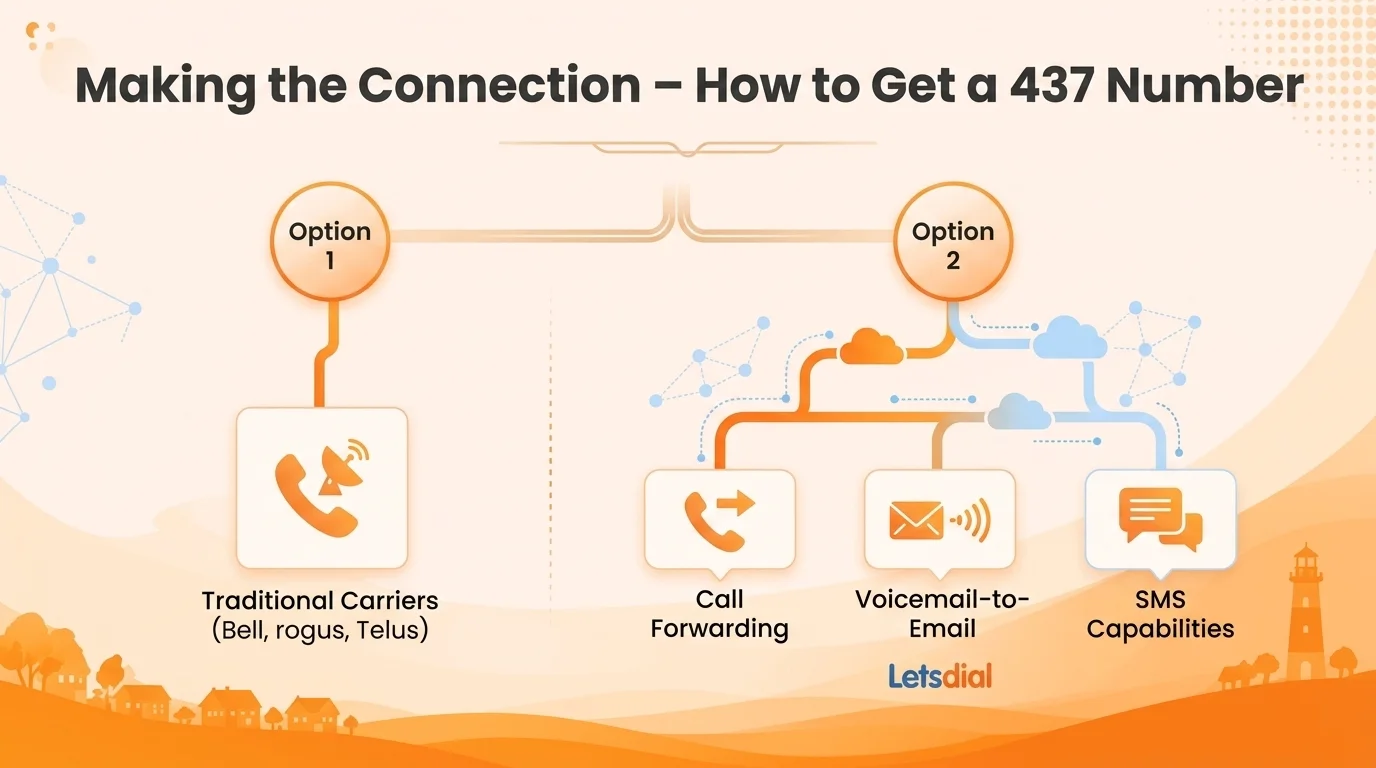
Option 1: Traditional Carriers
- Bell
- Rogers
- Telus
Option 2: VoIP Providers
Cloud phone providers like letsdial offer a faster, more flexible route to a 437 number, with features like call forwarding, voicemail-to-email, and SMS built in from the start — no Canadian office or hardware required to activate a line. Setup typically takes minutes rather than the days a traditional carrier order can take, and an existing Toronto number on another carrier can usually be ported over without any downtime.
Avoiding 437 Area Code Scams
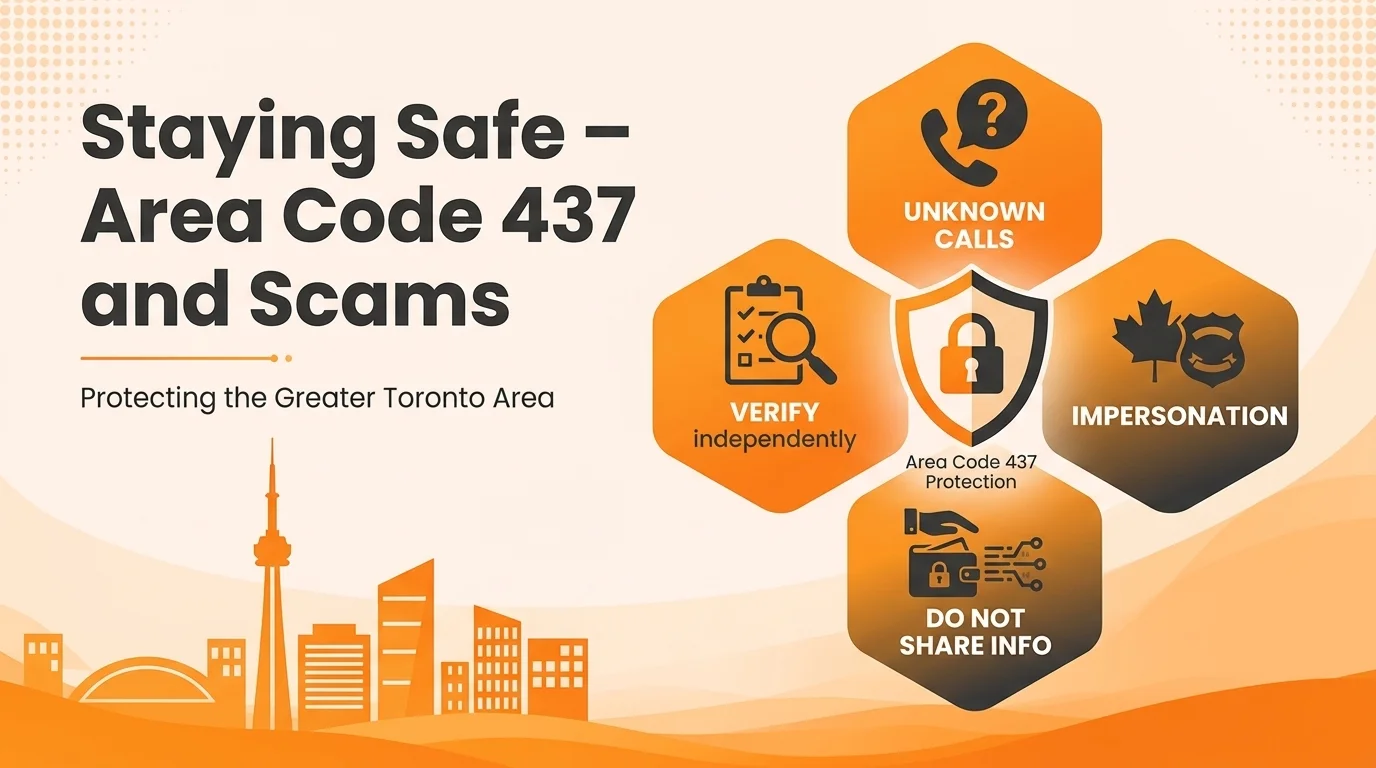
Like any active area code, 437 numbers can be spoofed by scammers looking to borrow Toronto's local credibility. A handful of habits go a long way toward staying safe: For the official record, see the FCC's North American Numbering Plan page.
- Verify the caller's identity before sharing any personal information
- Use call-blocking apps or carrier features to filter suspicious calls
- Register on the National Do Not Call List to reduce unsolicited calls
Conclusion
The 437 area code is now a permanent part of Toronto's telecommunications landscape, sharing the same footprint as 416, 647, and the newer 942 overlay to keep one of North America's largest cities supplied with phone numbers. For businesses and individuals alike, a 437 number is a straightforward way to establish a genuine local presence in Canada's largest market, with traditional carriers and VoIP providers both offering quick, accessible paths to activation.
Frequently Asked Questions
Written by Aryan Khan · June 20, 2026
Reply to the author