Introduction
The 301 area code answers across Maryland's Washington DC suburbs and the state's western counties — a footprint that runs from the federal offices and biotech labs of Bethesda and Rockville, through the flagship university town of College Park, out to Frederick, Hagerstown, and Cumberland at the edge of the Appalachians.
This guide maps where the 301 area code reaches, the federal government, research, and higher-education economy anchoring its eastern half, the manufacturing and tourism base of western Maryland, its Eastern Time calling window, its 1947 origin as one of the nation's first area codes, and how to put a Maryland number in front of customers in minutes.
Where the 301 Area Code Reaches
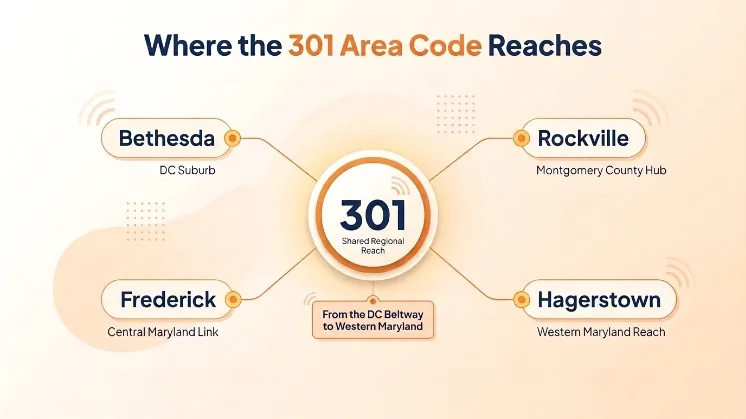
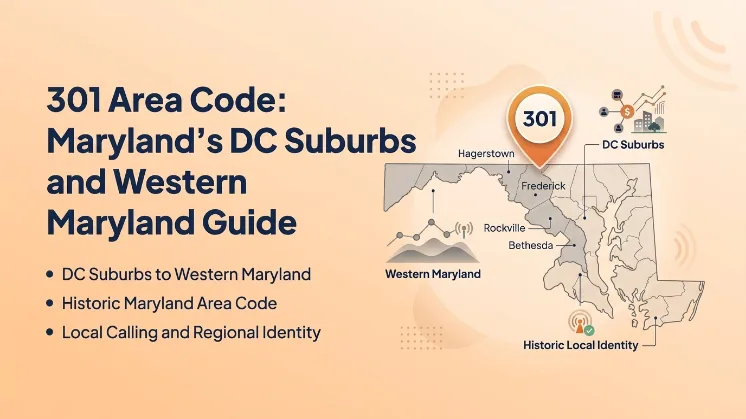
The 301 area code covers a wide stretch of Maryland split between two very different regions: the dense Washington DC suburbs of Montgomery and Prince George's counties, and the more rural, mountainous counties of western Maryland stretching toward the Pennsylvania and West Virginia lines, a mix of federal suburbs, college towns, and small mountain cities.
- Silver Spring — a Montgomery County hub just north of the DC line and home to the FDA's White Oak research campus
- Rockville — the Montgomery County seat and a core of the I-270 biotech corridor
- Bethesda — home to the National Institutes of Health, Walter Reed National Military Medical Center, and Marriott International's headquarters
- College Park — the Prince George's County home of the University of Maryland's flagship campus
- Frederick — the historic Frederick County seat and home to Fort Detrick's biodefense research
- Hagerstown — the Washington County seat at the crossroads of Interstate 81 and Interstate 70
- Cumberland — the Allegany County seat and former rail hub at the edge of the Appalachians
Because the footprint pairs a federal-and-biotech suburb economy with a major public university and a working western Maryland base, a 301 area code line can signal a Bethesda research office, a College Park university vendor, or a Cumberland manufacturing shop — one prefix carrying several distinct Maryland identities.
Federal Government, Higher Education, and the I-270 Biotech Corridor
The eastern half of the 301 area code sits inside the Washington DC federal orbit, and few corners of the country pack in more government, research, and academic employment per square mile. Montgomery and Prince George's counties together host tens of thousands of federal workers, scientists, and university staff, drawn by institutions headquartered inside the 301 footprint itself.
The National Institutes of Health and FDA
The National Institutes of Health anchors its main campus in Bethesda, employing thousands of researchers and support staff and drawing biotech and pharmaceutical firms to cluster nearby. The FDA's White Oak campus in Silver Spring adds a second major federal research employer, and together the two agencies make the 301 area code a genuine life-sciences address.
University of Maryland and Prince George's County
College Park is home to the University of Maryland's flagship campus, a major Big Ten research university enrolling more than 40,000 students and drawing faculty, contractors, and vendors into the local economy. Nearby, National Harbor's waterfront hotels and convention center give Prince George's County a second, tourism-and-events anchor alongside the university.
The I-270 Corridor and Corporate Anchors
North of Bethesda, Rockville and Gaithersburg anchor what the region calls the I-270 biotech corridor, a dense strip of pharmaceutical, genomics, and contract-research firms that grew up around the federal research base. Bethesda itself also hosts Marriott International's global headquarters, giving the 301 area code a hospitality and corporate anchor alongside its research economy.
Beyond NIH and FDA, Montgomery County hosts a dense network of federal contractors and consulting firms that service NIH, FDA, and other Washington agencies — engineering, IT, and life-sciences vendors that all rely on being reachable inside the same 301 dialing footprint their federal clients call every day. For a business working this market, a familiar 301 line reads as a genuine part of that research-and-contracting economy rather than an outside caller.
Western Maryland: Frederick, Hagerstown, and Cumberland
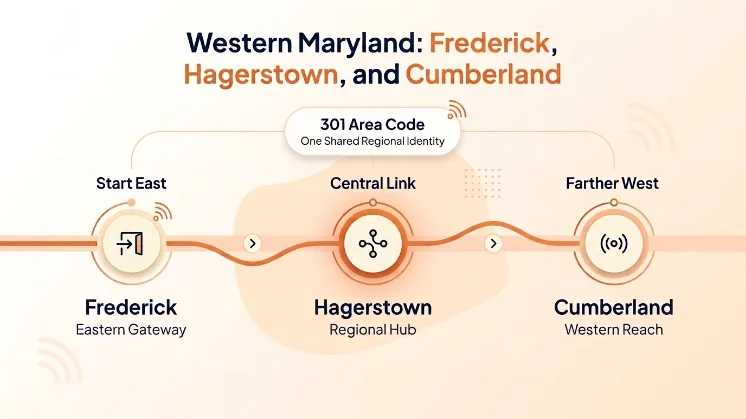
West of the DC suburbs, the 301 area code turns into a different Maryland entirely — a smaller-town, mountain-ringed economy built on history, logistics, and tourism rather than federal contracting.
Frederick and Fort Detrick
Frederick blends a historic downtown with Fort Detrick, the Army's biodefense research installation and home to the U.S. Army Medical Research Institute of Infectious Diseases. The base brings a steady flow of scientists, military personnel, and contractors through Frederick County, alongside a growing tech and biotech presence of its own.
Hagerstown at the Crossroads
Hagerstown runs on logistics and distribution, sitting at the junction of Interstate 81 and Interstate 70 where north-south and east-west freight routes cross. Warehousing, trucking, and manufacturing anchor the Washington County economy, and the nearby Antietam National Battlefield draws steady Civil War tourism through the area.
Cumberland and the C&O Canal
Cumberland carries the legacy of its railroad and canal past into a smaller present-day economy. Once a major rail junction and the western terminus of the Chesapeake and Ohio Canal, the city today leans on healthcare, light manufacturing, and Appalachian outdoor tourism along the canal towpath and nearby trails.
That western stretch shares its Eastern Time calling window with the DC suburbs but a very different customer base. Businesses working both halves of the state often pair a 301 line with a 410 area code number for Baltimore.
A full Maryland area codes breakdown maps how the state's prefixes fit together.
The full history of how regulators handle splits and overlays nationwide is documented in the FCC's overview of area code overlays.
Time Zone and Calling Hours for the 301 Area Code
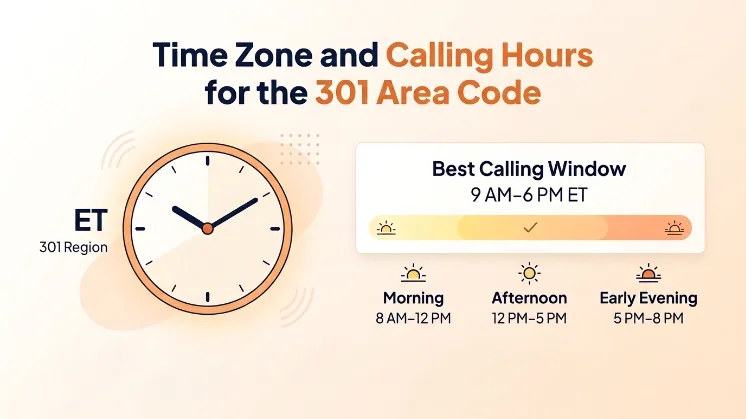
The entire 301 area code observes Eastern Time — UTC-5 (EST) in winter and UTC-4 (EDT) during Daylight Saving. Maryland shares the clock with Washington DC, Baltimore, and the rest of the East Coast.
West Coast teams calling area code 301 are three hours behind, so late-morning Pacific outreach lands mid-afternoon in Maryland — plan around the three-hour gap to catch both the federal-suburb and western Maryland business day.
301 History
The 301 area code was assigned in 1947, one of the original area codes created when the North American Numbering Plan launched. It originally covered the entire state of Maryland, from Baltimore and the Eastern Shore through the DC suburbs and the western counties.
As Maryland's population and phone demand grew, the 410 area code split off in 1991 to cover Baltimore and the Eastern Shore, leaving 301 with the DC suburbs and western Maryland. Continued growth in wireless lines led to the 240 overlay in 1997, and a second overlay, 227, layered onto the same region more recently — both adding numbering capacity without a new geographic split, at the cost of mandatory 10-digit dialing.
The overlays reflected explosive demand for wireless lines, pagers, and fax machines through the 1990s in one of the fastest-growing suburban markets in the country, as the DC region added residents and businesses faster than new numbers could keep pace.
How to Get a 301 Area Code Number
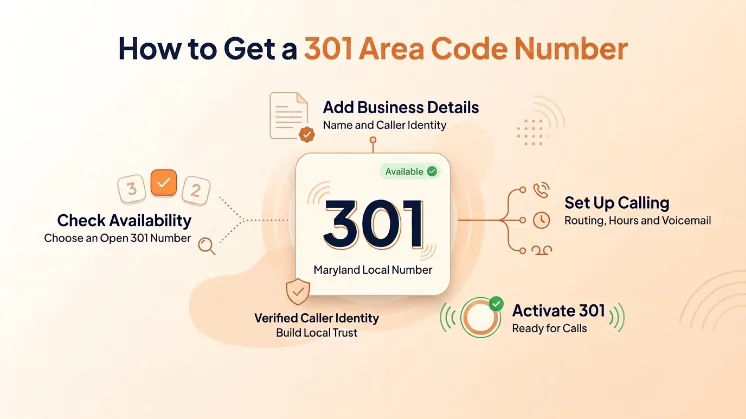
- Cloud phone platform — search available 301 numbers in real time and activate a line the same day, with no hardware and no technician visit.
- Port your existing number — already run a 301 line on another carrier? Move it over without downtime and keep the number active through the transition.
- Wireless SIM or landline carrier — valid for a single physical handset, but slower to provision and harder to scale seat by seat.
With letsdial, a UCaaS (Unified Communications as a Service) platform built for exactly this, a 301 number provisions in under three minutes on a free trial, no credit card required, so a Maryland presence can be answering calls the same afternoon.
Call Trust in the Maryland Market
The 301 area code market runs on federal procurement relationships, research-institution vendor channels, and western Maryland manufacturing contacts — settings where an unknown out-of-state number gets screened before it's answered. A recognizable local prefix earns the first hearing, and in a region fielding constant cold outreach from contractors and vendors, that first impression often decides whether the conversation happens.
STIR/SHAKEN for Federal and Biotech Vendors
Apply STIR/SHAKEN attestation so every outbound 301 call arrives verified with your registered business name on screen. As a UCaaS provider, letsdial registers text campaigns for 10DLC compliance from day one and warms new numbers before scaling volume, so a verified line reads as Maryland-local rather than out-of-area.
A trusted 301 line is the difference between a federal contracting officer or a Hagerstown distribution manager picking up the call and routing it straight to voicemail.
Conclusion
The 301 area code covers several distinct halves of Maryland — a federal, research, and university economy running from Bethesda through College Park and the I-270 corridor, and a western Maryland base of manufacturing, logistics, and mountain tourism running from Frederick through Hagerstown to Cumberland. From the NIH campus to Fort Detrick and the crossroads at Hagerstown, it identifies a business as genuinely Maryland.
Standing up a line takes minutes on a cloud UCaaS platform, with STIR/SHAKEN attestation so calls arrive verified rather than flagged. Put a 301 number in front of federal vendors, university partners, and western Maryland businesses, and let a familiar prefix open the door first, with letsdial handling the setup end to end.
Frequently Asked Questions
Written by Aryan Khan · July 28, 2026
Reply to the author