Introduction
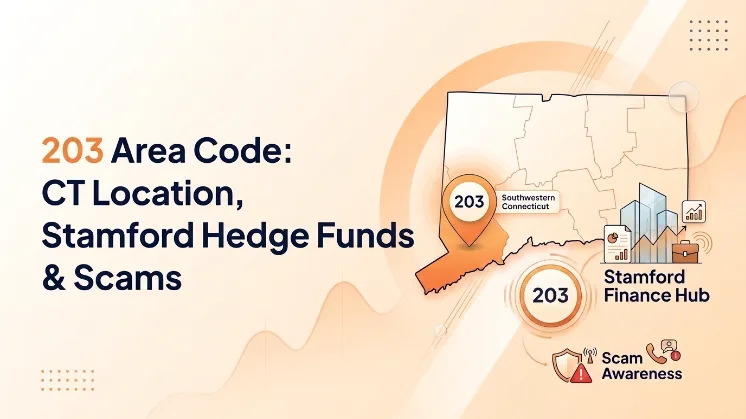
Stamford runs more hedge-fund and reinsurance capital through one area code than almost anywhere else in the country outside Manhattan — and that area code is 203. Assigned in 1947 as one of the original 86 area codes on the continent, 203 covered the entire state of Connecticut for nearly five decades before the numbers ran out.
This guide covers where 203 reaches today, why Connecticut split it in 1995 and overlaid it again in 2009, why Stamford's finance industry treats the code as a credibility marker, and the neighbor-spoofing scam pattern that rides along with all of that legitimacy. The 475 area code is the overlay sharing this exact footprint.
Where the 203 Area Code Reaches
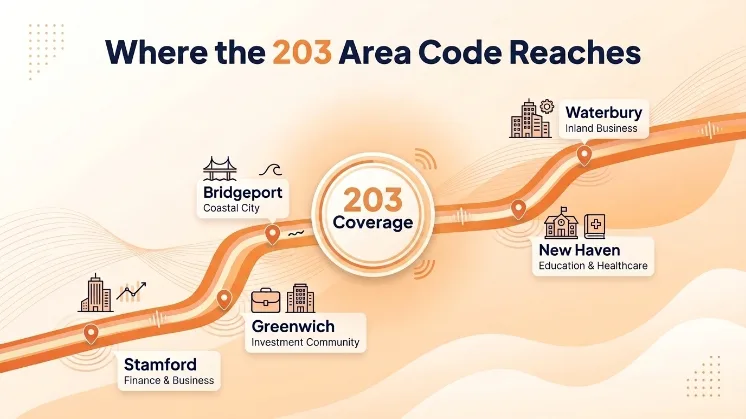
203 covers southwestern Connecticut: Fairfield County almost in full, most of New Haven County, and a small slice of Litchfield County. Bridgeport, New Haven, Stamford, Norwalk, Waterbury, Danbury, and Greenwich all answer to it.
That footprint used to be the entire state. Connecticut's first split came in 1995, when the 860 area code was carved out for the northern and eastern half of the state — Hartford's insurance corridor included — leaving 203 with just the southwest. By the late 1990s even that reduced territory was running low on numbers, and regulators authorized 475 as a straight overlay, activated on December 12, 2009. A full Connecticut area codes breakdown covers how 203, 475, and 860 fit together across the state.
The remaining 203 area code footprint still packs in a wide economic range for its size: Stamford and Greenwich carry the financial-services weight, Bridgeport is the state's largest city and an industrial and port hub on Long Island Sound, New Haven runs on Yale University and the biotech and healthcare firms clustered around it, and Danbury anchors the northern edge of Fairfield County closer to the New York border. Waterbury, once the country's brass-manufacturing capital, sits at the footprint's inland edge in New Haven County.
Is Every 203 Call Really From Connecticut?
Not the caller, no — even though the area code itself is entirely real. 203 covers genuine businesses and residents across Fairfield and New Haven counties, but it's also one of the more heavily spoofed codes in the country, because a local-looking number gets answered more often than an obviously out-of-state one.
Dialing Rules, Time Zone, and the 475 Overlay
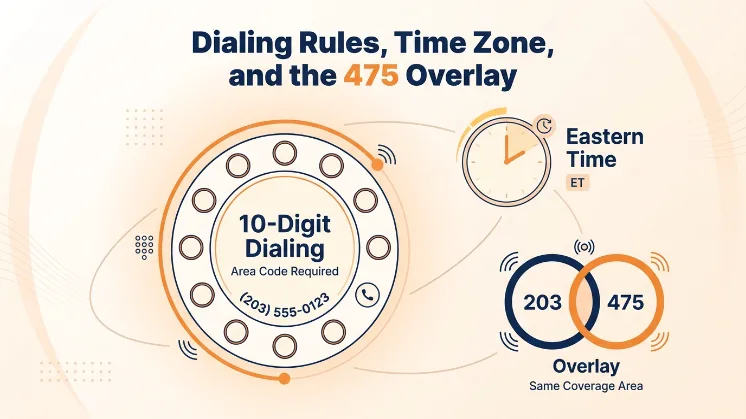
203 sits in the Eastern Time Zone, on the standard EST/EDT switch with the rest of the Northeast. Because 475 overlays the identical southwestern Connecticut footprint, ten-digit dialing is mandatory for every local call.
- Local calls (within the overlay): dial 203 + the 7-digit number — e.g., 203-555-1234
- Long-distance calls (within the US): dial 1 + 203 + the 7-digit number — e.g., 1-203-555-1234
- International calls to a 203 number: dial your country's exit code, then 1 (US country code) + 203 + the number — e.g., 00-1-203-555-1234 from the UK
A new line issued in Fairfield or New Haven County today may come back as 203 or 475 — both are equally valid, and neither prefix says anything about how long a business has operated there.
How to Get a 203 Number for Your Business
Setting up a 203 line doesn't require an office on Stamford's Atlantic Street or anywhere else in Fairfield County:
- Sign up with letsdial and search available 203 numbers
- Pick the features your team needs — call forwarding, an AI receptionist, voicemail transcription, SMS
- Start taking calls the same day — median setup runs under 3 minutes
Already have a number? Porting it in is free and stays active the entire time — wireless-to-wireless typically takes 1–3 business days, wireline-to-wireless 3–5, and VoIP-to-wireless 5–7.
Because 203 and 475 now draw from a shared, aging number pool, clean or memorable combinations are scarcer here than in newer markets. A provider that searches both codes at once, rather than a single carrier's fixed block, turns up meaningfully more options for a number worth putting on a pitch deck or a fund's letterhead — a small detail, but one that matters more in a market this dense with competing firms all reaching for the same short list of memorable digits.
Why Stamford Runs on a 203 Number
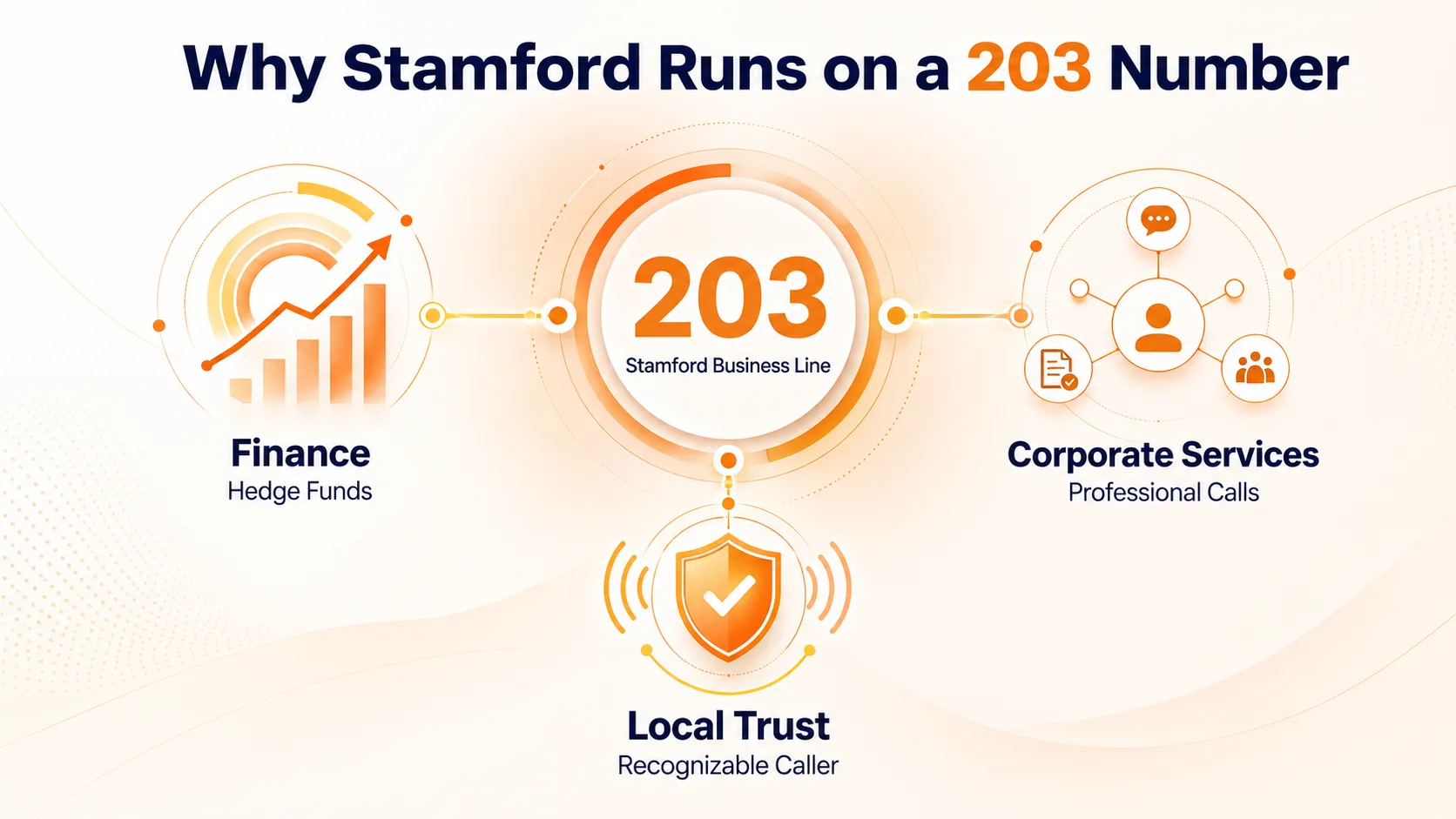
Stamford's downtown corridor is one of the densest concentrations of hedge funds, reinsurance carriers, and asset managers in the country, and proximity to that capital shows up directly in which area code a firm answers from. A 203 number signals a Fairfield County presence the way a 212 number signals Manhattan — close enough to Wall Street to matter, without actually being there.
Reinsurance in particular has deep roots here: several of the industry's largest carriers run major offices out of the Stamford–Greenwich corridor, alongside a dense cluster of asset managers and family offices. A firm cold-calling institutional investors or insurance cedents gets a meaningfully different reception from a 203 line than from an unfamiliar area code with no financial-district association.
What matters for a firm in this space when picking a provider:
- Call recording and transcription for compliance and audit trails
- CRM sync that doesn't require a separate integration project
- Free porting, in case the number needs to move later
Beyond Finance: New Haven's Biotech and Healthcare Cluster
Finance isn't the only sector where a 203 area code number carries weight. New Haven's biotech corridor, built around Yale University's research output, has spun off a steady stream of life-sciences startups and clinical-stage companies that lean on a local number for both hiring calls and investor outreach.
Healthcare systems and specialty practices across Fairfield and New Haven counties draw on the same logic as the finance firms in Stamford — a recognizable local line answers faster than an unfamiliar one, whether the call is a patient scheduling reminder or a biotech firm's outbound recruiting push. Manufacturing hasn't disappeared either: precision-parts and aerospace suppliers scattered through the Naugatuck Valley still rely on local numbers for supplier and logistics calls, even as the region's identity has shifted toward finance and research.
Neighbor Spoofing and the Debt-Collection Scam Pattern
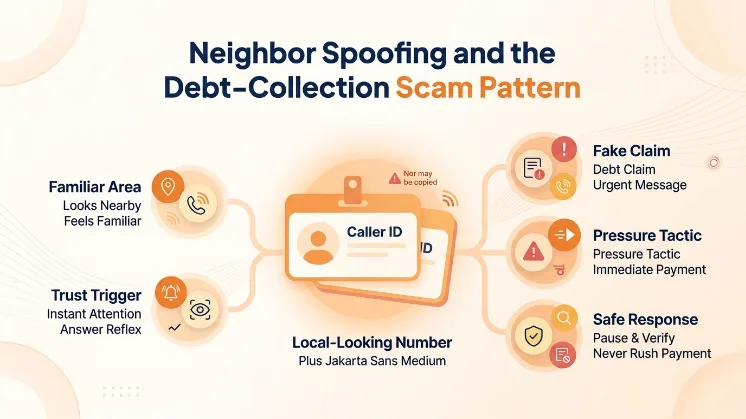
The same local trust that helps a Stamford fund get calls answered is exactly what scammers exploit. Roughly six in ten spoofed calls using a 203 number rely on "neighbor spoofing" — faking a number that shares an area code, and often the first few digits, with the person being called, so it reads as a familiar local call rather than a stranger.
The scripts that follow tend to be fake legal threats and debt-mediation pitches: a caller claims you're being sued or owe a debt you don't recognize, and pressures immediate payment to avoid arrest or a lawsuit. Warranty scams and business impersonation calls round out the rest of the volume, and consumer complaint trackers have logged tens of thousands of reports tied to 203 numbers in a single year — a volume that tracks with how densely populated and affluent the footprint is, not with anything wrong with the code itself.
Because the callers rotate through spoofed numbers by the thousand, blocking any individual number rarely helps for long. The more durable habit is treating the caller ID as decoration rather than proof, and verifying independently before acting on anything a caller says about a debt, a lawsuit, or an account.
None of this reflects on the area code itself. The FTC's guidance on fake debt collectors lays out the same core defense regardless of what a caller claims: real collectors are required to send written validation of a debt, and a call demanding instant payment over the phone — especially with threats attached — is a strong signal the debt isn't real.
Conclusion
203 went from covering the whole state of Connecticut to a shared Fairfield and New Haven County footprint, picked up an overlay in 2009, and along the way became the number Stamford's finance industry treats as a credibility marker — even as scammers lean on that same trust for neighbor-spoofed debt scams. That's the tension baked into any long-running, densely populated area code: the same familiarity that gets a legitimate call answered is what a scammer is trying to borrow. Getting a 203 number for your business takes minutes with letsdial, keeps your existing number if you're porting one in, and comes with the call handling — recording, an AI receptionist, CRM sync — that a Fairfield County-facing business actually needs.
Frequently Asked Questions
Written by Aryan Khan · July 27, 2026
Reply to the author