Introduction
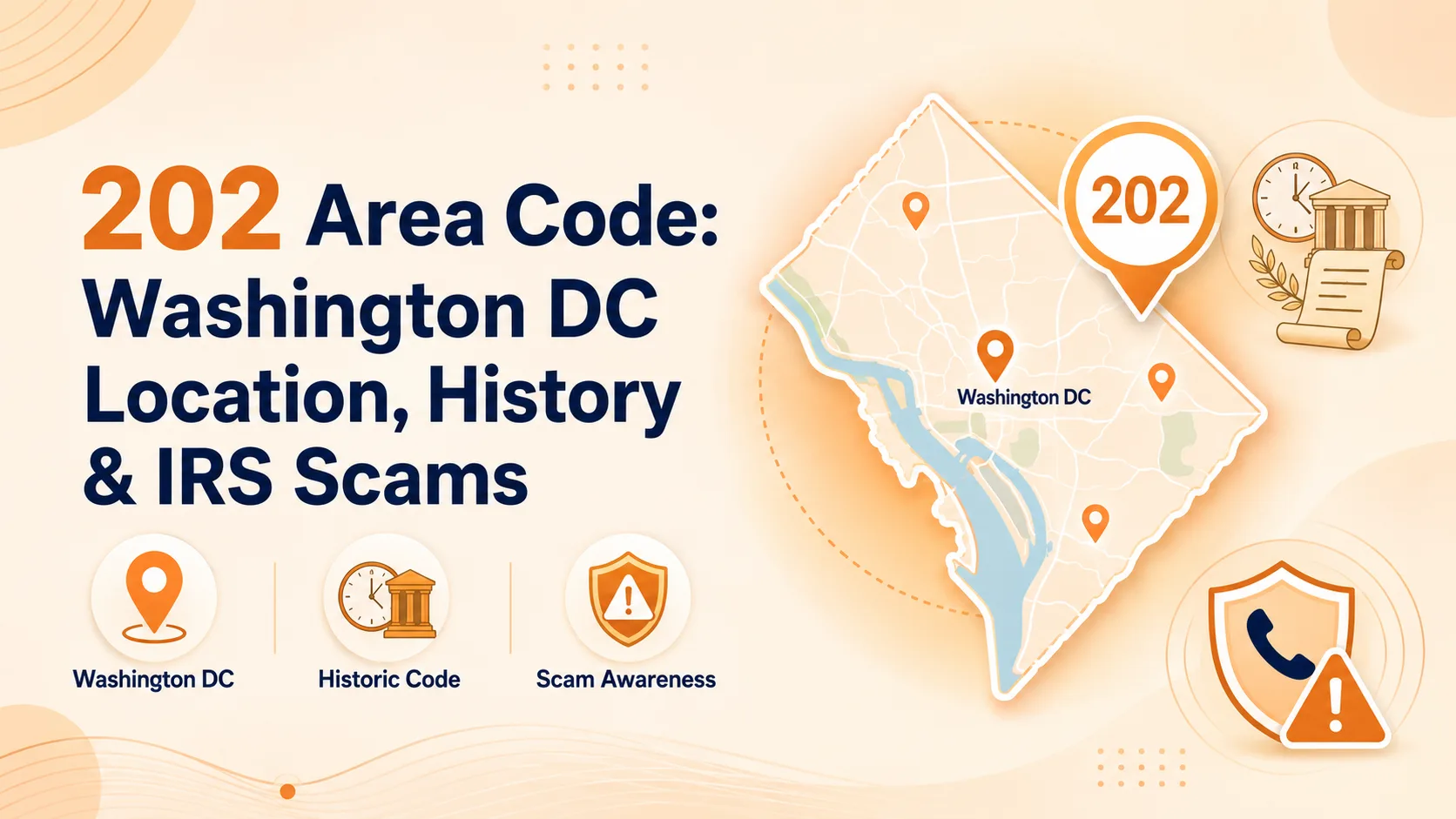
Washington, DC has used the same area code for longer than almost anywhere else in the country. Area code 202 was assigned in 1947, one of the original 86 area codes on the continent, and it has never been split — a 75-year run that almost no other major metro area can claim.
That stability is exactly why the 202 area code gets impersonated so often: a number that's never changed and always meant "Washington" is a convincing prop for a scammer posing as the IRS. This guide covers where 202 actually reaches, how the 771 overlay changed dialing in 2021, why K Street runs on it, and the federal-impersonation scam pattern DC's number sees more than most. The 771 area code is the newer code sharing this same footprint.
Where Is the 202 Area Code Located?
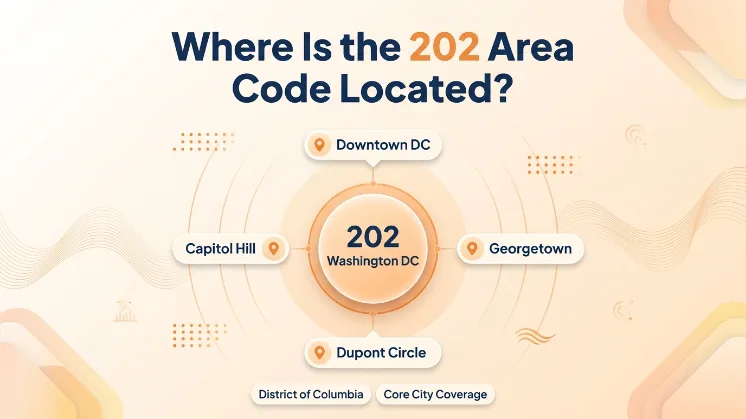
The 202 area code location is the entire District of Columbia — there's no split to describe, because there's never been one. Georgetown, Capitol Hill, Dupont Circle, Anacostia, and every federal building in between all answer to the same code.
That single-code history makes DC an outlier. Most dense metro areas — New York, Los Angeles, Chicago — split into two, three, or five overlapping codes decades ago as demand grew. Washington absorbed the same growth in phone lines by adding an overlay instead: 771, approved in April 2021 and assigned to new lines starting that November. A full Washington, DC area codes breakdown covers how 202 and 771 sit together today.
The geography itself is small — DC covers roughly 68 square miles, one of the smallest jurisdictions with its own area code — but the density of federal agencies, embassies, and national institutions packed into that footprint is unmatched anywhere else in the numbering plan. A single code covering the White House, Capitol Hill, the Supreme Court, and every cabinet department at once is part of why 202 carries more institutional weight than almost any other three digits in the country.
Is a Call From the 202 Area Code Always a Scam?
No. The 202 area code is a real, active code covering every legitimate business, agency, and resident in Washington, DC. What's not always real is the caller — scammers frequently spoof a 202 number specifically because it reads as "federal government" to whoever picks up.
Phone Number Format, Dialing Rules, and the 771 Overlay
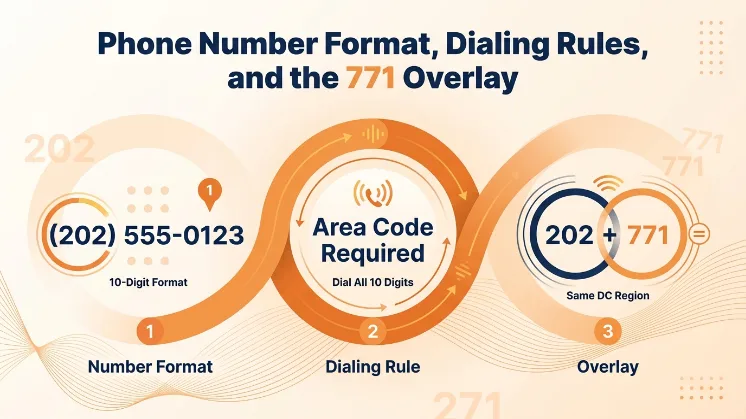
202 sits in the Eastern Time Zone, same EST/EDT switch as the rest of the East Coast. Because 771 now overlays the identical DC footprint, ten-digit dialing is required for every local call — dialing just seven digits won't connect.
- Local calls (within DC): dial 202 + the 7-digit number — e.g., 202-555-1234
- Long-distance calls (within the US): dial 1 + 202 + the 7-digit number — e.g., 1-202-555-1234
- International calls to a 202 number: dial your country's exit code, then 1 (US country code) + 202 + the number — e.g., 00-1-202-555-1234 from the UK
New numbers issued in DC today may come back as either 202 or 771 — the overlay pulls from a shared pool, and neither code indicates anything about how established or "official" a line is.
How to Get a 202 Number for Your Business
A 202 number doesn't require a K Street address or federal registration to obtain:
- Sign up with letsdial and search available 202 numbers
- Choose the features your team needs — call forwarding, an AI receptionist, voicemail transcription, SMS
- Start taking calls the same day — median setup runs under 3 minutes
Already have a business number? Porting it in is free and stays live the entire time — wireless-to-wireless typically takes 1–3 business days, wireline-to-wireless 3–5, and VoIP-to-wireless 5–7.
Availability is tighter here than in most markets. Because 202 has never split and now shares its remaining number pool with the 771 overlay, short or easily-remembered combinations get claimed quickly — a real constraint for a firm that wants a number matching its name or a toll-free-style vanity pattern. Searching both codes at once, rather than relying on a single carrier's fixed inventory, is the difference between finding a number worth printing on letterhead and settling for whatever's left.
Why K Street Runs on a 202 Number
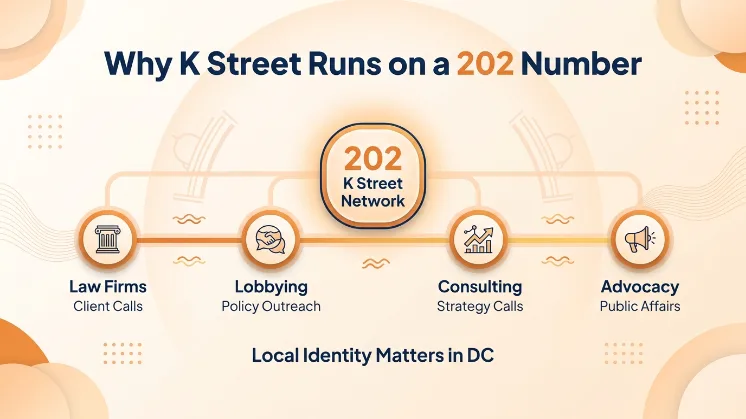
Washington's K Street corridor is the physical center of American lobbying, public affairs, and government-relations work, and a 202 number is close to a prerequisite for firms operating there. Advocacy groups, trade associations, and government-relations law practices all lean on the code because it signals direct proximity to Capitol Hill and federal agencies to the people they're calling.
That signal matters beyond K Street too. A policy nonprofit, a federal contractor, or a firm bidding on agency work all benefit from a number that reads as "actually in Washington" the moment it appears on a procurement officer's phone — regardless of where the team answering it actually sits.
What to check before picking a provider for that kind of work:
- Does the platform support call recording and transcription for compliance and audit trails?
- Can the number integrate with the CRM your government-relations team already runs?
- Is porting free if you need to move the number later?
The Other Industry Built on a 202 Number: National Press
K Street isn't the only DC institution that runs on this code. The national press corps — network news bureaus, wire services, and the trade press that covers federal agencies — clusters around the same downtown blocks and depends just as heavily on a recognizable Washington line.
A reporter or producer calling a source, an agency press office, or a Hill staffer gets picked up faster from a 202 number than an unfamiliar one, for the same reason a lobbying firm does: it signals "this call is actually about Washington business." Press shops running distributed or remote teams still want that local signal on outbound calls, even when the newsroom itself sits outside the District.
Nonprofits and think tanks fill out the rest of the cluster. Policy research organizations, issue-advocacy groups, and membership associations headquartered near Dupont Circle and downtown all run outbound campaigns — donor calls, member renewals, coalition outreach — where a recognizable 202 line answers faster than a number tied to wherever the call center actually sits.
The IRS and Federal-Impersonation Scam Pattern
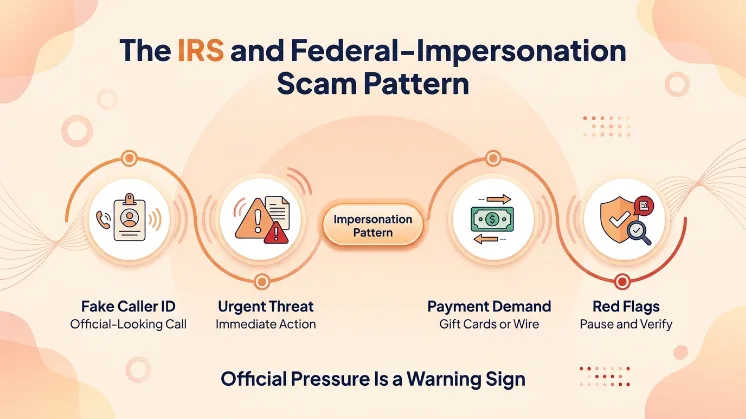
DC's federal identity cuts both ways. Because 202 reads as "Washington," it's one of the most spoofed area codes in the country for calls impersonating the IRS, Social Security Administration, and other federal agencies — usually with threats of arrest or lawsuits to pressure an immediate payment.
The DC Department of Health has publicly warned that its own real phone number was hijacked in a caller ID spoofing scheme, with callers falsely claiming to be agency staff. Neither the real agency nor a legitimate 202 line was actually placing those calls — the number displayed was faked outright.
Federal rules make this straightforwardly illegal. Under the FCC's Truth in Caller ID rules, transmitting misleading caller ID with intent to defraud carries penalties up to $10,000 per violation, capped at $1,000,000 for a continuing pattern — enforcement that hasn't stopped the volume, but does mean the practice is squarely against the law.
The practical defense is the same regardless of which agency the caller claims to represent: hang up, look up the agency's number independently rather than trusting anything read out on the call, and dial that number directly. The IRS, in particular, contacts taxpayers by mail before it ever calls about a balance due — a phone call demanding immediate payment is already out of step with how the real agency operates.
Conclusion
202 has covered Washington, DC without a single split for over 75 years, picked up its first overlay only in 2021, and become both a badge of legitimacy for K Street firms and a favorite disguise for IRS impersonation scams — sometimes in the same week. That's a rare combination for three digits to carry, and it's exactly why getting the number right matters more here than in most markets. Getting a 202 number for your business takes minutes with letsdial, keeps your existing number if you're porting one in, and comes with the call handling — recording, an AI receptionist, CRM sync — that a DC-facing business actually needs, no lease on K Street required.
Frequently Asked Questions
Written by Aryan Khan · July 27, 2026
Reply to the author