Introduction
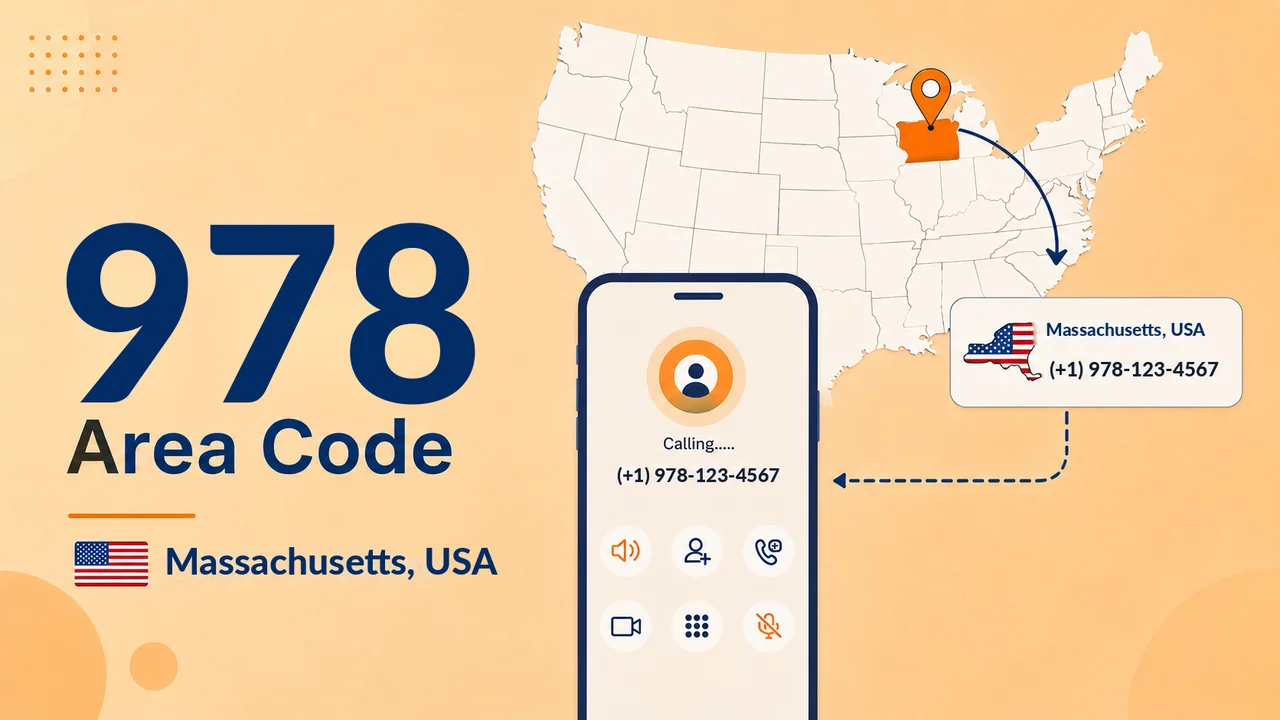
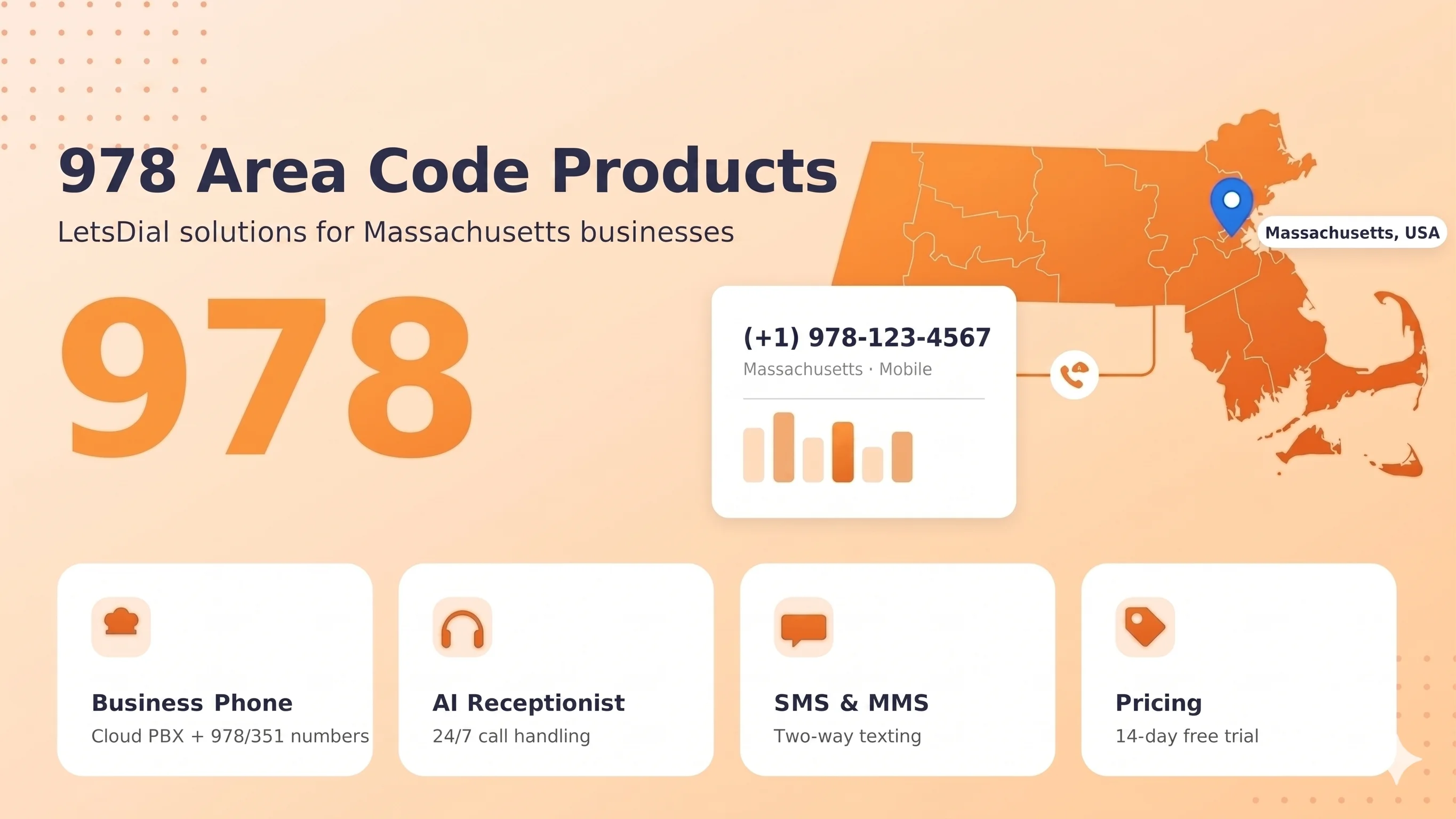
The 978 area code is a full overlay-paired code covering northeastern and north-central Massachusetts — the Merrimack Valley and much of the North Shore. It split off from area code 508 on September 1, 1997 to relieve a numbering shortage, and by 2001 that same 978 territory needed relief of its own: area code 351 was added as an overlay on May 2, 2001, and 10-digit dialing has been mandatory ever since.
This is a region defined by two very different economies layered on top of each other — nineteenth-century textile-mill cities like Lowell and Lawrence, and a modern defense and semiconductor corridor anchored by Raytheon and Analog Devices. A local 978 or 351 number signals familiarity with both halves of that identity to residents and businesses across the region.
- 978 covers the Merrimack Valley and North Shore — Lowell, Lawrence, Andover, Haverhill, Salem, Fitchburg, and Leominster
- It split from 508 on September 1, 1997, and has shared its footprint with the 351 overlay since May 2, 2001
- Letsdial issues a 978 number instantly, with forwarding, IVR, texting, and analytics built in
Where the 978 Area Code Reaches
978 and 351 together cover a broad stretch of northeastern and north-central Massachusetts, split across three counties.
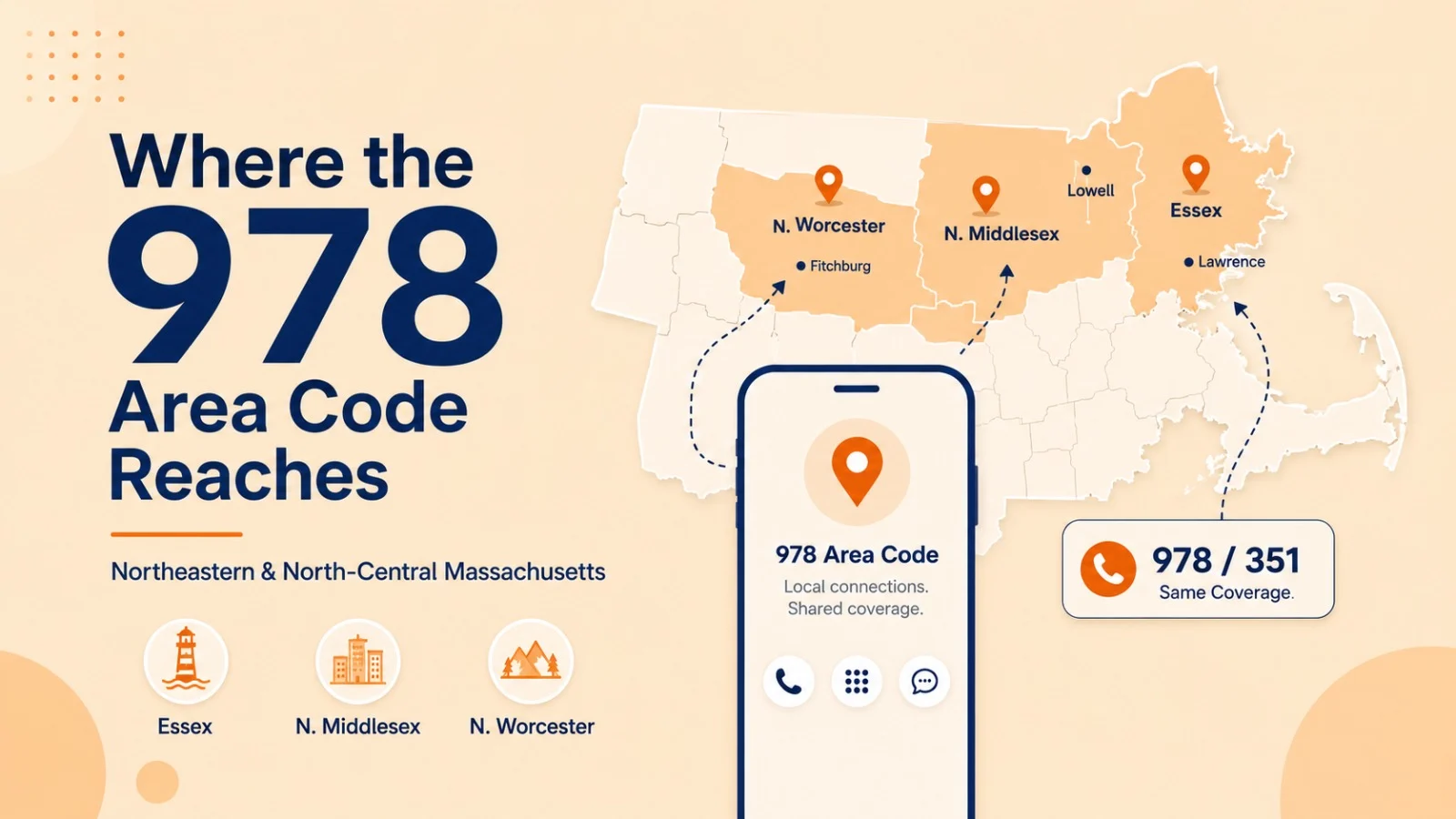
- Essex County (most of it) — Lawrence, Haverhill, Andover, Methuen, Peabody, Salem, and Gloucester
- Middlesex County (northern portion) — Lowell, Chelmsford, Billerica, Tewksbury, and Wilmington
- Worcester County (northern portion) — Fitchburg and Leominster
978 does not reach Boston or Cambridge, which sit in the 617/857 overlay pair, and it stops short of the New Hampshire border communities served by 603. Because 351 shares identical geography with 978, a business or resident anywhere in this footprint could be assigned either code with equal likelihood — neither carries more local credibility than the other, and every call requires all 10 digits.
The Route 3 and I-495 corridor running through Chelmsford, Billerica, and Tewksbury has become one of the denser technology and defense-contractor belts in the state, feeding directly off the talent pipeline from UMass Lowell and the region's community colleges — a quieter counterpart to the Route 128 tech corridor closer to Boston. More detail sits on our auto-attendant page.
Massachusetts's Defense and Semiconductor Corridor
Raytheon, now organized as one of RTX Corporation's three core businesses, operates a major Lower Tier Air and Missile Defense Sensor production facility in Andover, part of an Integrated Defense Systems operation historically employing more than 12,700 people between Andover and neighboring Tewksbury. RTX broke ground on a $53 million expansion of the Andover facility in October 2025, underscoring how central this corridor remains to U.S. missile-defense manufacturing.
Analog Devices, a $5-billion-plus global semiconductor maker, is headquartered at One Analog Way in Wilmington — squarely inside the 978 footprint. The company partners closely with UMass Lowell, including a fully funded master's fellowship program for its engineers, tying the region's chip industry directly to its largest public university. Smaller defense and electronics suppliers have clustered around both anchors over the decades, giving the Route 3/I-495 corridor a depth of subcontractor relationships that a single large employer alone wouldn't sustain — a supply chain that a local 978 or 351 number signals familiarity with in a way an out-of-state prefix cannot. More detail sits on our call recording page.
Lowell, UMass Lowell, and the Merrimack Valley's Industrial Heritage
Lowell was one of the birthplaces of the American Industrial Revolution — its nineteenth-century textile mills, powered by the Merrimack River, made it one of the largest planned industrial cities in the country. That history is preserved today at Lowell National Historical Park, a National Park Service site built around the city's original mill canals and buildings, including the Boott Cotton Mills Museum, whose weave room still runs more than 80 historic power looms from the 1920s.
The Boott Mills complex, built in 1835, remained in operation until 1954 — the last of Lowell's original mills to close, before the textile industry shifted south in search of cheaper labor and easier access to cotton. UMass Lowell, the city's public research university, now enrolls more than 18,000 students across engineering, business, health sciences, and the arts.
Salem, on the North Shore, carries its own distinct identity as the site of the 1692 witch trials — a history that now drives a substantial year-round tourism economy, peaking every October, alongside the Peabody Essex Museum, one of the oldest continuously operating museums in the country.
Andover adds another layer of institutional history: Phillips Academy, founded there in 1778, is the oldest incorporated academy in the United States and counts two U.S. presidents — George H.W. Bush and George W. Bush, both graduates — among its alumni. Between the Merrimack Valley's mill-town roots, Andover's centuries-old prep school, and Salem's colonial history, the 978 footprint carries a concentration of pre-Revolutionary and early-industrial American history rarely matched by a single area code.
Further up the coast, Gloucester rounds out the region's identity as America's oldest seaport — first settled by English fishermen in 1623 and continuously working the same fishing grounds since. The Fisherman's Memorial statue overlooking Gloucester Harbor honors the more than 10,000 fishermen lost at sea from the port over its history, and commercial fishing, now sustained in large part by generations of Portuguese and Italian immigrant families, remains a working part of the local economy rather than a purely historical one.
978 History and the 351 Overlay
Massachusetts split off 508 from the original 617 area code in 1988 to cover the state outside Greater Boston. By the mid-1990s, growth in the northeastern part of that 508 territory forced another split: 978 activated on September 1, 1997, with a permissive dialing period that ran until February 1, 1998. Within just a few years, mobile phones and fax lines had filled the new 978 pool too, and regulators added 351 as a full overlay on May 2, 2001 rather than splitting the region again — 10-digit dialing became mandatory at that point and has remained so ever since.
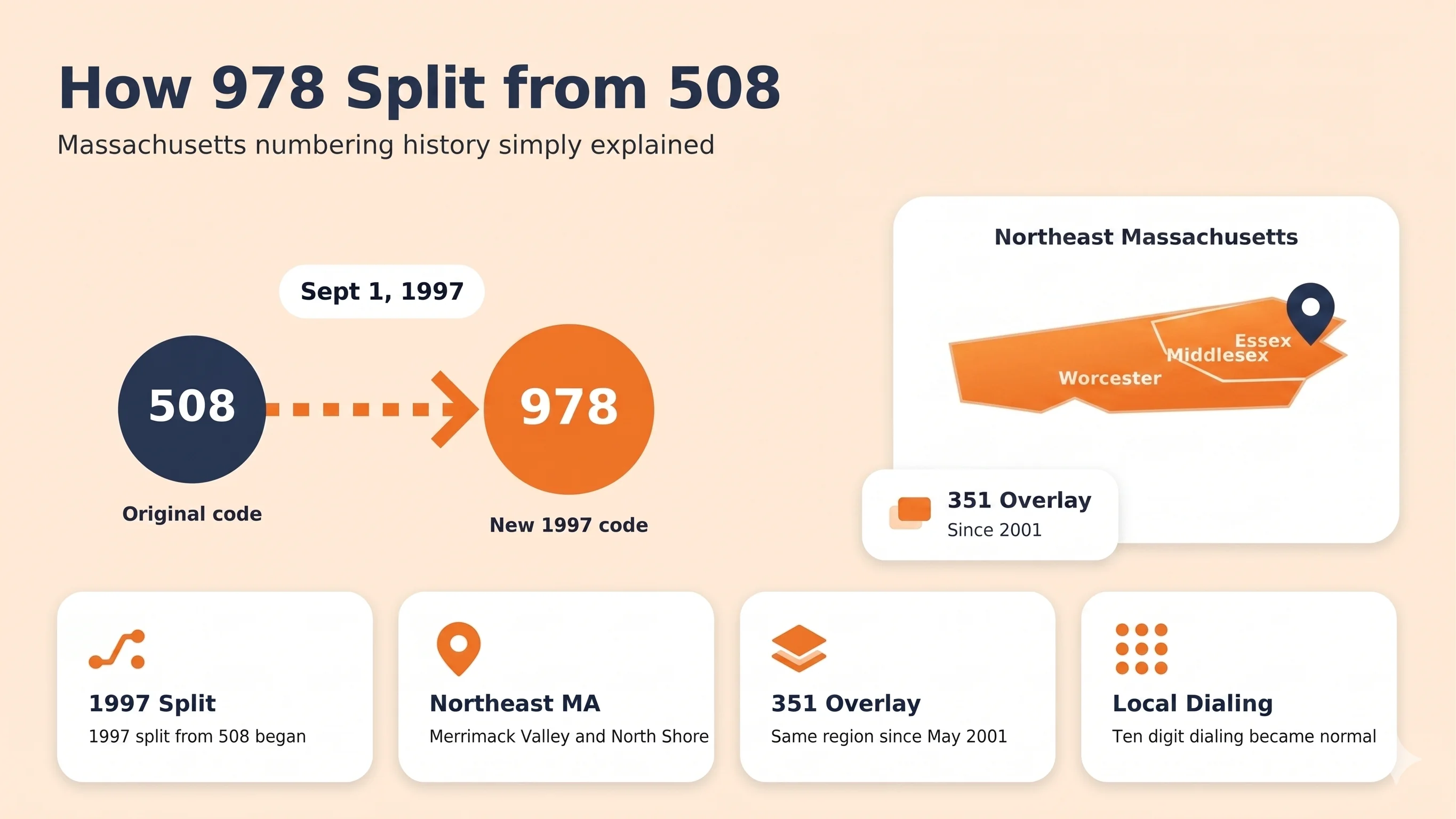
Every call within the 978/351 region — local, long-distance, or international — requires the full format: the area code plus the 7-digit number for local calls, 1 plus the area code and number for long-distance, and the exit code plus 1, area code, and number for international calls.
The overlay roughly doubled the region's numbering capacity, from about 7.6 million possible numbers under 978 alone to around 15.2 million across the combined 978/351 pool. That headroom has held up well: regulators don't project exhaustion until the 2150s, and no further relief planning — another overlay or a geographic split — is currently underway for the region.
Managing Calls and Getting a 978 Number
A local 978 or 351 number carries specific weight depending on which side of the region a business is calling into. A defense subcontractor reaching out to Raytheon's Andover facility, a component supplier calling Analog Devices in Wilmington, or a vendor pitching UMass Lowell's procurement office all benefit from a number that reads as a known regional caller rather than an out-of-state cold call — the same local-recognition effect that a Lowell retailer or a Salem tourism business relies on when marketing to its own community.
A number that looks local is a common target for spoofing, since callers are more likely to answer a familiar area code. Register with the National Do Not Call Registry, use a call-blocking app such as Nomorobo or Truecaller, and never share personal or financial information with an unverified caller, even one displaying a 978 or 351 exchange.
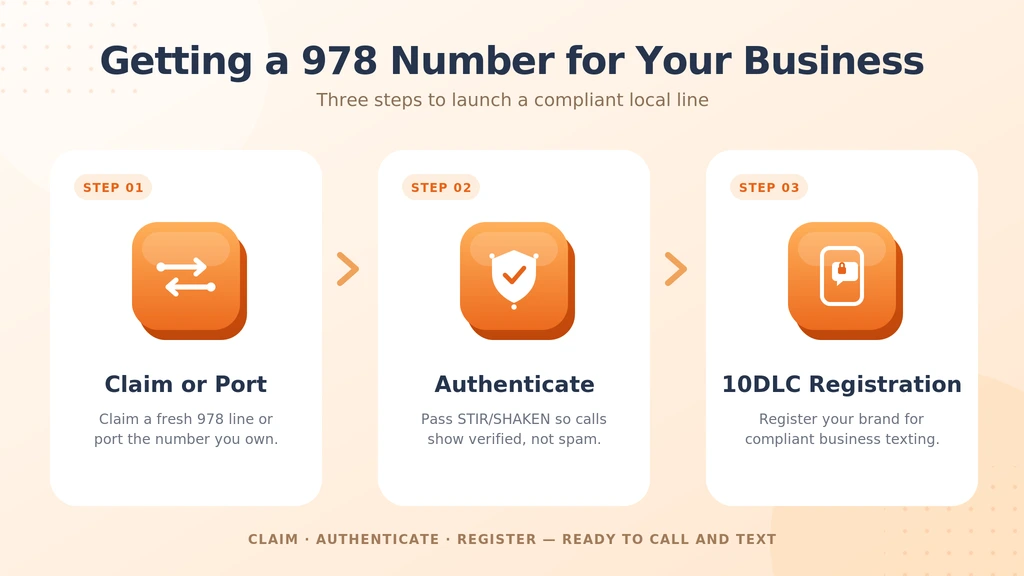
- Sign up at letsdial.com and choose a plan that fits your team
- Search available 978 or 351 numbers and reserve the one you want
- Configure call forwarding, voicemail-to-email, business texting, and an auto-attendant for after-hours routing
- Activate immediately — no hardware required, with call recording and number portability available from day one
978 is officially documented under the North American Numbering Plan, which governs area code assignments across the US, Canada, and the Caribbean. That record is published in full as North American Numbering Plan.
Conclusion
The 978 area code connects two very different Massachusetts economies — Lowell and Lawrence's nineteenth-century mill-city heritage, and the modern defense and semiconductor corridor built around Raytheon and Analog Devices. Since sharing its footprint with the 351 overlay in 2001, it has continued to serve the Merrimack Valley and North Shore with equal local recognition across both codes. A 978 number issued through Letsdial activates in minutes with no hardware, connecting any business to this corridor of Massachusetts.
Frequently Asked Questions
Written by Aryan Khan · September 26, 2024
Reply to the author