Introduction
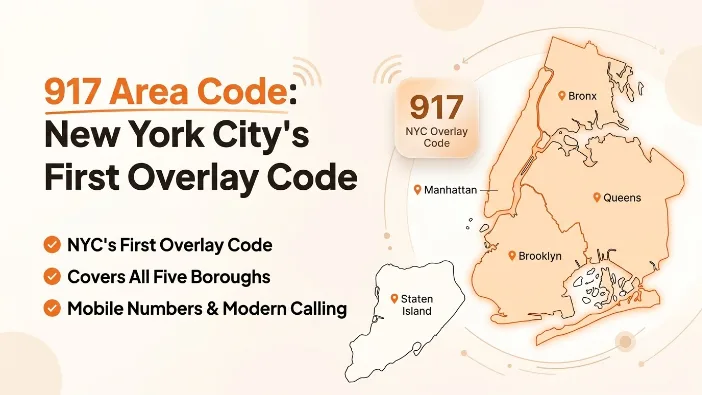
The 917 area code covers all five New York City boroughs: Manhattan, Brooklyn, Queens, the Bronx, and Staten Island. It went into service on February 4, 1992, as the first overlay area code in the North American Numbering Plan, and it is not tied to any single neighborhood.
Anyone asking what area code is 917 or where is 917 area code is usually looking at an unfamiliar New York number and wondering why it does not match a particular borough. The quick facts below give the basics, and the sections after it cover where 917 reaches, why it was created for mobile phones, how it became the template for every overlay since, and how to spot a scam call.
917 Area Code at a glance
- State: New York (all five NYC boroughs)
- Boroughs: Manhattan, Brooklyn, Queens, the Bronx, Staten Island
- In service since: February 4, 1992, the first overlay area code
- Shares territory with: 212, 646, 332 (Manhattan) and 718, 347, 929 (outer boroughs)
- Time zone: Eastern Time
- Dialing rule: Ten digits for every call
- Original purpose: Cellphones and pagers, later opened to all number types
- Coverage type: Full overlay, not tied to a neighborhood
Where Is the 917 Area Code Located?
The 917 area code covers the entire New York City footprint, overlaying both of the city's area code complexes at once: 212, 646, and 332 in Manhattan, and 718, 347, and 929 across Brooklyn, Queens, the Bronx, and Staten Island. There is no 917-only neighborhood, since the code shares its geography with every other NYC prefix.
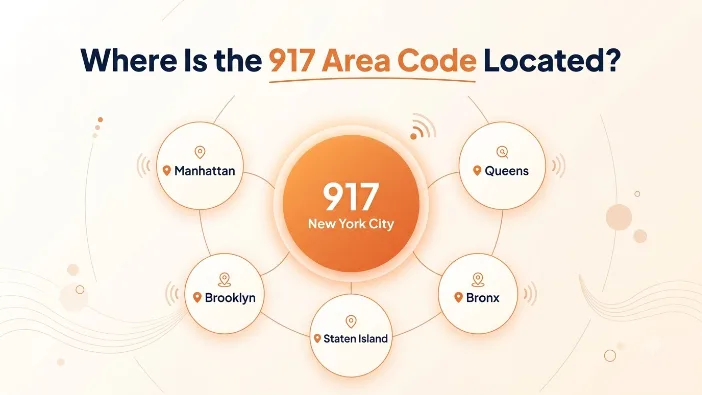
- Manhattan: shared with 212, 646, and 332
- Brooklyn and Queens: shared with 718, 347, and 929
- The Bronx and Staten Island: shared with the same 718-family codes
Every other New York City area code belongs to one of two groups, the Manhattan-centered 212/646/332 complex or the outer-borough 718/347/929 complex. 917 is the exception, assigned across the whole city before those groups had fully formed, which makes it the only prefix a caller might see on a number from any of the five boroughs. Every borough runs on Eastern Time, so partners in Boston, Washington, or Atlanta never face a time zone gap.
Why Was 917 the First Overlay Area Code?
By the late 1980s, New York City's numbers were running out faster than any other market's, driven by fax machines, pagers, and the earliest mobile phones. New York Telephone proposed a new code specifically for cellphones and pagers citywide, hoping to free up numbers in the existing 212 pool without redrawing any borough boundaries.
Federal regulators later barred area codes restricted to a single technology, but 917's original mobile-and-pager assignment was grandfathered. When it launched on February 4, 1992, it shared the exact same geography as 212 instead of replacing any part of it, and wireless numbers moved to 917 almost overnight, freeing landline capacity across the city.
Before 1992, every split simply drew a new boundary line and forced people on the wrong side to change their numbers. 917 broke that pattern: nobody with an existing landline had to change anything, because the new code applied only to newly assigned mobile and pager numbers.
Is 917 Still a Cell-Only Code?
No. As the overlay model 917 pioneered spread to other metros, New York opened the code to landlines and every other number type, and it now works identically to 212, 646, 332, 718, 347, and 929. What has not faded is its reputation. Because it was the city's first mobile-specific code, a 917 number has long carried a certain New York cachet, often associated with longtime residents who claimed one back when a cellphone was still a novelty.
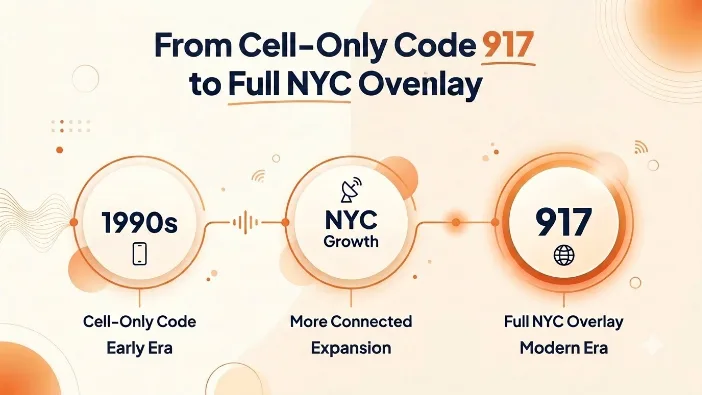
That reputation shows up in how people react to a 917 caller ID today. Where an out-of-state code can look unfamiliar or suspicious to a New York customer, a 917 number signals someone who has been reachable in the city for a long time, a small but real trust signal for a business building local credibility.
How Did 917 Set the Template for Other Overlays?
Once 917 proved an overlay could relieve numbering exhaustion without forcing anyone to change a number, regulators across the country adopted the approach instead of drawing new boundaries. New York City layered more overlays onto its own plan in the decades since: 646 and 347 in 1999, 929 in 2011, and 332 in 2017, each borrowing the precedent 917 set.
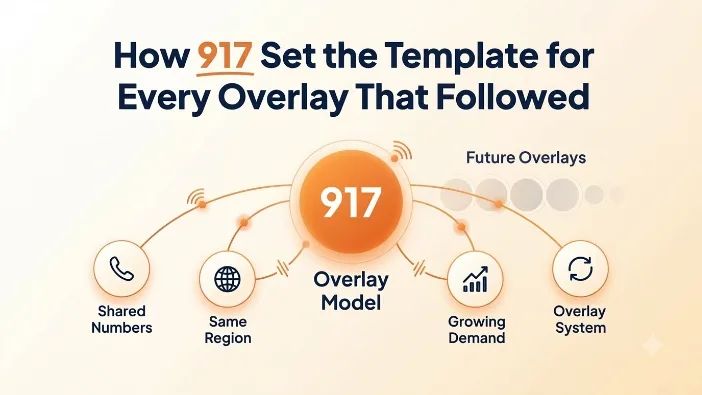
The legacy extends well beyond New York. Overlays now cover dozens of metros, from Atlanta's five-code stack to Chicago's three-way overlay on the same downtown footprint, and each avoided the disruption of a geographic split because 917's 1992 rollout showed the approach worked.
How Do You Dial a 917 Number?
Because 917 shares territory with every other New York City code, every call needs the full ten digits, even to a number a block away.
- Local calls: dial the area code plus the seven-digit number, for example 917-555-0100
- Long distance within the US and Canada: dial 1, then the area code and number, for example 1-917-555-0100
- International callers: dial your country's exit code, then 1, then the area code and number, for example 00-1-917-555-0100 from the UK
The digits cannot tell you which borough a number belongs to or how long someone has held it, so a 917 prefix says little about where the caller actually is. Saving every contact with its full ten digits avoids failed calls from older landlines and office phone systems that predate overlay dialing, and it keeps a contact list consistent across all six of the city's codes.
Is a Call From the 917 Area Code a Scam?
The code itself carries no more risk than any other, but its size and reputation make it a frequent disguise for spoofed robocalls impersonating banks, government agencies, and well-known New York businesses. Scammers can display any local number regardless of where a call really starts, so a familiar 917 on the screen proves nothing about who is calling.
The same wariness cuts the other way for legitimate businesses. A 917 number's strong recognition can work against a company if customers have grown suspicious of spoofed New York calls, which is why properly attested outbound calls help a real business stand out.
How Does 917 Compare to New York City's Other Area Codes?
917 shares its entire footprint with Manhattan's 646 area code, one of the later overlays that followed 917's template, and the two work identically on every technical level, differing only in when they entered service.
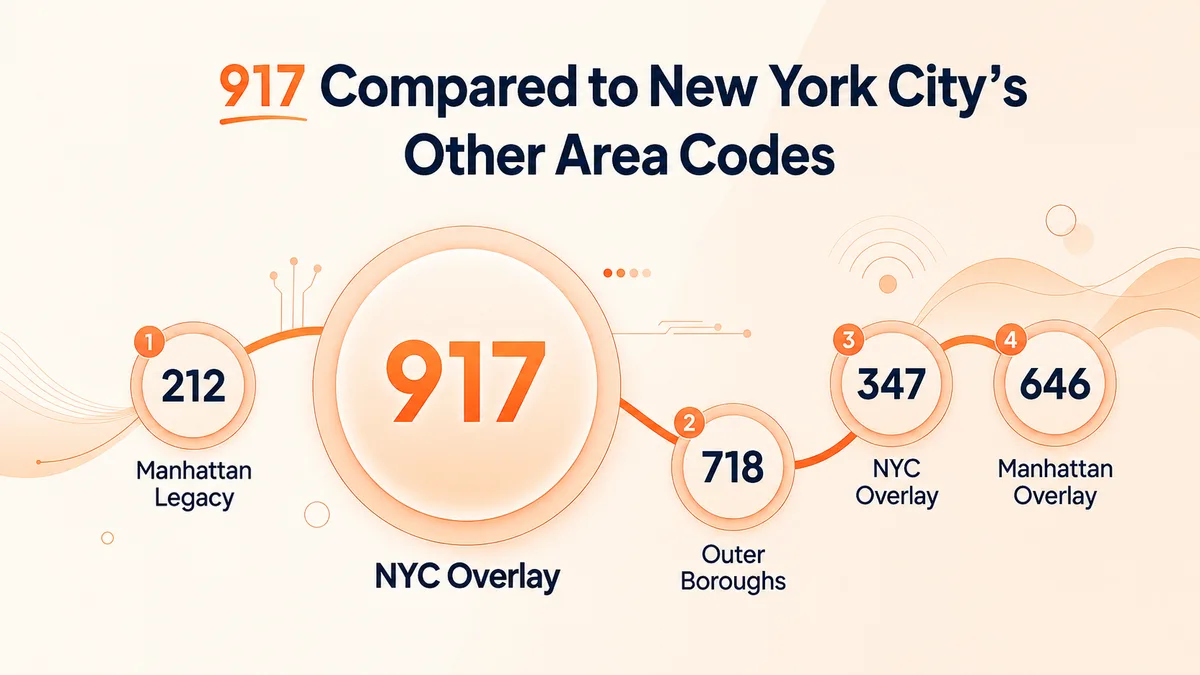
For a statewide view of every prefix serving New York's cities and counties, the New York area codes directory shows how 917 fits alongside the rest, which helps a business that serves customers across the five boroughs and beyond.
Where Can You Learn How to Stop Unwanted Robocalls?
Spoofed calls are the main nuisance tied to any high-profile area code, and the Federal Communications Commission publishes a consumer guide on avoiding phone scams, blocking robocalls and robotexts, and filing a complaint when a call crosses the line.
Getting a 917 Number for a Business
A business does not need an office anywhere in New York City to hold a 917 number. A cloud phone provider such as Letsdial lets a team search available numbers, activate a line the same day, and route calls to any phone or computer, while an existing number can be ported over without downtime. Because the city's codes share one footprint, searching several at once usually turns up more usable combinations than a single block.
Match the code to where customers actually are, confirm the provider ports numbers for free, and check for features such as STIR/SHAKEN attestation, call recording, or an AI receptionist. Verified caller ID matters most in a market where many customers already screen unknown New York calls.
Conclusion
The 917 area code has covered all five New York City boroughs since 1992, when it became the first overlay area code activated anywhere in the country. What began as a mobile-and-pager-only code aimed at relieving 212's exhaustion is now a full NYC prefix that works like any other while keeping a distinct reputation. Anyone asking what area code is 917 now has the complete answer, from its cellphone-only origins to why every later overlay followed its model.
Claiming a number here no longer requires an office near Manhattan. A cloud provider can assign the line, route the calls, and answer after hours while the team works from anywhere. Whether the goal is building trust with New York customers or testing the market, a Letsdial number gets a business sounding local the same day.
Frequently Asked Questions
Written by Aryan Khan · August 10, 2026
Reply to the author