Introduction
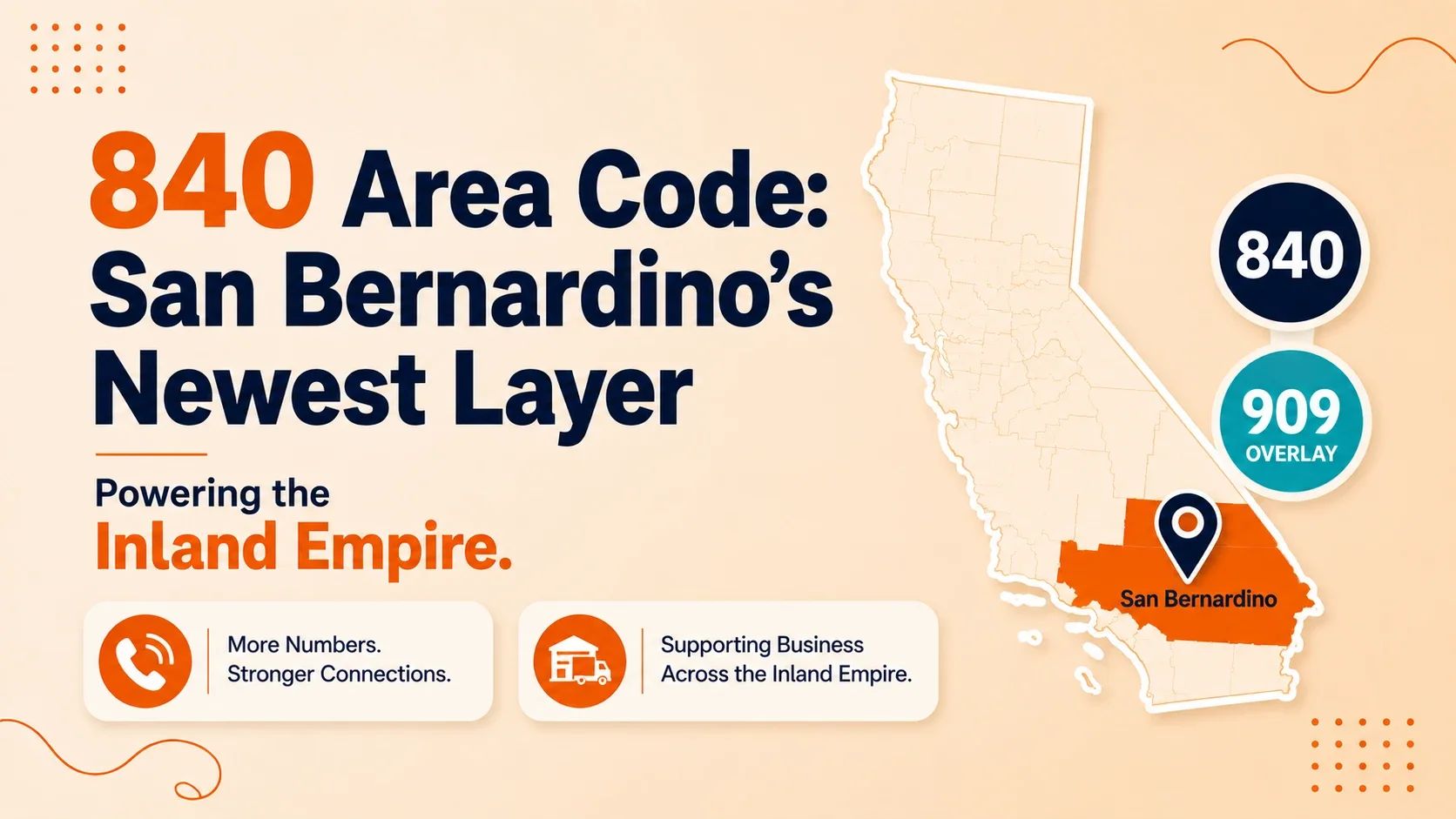
The 840 area code is one of the newer prefixes in Southern California, and plenty of callers still wonder what is 840 area code the first time it shows up on their phone. This guide explains exactly where it fits, since it does not stand alone but layers directly on top of the region's older 909 prefix. This article covers the cities the 840 area code reaches, the numbering history that led to it, how it compares to nearby Southern California codes, and how to spot a scam call that borrows it. By the end, this Inland Empire prefix will make complete sense, from its 2021 launch to why every local call here now needs 10 digits.
- The 840 area code covers San Bernardino, Ontario, Rancho Cucamonga, and the rest of the Inland Empire.
- It launched on February 23, 2021, as an overlay for the existing 909 area code.
- Area code 909 itself split from 714 in 1992, then lost territory again to area code 951 in 2004.
- A cloud phone provider lets any business activate a local San Bernardino number in minutes, with no hardware required.
Inland Empire Coverage: Where 840 Reaches
San Bernardino, Ontario, and the 909 Footprint
Anyone searching where is 840 area code wants a fast, map-based answer before anything else. The territory matches area code 909 exactly, covering the far-eastern edge of Los Angeles County, southwestern San Bernardino County, and a small slice of Riverside County. San Bernardino, Ontario, Rancho Cucamonga, Fontana, and Upland all fall inside this shared footprint.
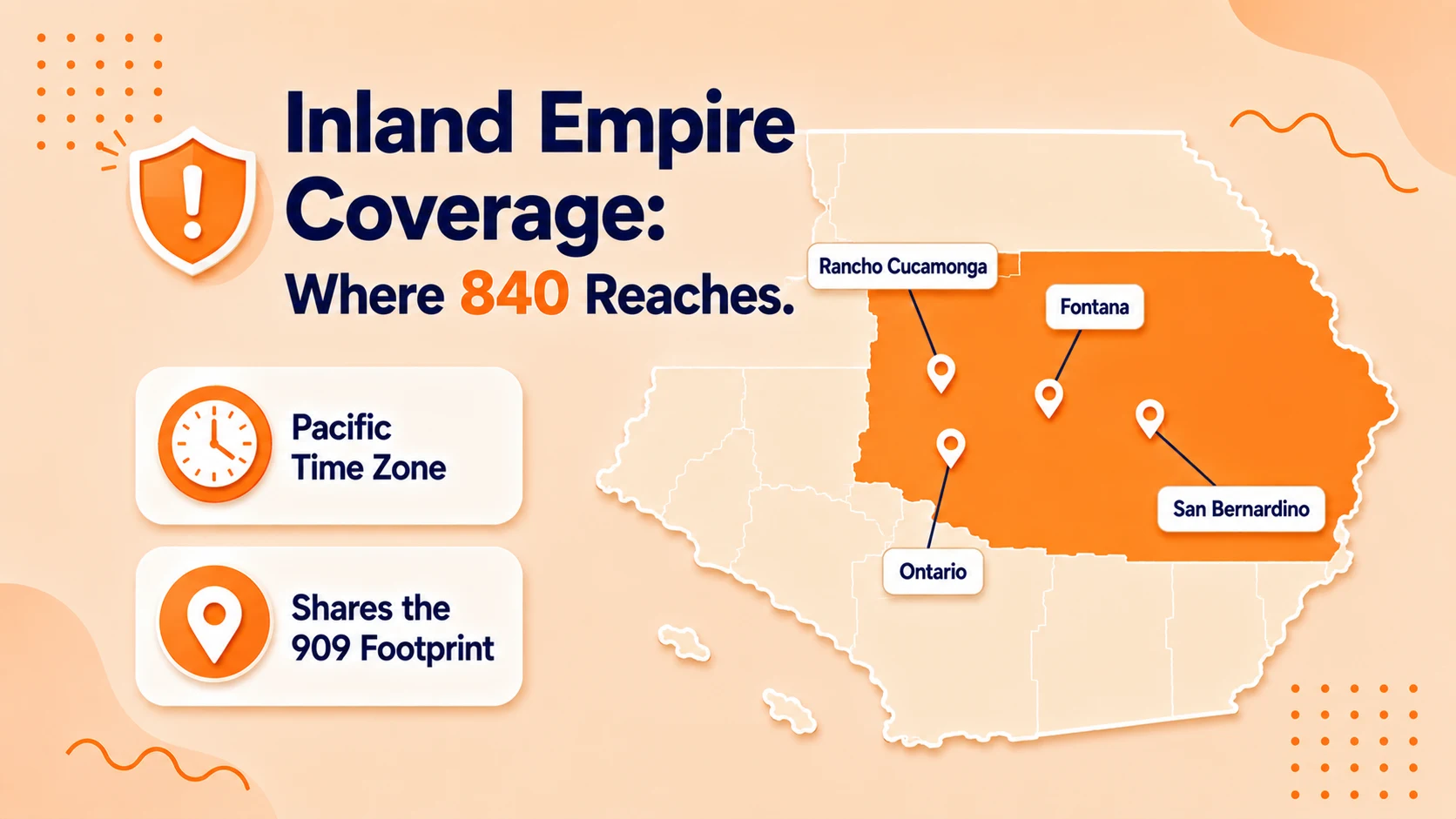
That mix spans a major logistics and warehousing corridor, historic railroad towns, and fast-growing suburban communities within the same calling region. A caller in Ontario and a caller in San Bernardino now share the exact same set of area codes, even though the cities sit on opposite ends of the region. The overlay treats the whole Inland Empire as one connected calling zone rather than carving out separate territories.
Pacific Time Across the Region
Every city under the 840 area code runs on Pacific Time, matching the rest of Southern California and the West Coast. That puts it three hours behind the East Coast, a gap that shapes how Inland Empire teams schedule calls with clients in an 813 area code market like Tampa Bay. Businesses coordinating with the rest of California never need to do any time zone math here at all.
From 714 to 909 to 840: A Numbering Timeline
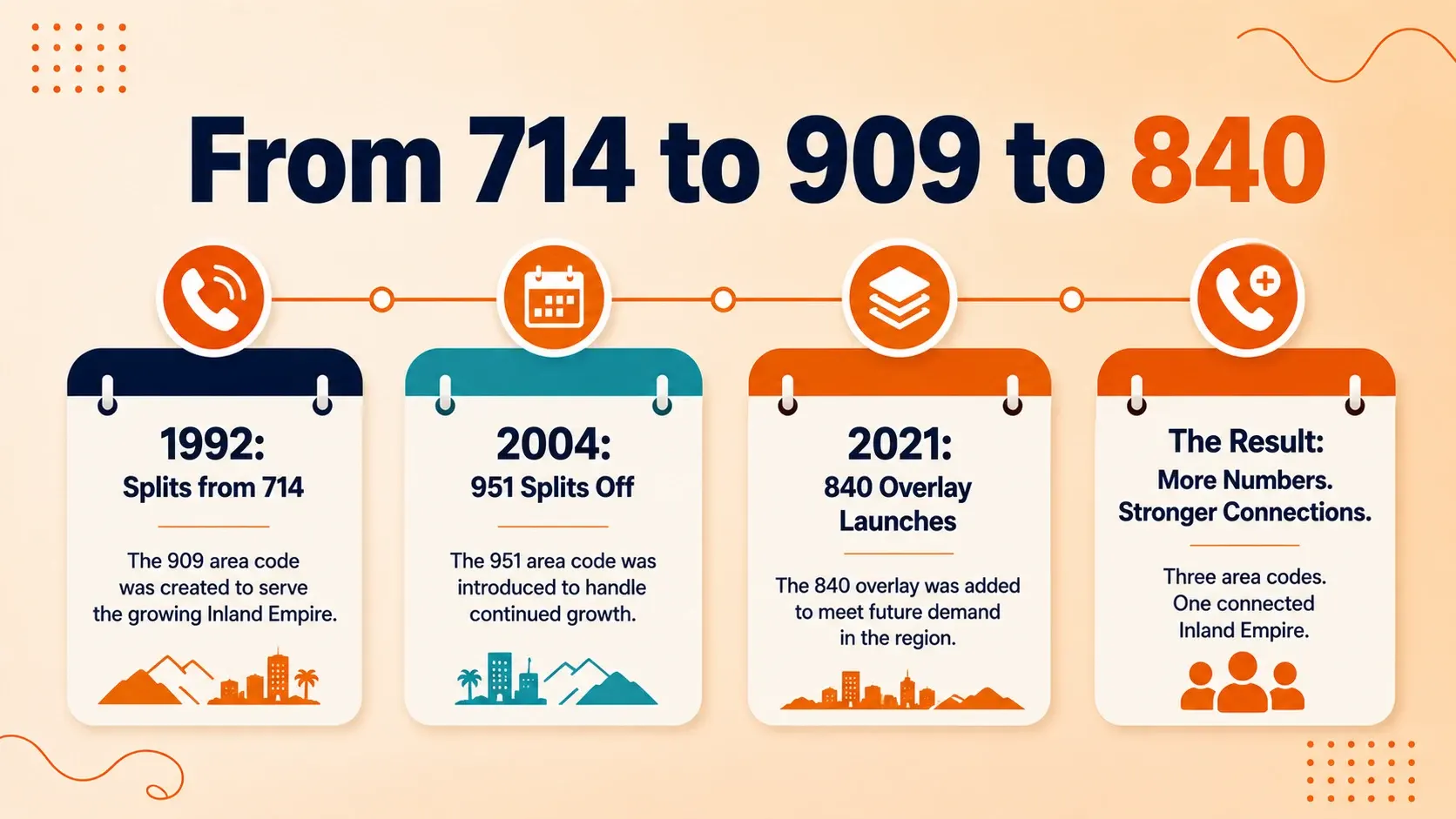
Southern California's phone numbers have been redrawn several times as the region's population exploded, and the 840 area code sits at the end of that chain. Understanding the full sequence explains why this particular prefix looks the way it does today, layered on top of a code that has already changed twice.
The 1992 Split from 714
Area code 909 was created on November 14, 1992, when it split away from the original 714 area code, which had covered a much larger stretch of Southern California. That split gave the Inland Empire its own dedicated prefix for the first time, separating it from the coastal Orange County numbers under 714. The new 909 territory covered San Bernardino, Riverside, and the surrounding valleys.
The 2004 Split That Created 951
By 2004, the 909 region had grown too large again, so regulators split off its western half into a new area code, 951, covering Riverside, Temecula, and most of Riverside County. A handful of communities near the border, including Eastvale and Corona, were allowed to keep their existing 909 numbers even after the split. That left 909 covering primarily San Bernardino County going forward.
The 2021 Overlay Arrives
By the late 2010s, the remaining 909 territory was running low on available numbers again, but a third split was not the answer this time. Area code 840 went into service as an all-services overlay on February 23, 2021, sharing the exact same footprint as 909 rather than replacing part of it. Because both codes now serve the same region, every local call requires all 10 digits, even a call between two neighboring warehouses.
Inland Empire's Logistics-Driven Economy
The Inland Empire has become one of the nation's most important logistics corridors, thanks largely to its proximity to the Ports of Los Angeles and Long Beach. More than 4,000 warehouses now sit across San Bernardino and Riverside counties, adding up to over a billion square feet of distribution space, much of it built in just the past decade. Roughly 40 percent of Amazon's global goods pass through this region on their way to consumers' doorsteps.
Transportation and warehousing has grown into the primary source of jobs in San Bernardino County, alongside a diversifying base of e-commerce, manufacturing, food processing, and aerospace companies. That freight-and-fulfillment backbone is a big reason an 840 or 909 number still carries weight with logistics clients and regional suppliers, the same way a business anchored in an 838 area code market signals real roots in New York's Capital Region. A caller ID that matches this corridor signals a business that actually understands how goods move through it.
That logistics-driven scale gives a local 840 number real weight with Inland Empire clients. A cloud phone provider such as Letsdial lets a business claim that presence immediately, without leasing warehouse or office space just to get a matching area code.
840 Area Code Scam Red Flags
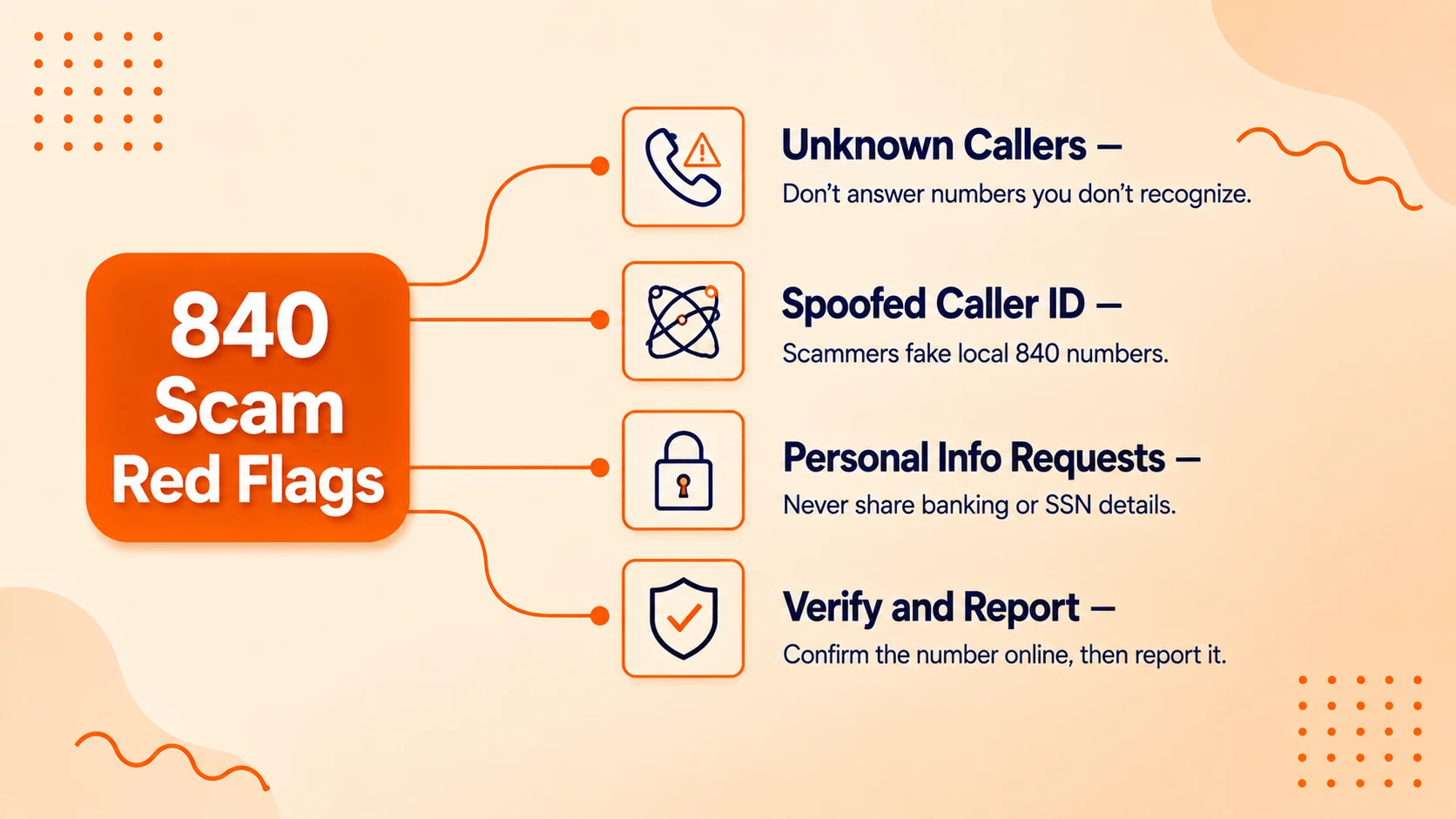
This prefix carries no more risk than any other, but its overlay status can confuse callers who assume every number is spam simply because it looks unfamiliar. Scammers can fake a caller ID to display a San Bernardino number even when the call actually originates far outside California. Verifying a suspicious call by searching the exact number online takes only a few seconds and usually settles the question fast.
Because 840 is still a newer prefix, some residents hang up on legitimate calls simply for not recognizing it yet. Businesses calling customers from a fresh 840 line can ease that hesitation by texting ahead or listing the number on their website, so a curious recipient can confirm it before picking up. That small step protects a legitimate 840 area code number from getting mistaken for spam.
840 and 909 Next to Southern California's Other Codes
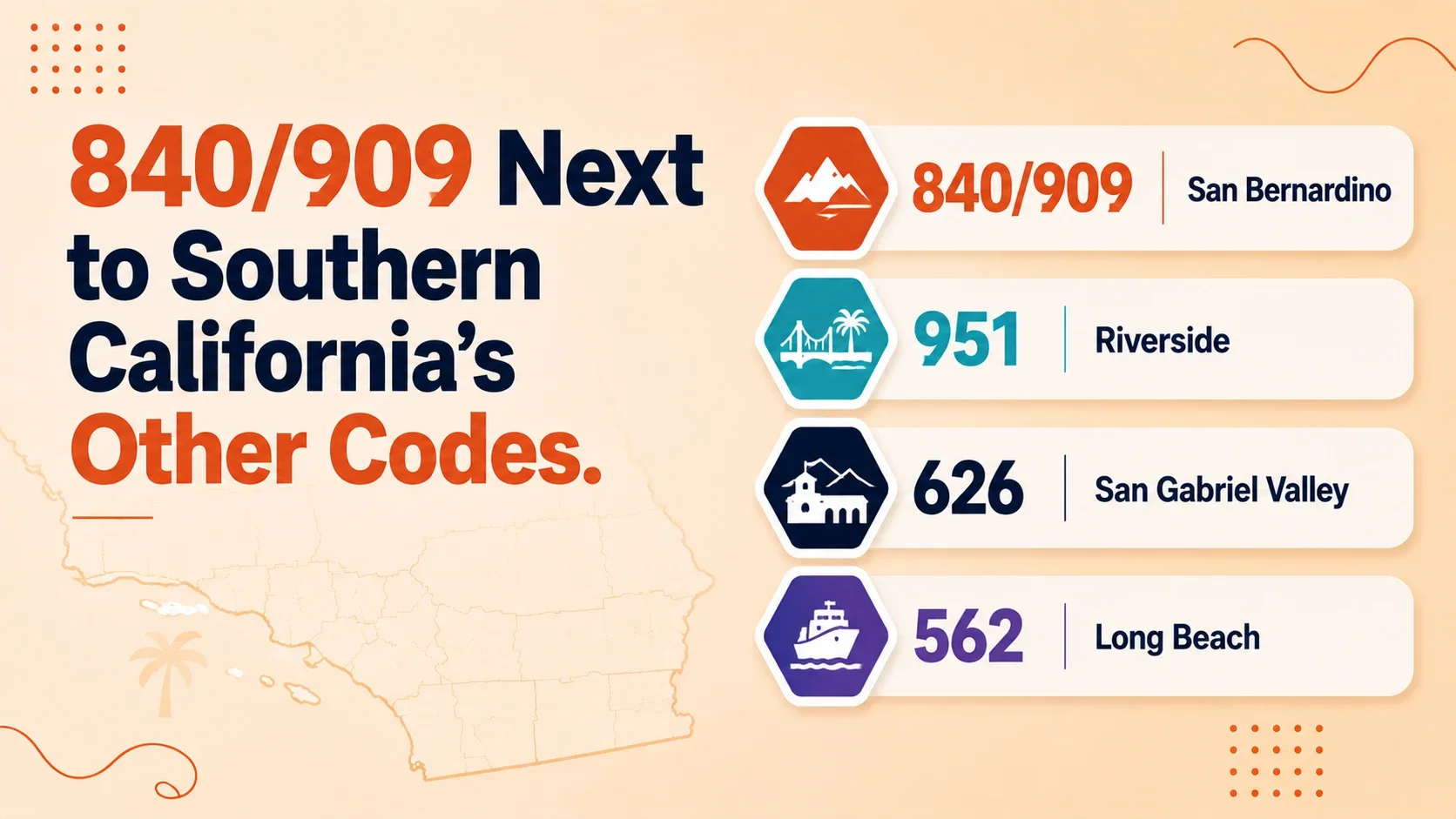
The Inland Empire's numbering map connects directly to several well-known neighboring codes. Area code 951 covers Riverside and Temecula after the 2004 split, while 813 area code territory on the other side of the country shows a similar pattern of splits eventually giving way to an overlay instead of a third division. According to the FCC's overview of area code overlays, 626 handles the San Gabriel Valley to the west, and 562 covers southeast Los Angeles County toward Long Beach.
Businesses serving customers across the wider Inland Empire and greater Los Angeles region often hold numbers in both 909 and 840, or even a neighboring code, rather than picking just one prefix. A cloud phone system keeps every one of those numbers inside a single login, the same way a company anchored in Albany might also hold an 838 area code line for a second market. That setup turns a complicated regional numbering map into a simple operational advantage.
Choosing an 840 number specifically still makes sense for any business rooted in San Bernardino or Ontario, even as more callers become familiar with the newer prefix. The area code remains tied to the same trusted 909 footprint that has anchored the region since 1992. That shared identity is a quiet advantage for companies planning to stay in the market long term.
Conclusion
The 840 area code stands out as one of the newest overlays in Southern California, layered onto a 909 footprint that has already weathered two splits since 1992. San Bernardino, Ontario, and Rancho Cucamonga all share this code today, running on Pacific Time alongside the rest of California. Its story traces from the original 714 split in 1992, through the 951 split in 2004, to the 840 overlay that finally arrived in 2021. Anyone asking what is 840 area code now has the complete picture, from its origin to why every call here needs 10 digits.
Claiming a number in this area code no longer requires opening a physical office anywhere near San Bernardino. A cloud-based provider can assign the line, route the calls intelligently, and even staff an AI receptionist while the rest of the team works from anywhere. Whether the goal is building trust with Inland Empire customers or simply testing the market, the next step is straightforward. Set up a Letsdial number today and start sounding local before a competitor claims the same advantage.
Frequently Asked Questions
Written by Aryan Khan · August 6, 2026
Reply to the author