Introduction
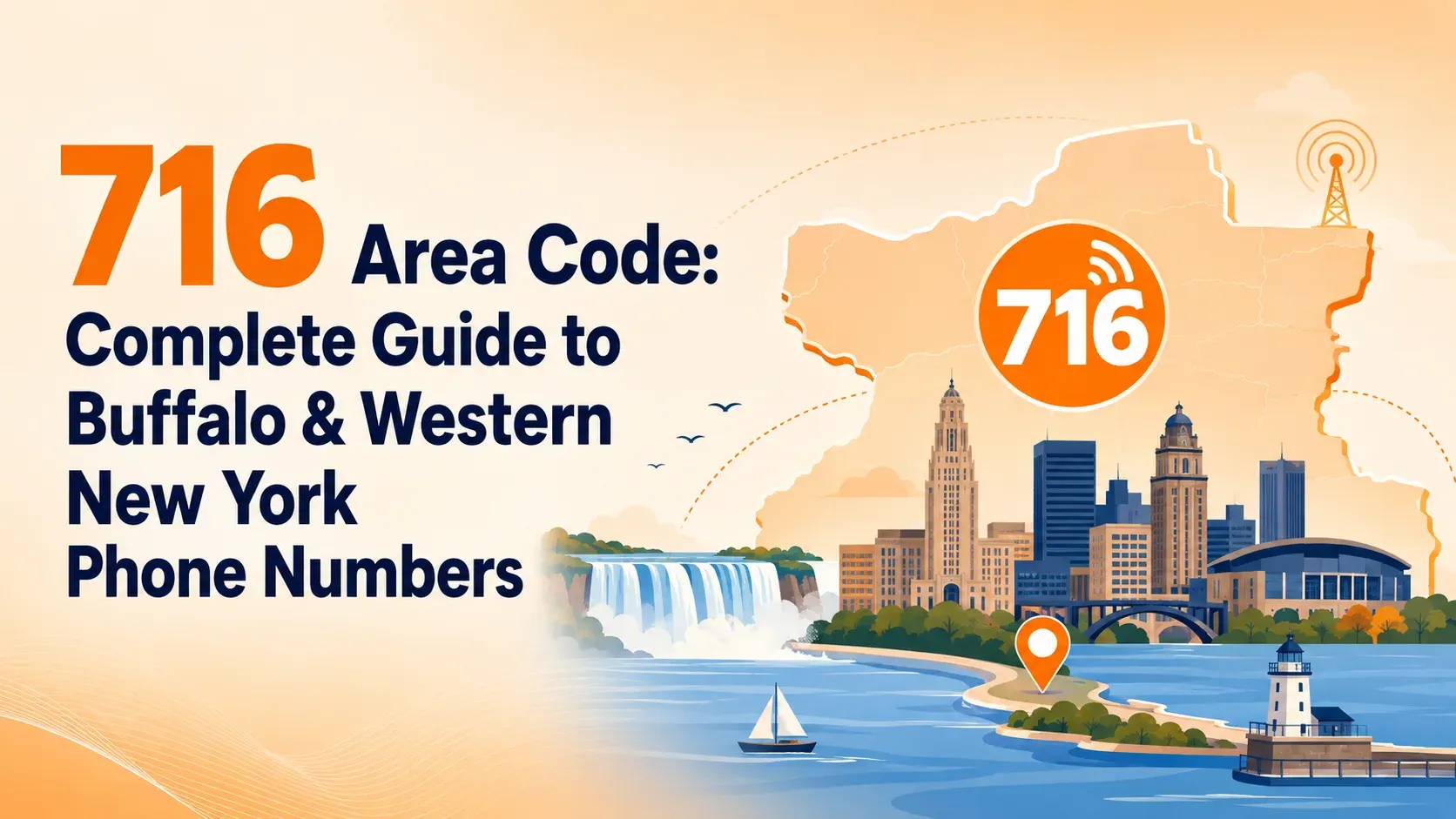
If you've seen a call or text from a 716 area code number, it's coming from Western New York — most likely Buffalo, Niagara Falls, or one of the surrounding communities that make up one of the oldest calling regions in the country. Whether you just missed a call from this prefix, you're moving to the region, or you're a business owner who wants a local Buffalo presence, this guide covers everything you need to know: where 716 is located, its history, its time zone, how to spot a scam call, and how to get your own 716 number in minutes.
Where Is the 716 Area Code Located?
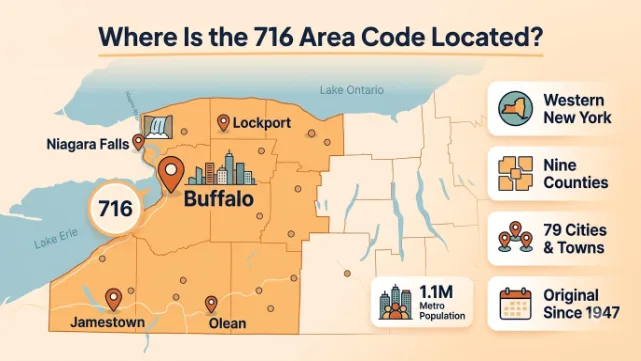
The 716 area code serves Buffalo and the Niagara Frontier region of Western New York, stretching across nine counties and reaching into the state's Southern Tier, the same rural corridor served further east by the 607 area code around Binghamton and Ithaca. It's one of the original 86 area codes created by AT&T and Bell System in 1947, when the North American Numbering Plan (NANP) first divided the continent into calling regions — which makes 716 nearly 80 years old and one of the longest-running area codes still in daily use.
Today, 716 covers roughly 79 cities and towns and 145 ZIP codes, anchored by Buffalo as the region's largest city and economic hub. With a metro population of roughly 1.1 million people, the 716 footprint is dense enough to matter for national brands running local campaigns, yet compact enough that a single local number can realistically reach most of the region's businesses and households.
Cities and Counties Covered by 716
The 716 area code footprint includes:
- Erie County — Buffalo, Cheektowaga, West Seneca, Tonawanda, Amherst, Lackawanna, Hamburg
- Niagara County — Niagara Falls, North Tonawanda, Lockport, Lewiston
- Chautauqua County — Jamestown, Dunkirk, Fredonia
- Cattaraugus County — Olean, Salamanca
- Allegany, Wyoming, Genesee, Orleans, and Chemung Counties — smaller towns across the Southern Tier and Genesee Valley
Buffalo, the second-largest city in New York State, anchors the region both economically and culturally — home to a growing tech and healthcare sector, two professional sports franchises, and a resurgent downtown waterfront that has attracted new businesses and residents over the past decade.
716 Area Code Time Zone
Every city and town in the 716 area code operates on the Eastern Time Zone (ET) — the same time zone as New York City, Boston, and Washington, D.C. Businesses calling into the region don't need to worry about time zone splits the way they might with larger area codes like 512 (Texas) or 209 (California), which can straddle multiple zones. A call placed to a 716 number at 9 a.m. Eastern reaches Buffalo at 9 a.m. local time, every time.
The History of the 716 Area Code
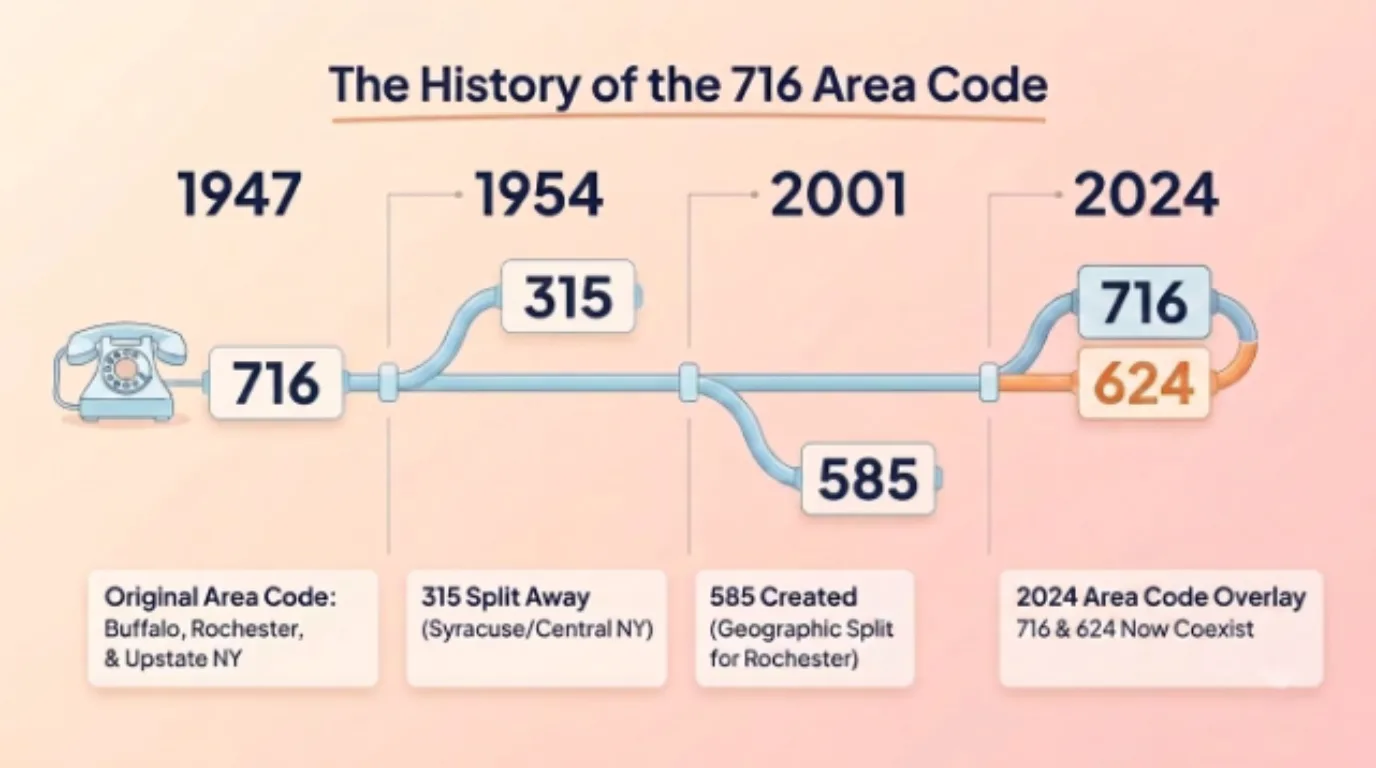
Understanding why 716 looks the way it does today means understanding a bit of area code history:
- 1947 — Original Assignment. When the NANP launched, 716 was assigned to cover a huge swath of upstate New York, including Buffalo, Rochester, and Syracuse-adjacent communities. Early area codes were deliberately chosen with a "1" or "0" as the middle digit to work with rotary-dial switching equipment.
- 1954 — First Split. As the region grew, Syracuse and central New York split off to form area code 315, narrowing 716's footprint to Western New York.
- 1999–2001 — The Rochester Split. By the late 1990s, the explosion of pagers, fax lines, and early cell phones meant Western New York was running out of available numbers. Rather than force an overlay (where two area codes share the same geographic region), regulators opted for a geographic split: Rochester and the surrounding Finger Lakes region broke off to form the new 585 area code in 2001, while Buffalo, Niagara Falls, and the rest of the Niagara Frontier retained 716.
- 2024 — The 624 Overlay. Even with the 2001 split, number demand in Erie and Niagara counties eventually caught up again. Rather than split the region a second time — which would have forced thousands of existing customers to change their numbers — regulators introduced 624 as an overlay code in 2024. An overlay assigns a second area code to the exact same geographic footprint, so new phone lines may be issued a 624 number while existing 716 numbers stay untouched.
The tradeoff: because two area codes now serve the same region, everyone in Western New York must dial all 10 digits (area code + number) for every call, even calls to a next-door neighbor. Seven-digit local dialing is no longer supported in the 716/624 overlay zone — a numbering squeeze that already played out once before here, when Syracuse and central New York split off from this same 716 territory to form the 315 area code back in 1954.
Is a 716 Number Safe? How to Spot 716 Area Code Scams
Because 716 is a real, high-population area code, scammers frequently spoof it to make robocalls and phishing attempts look like they're coming from a trusted local number. A call showing a 716 prefix is not inherently dangerous — most are legitimate calls from Buffalo-area businesses, healthcare providers, or contacts — but a few warning signs suggest a spoofed or fraudulent call:
- Urgent demands for payment, especially via gift cards, wire transfer, or cryptocurrency
- Threats involving arrest, lawsuits, or account suspension if you don't act immediately
- One-ring "missed call" schemes designed to get you to call back a premium-rate number
- Requests for sensitive information — Social Security numbers, bank details, or one-time verification codes — from an unsolicited caller
- Caller ID that doesn't match voicemail or the business you expect, since spoofing tools can fake the display name and number
If you're unsure whether a 716 call is legitimate, hang up and call the organization back directly using a number from their official website — never a callback number the caller provides. The FCC's guide to caller ID spoofing has more on how to identify and report calls like these.
Why Businesses Choose a 716 Local Number
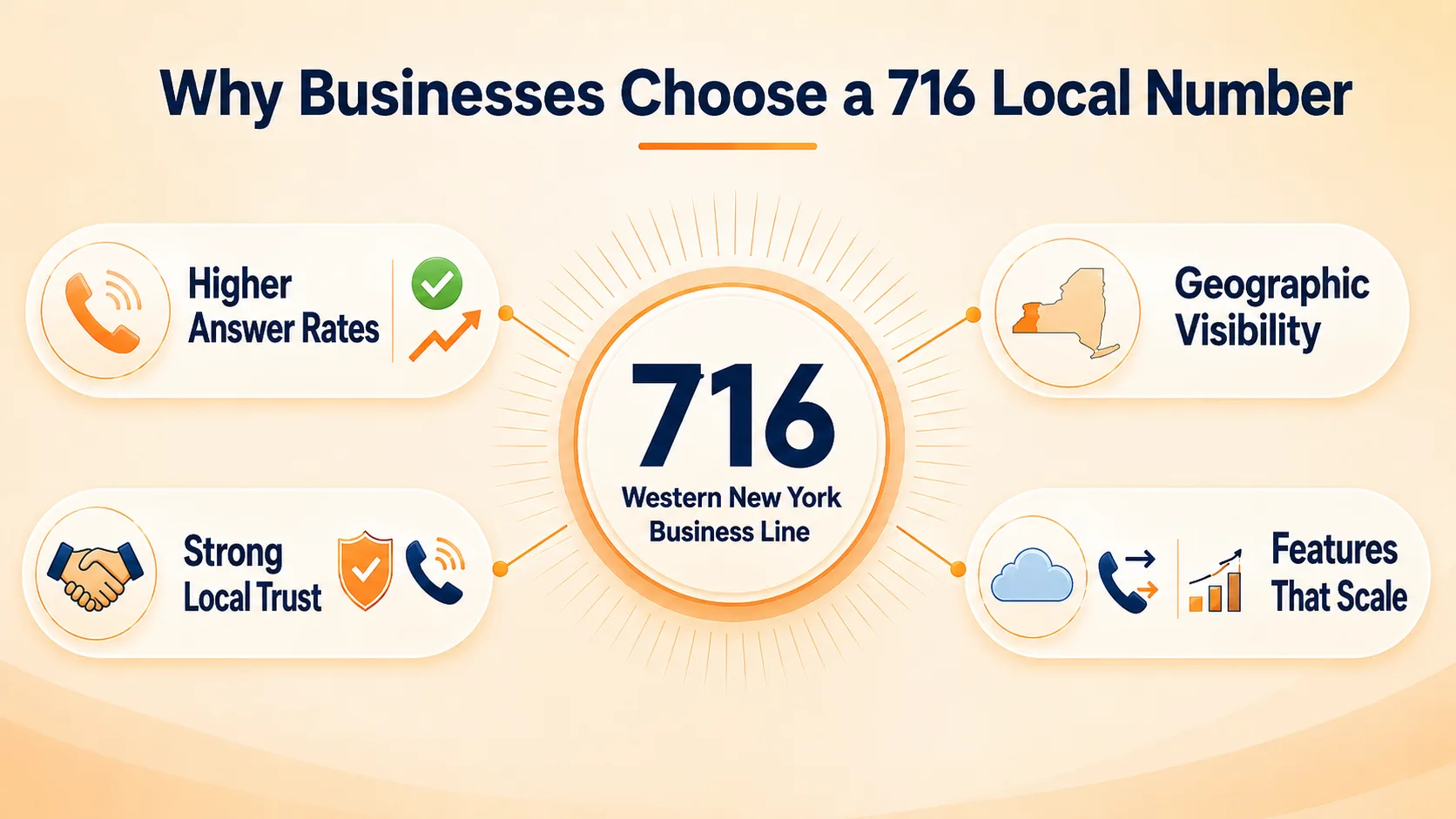
Even if your business isn't physically based in Buffalo, a 716 number carries real advantages if you sell to, support, or market toward Western New York customers:
- Higher answer rates. Consumers are measurably more likely to pick up a call from a local area code than an unfamiliar toll-free or out-of-state number, which matters for sales outreach, appointment reminders, and customer follow-up.
- Local trust and credibility. A Buffalo-area customer searching for a plumber, law firm, healthcare provider, or SaaS vendor is more likely to trust — and convert with — a business that displays a familiar local prefix rather than a generic 800 number.
- Regional marketing and SEO signals. Pairing a 716 number with a local business listing reinforces geographic relevance for search engines and directories, which can support local SEO rankings for "near me" searches.
- No physical office required. With a cloud-based business phone system, you don't need a Buffalo office or landline to claim a 716 number — the number routes to your team wherever they're working, whether that's a call center, a remote sales rep, or a mobile device.
- Room to scale. Cloud numbers support call forwarding, auto-attendants, voicemail-to-email, SMS, and CRM integrations that a traditional analog line can't offer — useful as your Western New York customer base grows.
- Better tracking and attribution. A dedicated 716 line makes it easy to isolate call volume, conversion rates, and campaign performance for the Buffalo market specifically, rather than blending that data into a single national number. For agencies and multi-location businesses running geo-targeted ads or listings, that separation makes ROI reporting far more accurate.
How to Get a 716 Area Code Phone Number
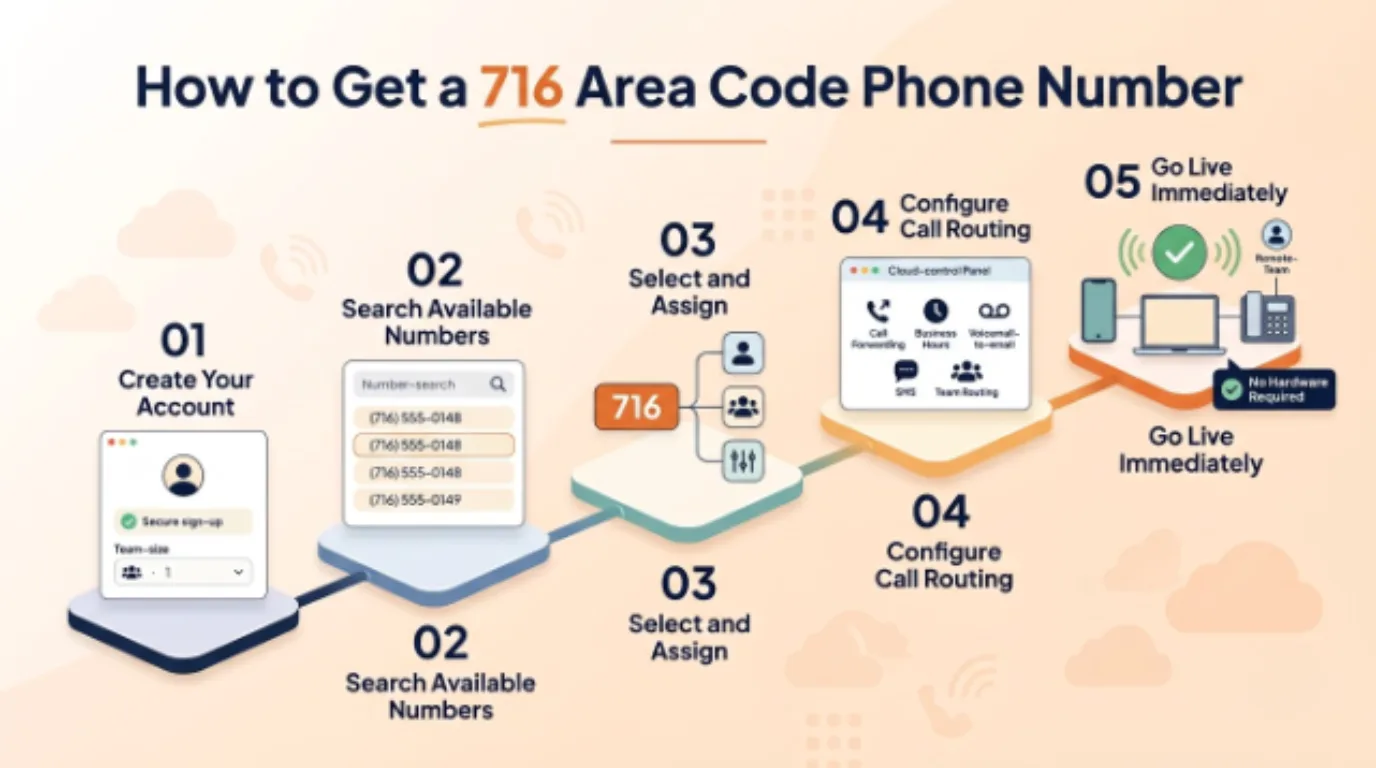
Getting a local 716 number no longer requires a physical presence in Buffalo or a contract with a legacy phone carrier. With a cloud phone platform like LetsDial, the process takes just a few minutes:
- Sign up for a LetsDial account and choose a calling plan that fits your team size.
- Search available 716 numbers in the number picker — filter by city, prefix, or vanity options.
- Select your number and assign it to a user, team, or auto-attendant/IVR flow.
- Configure call routing — forwarding, business hours, voicemail-to-email, and SMS can all be set up from the dashboard, no hardware required.
- Go live — your new 716 number is active immediately and works across desktop, mobile, and desk phone apps.
Conclusion
Because the number lives in the cloud, you can add 716 as a secondary line alongside numbers in other area codes, letting a single team manage multiple regional presences from one platform. LetsDial's business phone number plans and pricing make it easy to get started, or browse the full list of New York area codes if you need coverage beyond 716.
716 Area Code at a Glance
- Region: Western New York (Buffalo, Niagara Falls, Southern Tier)
- State: New York
- Time Zone: Eastern Time (ET)
- Assigned: 1947 (original NANP area code)
- Overlay Code: 624 (added 2024)
- Counties Covered: 9
- Cities Covered: ~79
- Dialing Requirement: 10-digit dialing required
- Largest City: Buffalo
Frequently Asked Questions
Written by Aryan Khan · August 12, 2024
Reply to the author