Introduction
The 539 area code is a full overlay on 918, put into service on April 1, 2011 across Tulsa and northeastern Oklahoma. It was Oklahoma's first overlay — added once the existing 918 number pool, in service since 1953, could no longer keep pace with the region's growth. 539 and 918 share the exact same footprint rather than dividing the region, so both prefixes coexist side by side in Tulsa, Broken Arrow, Owasso, and every other community the code serves.
Northeastern Oklahoma's economy runs on energy, aviation, and a growing technology sector, alongside the seat of the largest tribal nation in the United States — a mix that makes a recognizable local number valuable for businesses and residents across a wide range of industries. Because 539 is a full overlay, every call in the region, even a local one, requires all 10 digits to be dialed.
- 539 overlays the existing 918 area code across Tulsa and northeastern Oklahoma — it does not cover a separate territory
- It went into service April 1, 2011, once the 918 number pool neared exhaustion
- Letsdial issues a 539 number instantly, with forwarding, IVR, texting, and analytics built in
Where the 539 Area Code Reaches
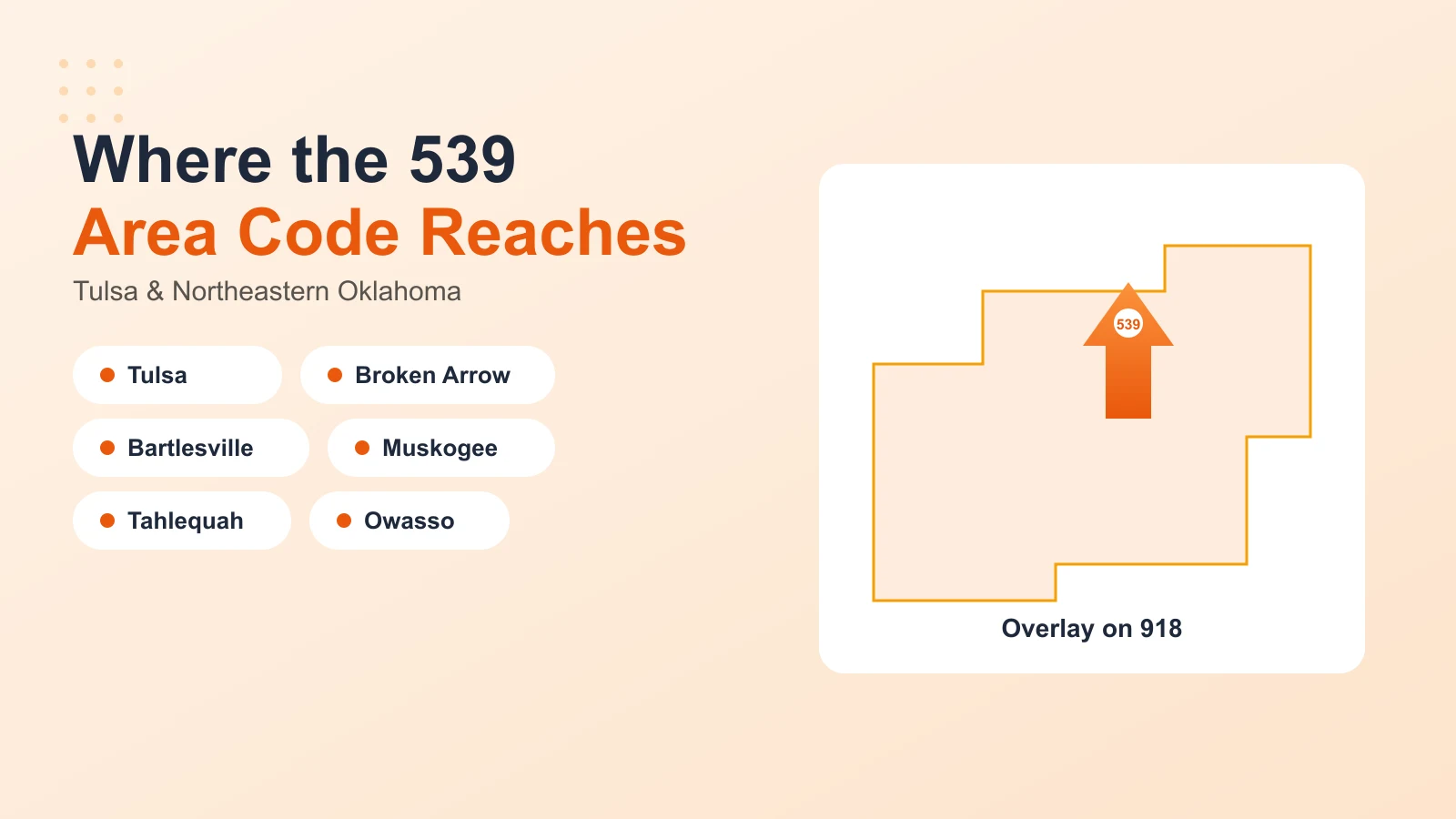
539 is a full overlay of 918 only — there is no part of northeastern Oklahoma that carries one prefix but not the other. The combined footprint spans a broad, multi-county stretch of the state, reaching from the Kansas border in the north down to McAlester in the south. The combined 918/539 footprint covers:
- Tulsa County — Tulsa, the second-largest city in Oklahoma and the region's economic center
- Broken Arrow, Owasso, Jenks, Bixby, and Sand Springs — the Tulsa metro's fastest-growing suburbs
- Rogers County — Claremore, northeast of Tulsa along the Verdigris River
- Washington County — Bartlesville, headquarters city for Phillips 66's legacy operations
- Muskogee and Okmulgee — county seats southeast of Tulsa with a strong agricultural and manufacturing base
- Cherokee, Mayes, and Adair counties — Tahlequah, Pryor Creek, and the heart of Cherokee Nation tribal jurisdiction
Because 918 and 539 share identical geography, a business or resident anywhere in this footprint could be assigned either code with equal likelihood — neither carries more local credibility than the other, and 10-digit dialing has been mandatory throughout the region since March 5, 2011. More detail sits on our toll-free numbers page.
Tulsa's Energy, Aviation, and Technology Economy
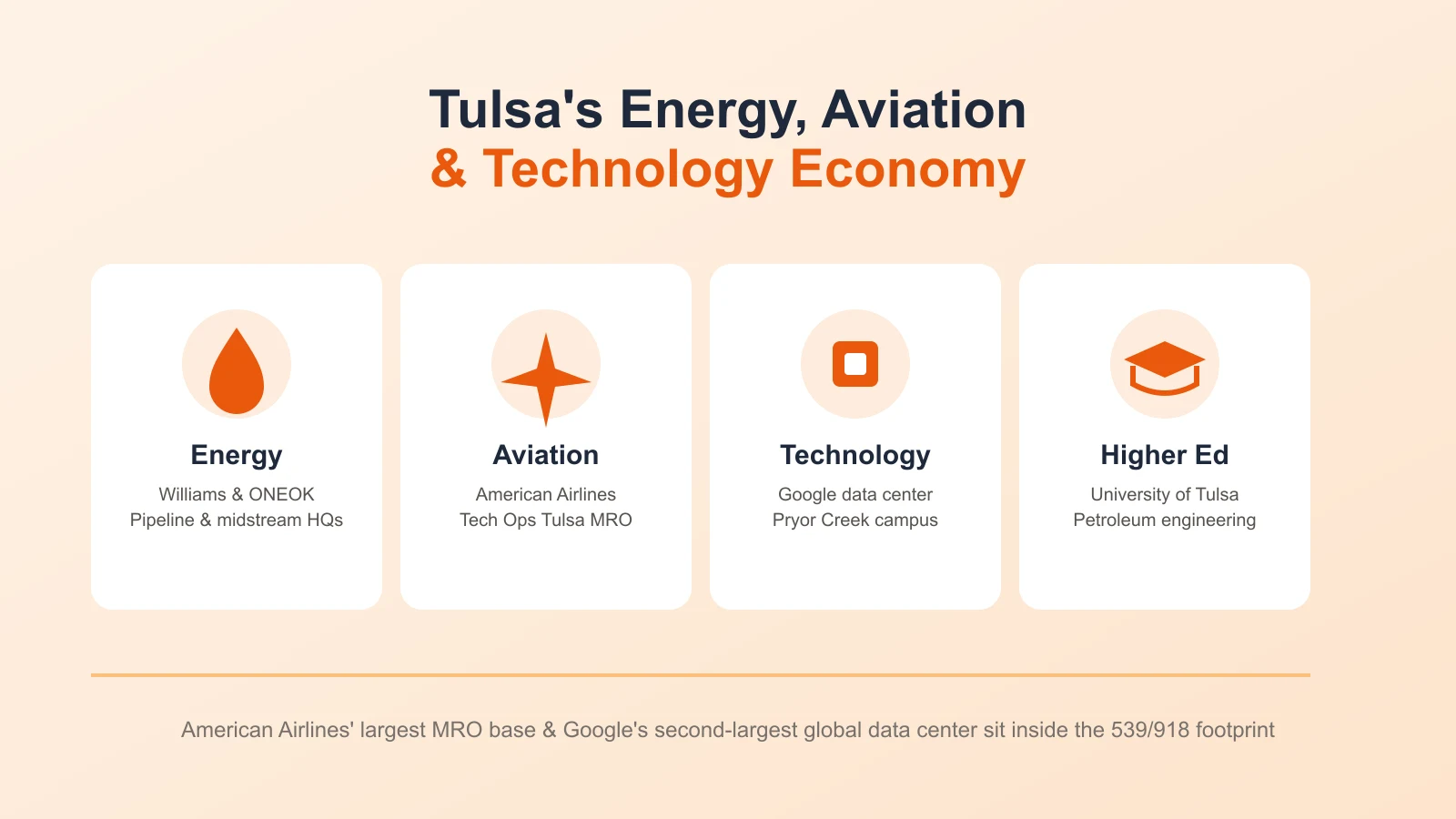
Tulsa built its identity as the historic "Oil Capital of the World," and the energy sector still anchors the local economy — Williams Companies and ONEOK, two major pipeline and midstream natural gas operators, are both headquartered in downtown Tulsa, alongside BOK Financial, one of the region's largest banks.
American Airlines' Tech Ops Tulsa base at Tulsa International Airport is the world's largest commercial aircraft maintenance facility — 3.3 million square feet of hangar and shop space across 330 acres, employing nearly 5,000 people including more than 3,200 licensed maintenance technicians. The base has anchored American's maintenance operations since 1946 and services roughly 400 aircraft a year, making it one of the largest single employers in the entire 539 footprint.
Further northeast in Mayes County, Google's data center campus at the MidAmerica Industrial Park in Pryor Creek is the company's second-largest data center in the world, trailing only its flagship site in Council Bluffs, Iowa. Google has invested more than $4.4 billion in the Pryor facility since choosing the site in 2007, and the surrounding MidAmerica Industrial Park — a 9,000-acre development — now hosts more than 80 companies and 4,500 workers across data centers, aerospace, and advanced manufacturing.
Bartlesville's energy pedigree runs even deeper than its present-day headquarters roster. Phillips Petroleum Company was founded there in 1917 by brothers Frank and L.E. Phillips, and by the mid-1920s it was the largest producer of natural gas liquids in the country. The Phillips 66 brand itself traces back to a 1927 road test in which a company car reportedly hit 66 miles per hour on Route 66, inspiring the name. Phillips merged with Conoco in 2002 and relocated to Houston, and the refining arm spun off again as Phillips 66 in 2012, but Bartlesville still carries the company's founding history and a substantial ConocoPhillips research and operations presence.
The University of Tulsa, a private research university with roughly 3,800 students, houses the McDougall School of Petroleum Engineering — ranked the No. 1 undergraduate petroleum engineering program among private universities in the country, with a student-faculty ratio kept below 5-to-1 and 21 active research consortia backed by major energy firms. That program has fed engineering talent directly into the Williams, ONEOK, and BOK Financial workforce for decades.
Oral Roberts University, a private Christian university founded in 1963, has grown past 6,000 students and offers more than 70 undergraduate programs across its 323-acre south Tulsa campus, adding a second significant higher-education anchor to the 539 footprint alongside TU's energy-focused programs. More detail sits on our auto-attendant page.
The Cherokee Nation and Northeastern Oklahoma's Tribal Economy
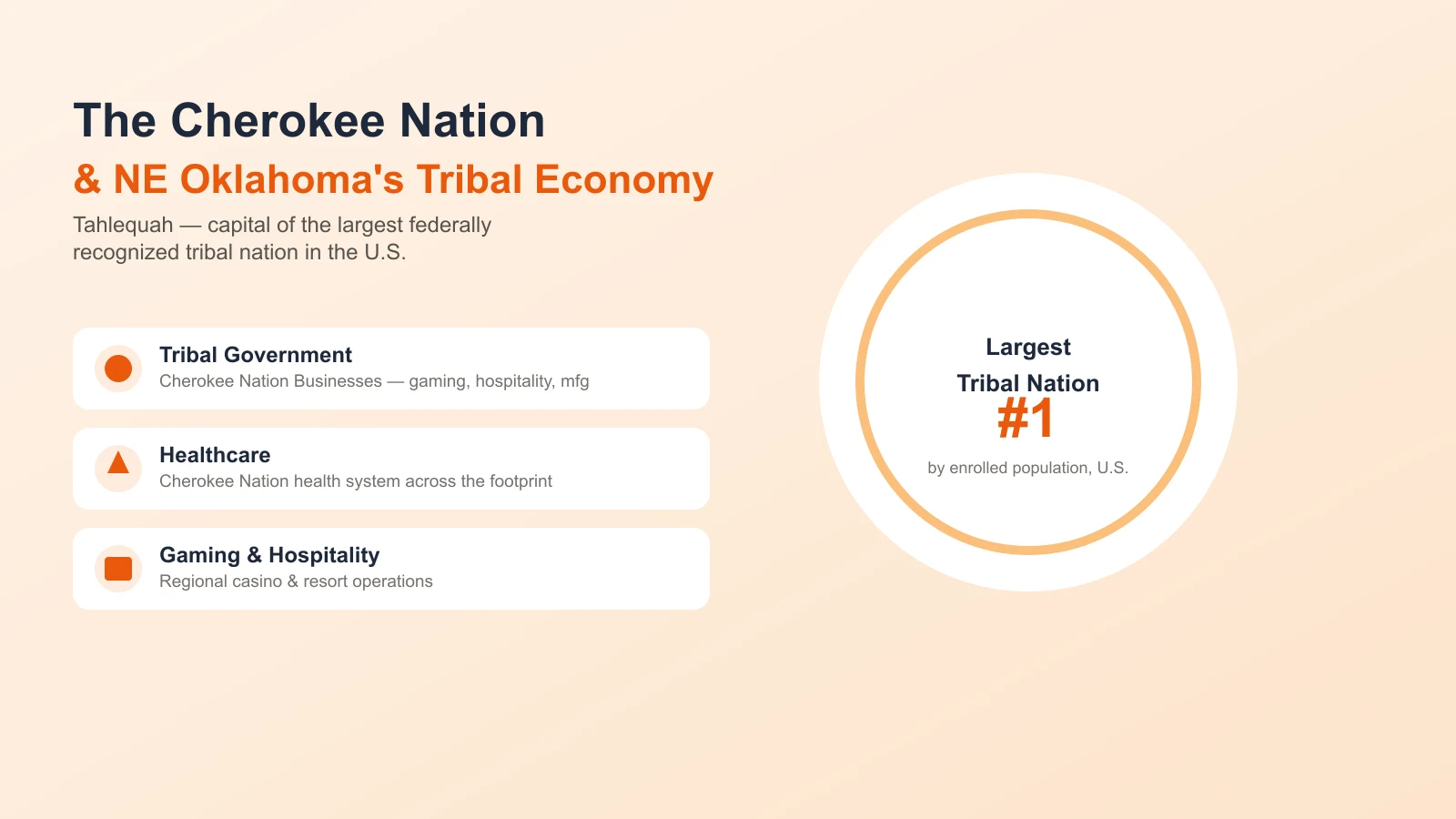
Tahlequah, within the 539/918 footprint, is the capital of the Cherokee Nation — the largest federally recognized tribal nation in the United States by enrolled population. The Cherokee Nation's tribal government, healthcare system, and business enterprises are major employers across the region, and Cherokee Nation Businesses operates gaming, hospitality, and manufacturing ventures throughout northeastern Oklahoma. For any business serving this market, a 539 or 918 number signals familiarity with a region where tribal government, energy, and agriculture all carry equal economic weight.
Tulsa itself draws steady tourism traffic as a stop on the original Route 66 alignment, anchored by landmarks like the Golden Driller statue and the Art Deco architecture of downtown's oil-boom era. Gathering Place, a large riverfront park along the Arkansas River funded largely by the George Kaiser Family Foundation, opened in 2018 and has since been ranked among the best public parks in the country — adding a hospitality and events economy alongside the energy and aviation sectors that otherwise define the 539 market.
How the 539/918 Overlay Works
918 has covered northeastern Oklahoma since 1953, when it split off from the state's original 405 code. By the late 2000s, mobile phone growth had pushed the 918 pool toward exhaustion, and regulators approved 539 as Oklahoma's first area code overlay rather than splitting the region and forcing existing subscribers to change their numbers. Mandatory 10-digit dialing took effect March 5, 2011, and the 539 overlay itself went into service April 1, 2011.
More than a decade on, the combined 918/539 numbering pool remains healthy. NANPA's most recent exhaustion analyses do not place the region on any near-term relief schedule, and Oklahoma regulators have no third overlay or split under active consideration for northeastern Oklahoma — a contrast to some faster-growing metro areas elsewhere in the country that are already planning their next numbering change.
Every call within the 918/539 region — local, long-distance, or international — now requires the full format: dial the area code plus the 7-digit number for local calls (539-555-1234), 1 plus the area code and number for long-distance (1-539-555-1234), and the exit code plus 1, area code, and number for international calls.
Managing Calls and Getting a 539 Number
A newer overlay code is a common target for spoofing, since callers are less immediately familiar with 539 than with the long-established 918. Install a call-blocking app such as Nomorobo, Truecaller, or Hiya, register with the National Do Not Call Registry, and report suspicious calls to the FTC or FCC. Never share personal or financial information with an unverified caller, even if the number appears local.
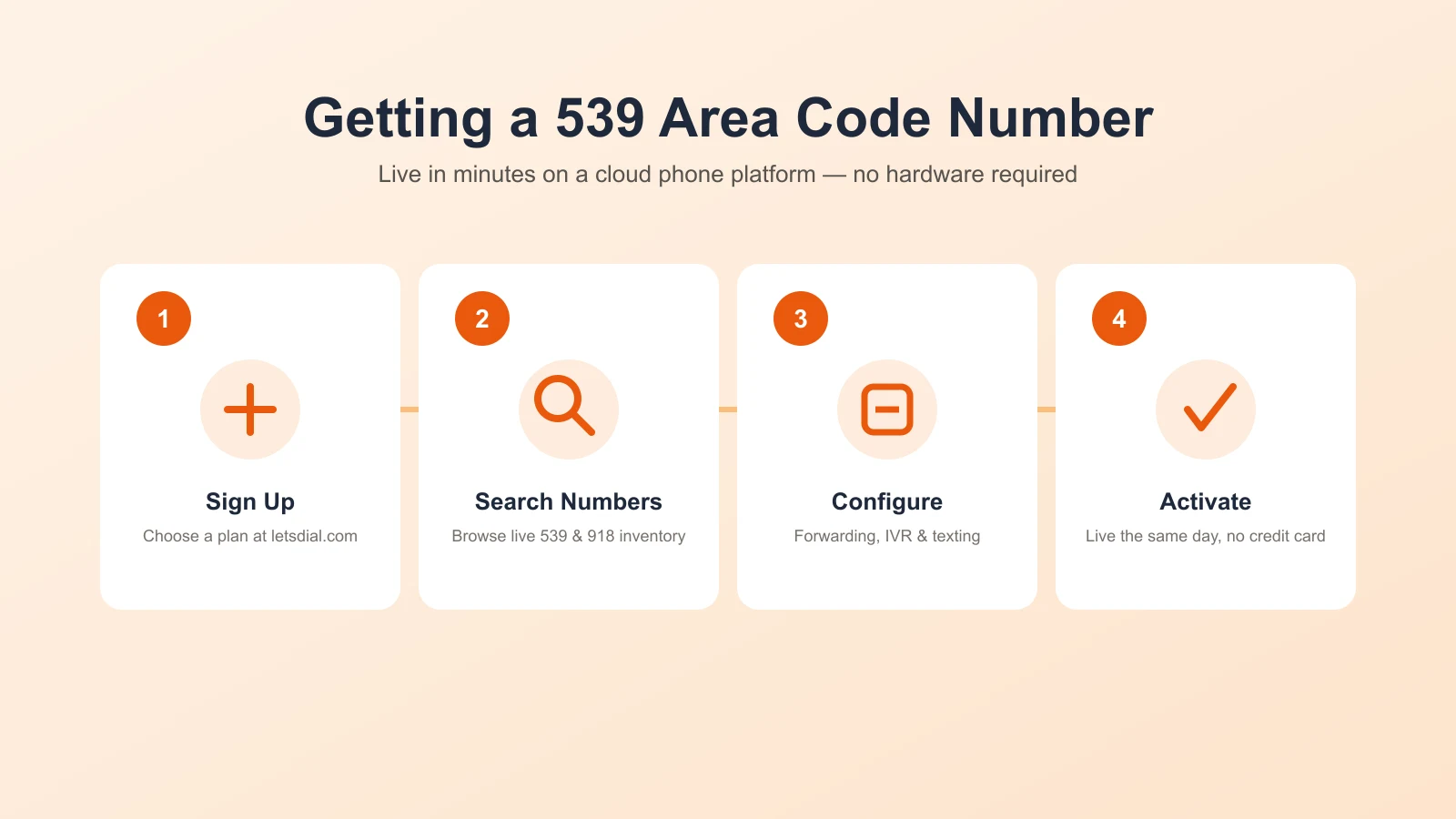
- Sign up at letsdial.com and choose a plan that fits your team
- Search available 539 or 918 numbers and reserve the one you want, including toll-free numbers if your business needs one
- Configure call forwarding, voicemail-to-email, business texting, and an auto-attendant for after-hours routing
- Activate immediately — no hardware required, with number portability if you're bringing an existing line from another carrier
539 is officially documented under the North American Numbering Plan, which governs area code assignments across the US, Canada, and the Caribbean. For the official record, see the FCC's North American Numbering Plan page.
Conclusion
The 539 area code gives Tulsa and northeastern Oklahoma room to grow without displacing a single existing 918 number. As a full overlay in service since 2011, it now carries equal local recognition alongside a code that has represented the region since 1953 — home to major energy headquarters, American Airlines' largest maintenance base, Google's Pryor Creek data center, and the capital of the Cherokee Nation. Whether you're a resident or a business anywhere in this footprint, a 539 number connects you to northeastern Oklahoma with professional features and instant activation through Letsdial.
Frequently Asked Questions
Written by Aryan Khan · June 20, 2026
Reply to the author