Introduction
The 505 area code covers the northern half of New Mexico, including Albuquerque, Santa Fe, and the communities surrounding both cities. Sandia National Laboratories in Albuquerque is one of the country's premier national security research institutions. It is managed by NTESS (a Honeywell subsidiary) and focused on nuclear weapons stewardship, energy research, and defense systems. The University of New Mexico, Kirtland Air Force Base, and the state government in Santa Fe anchor the region's institutional economy. 505 is New Mexico's original 1947 area code for the northern part of the state.
Businesses in defense contracting, government services, healthcare, tourism, and the arts all benefit from a 505 number in northern New Mexico. Santa Fe's world-renowned art market, Albuquerque's growing technology and aerospace sector, and the large federal workforce at Sandia Labs and Kirtland AFB all shape the region's business communities. These communities respond better to calls from local New Mexico prefixes than from out-of-state numbers.
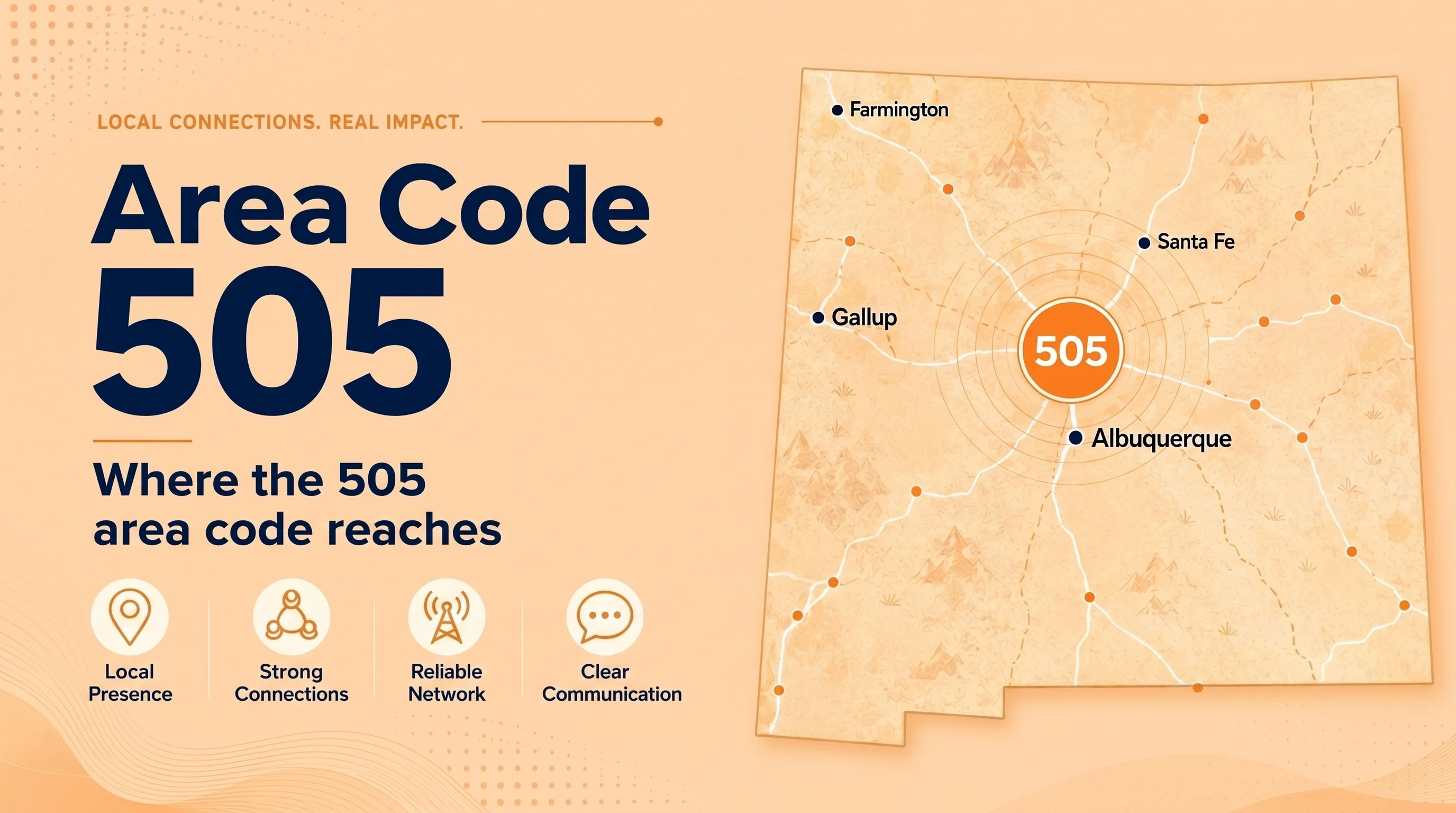
Where the 505 area code reaches
505 covers northern and central New Mexico — anchored by Albuquerque and extending to Santa Fe, Farmington, Gallup, Taos, and Los Alamos.
- Albuquerque — New Mexico's largest city, home to Sandia National Laboratories, Kirtland Air Force Base, and the University of New Mexico
- Rio Rancho — Albuquerque's main suburb on the west side of the Rio Grande, home to an Intel Corporation semiconductor fabrication facility
- Santa Fe — New Mexico's capital and a global arts destination, with significant state government employment and a major tourism economy
- Los Alamos — historic home of the Manhattan Project and the current site of Los Alamos National Laboratory, one of the most important science campuses in the world
- Farmington — the commercial hub of the San Juan Basin, New Mexico's largest oil and natural gas producing region
- Gallup — a major trading and economic center for the Navajo Nation, the largest Native American reservation in the United States
- Taos — the high-desert arts colony north of Santa Fe, home to the UNESCO World Heritage-listed Taos Pueblo
505 has no overlay. After the 575 split in 2007, it operates as the standalone code for northern and central New Mexico. Every number in this footprint carries the 505 prefix. More detail sits on our letsdial page.
Albuquerque: national laboratories, military, and film
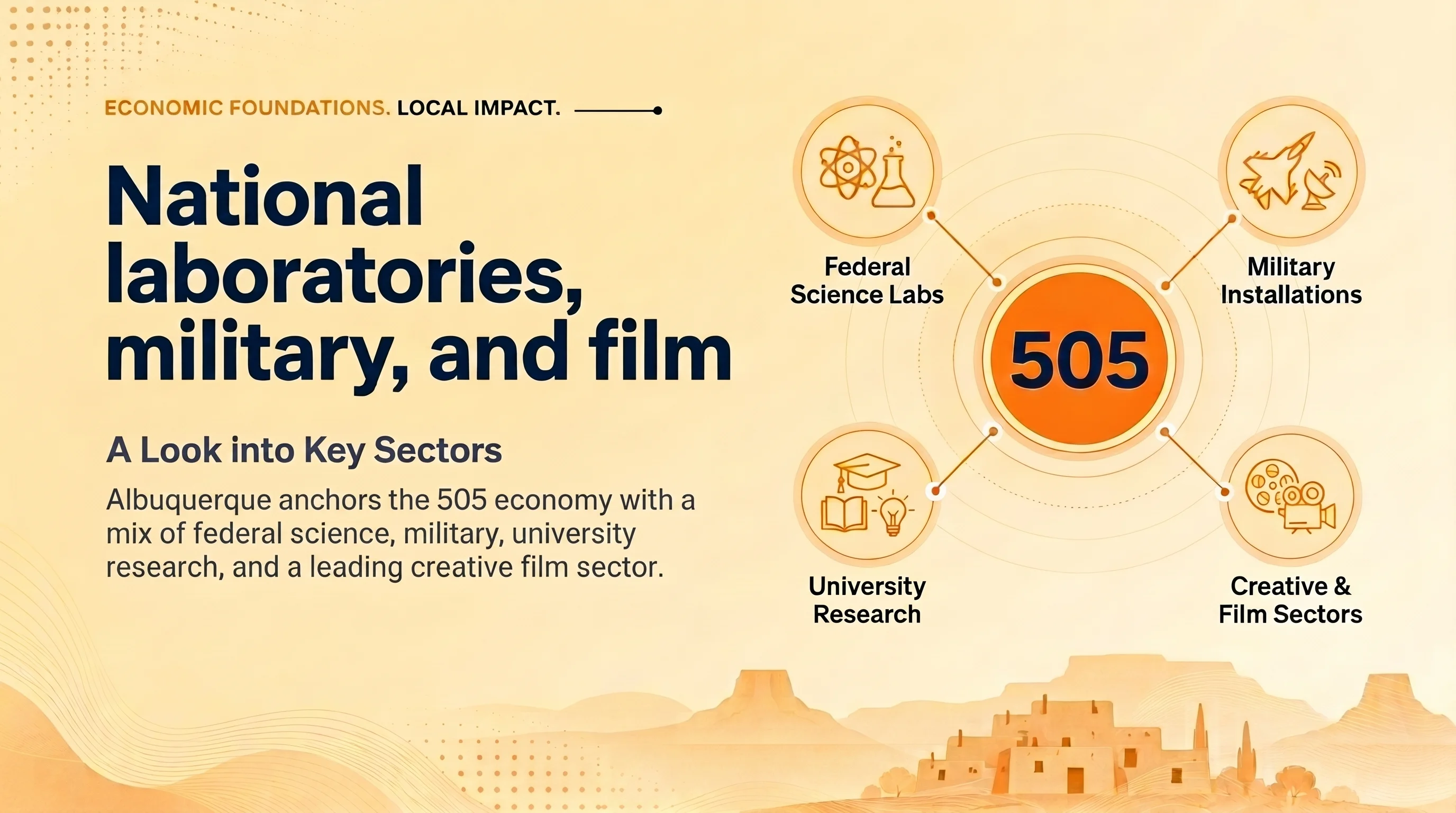
Albuquerque anchors the 505 economy with a combination of federal science infrastructure, military installation, university research, and a creative economy that has emerged as one of the state's fastest-growing sectors.
Sandia National Laboratories and Kirtland AFB
Sandia National Laboratories, managed by NTESS (National Technology and Engineering Solutions of Sandia, a Honeywell subsidiary) for the Department of Energy, is headquartered at Kirtland Air Force Base in southeast Albuquerque. That makes the base-and-lab campus one of the largest federal employer clusters in the Southwest. Sandia's work in nuclear weapons systems, cybersecurity, and renewable energy research employs thousands of scientists and engineers directly. It also supports hundreds of contractors and vendors operating throughout the 505 market.
Film production and the creative economy
New Mexico's competitive film tax credit has made Albuquerque one of the most active production markets in the United States. Albuquerque Studios hosts major productions, and the city's international profile was amplified by Breaking Bad and Better Call Saul — both filmed on location in the 505 footprint. The creative economy now supports a significant ecosystem of production services, talent agencies, and post-production firms throughout the metro. More detail sits on our STIR/SHAKEN page.
Santa Fe, Los Alamos, Farmington, and Gallup
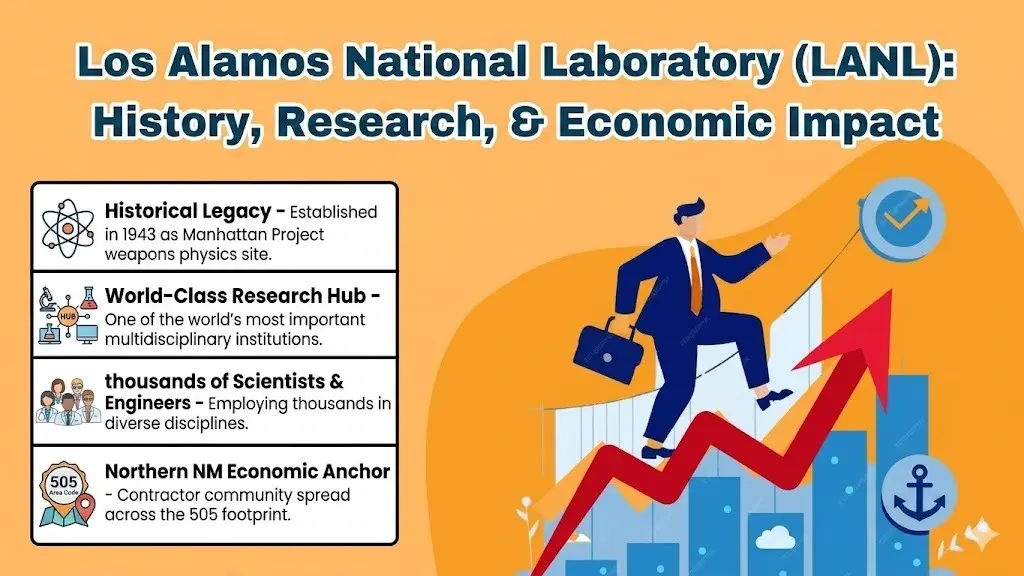
Beyond Albuquerque, the 505 footprint holds four distinct economies. The government-and-arts tier covers Santa Fe and Los Alamos to the northeast, while the energy-and-tribal tier covers Farmington and Gallup to the northwest. Together, they define the government, science, resource, and cultural dimensions of the New Mexico 505 zone.
Santa Fe: arts capital and state government
Santa Fe is one of the most-visited American cities for arts and culture. The Canyon Road gallery district and the historic Plaza draw visitors year-round, generating hospitality and retail revenue across the northern 505 zone. As state capital, Santa Fe carries a substantial public sector workforce that feeds steady demand for professional services, technology providers, and government contracting firms throughout the region.
Los Alamos National Laboratory
Los Alamos National Laboratory was established in 1943 as the site where Manhattan Project weapons physics were developed. It remains one of the world's most important multidisciplinary research institutions. LANL employs thousands of scientists and engineers in disciplines ranging from nuclear security to computational science. Its contractor community is spread across the broader 505 footprint, making it one of the primary economic anchors for northern New Mexico.
San Juan Basin energy
Farmington sits at the center of the San Juan Basin, one of the most productive natural gas basins in the United States. The basin has historically fueled a dense ecosystem of oil field services, pipeline operations, and energy logistics companies throughout the Farmington corridor. PNM Resources, New Mexico's largest electric utility, also maintains operations tied to the energy infrastructure of the broader 505 footprint.
Navajo Nation and Gallup
Gallup serves as the primary off-reservation retail and services hub for the Navajo Nation — the largest Native American reservation in the United States, spanning New Mexico, Arizona, and Utah. The Navajo economy generates significant retail, healthcare, and professional services demand that flows through the Gallup 505 exchange. That makes it a market that connects tribal economic activity directly to mainstream commercial supply chains.
505 History and Time Zone
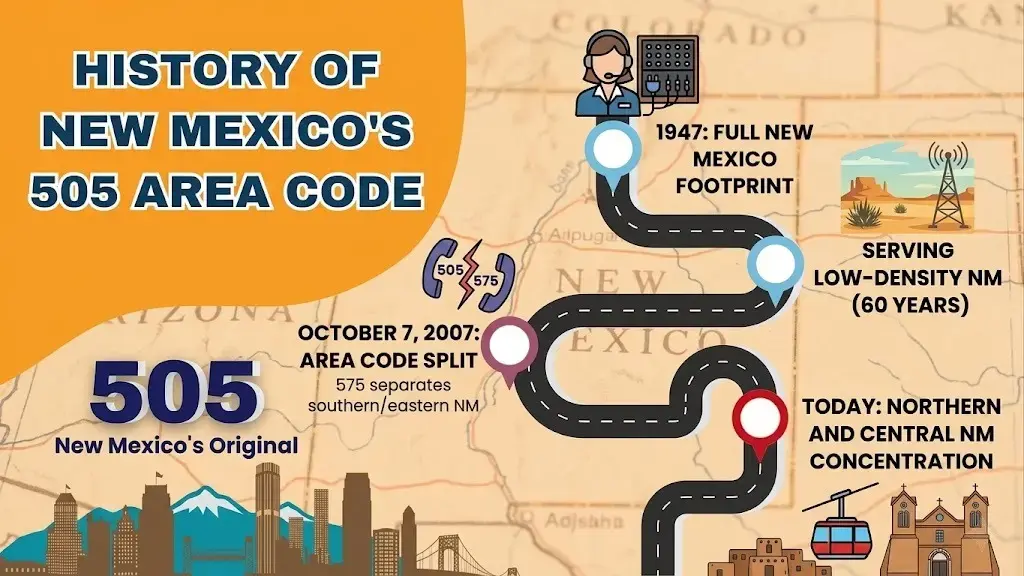
505 is one of the original 86 area codes assigned in 1947 when AT&T launched the North American Numbering Plan. At that time a single code covered the entire state of New Mexico. Its territory ran from the Colorado border in the north to the Texas and Mexican borders in the south, and from Arizona east to Texas.
575 splits off in 2007
For six decades, 505 served all of New Mexico without requiring a split or overlay — a reflection of the state's relatively low population density compared to faster-growing Sun Belt markets. On October 7, 2007, the 575 area code was created as a geographic split. It took southern and eastern New Mexico, including Las Cruces, Roswell, Carlsbad, and Hobbs. That left 505 concentrated in the northern and central portions of the state, where it operates today as a standalone code.
Time zone and calling hours
The entire 505 area code observes Mountain Time — UTC-7 in winter (MST) and UTC-6 during Daylight Saving (MDT). Unlike neighboring Arizona, New Mexico observes Daylight Saving Time — so from March through November, Albuquerque runs one hour ahead of Phoenix. West Coast teams calling 505 contacts are one hour behind during standard time. East Coast teams are two hours ahead during MST and three during MDT.
Getting a 505 Number and Call Trust
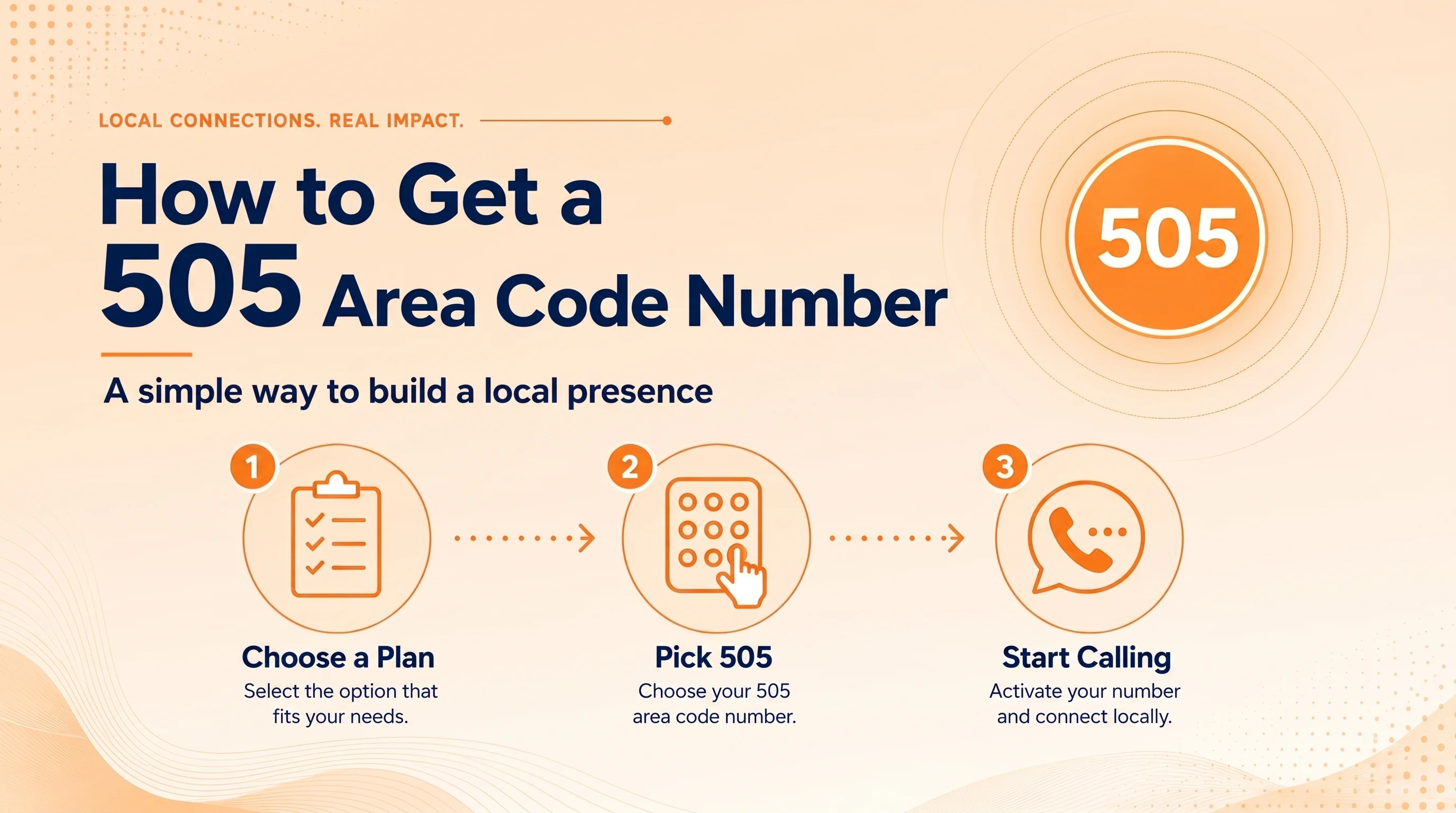
505 is the sole area code for northern and central New Mexico. There is no overlay and no competing prefix in the footprint. A 505 line signals Albuquerque, Santa Fe, and the broader New Mexico market without ambiguity, backed by more than 75 years of continuous use.
- Cloud phone platform — search available 505 numbers in real time and activate a line the same day. letsdial provisions a New Mexico number in under three minutes on a free trial, no credit card required.
- Port your existing number — already have a 505 line on another carrier? Port it in without downtime. letsdial handles the transfer at no charge and keeps the number active through the full transition.
- Wireless SIM or landline carrier — valid for a physical handset, but slower to provision and harder to scale without additional hardware per seat.
STIR/SHAKEN for government and science markets
New Mexico's federal laboratory and military sectors operate under security frameworks that make call trust a prerequisite, not an afterthought. A vendor contacting Sandia National Laboratories, Los Alamos, or Kirtland Air Force Base procurement from a number labeled Spam Risk is effectively invisible. Sensitive procurement environments dismiss unverified calls before they are answered.
Apply STIR/SHAKEN A-level attestation through your carrier so every outbound 505 call arrives fully signed with your registered business name on the screen. Government contractors, university research offices, and state agency procurement teams throughout the 505 footprint operate under compliance requirements that treat call verification as a baseline standard. Register all business text campaigns for 10DLC compliance, and warm new 505 lines gradually before scaling outbound volume.
> [TIP] Note: letsdial applies STIR/SHAKEN attestation automatically and files your 10DLC registration for text messaging — your 505 number is fully protected from the first call, no extra configuration required.
505 is officially documented under the North American Numbering Plan, which governs area code assignments across the US, Canada, and the Caribbean. For the official record, see the FCC's North American Numbering Plan page.
Conclusion
The 505 area code covers northern New Mexico's most commercially and institutionally significant communities. Its footprint includes Albuquerque's Sandia Labs and Kirtland Air Force Base, Santa Fe's state government and arts economy, and the University of New Mexico's research and healthcare operations. This guide has covered the geographic footprint, major institutions, the Mountain Time zone, and the code's origin as New Mexico's first area code.
letsdial provisions 505 numbers in minutes on a free trial with no hardware required. Activate a northern New Mexico number today and establish local identity with the federal agencies, universities, and cultural institutions that define Albuquerque and Santa Fe's unique market.
Frequently Asked Questions
Written by Aryan Khan · August 16, 2024
Reply to the author