On this page:
- Introduction
- How 480 Became One of Three Codes Sharing the Same Ground
- Where This Prefix Reaches
- The East Valley Economy Behind the Numbers
- Why a Local Number Still Matters in an Overlay Market
- Setting Up a 480 Number Without the Overlay Headache
- Conclusion
- Frequently Asked Questions
Introduction
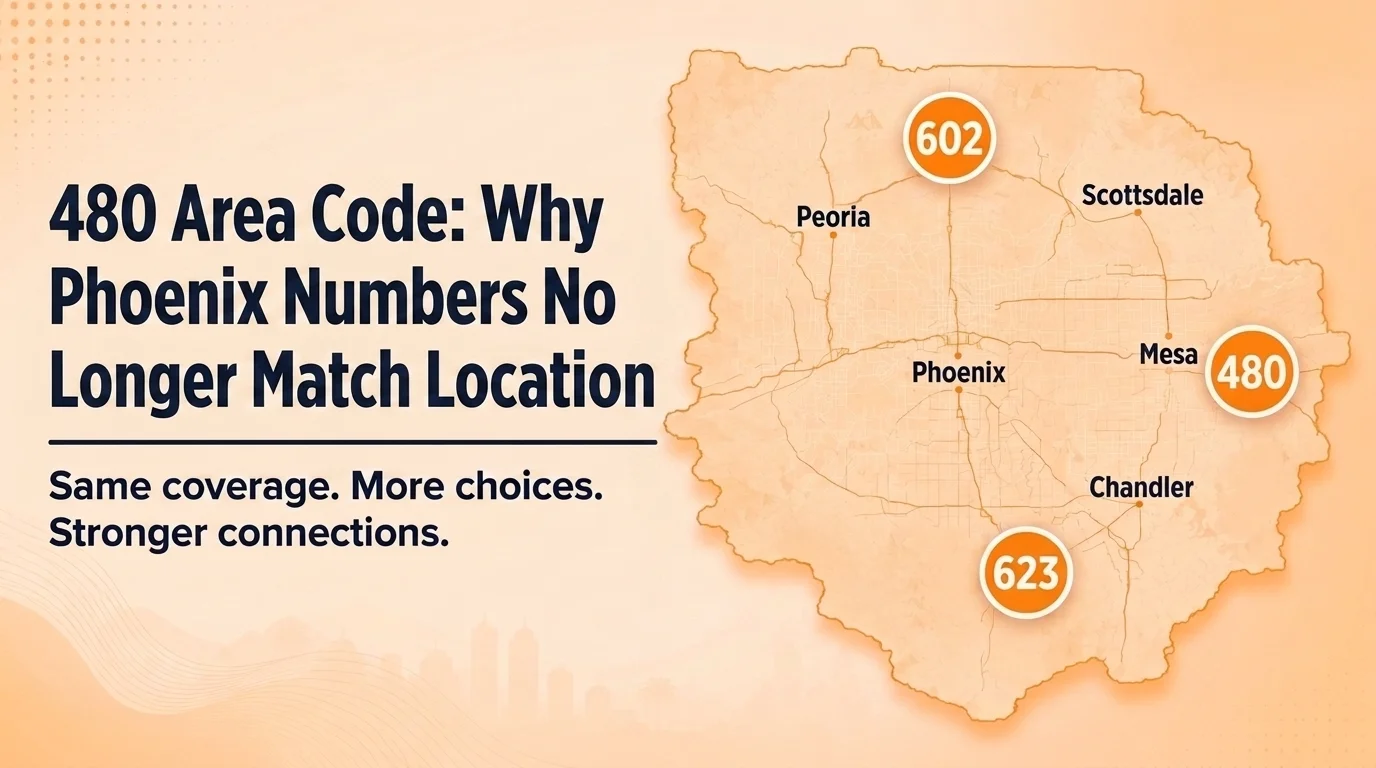
Dial a number in Scottsdale, Chandler, or Tempe today, and it could carry a 480 area code, a 602, or a 623 — and there's no longer any way to tell which just by the prefix. That wasn't always true. For over two decades, the three codes marked separate territory across Phoenix. Regulators erased those lines in 2023.
If you're picking up a number for a business calling into Arizona's East Valley, that shift changes how you should think about which code actually lands on your caller ID — and why the 480 area code specifically still carries weight even in a market where three prefixes now share identical ground.
- All three Phoenix-area codes — 480, 602, and 623 — now overlay the same territory as of 2023, with no geographic boundary between them
- The 480 area code originally launched in 1999 to cover the East Valley on its own, before the overlay merged the map
- letsdial activates an East Valley number in minutes, with 10-digit dialing and caller ID verification handled automatically
How 480 Became One of Three Codes Sharing the Same Ground
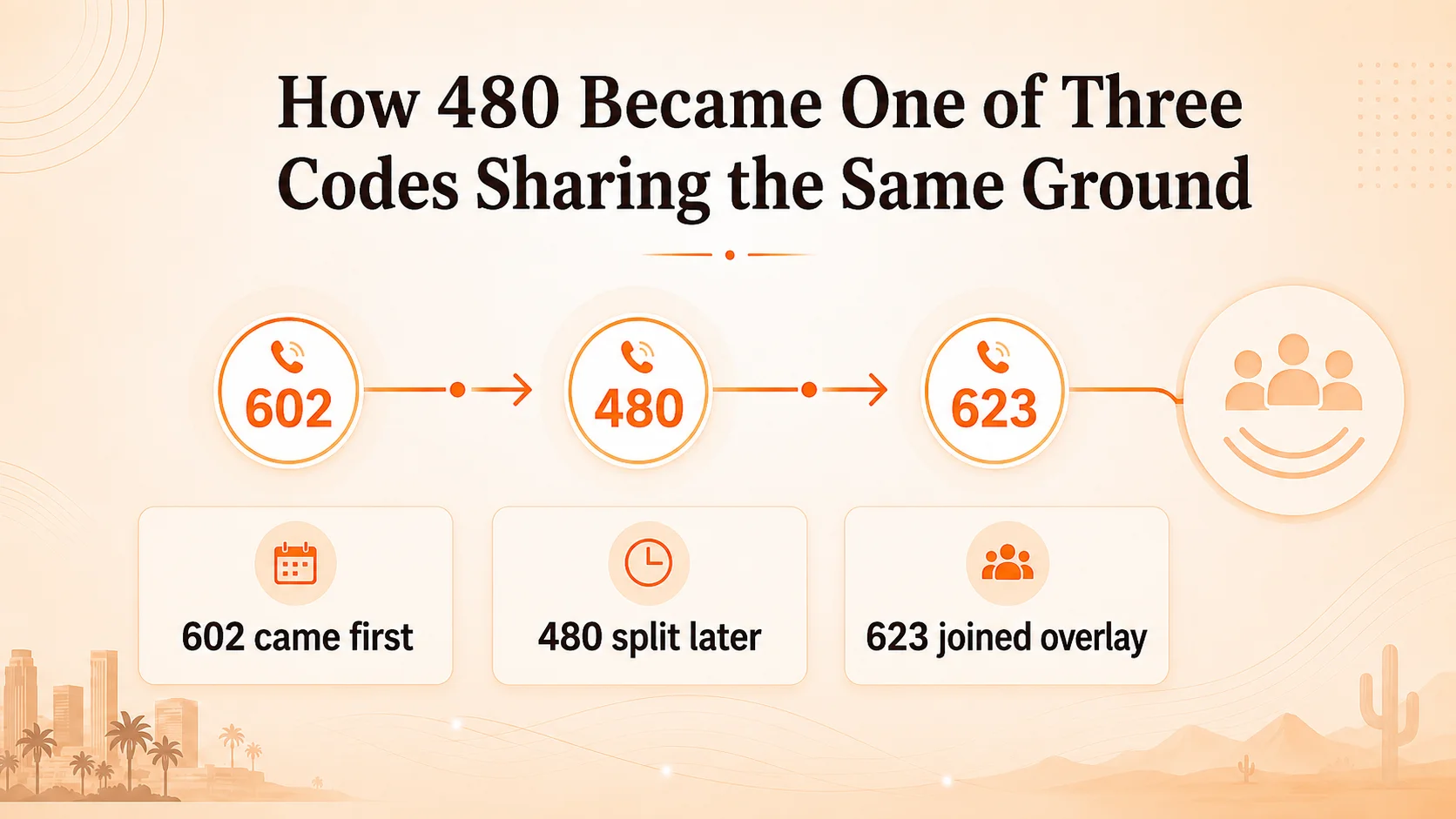
Phoenix ran on a single area code, 602, for the entire metro through the 1990s. Explosive population growth and a wave of new carriers pushed that single code toward exhaustion faster than regulators expected, and Arizona split it in two on March 1, 1999: the 480 area code took the East Valley, while 623 took the West Valley, and 602 shrank down to the urban core.
That arrangement held for over twenty years. Each code stayed tied to its own patch of the Phoenix metro, and a caller could reasonably guess which side of town a number belonged to just from its prefix.
The Arizona Corporation Commission, the state body that regulates telecom numbering, changed that in 2021, approving a plan to convert the three-code Phoenix numbering plan into a single overlay complex once growth again threatened to exhaust available numbers. The geographic boundaries between area code 480, 602, and 623 were formally removed in 2023 — meaning any new line issued anywhere in the metro, including a fresh 480 area code number, could just as easily land on 602 or 623 instead.
Ten-digit dialing had actually applied to this prefix since October 2021, well ahead of the overlay — a nationwide FCC rule tied to the 988 Suicide & Crisis Lifeline required it wherever the 988 prefix could be assigned as a working number. The 2023 boundary change simply extended that same requirement to 602 and 623, bringing the whole Phoenix numbering complex onto one dialing standard for the first time. More detail sits on our AI-handled call screening and routing page.
Where the 480 Area Code Reaches
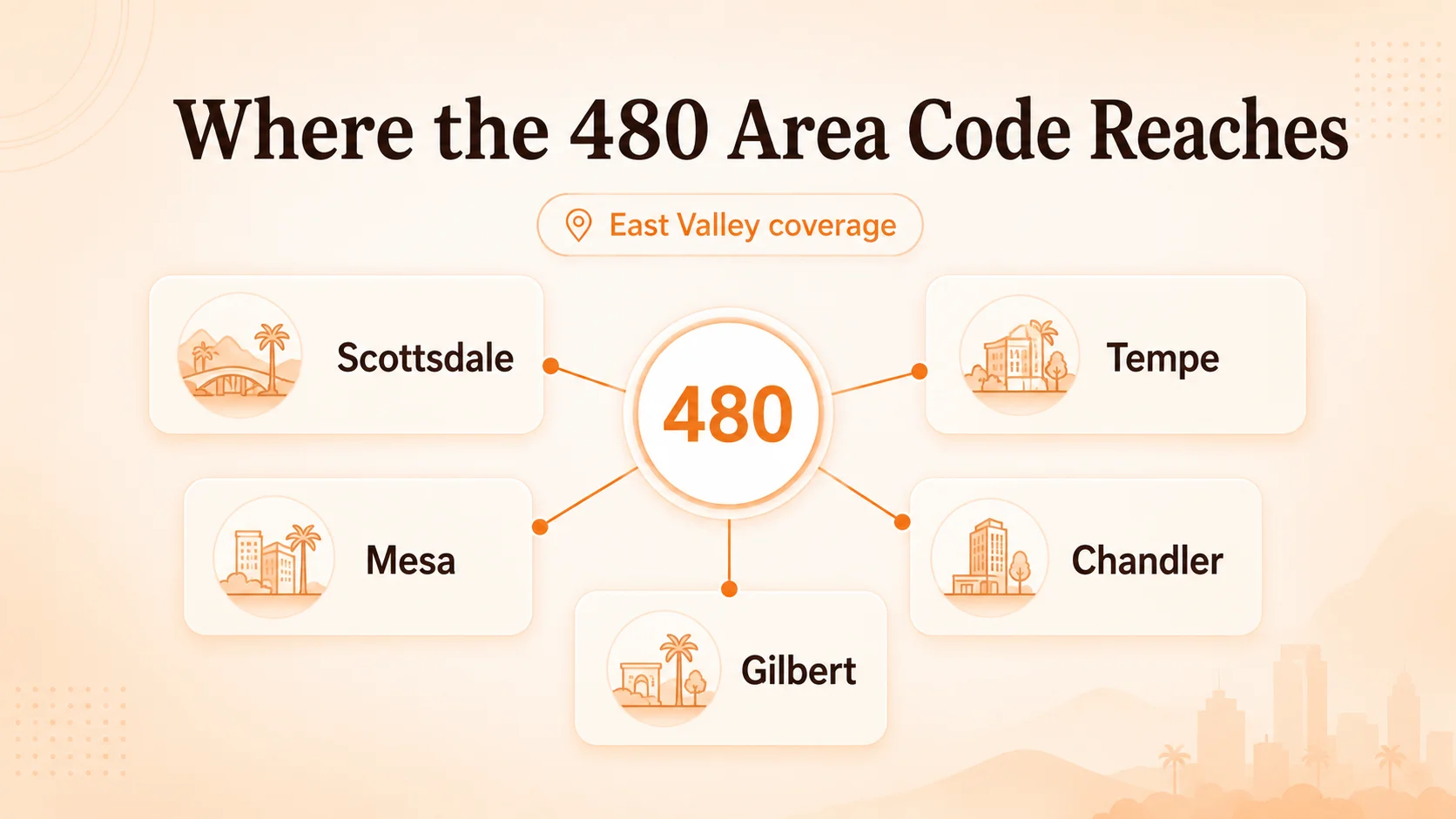
Even inside an overlay, the 480 area code still traces back to a specific footprint: the East Valley, the fast-growing southeastern half of the Phoenix metro across Maricopa and Pinal counties.
Tempe, Scottsdale, Chandler, Gilbert, and a slice of Mesa and Phoenix itself all sit inside the original area code 480 territory, along with the retirement community of Sun Lakes further south. Together those cities make up one of the fastest-growing corridors in the Southwest, adding residents and employers well ahead of the statewide average.
A number issued under this prefix today could technically serve a business anywhere in the wider overlay, but it still reads as East Valley first to anyone who remembers it from its original, pre-2023 territory. The 623 area code guide covers the neighbouring ground.
The East Valley Economy Behind the Numbers

Chandler's Price Corridor packs one of the largest semiconductor manufacturing clusters in the Western Hemisphere into roughly 15 square miles, anchored by Intel's Ocotillo campus — a 700-acre site employing more than 10,000 people today, with plans to grow past 15,000 as new fabs come online. That single employer generates billions in regional economic activity every year, and its vendor and supplier network runs almost entirely through East Valley phone lines.
Scottsdale carries a different kind of weight. Mayo Clinic's Arizona campus sits there, alongside a tourism and hospitality economy anchored by TPC Scottsdale, host of the highest-attended golf event on the PGA Tour calendar. Tempe adds Arizona State University, one of the largest public universities in the country by enrollment, generating a steady stream of calls tied to admissions, housing, and campus services on the same 480 area code footprint. Mesa rounds it out as spring training home to the Chicago Cubs, drawing a seasonal spike in ticketing and hospitality calls each year.
One quirk worth knowing before you dial in from out of state: Arizona doesn't observe Daylight Saving Time. For roughly half the year, an East Valley business runs on the same clock as Pacific time, not Mountain — a scheduling trap that catches out-of-state sales and support teams more often than the overlay itself does. Factor that shift into any outbound calling schedule you set for the region, since a 9 a.m. call plan back home can land at 7 a.m. or 8 a.m. locally depending on the month.
Why a Local Number Still Matters in an Overlay Market

You might assume an overlay erases the point of choosing 480 specifically — if 602 and 623 ring in the same territory now, why does the prefix matter? In practice, it still does, just differently than before.
Callers in Chandler's semiconductor supply chain, Scottsdale's healthcare and hospitality sector, and Tempe's university-adjacent business community still recognize a 480 area code number as a legacy East Valley prefix, even if they can no longer assume geography from 602 or 623 either. What the overlay actually changed is that *any* East Valley business now needs a verified, correctly attested caller ID — because the prefix alone can no longer do that credibility work on its own.
That's where call verification tools carry more weight than they used to. Pairing an area code 480 number with AI-handled call screening and routing keeps a growing sales or support team from losing East Valley leads to a caller ID that looks unfamiliar in an increasingly crowded three-code market. It's also worth comparing notes with the sibling code across town — the 623 area code covers the West Valley side of the same 2023 overlay change, and shares nearly identical dialing rules today.
Setting Up a 480 Number Without the Overlay Headache
Getting a number on this prefix doesn't require an Arizona office or a legacy landline contract:
- Cloud phone platform — search live inventory for an area code 480 number and activate it the same day, fully remote. letsdial provisions an East Valley line in under three minutes.
- Port an existing number — already running a 480 area code line through another carrier? letsdial ports it over with zero downtime and no porting fee.
- Traditional carrier or SIM — works for one physical handset but doesn't scale past a single line without extra hardware per seat.
Whichever route you pick, confirm 10-digit dialing is configured correctly on every outbound campaign before you scale volume — a number that still dials 7 digits internally will fail calls across the merged overlay. Apply STIR/SHAKEN attestation to any new 480 area code line as well; Intel's vendor network, Mayo Clinic's patient-facing lines, and ASU's admissions offices all screen unverified callers aggressively, and letsdial applies that attestation automatically on every number it issues. That record is published in full as Arizona Corporation Commission.
Conclusion
Three area codes answering for the same East Valley streets sounds like a numbering headache, and in some ways it is — but it also means the businesses that get caller ID and verification right stand out more than ever. A 480 area code number still carries the East Valley's legacy weight; it just needs the verification layer that the old geographic boundaries used to provide for free.
Grab an East Valley number today — live before your next outbound call, no credit card required, 10-digit dialing handled from the first ring.
Frequently Asked Questions
Written by Aryan Khan · July 13, 2026
Reply to the author