Introduction
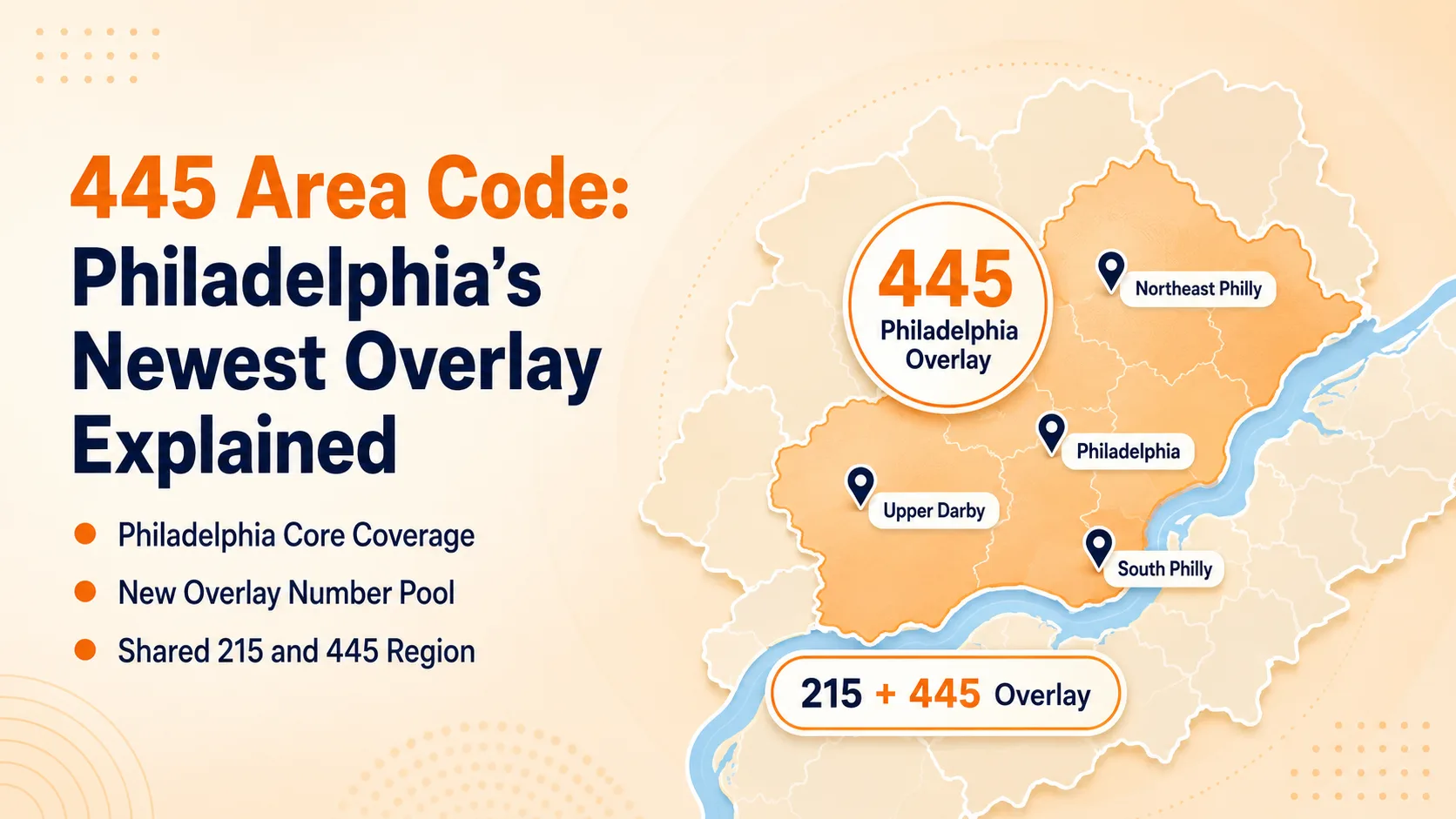
The 445 area code is Philadelphia's newest overlay. It's not a separate city, but a third prefix sharing the exact same territory as the older 215 and 267 area codes across the city and its surrounding Pennsylvania counties.
This guide answers where 445 is located and how it relates to 215 and 267. It covers the history, culture, and food economy behind greater Philadelphia, plus its Eastern Time calling window. It explains the code's 2018 launch after nearly two decades of delay. And it shows how to put a Philadelphia number in front of customers in minutes.
Where the 445 Area Code Reaches
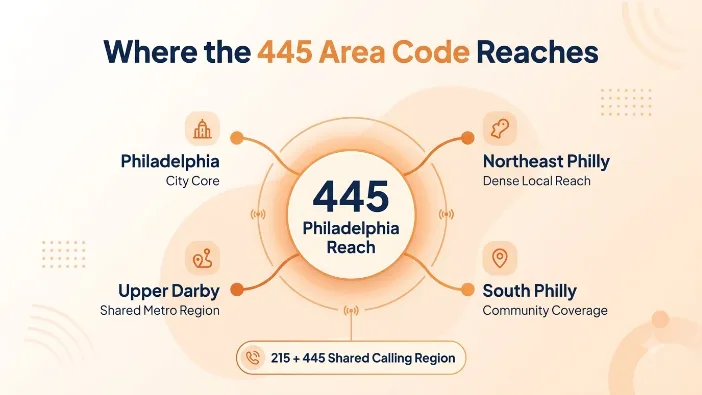
445 covers the city of Philadelphia and the surrounding southeastern Pennsylvania counties. It shares its entire territory with 215 and 267 rather than covering separate ground.
- Philadelphia — Pennsylvania's largest city and the historic birthplace of American independence
- Bucks County — the northeastern suburban county bordering New Jersey
- Montgomery County — the affluent suburban county northwest of the city
- Lehigh and Berks counties — the outer reaches of the footprint toward Allentown and Reading
- Chester County — the southwestern edge of the Philadelphia metro
445 shares its entire territory with 215 and 267. So a 445 area code number carries exactly the same greater-Philadelphia identity as its older sibling codes, whether the caller is a Center City law firm, a Bucks County contractor, or a Montgomery County healthcare vendor.
Philadelphia International Airport, one of the busiest airports on the East Coast, sits within the same 445 footprint. It connects the region's healthcare, legal, and hospitality industries to direct flights across the US and overseas.
445, 215, and 267: One Region, Three Area Codes
445 is what the industry calls an overlay: a third area code layered on top of an existing pair so a region doesn't run out of phone numbers. Every 445 number rings inside the identical greater-Philadelphia footprint as 215 and 267 — Center City, Bucks County, Montgomery County, and the rest. It's just drawn from a newer numbering pool.
Practically, that means a business can't tell whether a Philadelphia-area contact uses 445, 267 area code, or 215 just by the prefix. All three read as equally local. The only functional difference is that every call in the region, even one between two Philadelphia numbers, now requires all 10 digits.
For the full county-by-county breakdown of greater Philadelphia's economy — including Comcast, Penn Medicine, and Wharton — see the companion 215 area code guide.
A full Pennsylvania area codes breakdown maps how the state's prefixes fit together.
Philadelphia's History and Culture: Independence Hall and Reading Terminal Market
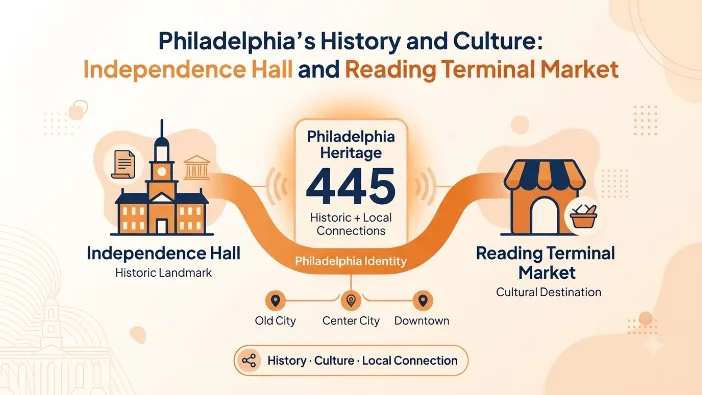
Whether a Philadelphia business answers on 445, 267, or 215, the same historic landmarks and food culture define the region's identity.
Independence National Historical Park
Independence National Historical Park preserves Independence Hall, where both the Declaration of Independence and the US Constitution were debated and signed, alongside the Liberty Bell. Together, they draw millions of history-focused tourists to Center City Philadelphia every year.
The 445 overlay that now shares this territory with 267 and 215 follows the same numbering-relief process documented in the FCC's guide to ten-digit dialing and area code changes.
Reading Terminal Market and Philly Food Culture
Reading Terminal Market, operating continuously since 1893, remains one of the oldest and largest public markets in the country. The cheesesteak — a Philadelphia invention still fiercely debated between rival shops — has become the city's most famous culinary export. Together they give greater Philadelphia's food-and-hospitality sector a tourism draw independent of its history.
The Philadelphia Museum of Art and the "Rocky Steps"
The Philadelphia Museum of Art anchors the city's Fairmount Park cultural district. Its front steps, made famous by the 1976 film Rocky, remain one of the most photographed staircases in the country. Visitors reenact the scene year-round alongside taking in the museum's own art collection.
Time Zone and Calling Hours for the 445 Area Code
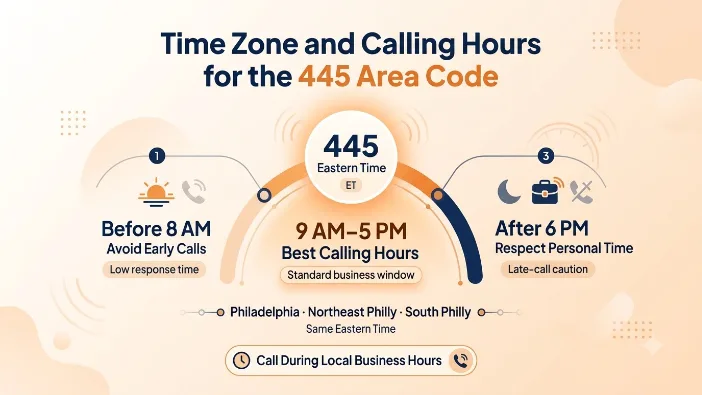
The entire 445 area code observes Eastern Time — UTC-5 (EST) in winter and UTC-4 (EDT) during Daylight Saving. Greater Philadelphia shares the clock with New York, Boston, and the rest of the East Coast.
West Coast teams calling area code 445 are three hours behind. Late-morning Pacific outreach lands mid-afternoon in Philadelphia, so plan around the three-hour gap to catch the full business day.
445 History
The 215 area code was assigned in 1947, one of the original area codes created when the North American Numbering Plan launched. It originally covered all of southeastern Pennsylvania.
As the Philadelphia region's population and phone demand grew, the 610 area code split off in 1994 to cover the outer suburbs. The 267 area code was added as an overlay in 1999, sharing the same territory as 215 rather than dividing it further.
Area code 445 was actually proposed as early as 2000 to add still more capacity to the region. Implementation was delayed for nearly two decades before finally activating on March 3, 2018. That's one of the longest gaps between an area code's proposal and its actual launch in recent US numbering history.
That delay mirrored a broader pattern in dense East Coast numbering areas. Number-conservation measures — reclaiming unused blocks and pooling exchanges more efficiently — repeatedly pushed back the point at which regulators actually needed to activate a reserved code like 445.
How to Get a 445 Area Code Number
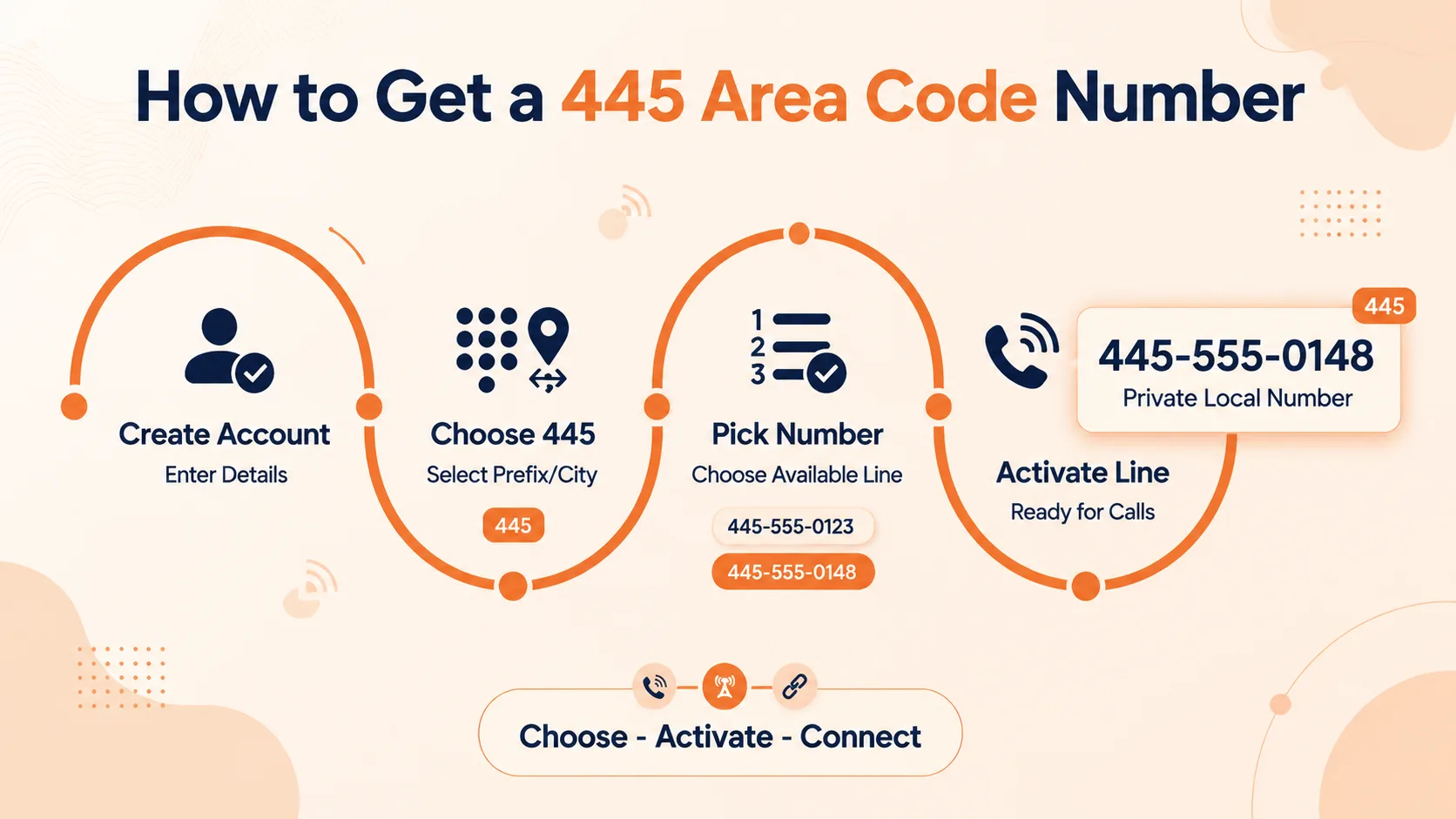
- Cloud phone platform — search available 445 numbers in real time and activate a line the same day, with no hardware and no technician visit.
- Port your existing number — already run a 445, 267, or 215 line on another carrier? Move it over without downtime and keep the number active through the transition.
- Wireless SIM or landline carrier — valid for a single physical handset, but slower to provision and harder to scale seat by seat.
With letsdial, a UCaaS (Unified Communications as a Service) platform built for exactly this, a 445 number provisions in under three minutes on a free trial. No credit card is required, so a Philadelphia presence can be answering calls the same afternoon.
Call Trust in the Philadelphia Market
The greater Philadelphia market runs on healthcare-and-university vendor channels, legal and financial-services referrals, and hospitality relationships around Center City's tourism economy. These are settings where an unknown out-of-state number gets screened before it's answered. A recognizable local prefix earns the first hearing, whether it carries the 445, 267, or 215 code. That first impression often decides whether the conversation happens.
STIR/SHAKEN for Healthcare, Legal, and Hospitality Contacts
Apply STIR/SHAKEN attestation so every outbound 445 call arrives verified with your registered business name on screen. As a UCaaS provider, letsdial registers text campaigns for 10DLC compliance from day one and warms new numbers before scaling volume. That means a verified line reads as Philadelphia-local rather than out-of-area.
A trusted 445 line is the difference between a Center City law firm or a Reading Terminal Market vendor picking up the call and routing it straight to voicemail. That first-hearing advantage compounds over dozens of calls a month for any business selling into greater Philadelphia.
Conclusion
445 is not a separate place — it's the newest of three area codes sharing greater Philadelphia, covering the same Independence Hall, Reading Terminal Market, and Center City business district as 215 and 267. From the Liberty Bell to the cheesesteak counter, a 445 number identifies a business as genuinely Philadelphia.
Standing up a line takes minutes on a cloud UCaaS platform, with STIR/SHAKEN attestation so calls arrive verified rather than flagged. Put a 445 number in front of healthcare contacts, legal partners, and hospitality vendors. Let a familiar prefix open the door first, with letsdial handling the setup end to end.
Frequently Asked Questions
Written by Aryan Khan · August 3, 2026
Reply to the author