Try to get a 212 number for a new Manhattan business and you'll likely fail — or pay a broker hundreds to thousands for one. The number you'll actually be assigned is a 332. That's Manhattan's newest code, layered over the legendary 212 and the later 646 and 917. Below is how the island ran through its codes, whether the famous 212 is worth chasing, and how to set up a line that gets answered.
Introduction
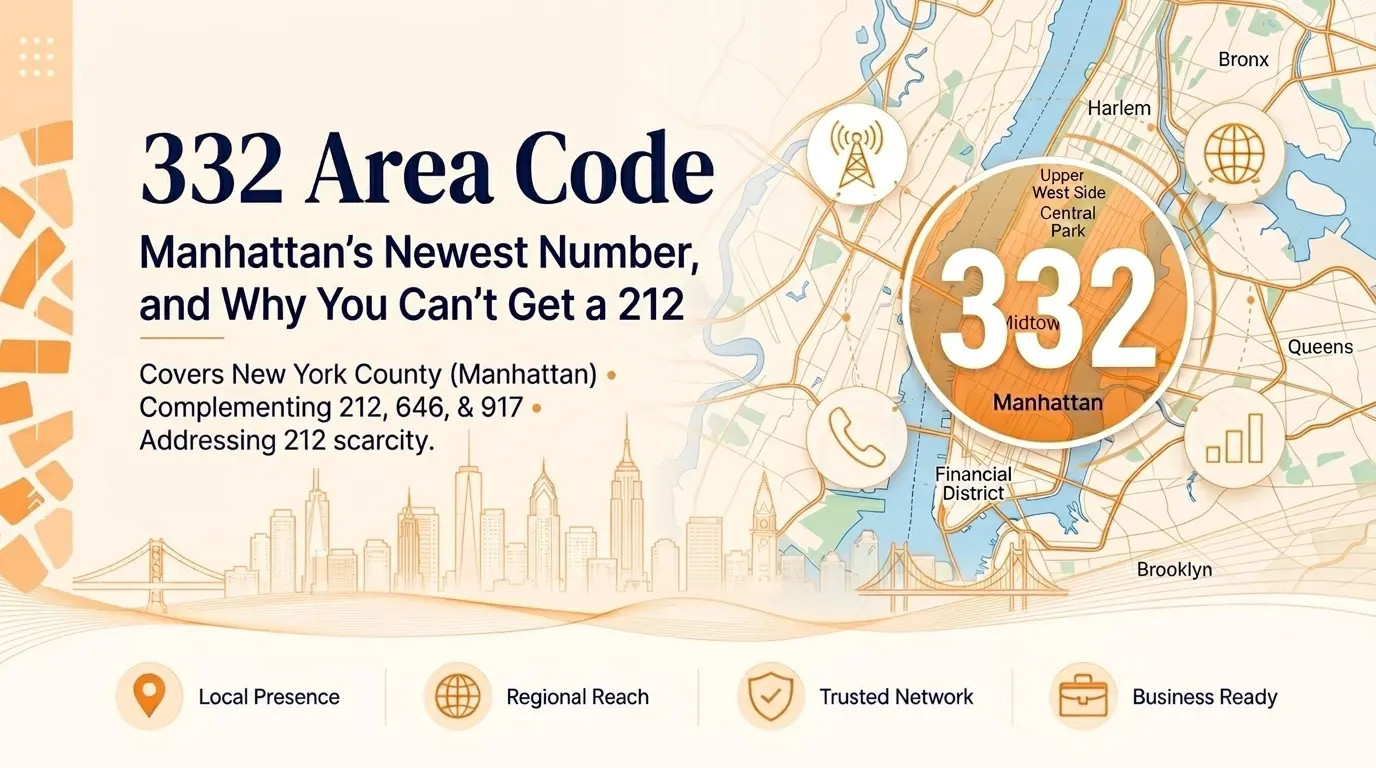
The 332 area code is Manhattan's newest phone code, added on June 10, 2017, as the iconic 212 code — one of the most recognized phone prefixes in the world — approached exhaustion. 332 covers the same Manhattan footprint as 212 and 646, giving businesses a third option for Manhattan phone identity when the prestige 212 numbers are unavailable. Manhattan's economy spans global financial services, media, technology, fashion, and real estate, making a local New York City number one of the most commercially valuable phone identities anywhere.
Any business that wants Manhattan identity but cannot obtain a 212 number now has 332 as the primary alternative. For companies in financial services, law, media, technology, and professional services that call into Manhattan's dense corporate community, a 332 number signals New York City presence just as effectively as 646 has since 1999. Manhattan's corporate gatekeepers answer local NYC numbers at significantly higher rates than out-of-state or outer borough codes.
- 332 is Manhattan's newest area code, added June 10, 2017, as an overlay on 212 and 646
- It covers the same Manhattan footprint as 212 and 646, and calls between all of Manhattan's codes are local
- Genuine 212 numbers are scarce and often resold; 332 and 646 are the codes issued for new Manhattan lines today
How Manhattan ran through four codes
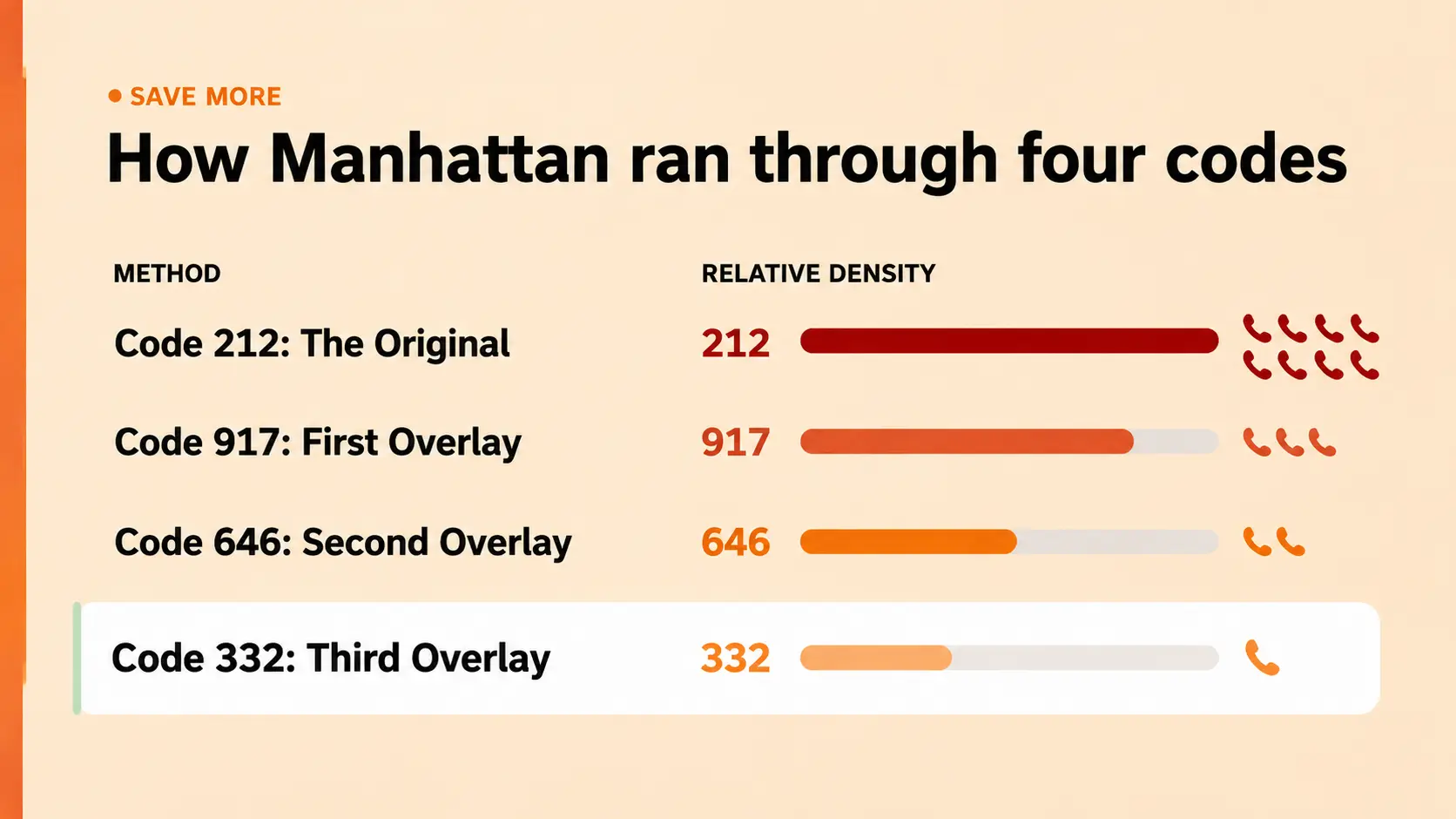
No place burns through phone numbers like Manhattan. Here's the stack.
212, the 1947 original
212 was assigned to New York City in 1947 and became shorthand for Manhattan itself — and, over time, a genuine status symbol on a business card.
The 212 assignment wasn't random. Under the rotary-dial system in use when AT&T divided the country into 86 original area codes in 1947, lower digits took fewer mechanical pulses to dial — so the highest call-volume markets got the fastest-to-dial codes to reduce trunk load. New York, the busiest calling market in the country, received 2-1-2, requiring only five total clicks of the dial and the lowest possible combination available. Chicago and Los Angeles got the next-lowest codes, 312 and 213, for the same engineering reason — a rotary-era design decision that quietly built the prestige 212 still carries today.
646 in 1999, then mobile 917
As 212 filled, 646 arrived as an overlay on July 1, 1999, while 917 — first activated February 4, 1992 for pagers and early cell phones — already blanketed the city. Manhattan was stacking codes well before most places, a preview of the overlay pattern that would later spread to the outer boroughs, New Jersey, and dozens of other fast-growing metros nationwide.
332 joined in 2017
With 212 expected to run dry, 332 went live on June 10, 2017. Existing 212, 646, and 917 numbers were untouched — 332 simply gave Manhattan a fresh pool of numbers.
Ten-digit dialing, no exceptions
With four codes sharing the same island, every local call needs all ten digits. Keep the area code on your site, signage, and CRM fields.
> [TIP] Note: Standing up a Manhattan line from anywhere? letsdial provisions a local 332 or 646 number in under three minutes on a free trial — no credit card, and the number is yours to keep or port out free. More detail sits on our letsdial page.
212 vs. 332: is the premium worth it?
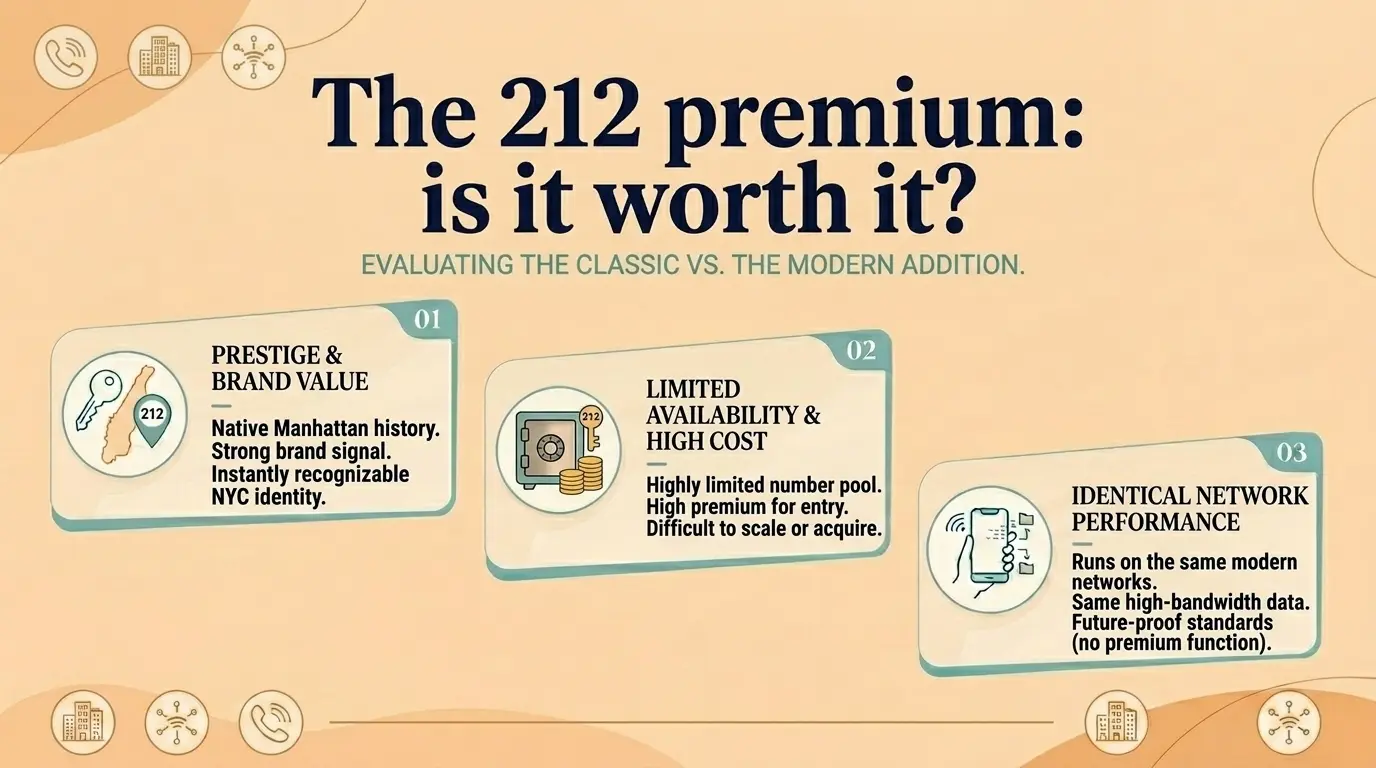
Unlike most codes, a 212 number trades on a secondary market. Whether that's worth your money — or whether a 332 does the job just as well — is the real question.
Why 212 became a status symbol
Decades of films, finance, and media wired 212 into the image of 'made it in Manhattan.' For some luxury and legacy brands, it still signals exactly that.
The resale market
Because genuine 212s are scarce, brokers resell them — sometimes for serious money. You're paying for perception, not for any difference in how the line works.
332 covers the same ground
332, 646, and 212 all serve the identical Manhattan map, and to anyone dialing, all three read as local Manhattan numbers. The citywide 917 overlay reaches Manhattan too, alongside the other four boroughs — calls between all four codes are still local, even though 917 itself isn't confined to the island the way 212, 646, and 332 are. Plenty of Manhattan now runs on 646 and 332, and most callers don't blink. A 212 is a flex, not a functional edge.
Verified beats vintage
A signed, branded call earns the pickup now — not the prefix. STIR/SHAKEN attestation and a displayed business name do more for trust than a vintage 212 ever could, and in the most competitive market on earth, what you say and how fast you pick up beats three digits every time. More detail sits on our AI Receptionist page.
How to get a 332 number that gets answered
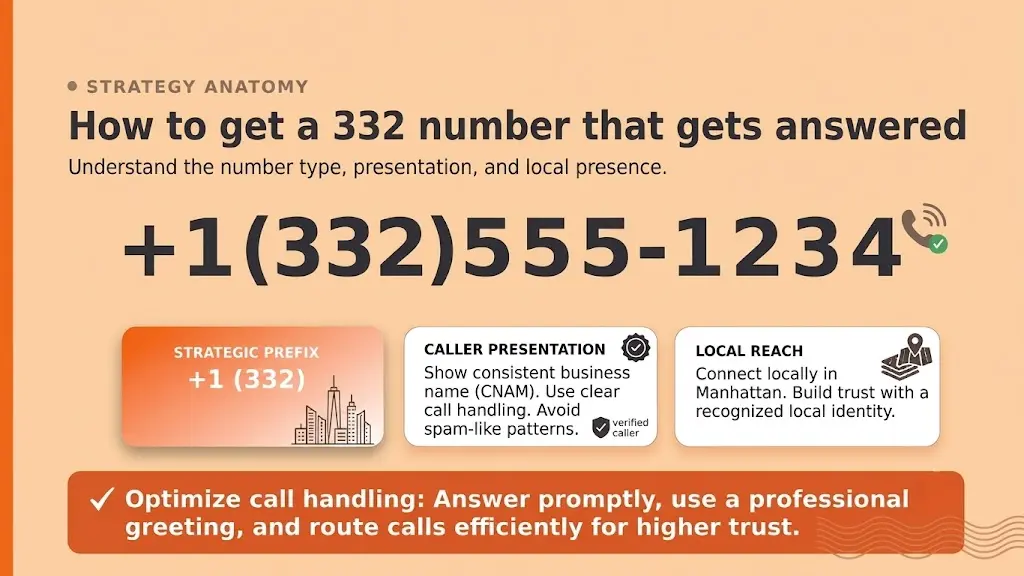
- Claim or port the line — grab an open 332, or port the Manhattan number already on your site so nothing breaks. letsdial ports numbers in and out free, both directions.
- Sign your calls and file 10DLC — apply A-level STIR/SHAKEN attestation so your 332 calls clear as verified, and register for 10DLC so texts land.
- Put a real answer on the line — a Manhattan number is wasted if it rings out. An AI Receptionist answers, qualifies, and books even when your team is slammed.
Manhattan's financial services and media economy
Manhattan is home to the New York Stock Exchange, NASDAQ's global headquarters, and the largest concentration of financial services companies in the world. Investment banks, hedge funds, private equity firms, and asset managers operating in the 332 footprint collectively manage a significant share of global capital. A local 332 or 646 number signals Manhattan presence to financial industry contacts who answer calls from recognized New York City prefixes at significantly higher rates than from out-of-state codes.
That financial center traces back to May 17, 1792, when 24 stockbrokers signed the Buttonwood Agreement outside 68 Wall Street, agreeing to trade only with each other and fix commissions at a flat 0.25% — the founding document of what became the New York Stock Exchange. More than two centuries later, the 332 footprint still sits on top of the same few blocks of Lower Manhattan where that agreement was signed.
The media and entertainment industries are concentrated in Manhattan, from the major broadcast networks to publishing houses, advertising agencies, and streaming content operations. NBCUniversal, ViacomCBS, Condé Nast, and thousands of production companies and talent agencies operate in the 332 footprint. For businesses in media, entertainment, advertising, and public relations, a Manhattan phone identity signals industry belonging in a market that notices where calls originate.
Technology and real estate in the 332 footprint
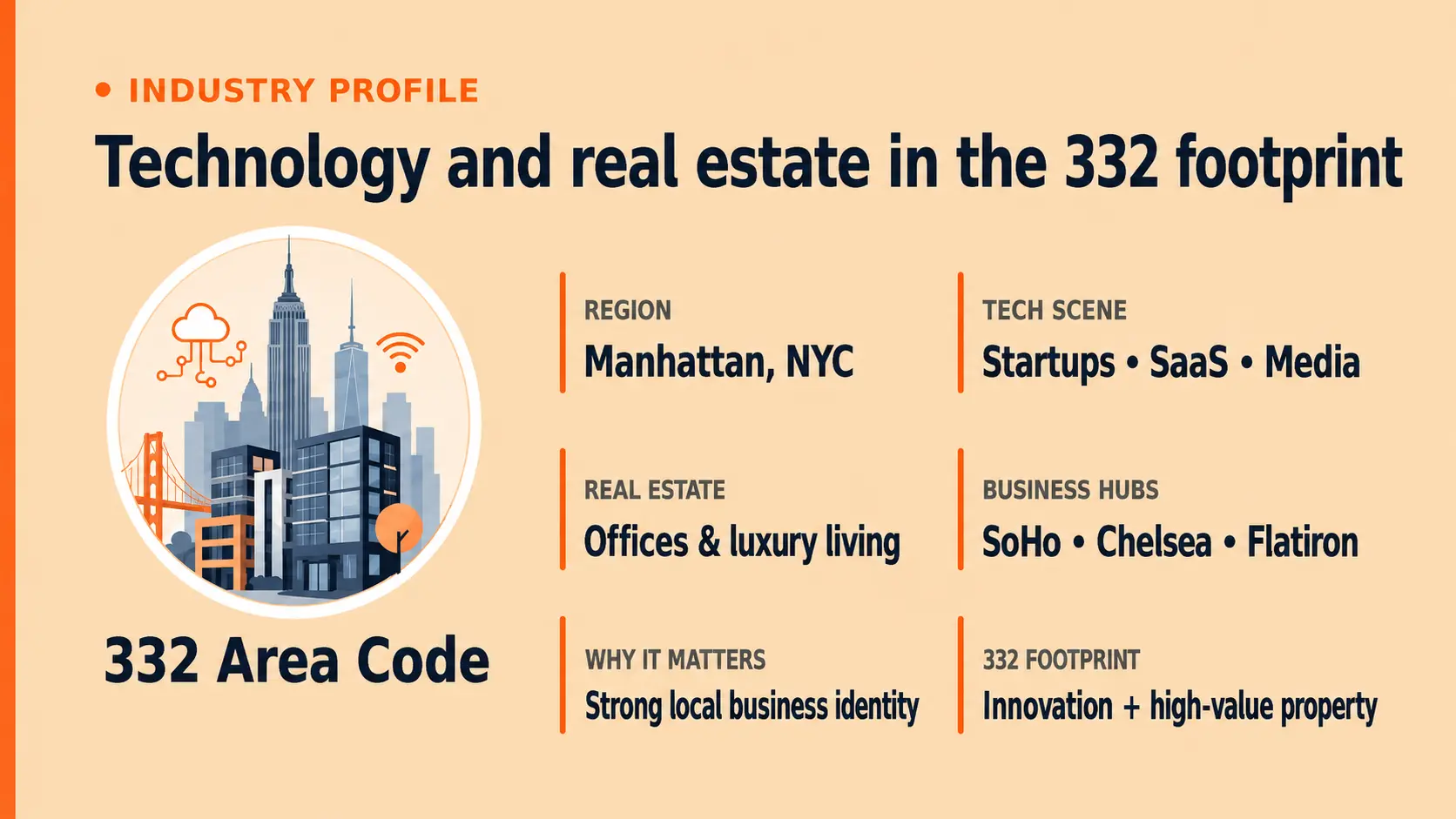
New York City's technology sector has grown into one of the world's leading startup and venture capital ecosystems, with Manhattan's Flatiron District, Chelsea, and Midtown South serving as the geographic center of the city's tech community. Google, Amazon, Apple, and Meta all maintain large New York City offices in the 332 footprint. Local venture capital firms, accelerators, and startup communities have made Manhattan one of the top three technology markets globally.
That tech identity has a name with its own history: "Silicon Alley," a pun on Silicon Valley that first appeared in New York recruiting job postings in early 1995, during the dot-com boom's earliest days. The nickname stuck to the cluster of new-media startups that grew up around the Flatiron Building at Fifth Avenue and 23rd Street, with Columbia University and NYU both playing an outsized role feeding talent into the neighborhood's earliest companies. Three decades later, the same blocks — now inside the 332 overlay footprint — still anchor a meaningfully large share of the city's startup and venture activity, even as the label itself has faded from everyday use.
That startup density creates a specific caller-ID problem: a Manhattan tech company fielding calls from investors, recruiters, and enterprise sales prospects is competing for attention with a market that fields more unsolicited business calls per capita than almost anywhere else in the country. A verified 332 or 646 number that displays a real business name is one of the few signals that cuts through that noise before the call even connects.
Manhattan real estate is one of the world's most intensely competitive and valuable property markets. Commercial and residential brokerages, property developers, construction firms, and real estate investment trusts all rely on local phone identity when reaching building owners, corporate tenants, and individual buyers in the 332 market. A Manhattan number signals local market knowledge and established relationships — qualities that matter in a real estate market where trust and local expertise are primary differentiators.
Brokers in particular live and die by callback speed — a listed apartment or office suite in a market this competitive can turn over in days, and a broker whose number gets screened as unfamiliar loses leads to whoever answers first. A verified 332 number that displays clearly on a prospective tenant's phone is a small edge that compounds over dozens of calls a week.
332 is officially documented under the North American Numbering Plan, which governs area code assignments across the US, Canada, and the Caribbean. That record is published in full as North American Numbering Plan.
Conclusion
The 332 area code is Manhattan's current code — the practical path to Manhattan phone identity now that genuine 212 numbers have become scarce and trade at a premium most businesses don't need to pay. Covering the same Manhattan footprint as 212 and 646, it offers businesses in financial services, media, technology, and professional services a way to signal New York City presence when the legacy codes are unavailable. This guide has covered the overlay structure, Manhattan's economy, and why NYC phone identity commands a premium.
letsdial provisions 332 numbers in minutes on a free trial with no hardware required. Sign every call, put a real answer on the line, and a 332 number does everything a Manhattan number is supposed to do — the local presence that opens doors in the world's most commercially competitive urban market.
Frequently Asked Questions
Written by Aryan Khan · June 18, 2026
Reply to the author