Introduction
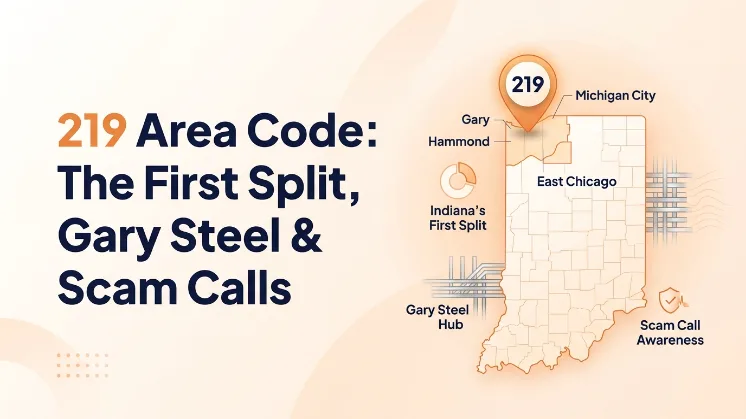
Every area code split in US history traces back to one moment in 1948, when regulators carved 219 out of Indiana's original 317 to relieve the north of the state. It was the first time any area code in the country had ever been divided — a full year after the original 86 area codes went live in 1947.
This guide covers how far 219 has shrunk since that first split, why Gary's steel industry still leans on the code for credibility, and the Medicare and fake-charity scam patterns most often reported against it. The 574 area code took the neighboring north-central Indiana territory in a later split.
From All of Northern Indiana to the Calumet Region
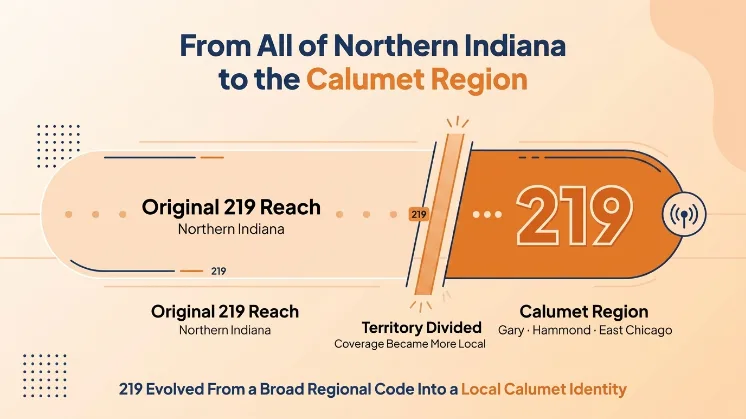
219 originally covered the entire northern third of Indiana — Gary and Hammond, but also South Bend, Elkhart, and Fort Wayne, hundreds of miles to the east. None of that reach survived the numbering pressure of the 1990s.
On January 15, 2002, regulators split the territory three ways: 219 kept the northwest — the Calumet Region along the Lake Michigan shoreline, including Gary, Hammond, East Chicago, Hobart, Merrillville, Chesterton, Crown Point, Michigan City, Portage, and Valparaiso. North-central Indiana took the new 574 code, and the Fort Wayne area in the northeast became 260. A full Indiana area codes breakdown maps how all three sit together today.
The three-way split followed the same pattern that had already reshaped most of the country by the late 1990s: the original 1948 boundary was drawn for a state with rotary phones and one line per household, and it simply couldn't hold once fax machines, pagers, and a second line per family became standard. Indiana regulators chose a clean geographic split rather than an overlay, meaning every existing 219 number in South Bend or Fort Wayne had to change to 574 or 260 — inconvenient in the short term, but it kept seven-digit dialing intact within each new region for years afterward.
Is Every 219 Call Really From Gary or Hammond?
The 219 area code itself covers real residents and businesses across the Calumet Region, but the caller isn't always who the number suggests. 219 gets spoofed like any other recognizable local code — scammers borrow its familiarity to get a call answered, without any actual presence in Indiana. A number that displays 219 tells you where it's registered to ring, not where the person dialing actually is.
Dialing Rules and Time Zone in the Calumet Region
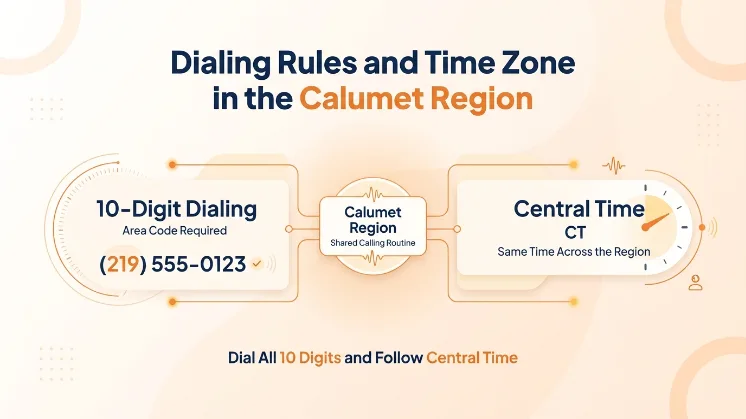
219 sits in the Central Time Zone, sharing the clock with Chicago rather than the rest of Indiana, most of which runs on Eastern Time. That's a quirk of geography: the Calumet Region sits close enough to Chicago that it follows the same time as its larger neighbor across the state line.
- Local calls (within the region): dial 219 + the 7-digit number — e.g., 219-555-1234
- Long-distance calls (within the US): dial 1 + 219 + the 7-digit number — e.g., 1-219-555-1234
- International calls to a 219 number: dial your country's exit code, then 1 (US country code) + 219 + the number — e.g., 00-1-219-555-1234 from the UK
Unlike many metro codes with two or three overlapping prefixes, 219 has never been overlaid — the region has stayed on a single code since the 2002 split, and seven-digit local dialing still works here today. That puts it in an increasingly small group: most dense industrial and metro corridors nationwide have needed at least one overlay by now, and the Calumet Region's population, while substantial, still fits comfortably inside what a single code can support.
Setting Up a 219 Number for Your Business
A Calumet Region presence doesn't require an office anywhere near Lake Michigan's shoreline or the mills that line it:
- Sign up with letsdial and search available 219 numbers
- Choose the features your team needs — call forwarding, an AI receptionist, voicemail transcription, SMS
- Start taking calls the same day — median setup runs under 3 minutes
Already have an existing business number? Porting it in is free and stays active the whole time — wireless-to-wireless typically takes 1–3 business days, wireline-to-wireless 3–5, and VoIP-to-wireless 5–7.
Because 219 has never needed an overlay, the number pool here has aged more gracefully than in overlay-heavy metros — clean and memorable combinations still turn up more often than in a market splitting three ways at once. That's a genuine advantage for a business picking a fresh 219 area code number today rather than porting an old one in.
Steel Country: Why Gary Runs on a 219 Number
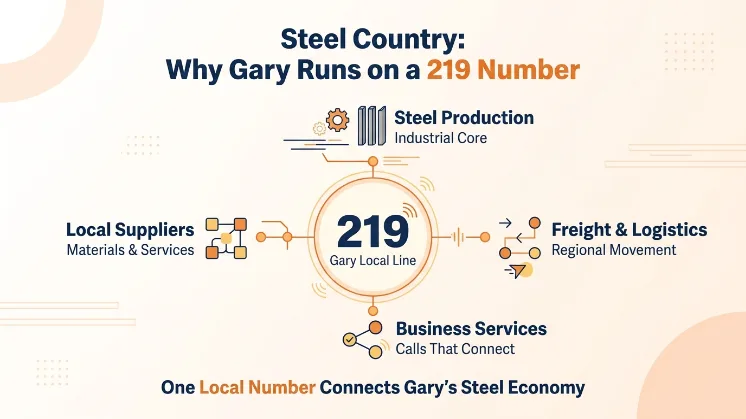
Gary's identity is built on steel. U.S. Steel's Gary Works, opened in 1908 on the Lake Michigan shoreline, remains the largest integrated steel mill in North America, with an annual raw steelmaking capacity of 7.5 million tons and roughly 5,100 employees on-site today.
Gary Works isn't the only mill defining the region. Neighboring East Chicago hosts the Indiana Harbor complex, another integrated steelmaking site with roots back to 1901 — between the two, the Calumet Region holds one of the largest concentrations of integrated steelmaking capacity anywhere in North America.
That single facility anchors a wider supply chain of fabrication shops, logistics operators, and industrial-services firms across the Calumet Region, all of whom deal with suppliers and customers who expect a recognizable local number rather than an out-of-state line. A 219 number signals the same thing a 213 number signals in downtown LA's entertainment industry — proof of actually being where the business claims to be.
Freight and rail logistics run underneath all of it. Every ton of ore, coke, and finished steel moving through the Calumet Region's mills travels by rail or Great Lakes shipping first, and the dispatch, brokerage, and trucking firms coordinating that flow depend on the same local-number trust as the mills themselves.
Healthcare and municipal services fill out the rest of the region's call volume — hospital systems, school districts, and city offices across Gary, Hammond, and the surrounding townships all answer from the same 219 pool, running on the same expectation of a locally recognizable number that any Calumet Region business relies on.
What matters most for an industrial or logistics operation choosing a provider:
- Call recording for supplier disputes and compliance documentation
- Reliable call routing that doesn't drop during shift-change call volume
- Free porting, so an existing number survives a move to a new carrier
Medicare Robocalls and Fake Police-Charity Solicitations
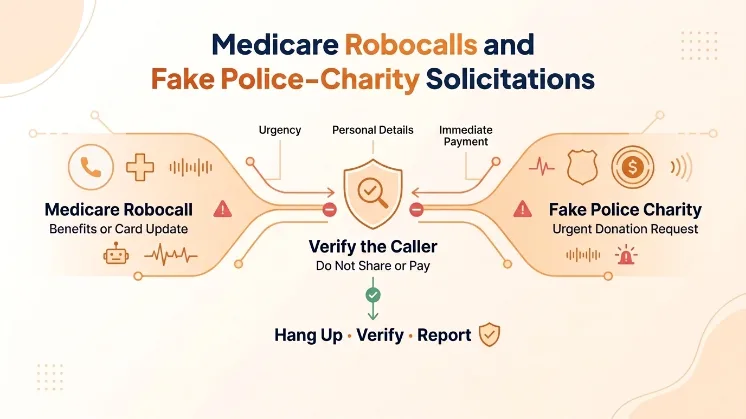
Health insurance and Medicare-related robocalls top the list of complaints reported against 219 numbers — pitches for supplemental coverage, fake enrollment deadlines, and unsolicited plan-switching offers, all riding on a spoofed local caller ID to get past the recipient's guard.
A second pattern shows up nationally but has been flagged repeatedly against 219 specifically: calls soliciting donations on behalf of police or fraternal-order charities. Legitimate police organizations rarely solicit money by phone, and national consumer advocates including AARP have warned that most of these calls route the bulk of any donation to a professional fundraising operation rather than the department itself — often as little as ten cents on the dollar actually reaching the officers the caller claims to represent.
Fake prize giveaways round out the pattern: a call or text claims a winning entry in a sweepstakes the recipient never joined, then asks for a processing fee or tax payment before the prize can be released. No legitimate sweepstakes requires payment to release a prize, regardless of what caller ID displays.
The Indiana Utility Regulatory Commission oversees telecom numbering and utility regulation across the state, including the 2002 split that created today's 219 footprint — a useful, authoritative reference separate from the scam volume riding on top of the code.
Conclusion
219 started as the first area code split in American telecom history, shrank from all of northern Indiana down to the Calumet Region alone, and never needed an overlay to get there — a quieter numbering story than most of the metro codes that came after it, but arguably a more historically important one. Getting a 219 number for your business takes minutes with letsdial, keeps your existing number if you're porting one in, and comes with the call handling — recording, an AI receptionist, CRM sync — that a Northwest Indiana-facing business actually needs.
Frequently Asked Questions
Written by Aryan Khan · July 27, 2026
Reply to the author